
Get Paid To Own A Battery: How VPPs Are Changing Solar Payback In Nova Scotia And Beyond
December 9, 2025
120,000 BC Homes Lost Power: Is A Home Battery The BEST Power Backup For Canadian Storms?
December 21, 2025
So you’re thinking about going solar, but you’re worried about Canada’s cloudy weather?
They won’t generate as much power as they do when the sun is blazing, but they still capture light and convert it into electricity.
I’m going to walk you through exactly how this works, what you can expect in different Canadian provinces, and how to get the most out of your system, even when the sky is grey. Let’s explore this together.
Key Takeaways
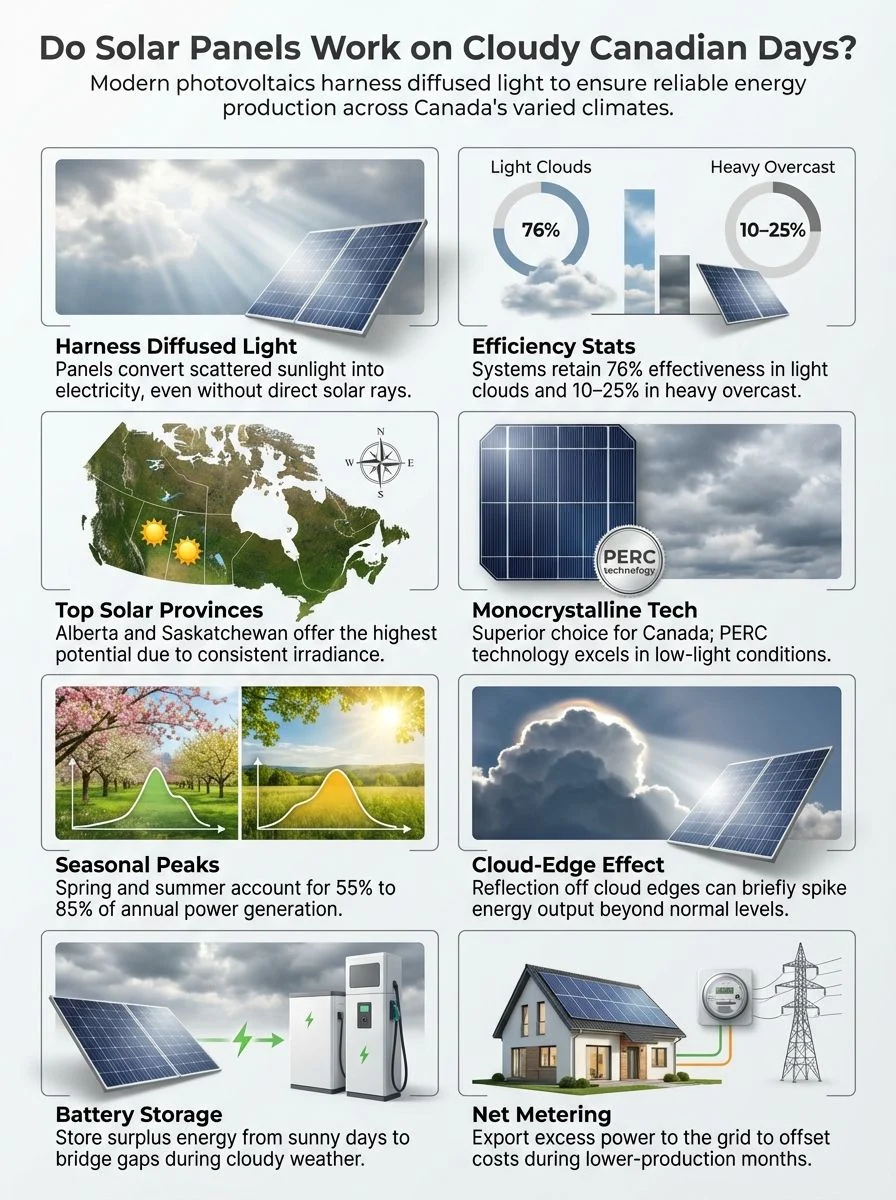
- Solar panels in Canada still generate 10% to 25% of their usual power output on cloudy days by capturing diffused sunlight.
- Provinces like Alberta and Saskatchewan offer higher solar panel efficiency due to more sunny days, while Atlantic provinces see reduced performance because of frequent cloud cover.
- Monocrystalline panels, especially those with PERC technology, perform better than polycrystalline panels during overcast weather due to higher efficiency rates and improved low-light absorption.
- Battery storage systems and net metering help Canadians use stored or credited energy during cloudy periods, reducing reliance on the electrical grid and saving costs.
- Seasonal changes in daylight dramatically impact annual solar yield. Up to 85% of some regions’ yearly output comes from spring and summer months.
How do solar panels generate electricity?
Solar panels work by using photovoltaic cells to turn sunlight into power.
These cells contain materials like silicon. When sunlight hits them, it excites electrons and creates an electrical current. This current starts as direct current (DC) electricity. A device called a solar inverter then changes this DC power into alternating current (AC), which your home can use.
Here’s the good news: modern solar technology doesn’t need direct, intense sunlight to work. Panels can capture both direct and diffused light. This means they still produce energy on cloudy or rainy days, just at a lower output than on a sunny day.
According to research from the National Renewable Energy Laboratory, high-quality photovoltaic panels perform better in overcast weather because they capture more of the available light. Some systems even store excess solar energy in batteries for later use. Others send surplus electricity back to the grid through net metering programs that are available across Canada.
Can solar panels produce power on cloudy days?
Yes, your solar panels will keep working when clouds roll in.
Cloud cover affects how much solar energy reaches the panels, but your solar system doesn’t just shut down. Your panels are designed to harness whatever light gets through.
What is diffused light and how does it affect solar panels?
Diffused light is indirect sunlight that still reaches solar panels even on cloudy days.
Clouds scatter the sun’s rays. They don’t block all the light, they just spread it out in all directions. Photovoltaic (PV) panels convert both direct and diffused light into electricity. This is why solar panels work in cloudy weather across Canada.
Studies show PV systems can generate 10 to 25 percent of their typical power output during overcast conditions compared to a sunny day. In my experience, I’ve seen residential systems continue producing usable energy under thick cloud cover because panels harness available diffused irradiance. This means solar electricity is not limited only to clear sky conditions. Your system will still generate power even if you don’t see the sun directly.
Homeowners often ask me if energy production stops altogether with dense cloud cover or snow. It doesn’t. Modern photovoltaic technology maximizes whatever light gets through.
How does cloud density impact solar panel efficiency?
Cloud density plays a big role in solar panel performance during cloudy conditions.
Light, thin clouds allow more solar irradiance to reach the photovoltaic system, Thin or broken cloud can still produce strong output, while thick overcast commonly drops production into the ~10–25% range compared to clear skies. Thick or heavy overcast can reduce solar output by more than 60%.
Heavy rain may also cut power production short-term. But here’s a bonus: rain helps clean your panels, which could boost efficiency after storms.
Partial cloud cover sometimes increases solar output for short moments. This happens because sunlight reflects off the edge of clouds and focuses on the panel surface. Research shows that these brief bursts make a difference in total electricity generation. Solar energy systems across Canada experience this variation, especially in provinces known for frequent overcast days and variable weather.
Best And Worst Cloudy Provinces in Canada
Different regions in Canada experience varied cloud cover. This directly impacts solar energy output.
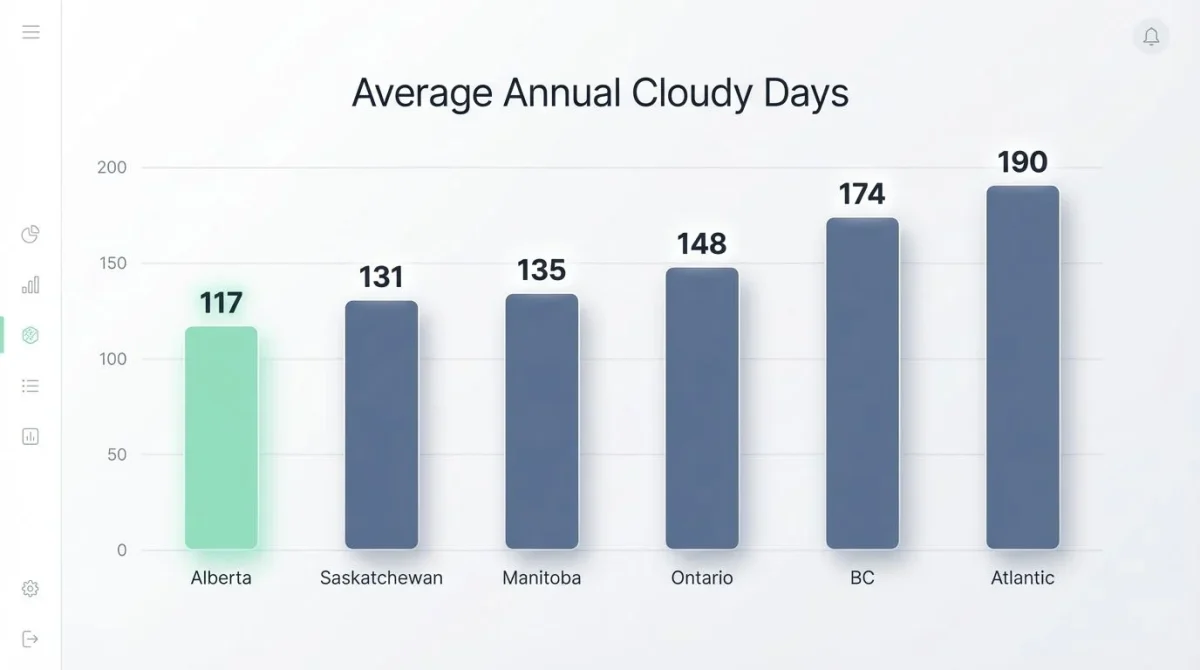
This table highlights the best and worst provinces for solar panel performance on cloudy days.
| Province/Territory | Average Annual Cloudy Days | Solar Panel Output Potential | Key Notes |
|---|---|---|---|
| Alberta | ~117 | High |
|
| Saskatchewan | ~131 | High |
|
| Manitoba | ~135 | High |
|
| British Columbia | ~174 | Moderate to Low |
|
| Ontario | ~148 | Moderate |
|
| Quebec | ~175 | Moderate to Low |
|
| Atlantic Provinces (Nova Scotia, Newfoundland and Labrador, New Brunswick, Prince Edward Island) | ~180-200 | Low |
|
| Territories (Yukon, Northwest Territories, Nunavut) | High seasonal variation | Variable |
|
Key factors influencing solar panel performance in cloudy weather
Several factors can affect how much electricity solar panels generate on cloudy days in Canada.
Let’s look at what makes a real difference.
How do monocrystalline and polycrystalline panels compare?
Monocrystalline and polycrystalline solar panels differ in design, efficiency, and suitability for Canadian weather.
The table below summarises their key differences.
| Feature | Monocrystalline Panels | Polycrystalline Panels |
|---|---|---|
| Material Structure | Single silicon crystal | Multiple silicon fragments |
| Efficiency Rate | 20% to 24%+ | 15% to 17% |
| Performance on Cloudy Days | Higher output due to better light absorption. PERC monocrystalline panels can produce 10-25% of rated power on heavily cloudy days | Lower output in low-light conditions. Less effective in diffused sunlight |
| Space Efficiency | Produces more power per square metre, which is ideal for limited roof space | Requires more space for the same output |
| Cost | Higher upfront cost, but decreasing as manufacturing advances | Lower upfront cost, but may have higher lifetime costs due to less output |
| Best Use Case | Cloudy provinces like British Columbia and Atlantic Canada. Homes with limited roof area | Sunny, budget-sensitive projects with ample installation space |
| Technology Example | PERC (Passivated Emitter and Rear Contact) technology for Canadian climates. Products like the Longi 410 54-Cell Module capture sunlight effectively even on overcast days | Standard multi-crystalline panels |
Pro Tip: PERC technology adds a dielectric layer to the rear of the cell that reflects unabsorbed light back into the cell. This improves light absorption by up to 12% in low-light conditions, making PERC monocrystalline panels the best choice for Canadian climates with frequent cloud cover.
How do seasonal changes in Canada affect solar energy?
Solar energy production in Canada changes a lot with the seasons.
Spring and summer give solar panels much more sunlight. Provinces generate about 55% to 75% of their yearly solar power during these months. The territories, which are farther north, get up to 85% of their annual solar output from spring and summer thanks to longer daylight hours.
Canada’s cooler climate actually helps your panels perform better. According to industry research, excess heat is one element that limits solar production. Our cooler temperatures help the panels regulate their temperature, so they perform better than in hot climates.
Fall and winter cut down the amount of sunlight that reaches panels. Shorter days, heavy cloudiness, and snowfall all lower photovoltaic power capacity. In some years, snow cover stays on panels for weeks if not cleaned off regularly. This reduces electricity generation even further.
People in Canada who use home energy storage or net metering can save excess energy produced on bright summer days. This helps offset lower production in darker months. Many solar professionals recommend tilting your panels at a steeper angle. This allows snow to slide off more easily and helps capture low-angle winter sun.
How to improve solar panel efficiency during cloudy days
You can increase solar panel performance during cloudy days with smart energy choices.
Here are clear tips that make a real difference.
What role do battery storage systems play?
Battery storage systems change how solar panels work on cloudy days.
Homeowners can use stored energy when sunlight drops, supporting daily needs.

- Battery storage lets you keep excess electricity solar panels produce on sunny days for use during low-sunlight periods, like cloudy weather or at night.
- Installing a battery system increases your energy independence from the electrical grid and helps avoid fluctuating utility rates in Canada.
- Solar batteries such as the Tesla Powerwall allow you to store significant power at home, providing backup even during power outages.
- Energy stored in batteries powers your home appliances or heating systems during cloudy stretches, ensuring consistent access to renewable energy.
- Many Canadian homeowners who go solar add battery energy storage systems to maximize savings by using their own excess energy instead of buying back from utilities.
- Canadian Solar’s e-Storage has delivered over 10 GWh of battery energy storage solutions globally as of December 2024, including multiple grid-scale projects across Nova Scotia and other Canadian provinces.
- Off-the-grid living becomes more practical with battery storage since the system can work without constant reliance on electric power transmission or utility companies.
Understanding how net metering programmes help you save money is another way to increase the benefits of your solar adoption.
How can net metering save energy costs?
Net metering allows your solar system to send excess electricity back to the grid on sunny days.
This creates credits on your utility bill.
Every province and territory has some form of customer self-generation program (net metering, micro-generation, or net billing), but credit rules and payout methods differ by utility, though the details vary by region. These credits can offset the cost of electricity drawn from the grid when your panels produce less power, like during winter or heavy cloud cover.
As of January 1, 2024, net metering customers in Ontario can choose between Time-of-Use (TOU), Tiered, or Ultra-Low Overnight (ULO) prices. Ontario regulation 541/05 governs the program, and credits can be carried over for up to 12 months.
Strong net metering policies in Canada encourage using more renewable energy sources by making it financially attractive. Homeowners with a home solar system may notice significant savings each year because their bills reflect only net usage after crediting extra kilowatt-hours produced.
In provinces with higher utility rates and strong buy-back programs, such as Ontario and British Columbia, many customers have cut monthly electric bills by up to 60 percent using this approach. Reduced reliance on conventional sources also helps lower overall household expenses while supporting clean energy development across Canada.
Conclusion
Solar panels do work when it’s cloudy in Canada.
While efficiency drops by 10% to 25%, panels still receive sunlight and generate electricity on cloudy days. The right panel technology, like PERC monocrystalline panels, can improve output even during winter or heavy cloud cover.
Solar systems work year-round. This makes going solar a smart choice for those considering clean energy in Canada.
FAQs
1. Do solar panels work when it’s cloudy in Canada?
Yes, solar panels absolutely work on cloudy days because photovoltaic cells are designed to capture diffuse sunlight even when it isn’t bright out. In Canada, you can typically expect your system to generate between 10% and 25% of its rated capacity on a heavily overcast day.
2. What happens to solar panels at night when there’s no sunlight?
Solar panels naturally go into standby mode at night since they need light to convert energy. However, through net metering, you can seamlessly power your home using the excess energy credits you banked with the utility grid during sunny hours.
3. How much energy can solar panels produce in Canadian winters?
Surprisingly, the reflection of sunlight off snow, known as the albedo effect, can actually boost your system’s production by up to 10% on clear winter days.
4. Does temperature affect your solar panel performance?
Cold weather is actually a performance booster because high heat increases resistance and lowers voltage. Most panels lose efficiency when temperatures rise above 25°C, so Canadian winters help maintain optimal voltage levels for better output.
5. Will my solar system still provide enough electricity for my home?
Most Canadian homes stay powered year-round by using net metering to balance seasonal differences. You effectively “store” your summer surplus on the grid and draw from those credits when production slows down in winter.
6. How does Canadian weather impact photovoltaic power stations?
Research from the Northern Alberta Institute of Technology shows that snow causes less than 3% annual energy loss because modern panels are designed to shed snow quickly. Your system is built to withstand our specific climate extremes, from hail to heavy snow loads, ensuring reliable generation.
References
- https://empowerenergysolar.ca/solar-pv-vs-canadian-weather/ (2022-04-14)
- https://seia.org/what-happens-to-solar-panels-when-its-cloudy-or-raining/
- https://lightsourcebp.com/news/do-solar-panels-work-on-cloudy-days/ (2024-04-16)
- https://www.sciencedirect.com/science/article/pii/S1364032124007998
- https://r1power.com/monocrystalline-vs-polycrystalline-solar-panels-best-choice-for-cloudy-climates/
- https://www.cer-rec.gc.ca/en/data-analysis/energy-markets/market-snapshots/2019/market-snapshot-solar-power-generation-in-canada-is-highly-seasonal.html (2022-06-30)