
Solar Panels Saskatchewan Cost Guide 2026
August 7, 2025
Solar Panels Ontario Installation Cost Guide 2026
August 11, 2025Last Updated on May 19, 2026 by Vitaliy
Manitoba is in a unique spot. You have some of the cheapest and cleanest electricity in North America thanks to massive hydro power. So, the big question is, why would anyone here even think about getting a solar PV system?
It is a fair question, and the answer is not just about saving a few bucks on your hydro bill.
For many people in Manitoba, the move to solar energy is about predictability and independence. Energy prices can change. Rebates can change. Export credits can change. Installing solar panels lets you generate part of your own power right on your own roof or property, instead of relying 100% on whatever the grid price is in the future.
The important thing is this: Manitoba is not Alberta, Ontario, or Nova Scotia. The math is different here because electricity is relatively cheap and Manitoba Hydro uses net billing, not full 1-for-1 net metering. Solar can still make sense, but you need clean numbers before you spend serious money.
Key Takeaways
- A typical grid-tied residential solar panel system in Manitoba costs roughly $2.60 to $3.30 per watt before rebates in 2026.
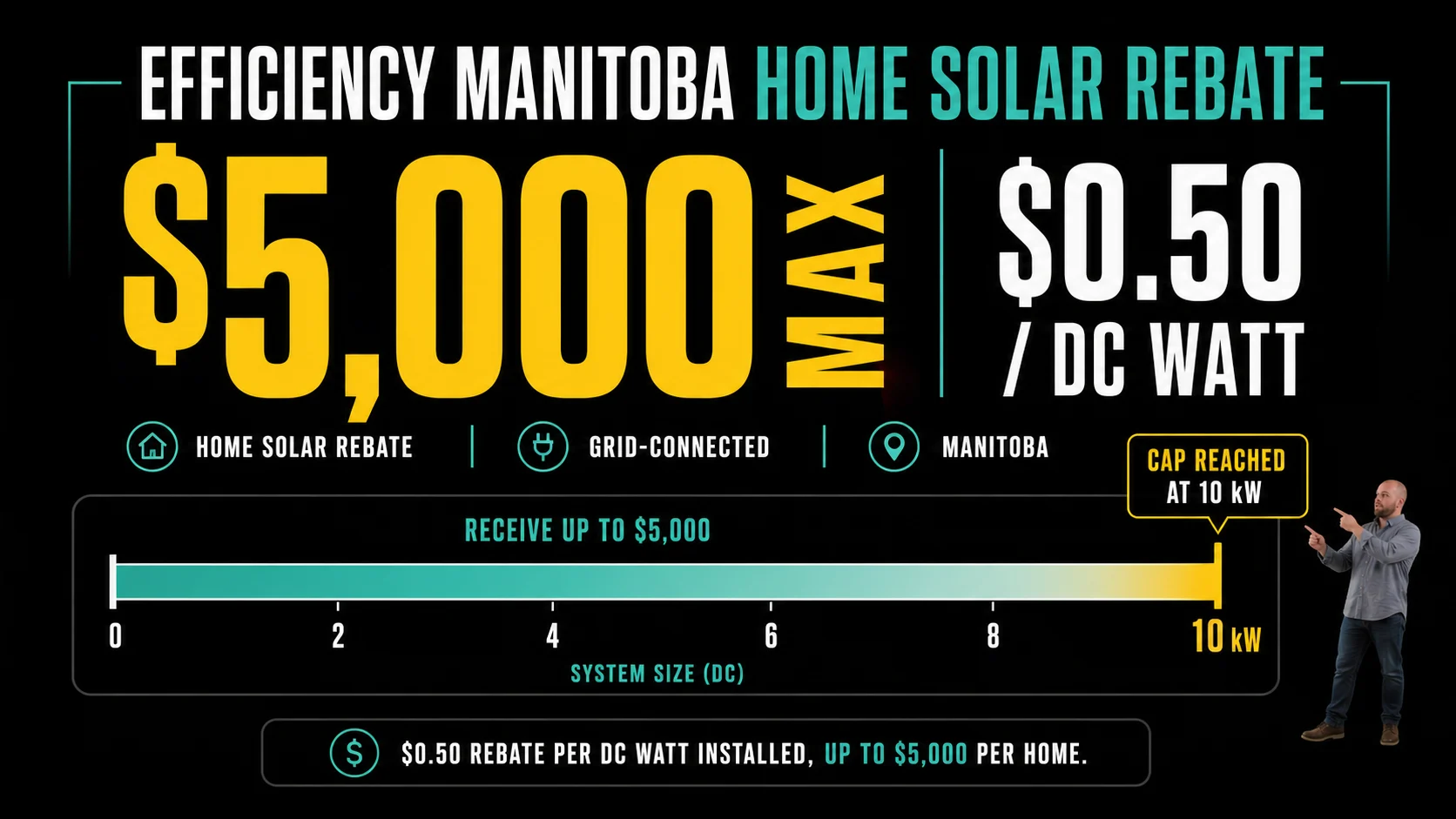
- Efficiency Manitoba's residential solar rebate is $0.50 per DC watt, up to $5,000 per home, according to the current Efficiency Manitoba home solar rebate.
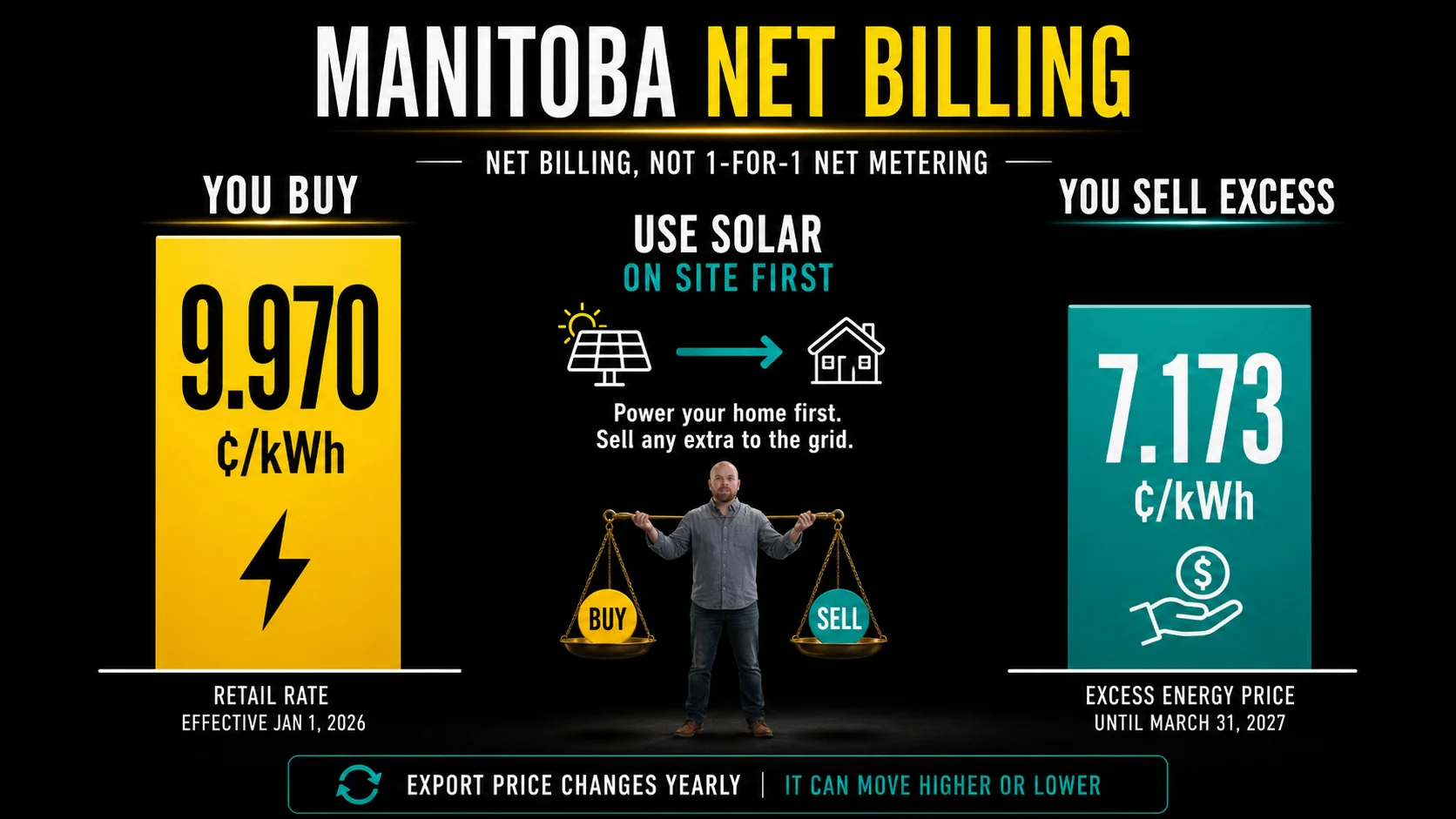
- Manitoba Hydro's residential electricity energy charge is 9.970 cents/kWh effective January 1, 2026, according to Manitoba Hydro residential rates.
- Manitoba uses net billing. The current excess energy price is $0.07173/kWh until March 31, 2027, according to Manitoba Hydro customer generation information.
- The Canada Greener Homes Loan is closed to new applications, according to Natural Resources Canada.
- Commercial solar can pencil out better in Manitoba when daytime usage is high, because more solar power is used on site instead of exported at the excess energy price.
Why Consider Solar Energy in Manitoba?
The main reason to install solar in Manitoba is not because the grid is dirty. Manitoba Hydro already gets most of its electricity from hydroelectric generation. Manitoba Hydro says hydroelectricity makes up 98% of Manitoba's generation, and it also notes that solar PV has a higher lifecycle carbon footprint per unit of energy than Manitoba's hydroelectricity (Manitoba Hydro customer generation).
That does not make solar useless. It just changes the reason for buying it.
For Manitoba homeowners, solar is usually about:
- long-term bill control
- reducing exposure to future rate changes
- using your own daytime power
- adding customer choice
- planning for backup only if batteries or proper backup equipment are included
- making better use of roof, shop, barn, or land space that already gets sun
Across Canada, solar adoption is growing. New solar panel technology is making panels more efficient than ever. Manitoba has not seen the explosive growth of provinces with higher electricity prices, but homeowners in Winnipeg, Brandon, Steinbach, Portage la Prairie, and rural Manitoba are getting more curious.
For businesses, farms, shops, and commercial buildings, the financial case can be stronger. Those properties often use electricity during the day, right when the solar panels are producing.
What Makes Manitoba Ideal for Solar Panels?
You might be surprised to learn that Manitoba has real solar potential. Winnipeg gets around 2,300 hours of sunshine a year. Solar panels also work well in cold temperatures, so winter cold is not the problem people often think it is.
The bigger issue is seasonality. Winter days are shorter, the sun is lower, and snow can reduce production. Many Manitoba homes also use more electricity in darker winter periods, while solar produces more in long summer days.
That is why local data matters.
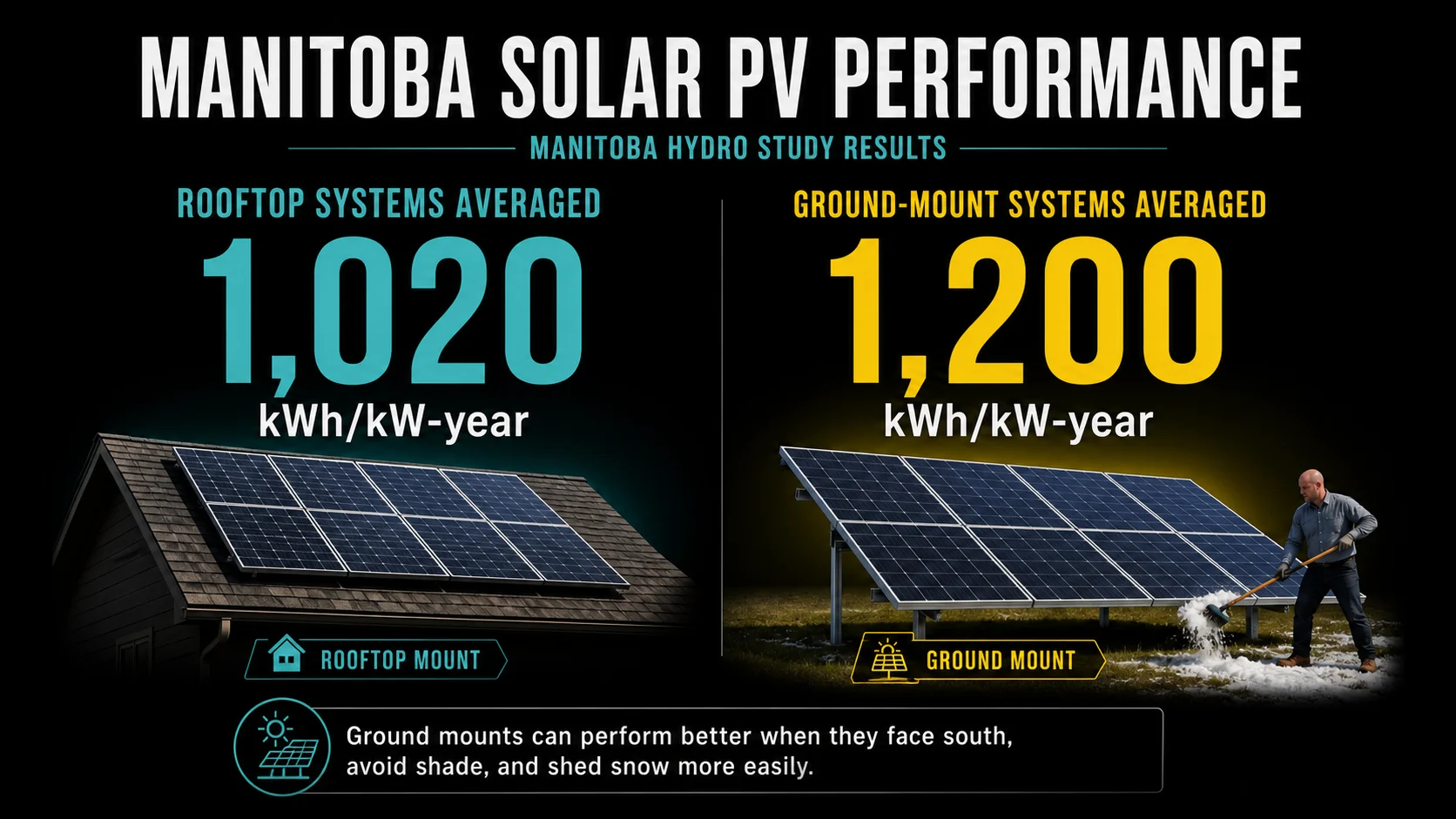
Manitoba Hydro's solar PV performance study found average real-world output of about 1,020 kWh per installed DC kW per year for rooftop systems and about 1,200 kWh per installed DC kW per year for ground-mounted systems (Manitoba Hydro solar PV generation study PDF).
Ground mounts often perform better because they can be aimed closer to the ideal angle, avoid roof shade, and are easier to clear after snow. Rooftop systems can still work well, but the roof direction, slope, shade, and snow pattern matter a lot.
Understanding Solar Panel Costs in 2026
Let's get straight to the numbers. The upfront cost is still the biggest hurdle for anyone looking to install solar panels in Manitoba.
What affects solar panel costs?
The final price of your solar system depends on a few things:
- System size: This is still the biggest factor. The more power you need, the more panels, racking, wiring, and labour you need.
- Panel quality: Higher-efficiency panels cost more but produce more power in a smaller space.
- Inverter type: String inverters, optimizers, and microinverters can change both price and long-term service planning.
- Roof complexity: A simple south-facing roof is cheaper to work on than a roof with multiple angles, dormers, shade, or difficult access.
- Electrical work: Panel upgrades, meter work, trenching, or service changes can move the final cost quickly.
- Permits and inspections: These should be included clearly in the quote.
Efficiency Manitoba's solar payback education page says the average price of installing a solar PV system in Manitoba is about $3 per watt, and recommends getting at least three contractor quotes (Efficiency Manitoba payback guidance).
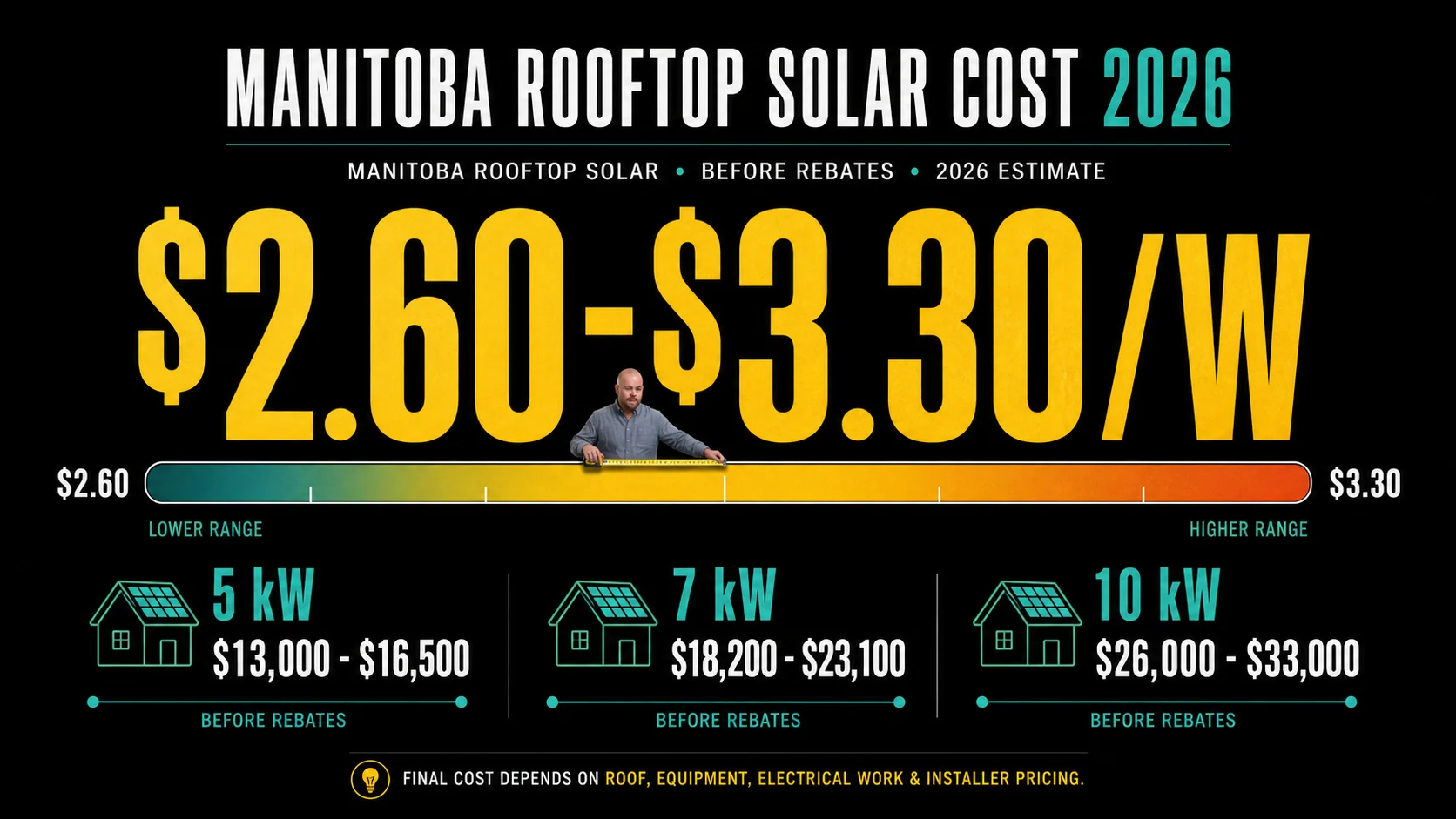
For 2026, a practical planning range for grid-tied rooftop solar in Manitoba is about $2.60 to $3.30 per watt before rebates. Use that as a starting point, not a final quote.
What is the average cost of residential solar panels in Manitoba?
Most homes in Manitoba will look at a system between 5 kW and 10 kW. Here is a simple table to give you an idea of the gross system costs before and after the Efficiency Manitoba residential rebate.
| System size | Estimated gross cost before rebate | Efficiency Manitoba rebate | Estimated net cost |
|---|---|---|---|
| 5 kW | $13,000-$16,500 | Up to $2,500 | $10,500-$14,000 |
| 7 kW | $18,200-$23,100 | Up to $3,500 | $14,700-$19,600 |
| 10 kW | $26,000-$33,000 | Up to $5,000 | $21,000-$28,000 |
The price per watt usually includes the panels, inverter, racking, wiring, permits, and the labour for installation. There should not be major hidden fees with a reputable installer, but you still need to ask. Electrical upgrades, roof repairs, trenching for a ground mount, or battery storage can change the total quickly.
Tip for homeowners: Always get a detailed, itemized quote. It should clearly separate equipment, labour, permits, interconnection work, monitoring, and any upgrade costs. This helps you compare apples to apples when looking at different solar solutions.
If you want a quick first check before collecting quotes, use the SolarEnergies.ca online solar calculator to see whether solar makes sense for your property, annual usage, and rough budget.
What are the long-term maintenance costs?
This is one of the best parts about solar. Solar photovoltaic panels have no moving parts and require very little maintenance. You might need to clean them if they get particularly dirty, but rain and snow often handle part of that naturally.
The main component you may need to replace later is the inverter. Some inverters have warranties around 10 to 12 years, while many microinverters and premium products offer longer terms. Ask for the exact product warranty, performance warranty, workmanship warranty, roof-penetration warranty, monitoring terms, and service response process in writing.
Financial Incentives and Rebates
Financial help is critical for making the numbers work in Manitoba. Here is what buyers should know in 2026.
What incentives are available for solar panel buyers in Manitoba?
The main homeowner incentive comes from Efficiency Manitoba.
Efficiency Manitoba's current residential solar page says the rebate is $0.50 per direct-current watt installed, up to $5,000 per home, for eligible homes connected to Manitoba Hydro's grid (Efficiency Manitoba home solar rebate).
To qualify, the system must be grid-connected, installed by an Efficiency Manitoba registered contractor, connected to the primary residential meter, and the rebate application must be submitted within the program's timing rules.
For commercial systems, Efficiency Manitoba says the business solar rebate is $0.75 per DC watt installed on buildings connected to Manitoba Hydro's grid. Commercial projects require Efficiency Manitoba approval before any work starts, including before purchase or installation (Efficiency Manitoba business solar rebate).
What financing is still available?
This is where Manitoba solar buyers need to be careful.
The Canada Greener Homes Grant is closed, and the Canada Greener Homes Loan is also closed to new applications. Natural Resources Canada says funding is fully committed and new loan applications cannot be approved (Canada Greener Homes Loan status).
If a quote still builds the project around a new federal Greener Homes Loan, ask for revised financing assumptions.
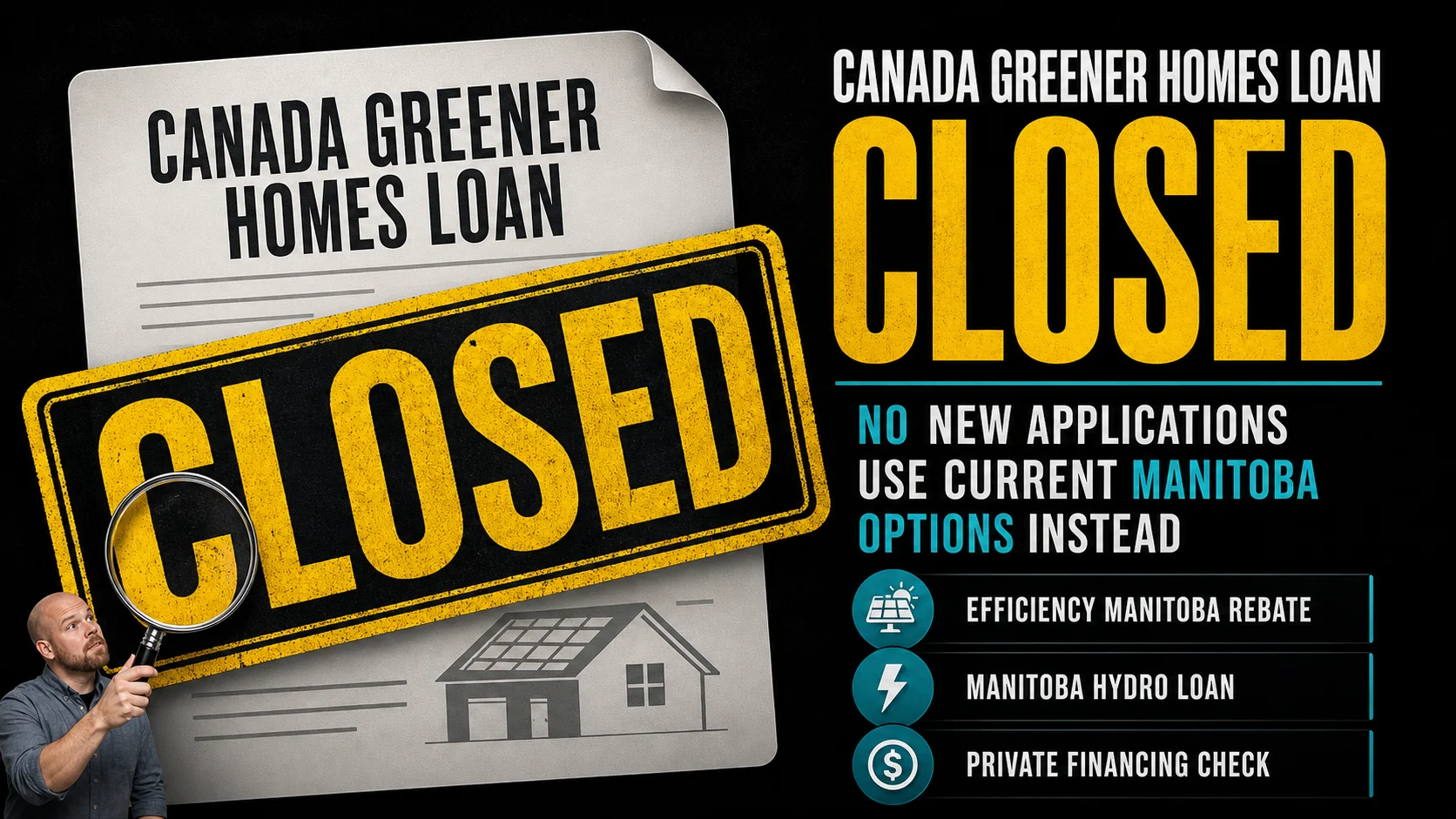
Manitoba Hydro's Home Energy Efficiency Loan may still help some homeowners. Manitoba Hydro's loan page lists solar PV financing at $3,000 per kW installed, up to $20,000, but the same page also lists a general $12,500 residence limit. Confirm the current solar-specific cap with Manitoba Hydro before building your budget around it (Manitoba Hydro Home Energy Efficiency Loan).
Some installers may advertise promotional financing. Check the total installed price, dealer fees, term, interest triggers, and whether the financing is actually available in Manitoba in 2026.
How can rebates impact overall costs?
Let's apply the Efficiency Manitoba rebate to a 7 kW system example:
- Gross cost at $2.60-$3.30/W: $18,200-$23,100
- Efficiency Manitoba rebate at $0.50/W: -$3,500
- Estimated net cost: $14,700-$19,600
That cash incentive makes a real difference. It does not turn every home into a fast-payback case, but it reduces the initial investment enough that the conversation becomes more realistic.
Are there tax credits to consider?
For homeowners, there is no normal federal 30% residential solar tax credit like the U.S. credit.
For businesses, the federal tax picture can matter. CRA says the Clean Technology ITC is a refundable tax credit for eligible clean technology property in Canada from March 28, 2023 to December 31, 2034, with a rate of up to 30% for qualifying property available for use through 2033 (CRA Clean Technology ITC overview). CRA also says eligible claimants generally include taxable Canadian corporations and certain real estate investment trusts, so this is not a normal homeowner credit (CRA Clean Technology ITC who can claim).
The Clean Electricity ITC is now in effect, but it is not a normal homeowner rebate and not every private business will qualify. It applies to qualifying entities and eligible clean electricity property, including some solar generation equipment, according to CRA's clean economy ITC update (CRA Clean Economy ITC updates).
Tip for businesses: ask your accountant or tax advisor to confirm the ITC and capital cost allowance assumptions before you treat them as part of the return.
Net Billing in Manitoba
This is probably the most important, and most misunderstood, part of going solar in Manitoba. This is where the cheap hydro really comes into play.
When your solar panels produce more electricity than you are using, that excess energy is sent to the Manitoba Hydro grid. In return, you get a credit on your bill.
The key detail is the rate. Manitoba Hydro uses a net billing system, which is different from 1-for-1 net metering in some other provinces. Manitoba Hydro explains that net billing gives you a money credit for excess generation, not a banked electricity credit for later use (Manitoba Hydro net billing).
In 2026:
- You buy residential electricity at 9.970 cents/kWh under the standard residential energy charge.
- You sell excess energy under 100 kW at $0.07173/kWh until March 31, 2027.
You get less value for the power you export than the electricity you avoid buying from the grid. The spread is narrower than it used to be, but it still matters. This means the best way to save money is to use as much of your own solar power as you can right when it is being generated during the day.
Manitoba Hydro also warns that the excess energy price changes yearly and can move higher or lower. Do not build a 25-year payback model using today's export price as if it is fixed forever.
Tip for maximizing savings: Shift high-energy tasks to daytime when you can. Run your dishwasher, laundry, EV charging, shop tools, cold storage, or other flexible loads when the sun is shining. This uses more of your own power instead of exporting it for a lower credit.
Calculating Return on Investment
So, with all these numbers, how long does it take to get your money back?
The ROI depends on your net cost, how much electricity you use, and how much of your solar production you can use during the day versus exporting to the grid.
Manitoba Hydro's solar PV study found that electrically heated residential customers in the sample exported about 64% of their solar production and used about 36% on site (Manitoba Hydro solar PV generation study PDF). That matters because many Manitoba homes need the most electricity during darker winter periods, while solar produces much more in long summer days.
Here is a conservative 7 kW rooftop example:
| Assumption | Example |
|---|---|
| System size | 7 kW |
| Net installed cost after rebate | $16,500-$20,000 |
| Annual output at 1,020 kWh/kW | 7,140 kWh |
| On-site use | 50% |
| Export | 50% |
| Approximate annual value at 2026 rates | About $615 |
| Simple payback | About 27-33 years |
That does not mean every Manitoba project takes 30 years. It means assumptions matter. If your installed cost is lower, your on-site use is higher, your roof performs well, electricity rates rise, or you have a strong daytime commercial load, the numbers improve. If your roof is shaded, your cost is high, or most energy is exported, the numbers get weaker.
What is the payback period for solar panels?
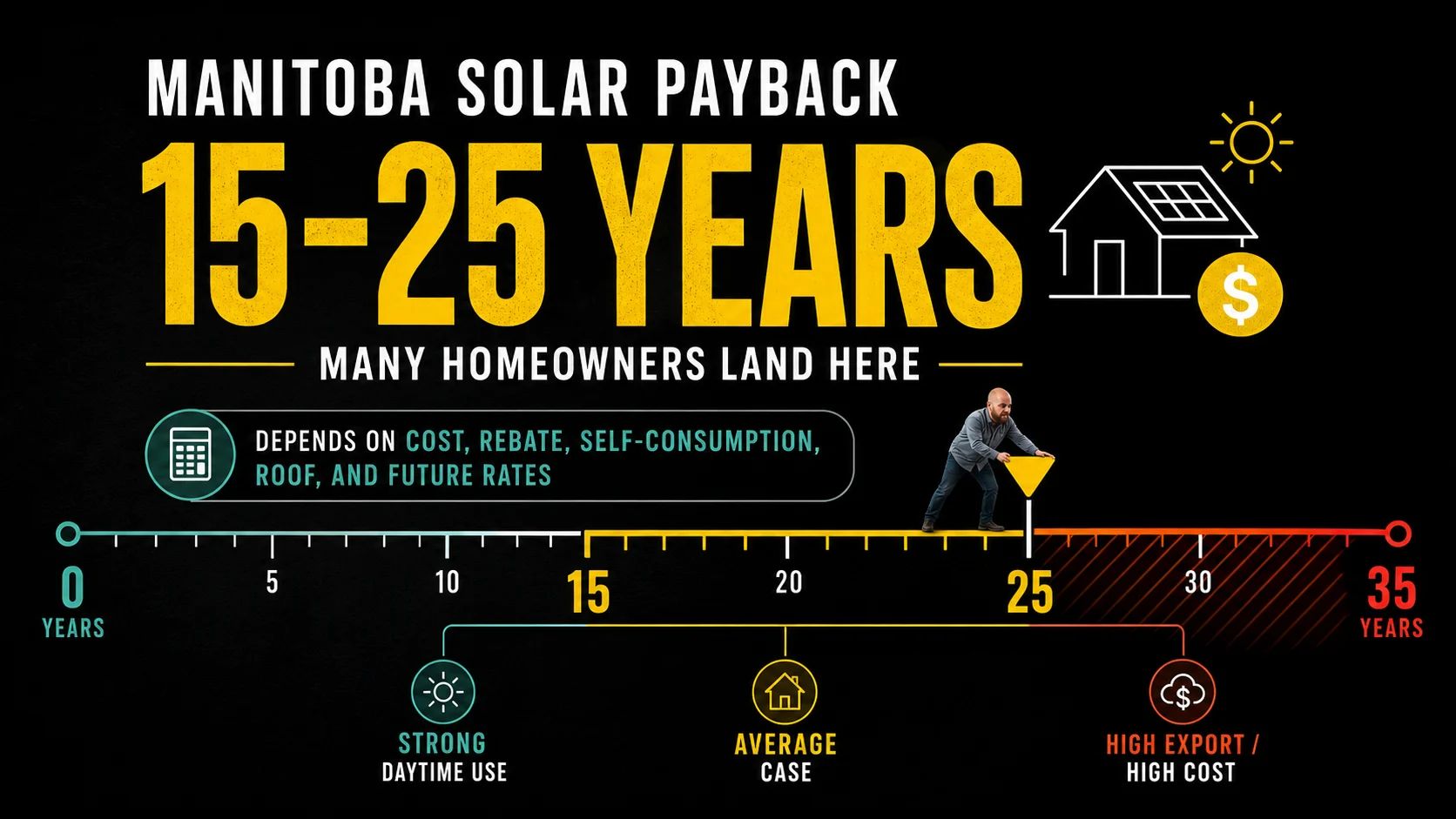
For many homeowners, solar payback in Manitoba can land around 15 to 25 years, and weaker cases can stretch beyond 25 years. This is longer than in provinces with higher electricity rates and stronger net metering policies.
For commercial properties, the payback can be faster when the building uses a lot of power during the day. Those projects use more solar energy on site, may qualify for the higher Efficiency Manitoba business rebate, and may be able to use federal tax tools if the ownership structure qualifies.
How can solar panels increase home value?
Homes with solar panels can be more attractive to some buyers because they come with lower future electricity bills and some protection against rate increases. Do not assume you will recover the full system cost at sale, especially in a long-payback market. But a clean, permitted, well-documented solar installation can help a home stand out.
Choosing the Right Solar Panel System
If you decide to move forward, picking the right gear and the right team is crucial.
What types of solar panels are available in 2026?
The main choice is still between standard monocrystalline panels and higher-efficiency models. For most homes in Manitoba with ample roof space, standard high-quality panels are perfectly fine and more cost-effective. If you have a small roof and want to maximize your power needs, premium high-efficiency panels may be worth pricing, but they come at a higher cost.
Do not buy panels based on wattage alone. Ask about product warranty, performance warranty, degradation rate, inverter compatibility, snow/wind loading, and how the system is expected to perform on your actual roof.
What about battery storage?
With the lower credit for excess energy, a solar battery is something some Manitoba homeowners will want to consider. A battery lets you store extra solar power during the day and use it later instead of selling all of that extra power to the grid.
But be careful with the payback promise. A battery adds cost. It needs to be designed properly. And standard grid-tied solar does not keep your home powered during an outage unless the system includes proper battery or backup equipment. Manitoba Hydro explains that grid-connected systems must shut down during outages for worker safety (Manitoba Hydro customer generation).
For homeowners, treat batteries as a backup and control decision first, not a guaranteed ROI booster. Ask for two versions of the quote: solar without battery and solar with battery.
Permits, Code, and Manitoba Hydro Approval
Solar is electrical work, so the paperwork matters.
Manitoba Hydro says all solar panel installations need an electrical permit, and usually a municipal building permit. Electrical work must be done by a licensed electrical contractor and must meet the Manitoba Electrical Code (Manitoba Hydro customer generation).
The code reference changed in 2026. Manitoba's current electrical code regulation is Manitoba Electrical Code, M.R. 30/2026, registered March 30, 2026. It adopts the Canadian Electrical Code, Part I, 26th edition, CSA C22.1:24, and repeals the 2018 Manitoba Electrical Code (Manitoba Electrical Code M.R. 30/2026).
Before work starts, your contractor should be clear about:
- electrical permit
- municipal building permit where required
- Manitoba Hydro interconnection requirements
- site plan and single-line diagram
- inverter, disconnect, grounding, bonding, labelling, and rapid shutdown details
- bi-directional meter requirements
- inspection before energization
For grid-connected systems, Manitoba Hydro separates smaller projects from larger generators. Systems under 100 kW may sell excess energy through net billing, while larger projects can require case-specific arrangements (Manitoba Hydro grid connection).
How to Choose the Right Solar Installer
Your solar installer is your partner in this project. Look for a company that is experienced, has good reviews, is registered with Efficiency Manitoba, and can clearly explain the Manitoba Hydro interconnection process.
Efficiency Manitoba says homeowners should use a registered contractor, compare several quotes, and check references (Efficiency Manitoba home solar).
Ask potential installers:
- Are you registered with Efficiency Manitoba?
- Who holds the electrical contractor's licence?
- Can you provide references from recent installations in Manitoba?
- What warranties do you offer on your workmanship and the equipment?
- Who handles permit applications and the interconnection process with Manitoba Hydro?
- What production model are you using, and does it account for snow, shading, and roof angle?
- What percentage of my solar production do you expect I will use on site?
- Are meter costs, panel upgrades, monitoring, and inspections included?
- What is the estimated timeline from signing the contract to having the system operational?
Use those answers to compare Manitoba solar installers and quotes so you are not relying on one proposal.
Conclusion: Is Solar Worth the Investment in Manitoba?
Let's wrap this up with a straight answer.
For the average homeowner in Manitoba, going solar in 2026 is not a clear financial win if you are looking for a quick payback. The combination of low electricity rates and net billing makes the ROI longer than in many other provinces. The Efficiency Manitoba rebate helps, but the federal Greener Homes Loan is no longer available to new applicants.
For businesses, farms, shops, and buildings with daytime load, the math can be much better. Those projects use more power while the sun is up, export less, and may qualify for stronger rebates and federal tax tools.
So, what is the verdict for a Manitoba homeowner? It comes down to a decision between your head and your heart.
Your Head (the finances): The numbers are tough for some homes. With a long payback period, this is not a quick ROI investment. It is a long-term play to hedge against rising energy costs and future electricity uncertainty.
Your Heart (the independence): If you want more control over your power, more predictable bills, and the option to pair solar with proper backup equipment, solar can still be worth it.
For homeowners, if you are comfortable with the long-term view and value energy independence, solar panels in Manitoba are worth pricing out. If your primary goal is fast ROI, be careful and run the numbers twice.
For businesses, the decision can be easier when daytime consumption is high. Get a detailed quote, model the self-consumption, and have your accountant review the tax side.
No matter who you are, do your homework. Get multiple quotes from qualified solar panel installers, understand the net billing system, and make a decision that lines up with your own financial and personal goals.
Canada is going solar, and even with the challenges, Manitoba can still be part of that journey.
FAQ
How much does it cost to install solar panels in Manitoba?
Most residential grid-tied solar panels in Manitoba cost about $2.60 to $3.30 per watt before rebates in 2026. A 7 kW system may cost around $18,200 to $23,100 before incentives, while a 10 kW system may cost around $26,000 to $33,000 before incentives.
Your quote may be higher if you need electrical upgrades, roof work, trenching, premium inverters, battery storage, or a more complex racking design.
What is the Manitoba solar rebate in 2026?
Efficiency Manitoba currently offers a residential solar rebate of $0.50 per DC watt installed, up to $5,000 per home, for eligible homes connected to Manitoba Hydro's grid. The rebate is capped at 10 kW for residential projects, according to Efficiency Manitoba.
Businesses may qualify for $0.75 per DC watt installed, but commercial projects need pre-approval before work starts.
Is the Canada Greener Homes Loan still available for solar panels in Manitoba?
No. The Canada Greener Homes Loan is closed to new applications, and Natural Resources Canada says new loan applications cannot be approved because program funding is fully committed (NRCan loan status).
If your quote still includes a new federal Greener Homes Loan as a 2026 financing path, ask the installer to revise the proposal.
Does Manitoba have net metering?
Manitoba uses net billing, not full 1-for-1 net metering. You use your own solar power first, and excess power can be sold back to Manitoba Hydro as a money credit at the excess energy price.
That means self-consumption matters. A system that exports too much electricity may have a weaker payback than a smaller system that better matches daytime load.
What is the current Manitoba Hydro solar export rate?
Manitoba Hydro says the excess energy price is $0.07173/kWh until March 31, 2027 for generators under 100 kW selling excess energy through net billing (Manitoba Hydro excess energy price).
The price changes yearly and can move up or down, so do not treat today's export price as fixed for the life of the system.
How long does solar payback take in Manitoba?
For many homeowners, solar payback in Manitoba can land around 15 to 25 years, and weaker cases can stretch beyond 25 years. Manitoba's low electricity rates and net billing structure make fast payback harder than in higher-rate provinces.
Commercial projects can be stronger when businesses use more electricity during the day and qualify for larger rebates or tax incentives.
Do solar panels work in Winnipeg winters?
Yes. Solar panels still produce electricity in cold weather, but winter days are shorter, the sun angle is lower, and snow can reduce production. Manitoba Hydro's study found ground-mounted systems performed better than rooftop systems on average because they were usually better angled, less shaded, and easier to clear.
For a Winnipeg home, ask for a production estimate that accounts for roof direction, tilt, snow, shading, and actual local conditions.
Should I install a solar battery in Manitoba?
Maybe, but do not assume it automatically improves payback. A battery can help you use more of your own solar power and provide backup during outages, but it also adds cost. Standard grid-tied solar does not keep your home powered during an outage unless the system is specifically designed with backup equipment.
Ask for two quotes: solar without battery and solar with battery. Compare the added cost, backup capability, expected self-consumption increase, warranty, and payback separately.
Can I install solar panels myself in Manitoba?
Grid-connected solar is not a good DIY project in Manitoba. Manitoba Hydro says solar electrical work must be done by a licensed electrical contractor and installations require electrical permits and inspection before energization.
You can still educate yourself, compare quotes, and ask better questions. But the actual grid-connected electrical work needs proper licensing and approval.
What size solar system do I need in Manitoba?
Most homes look at systems between 5 kW and 10 kW, but the right size depends on annual electricity use, daytime load, roof space, rebate cap, self-consumption, and export economics.
In Manitoba, bigger is not always better. Since exported electricity is credited under net billing, oversizing can weaken the return. A good installer should model both annual production and the expected split between on-site use and exports.