
Solar Panels Yukon Guide 2025 + Calculator
August 7, 2025
Solar Panels Saskatchewan Cost Guide 2026
August 7, 2025Last Updated on May 16, 2026 by Vitaliy
Last reviewed: May 16, 2026
If you are comparing solar panels in Alberta in 2026, the answer is still mostly positive: Alberta has strong sun, high summer production, and a micro-generation framework that lets homeowners earn bill credits for excess power. The catch is that some 2025 residential solar cost and rebate advice is now wrong.
The expensive mistake is simple: planning your solar investment around a federal loan, grant, export rate, or permit timeline that no longer applies. Before you sign a quote, you need the current Alberta rules, the real incentive picture, and a system size that fits your home instead of a sales target.
This updated Alberta solar guide keeps the practical parts that still matter: cost, production, net billing, snow, hail, installers, and payback. Then it refreshes the areas that changed for 2026.
If you want a quick first check before calling installers, use the SolarEnergies.ca solar calculator to estimate whether solar panels in Alberta make sense for your roof, electricity use, and budget.
Key Takeaways for Solar Panels in Alberta in 2026
- Alberta has strong solar potential compared with many Canadian regions. Cold sunny weather helps panel efficiency, and sunny cities like Edmonton and Calgary are good fits for rooftop solar.
- The old federal incentive language must be removed. The Canada Greener Homes Grant is closed, and the Canada Greener Homes Loan closed to new applicants after October 1, 2025.
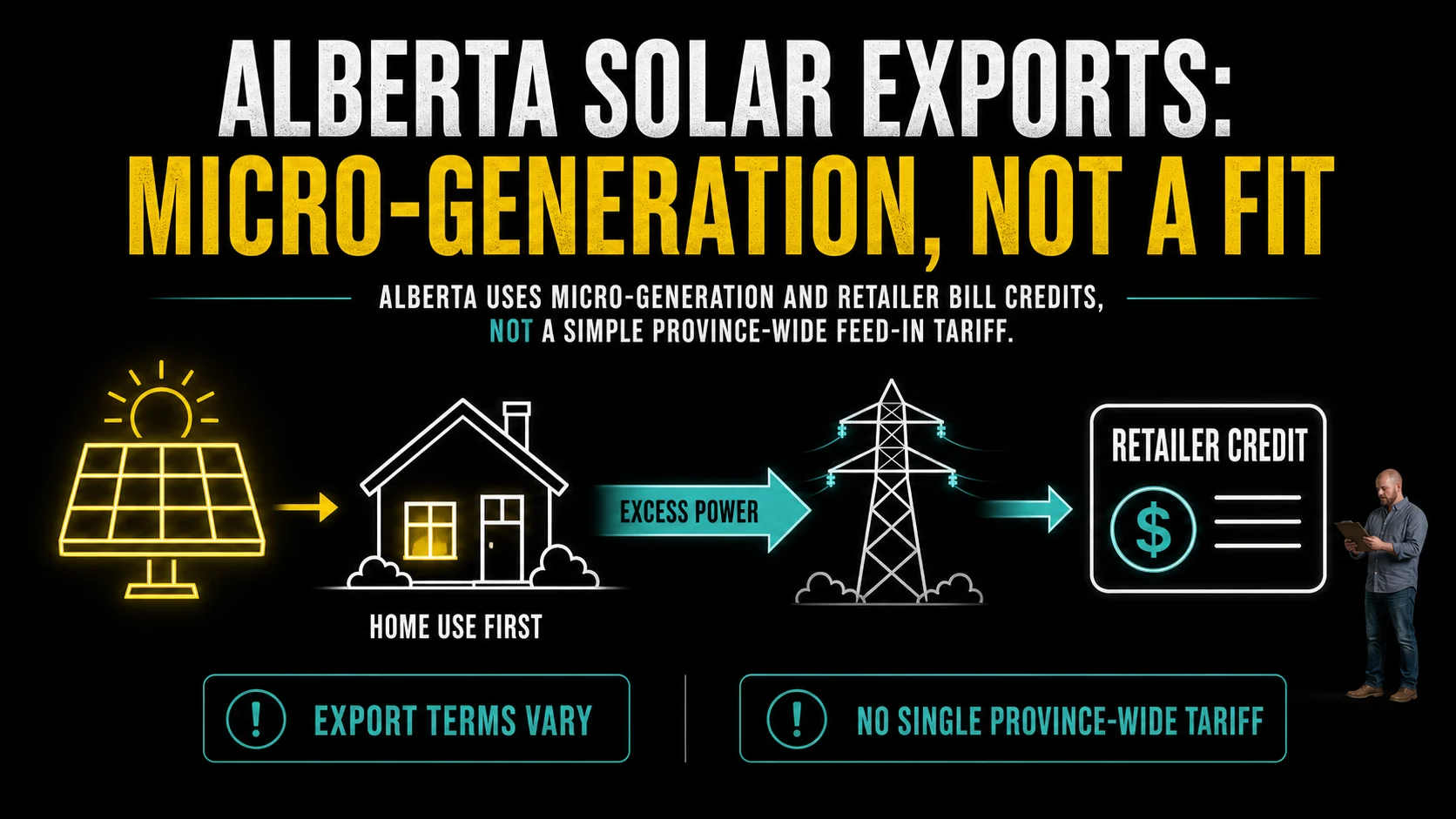
- Alberta uses micro-generation and net billing. People often call it net metering, but the official Alberta framework credits small micro-generators for exported electricity through retailer billing, not a province-wide feed-in tariff.
- System size matters. Alberta micro-generation is meant to meet all or part of your own electricity needs, so your proposed annual production should line up with your site’s consumption.
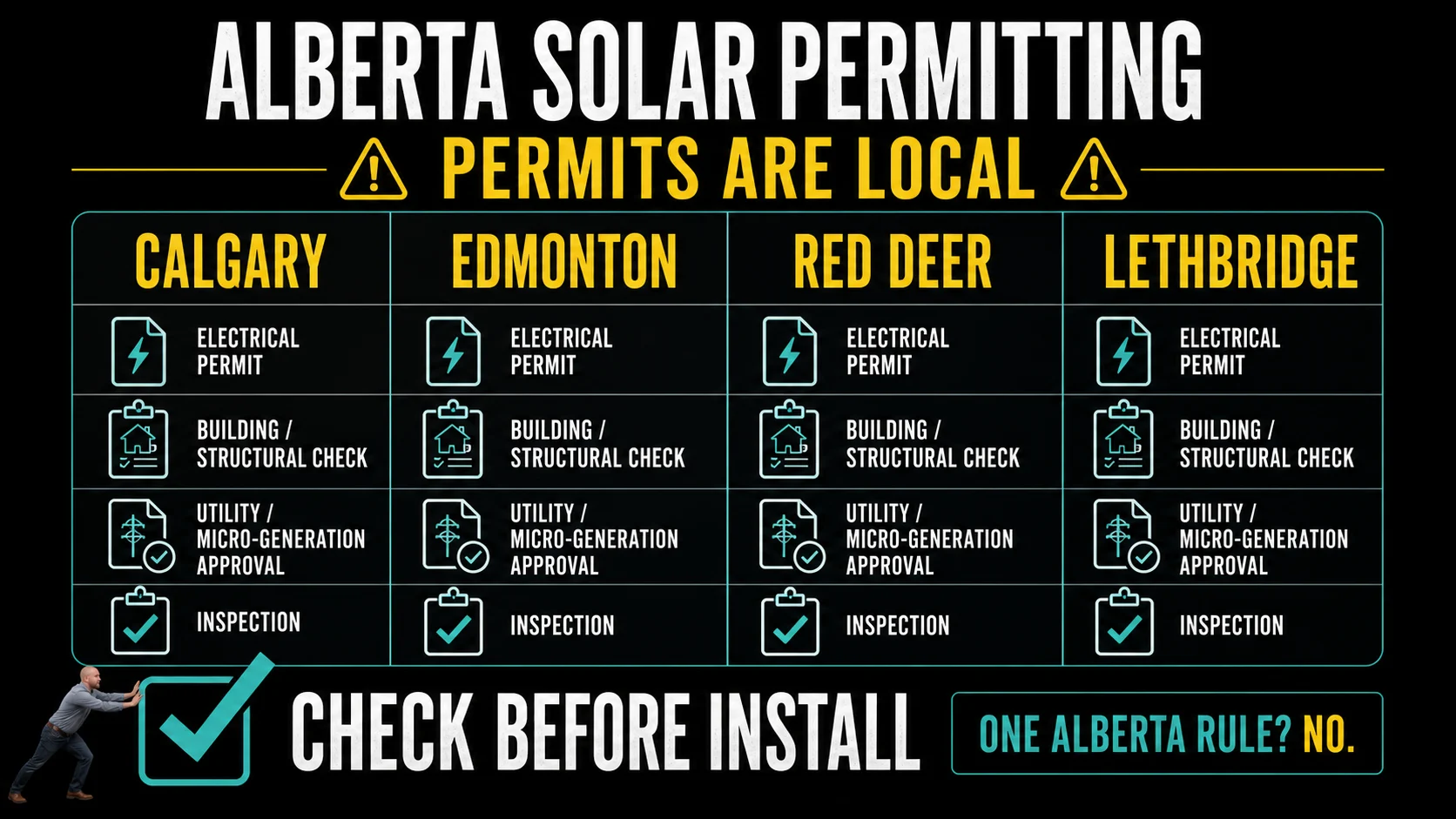
- Permits are local. Calgary, Edmonton, Red Deer, and Lethbridge do not handle solar panel installation the exact same way.
- Payback is still possible. The best results usually come from a good south, east, or west roof, fair pricing, clean permitting, and smart retailer rate selection during summer export months.
Why Alberta Is Still a Strong Solar Province
It sounds strange at first. Alberta has long winters, hail risk, and cold nights. But solar panels do not need hot weather. They need sunlight, and Alberta gets plenty of it.
Cold air can actually help solar panel efficiency because photovoltaic equipment performs better when it is cool. A clear winter day can produce useful solar power even when the temperature is well below zero. Snow reduces production when it covers the panels, but most annual solar energy comes from the brighter spring, summer, and fall months.
Edmonton’s own solar page says the city gets about 2,300 hours of sun in an average year, which is one reason Alberta homeowners keep considering solar despite the weather.
How solar panels work in Alberta’s climate
Snow is not a dealbreaker. Light snow often slides off angled panels, and darker panel surfaces warm faster once sunlight returns. Production still drops during covered periods, so your annual estimate should include winter losses instead of assuming perfect conditions.
Hail deserves more attention. Modern solar panels are built and tested for impact resistance, but Alberta storms are real. Ask every solar installer what panel model they are quoting, what hail rating it carries, how the racking is engineered, and how your home insurance treats a rooftop solar array.
Tip for Alberta homeowners: do not judge the solar system only by panel wattage. Ask for the annual kWh estimate, monthly production curve, inverter specs, warranty terms, and what happens if actual production is lower than the proposal.
Solar Panel Costs in Alberta: How Much Do Solar Panels Cost in 2026?
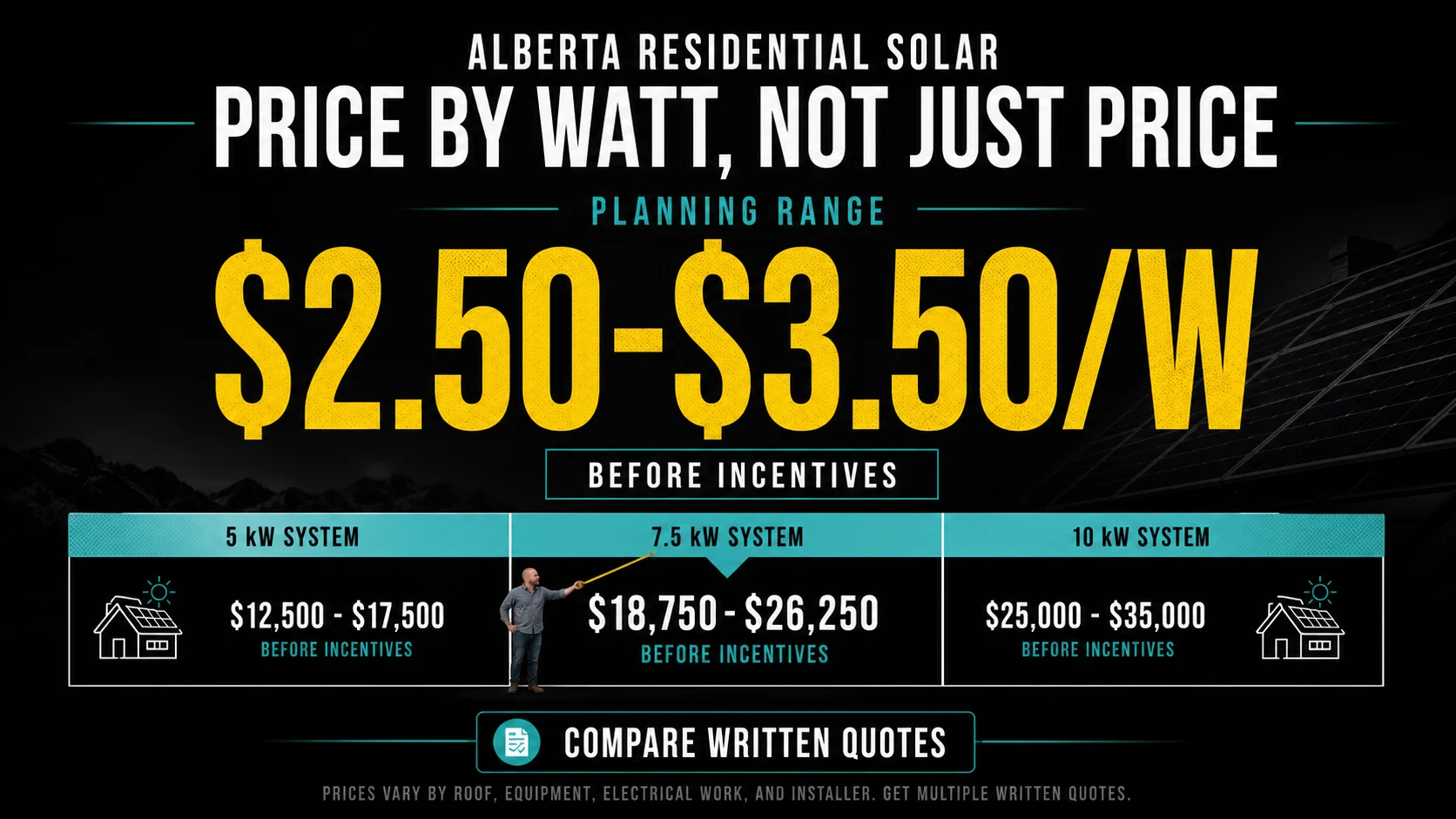
For a typical home, the cost of solar panels in Alberta is usually quoted in dollars per installed watt. Recent residential quotes commonly vary by roof, equipment, electrical work, and installer. For planning only, many Alberta homeowners see written quotes around the $2.50 to $3.50 per watt range before financing, municipal incentives, electrical upgrades, or roof work. A 7.5 kW system at $3.00 per watt would be about $22,500 before any local rebate or financing option.
That is only a planning number. Your actual solar panel installation cost depends on roof pitch, roof material, panel count, inverter type, electrical panel capacity, wire run, snow guards, permitting, and whether the installer is including monitoring, extended warranties, or service work.
The average cost to install solar panels can move quickly once design details are included. A simple south-facing roof is usually easier to price than a steep roof with multiple faces, shading, older shingles, or a needed electrical panel upgrade. That is why the upfront cost of your solar system should be compared against the year-one production estimate, not just the number of solar panels.
| System size | Rough installed cost at $2.50/W | Rough installed cost at $3.50/W | Common fit |
|---|---|---|---|
| 5 kW | $12,500 | $17,500 | Lower-use home, limited roof space |
| 7.5 kW | $18,750 | $26,250 | Average detached home |
| 10 kW | $25,000 | $35,000 | Higher-use home, EV-ready home, larger roof |
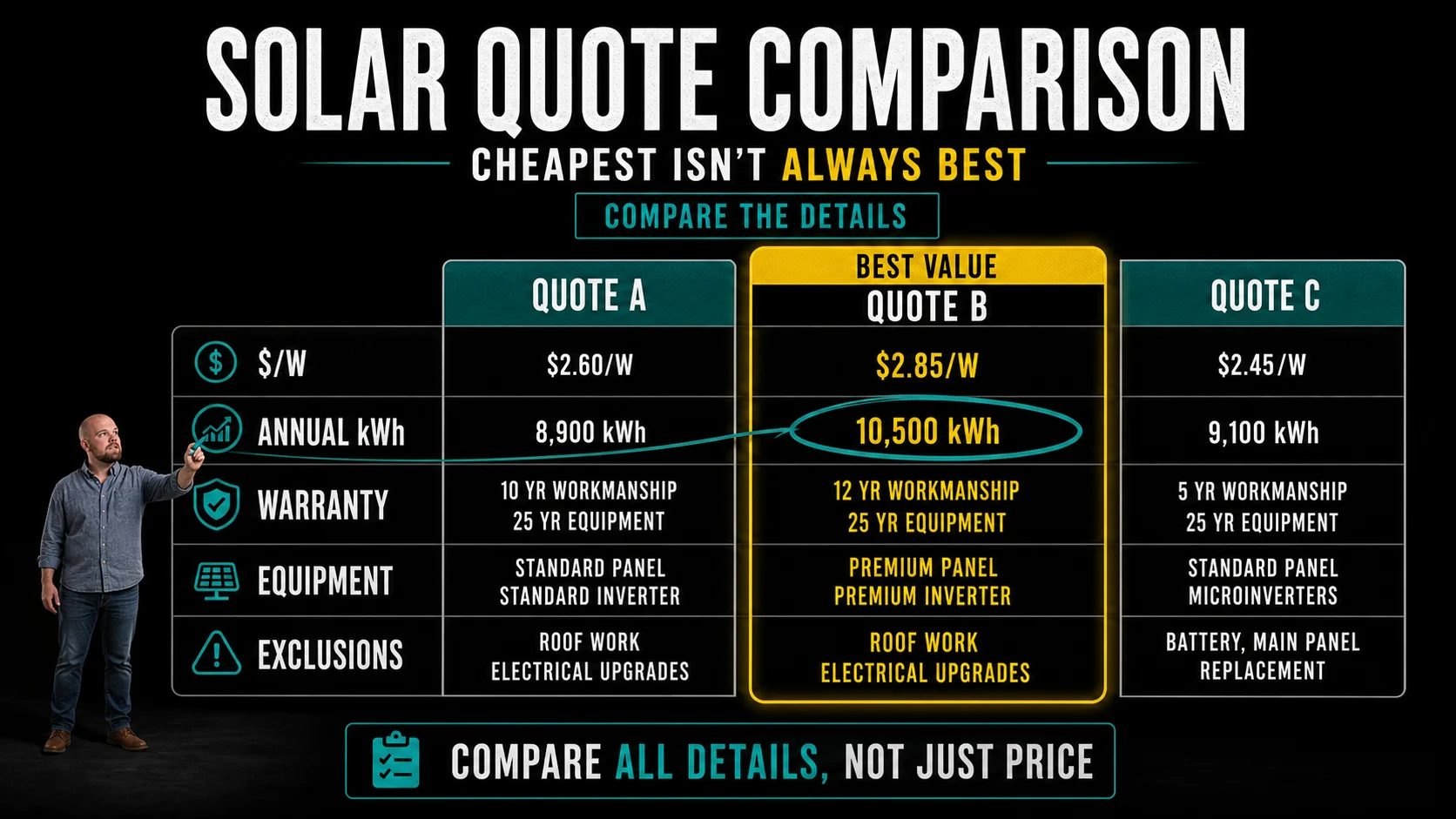
Do not compare quotes by the final price alone. A cheaper quote can cost more over time if it uses weaker equipment, poor roof layout, thin warranties, or unrealistic production assumptions. Before choosing a solar installer, compare at least a few detailed quotes side by side; this solar quote comparison guide explains what to check.
If a quote looks high, ask which items are driving the installation cost. Racking, inverter choice, roof access, trenching, electrical upgrades, permit handling, monitoring, and warranty coverage can all affect the cost of your solar project.
What can increase or reduce the cost of solar panels?
The cost of your solar panel system depends on several factors: roof layout, shading, electrical capacity, inverter design, installer labour, permit requirements, and how much energy you use each year. A larger system in Alberta may have a higher total price but a lower cost per watt if the roof is simple and the installation process is clean.
The easiest ways to reduce the cost are to compare several solar companies, avoid oversizing, check local rebates before signing, and make sure the roof is ready before installation day. If the installer finds a weak roof deck, outdated electrical panel, or code issue late in the process, the cost savings can disappear quickly.
SolarEnergies.ca can help you compare options from certified installers across Canada. Look at system size, equipment, warranty, production estimate, payment terms, and service quality before you decide.
Solar Incentives and Rebates in Alberta: What Can Reduce the Cost in 2026?
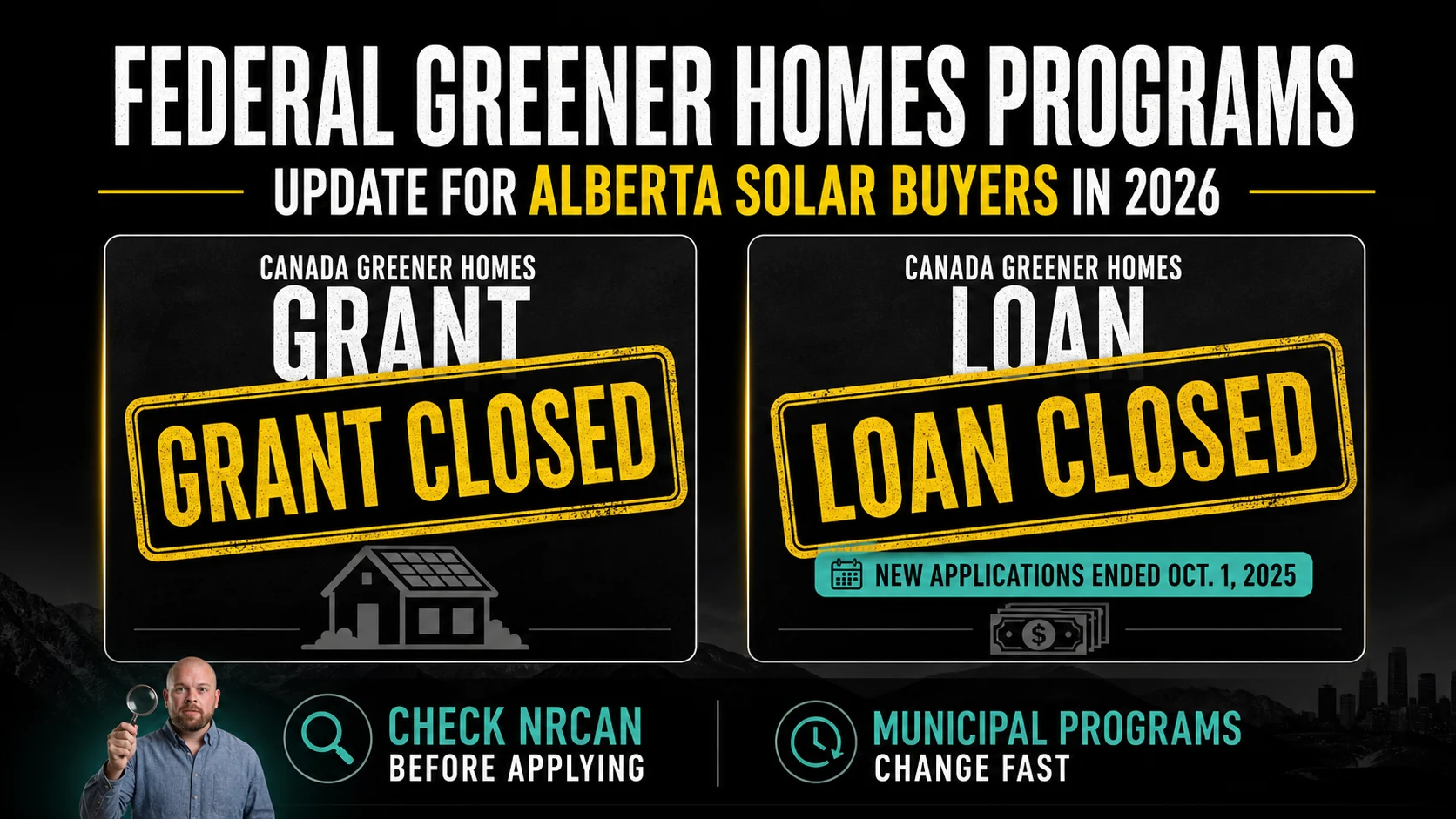
This is the biggest update from the 2025 guide. Alberta homeowners should not plan a new 2026 rooftop solar project around the old federal Greener Homes programs.
The Canada Greener Homes Grant is closed. The Canada Greener Homes Loan is also closed to new applicants, with October 1, 2025 listed as the last day to apply. If you already applied, follow the official program instructions. If you are starting fresh in 2026, do not treat that loan as available money.
Some municipal pages may still mention the broader Canada Greener Homes Initiative. New applicants should rely on NRCan’s current program status: the grant and loan are closed for new solar applicants.
Current Alberta solar incentive picture
| Program or option | 2026 status | What it means |
|---|---|---|
| Canada Greener Homes Grant | Closed | Do not use it as a current solar rebate for new Alberta applicants. |
| Canada Greener Homes Loan | Closed to new applicants | The old federal 0% loan should not be shown as available for new 2026 solar buyers. |
| Calgary Residential CEIP | Intake status changes quickly | The City of Calgary CEIP page should be checked before applying. CEIP stands for Clean Energy Improvement Program. |
| Edmonton CEIP | Program details can change | Check the City of Edmonton CEIP page before applying for current Clean Energy Improvement Program financing details. |
| Edmonton residential solar rebate | Fully subscribed | The City of Edmonton solar page says the residential solar rebate is no longer accepting applications. |
| Retailer seasonal solar rates | Retailer-specific | Plans such as ENMAX Easymax Seasonal Solar can improve summer export credits, but they are retailer products, not provincial rebates. |
Some installer or third-party financing options may include 0% financing with $0 down payment where approved, but read the terms carefully. For more context, see our guide on how to finance solar panels after the Greener Homes Loan is gone. That is different from the closed federal Greener Homes Loan.
Source-check before applying: program statuses change fast. Before applying, check NRCan for federal programs, your municipality for CEIP or permit rules, your wires owner for micro-generation forms, and your retailer for export credit terms.
Watch sales claims: if a quote says “free solar,” “your bill disappears,” or “the government pays for it,” ask for the exact program name and an official source link.
How Alberta Net Metering Really Works in 2026
Many people search for “net metering” in Alberta, and the phrase is useful because homeowners recognize it. Officially, Alberta uses a micro-generation and net-billing framework.
Under the Government of Alberta micro-generation rules, small micro-generators under 150 kW generally receive bill credits through their retailer for electricity sent back to the grid. The credit rate depends on the retail agreement and metering setup. Larger micro-generators at or above 150 kW are treated differently and may be credited using hourly wholesale market prices.
The key point: Alberta does not set one province-wide homeowner feed-in tariff. The government says you must negotiate compensation and billing with your retailer, and your retailer credits you for excess electricity supplied to the grid. The Utilities Consumer Advocate also notes that consumers should confirm with their retailer how and when credits will be paid.
Can you sell extra electricity from solar in Alberta?
Yes, but think of it as bill credits and retailer settlement, not a guaranteed profit program. Your home uses solar power first. When your solar PV system produces more than your home needs, the excess energy goes back to the grid and appears as a credit through your retailer.
You will still receive a power bill. Delivery charges, transmission charges, local access fees, administration fees, and other fixed or partly fixed charges may remain even if your energy charge is low or negative in sunny months.
Tip for summer exports: ask your installer and retailer whether a solar club or seasonal solar rate fits your usage. ENMAX, for example, currently advertises a 35.0 cents/kWh seasonal solar option for qualifying small residential micro-generators, but the active rate applies to both imports and exports, so timing matters.
How Big Should Your Alberta Solar System Be?
A good Alberta solar system is sized around your annual electricity consumption, not just the maximum number of panels that fit on your roof.
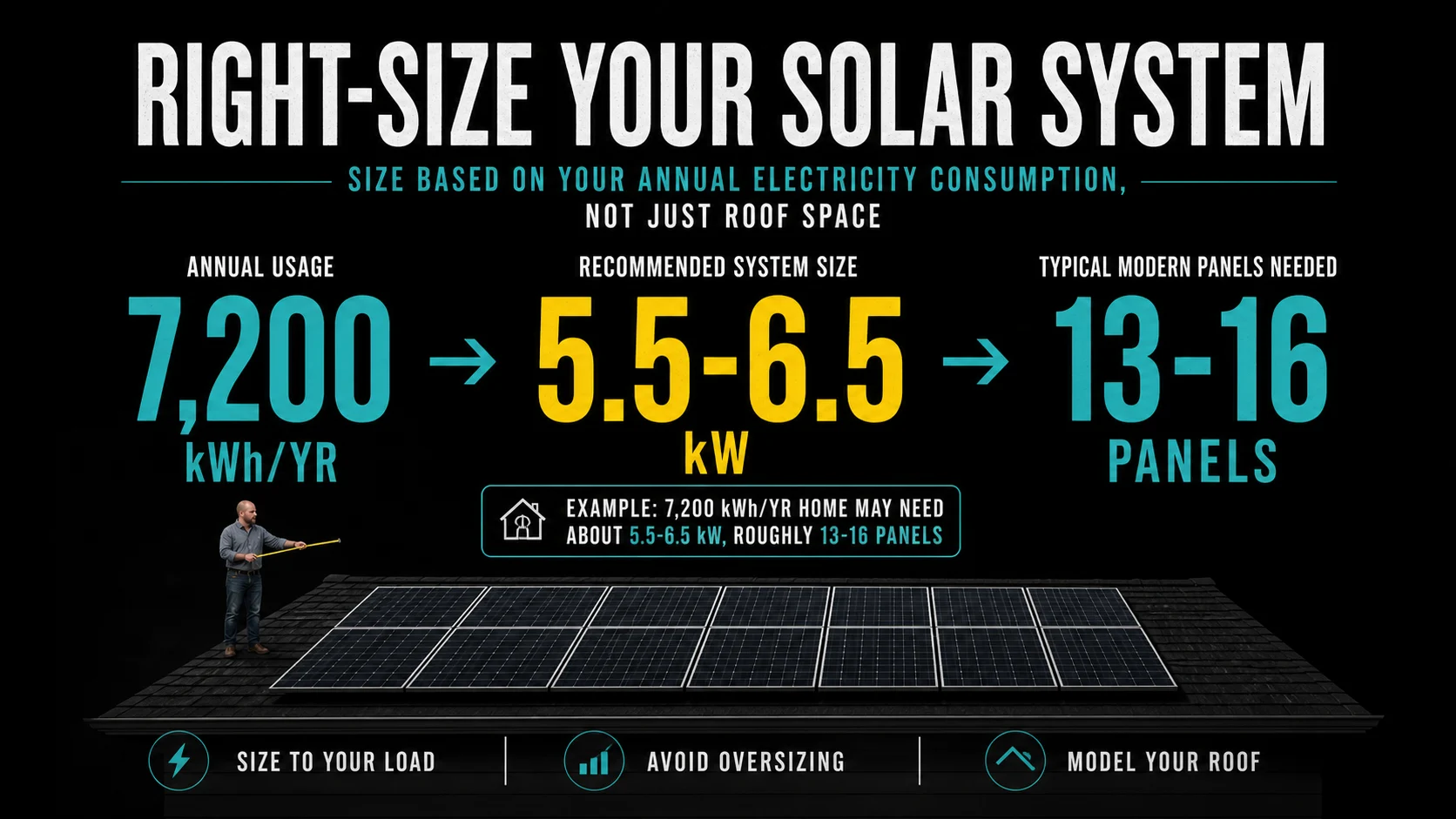
ENMAX’s micro-generation application guidance says sizing should use 12 months of site consumption history and that proposed annual production must not exceed the site’s consumption requirements to qualify as micro-generation. That same principle shows up across Alberta utility processes.
For many Alberta homes, a 6 kW to 10 kW solar power system is the normal planning range. A smaller efficient home may need less. A larger home with an EV, hot tub, heat pump, or high summer cooling load may need more, assuming the annual consumption and electrical service support it.
As a rough example, if your home uses 7,200 kWh per year and your roof can produce 1,100 to 1,300 kWh per installed kW annually, you might be looking at about 5.5 kW to 6.5 kW before design losses and future load changes. With modern 430 W to 460 W monocrystalline panels, that could mean roughly 13 to 16 panels. Your installer should model your exact roof.
Solar Panel Installation in Alberta: The 2026 Process
The broad installation process still looks familiar, but the paperwork deserves more respect in 2026.
- Review your electricity use. Pull 12 months of bills so the solar installer can size the system properly.
- Check your roof. Age, structure, shading, orientation, vent placement, and future roof replacement all matter.
- Compare solar quotes. Look at equipment, annual kWh estimate, warranties, inverter type, financing, and assumptions.
- Confirm your wires owner and retailer. ENMAX, EPCOR, FortisAlberta, ATCO Electric, Red Deer, and other utilities have different application paths.
- Apply for municipal permits. Your city may require electrical, building, structural, or development review depending on the project.
- Submit the micro-generation application. Your installer usually prepares the drawings, site plan, equipment specs, and utility forms.
- Install the solar array. Most residential installs take a few days once permits and approvals are ready.
- Pass inspection and commission the system. Your utility and retailer must recognize the micro-generation setup before credits flow correctly.
The AUC’s Rule 024 page now points to Rule 024 effective April 1, 2026, updated micro-generation notice forms, and a February 2026 notice submission guideline. A good installer should already be working from the current forms.
City-by-City Solar Permit Notes for Alberta Homeowners
Do not assume one Alberta permit rule applies everywhere. Municipal rules are one of the easiest places for a solar guide to become outdated.
| City | 2026 solar permit notes | Useful official source |
|---|---|---|
| Calgary | Photovoltaic collectors require an electrical permit and must be installed by a licensed and registered electrical contractor. A development permit is not required if the project follows Land Use Bylaw rules and the property is not on the heritage inventory. A building permit may be required where structural loading is an issue. | City of Calgary solar collectors |
| Edmonton | Solar installation requires permits, and grid-tied systems also involve EPCOR’s micro-generation process. Edmonton’s January to March 2026 processing page listed a 5-day target and a 6-day average for renewable energy system permits. Homeowners can also compare local pricing in our solar panels in Edmonton cost guide. | City of Edmonton processing times |
| Red Deer | Solar installations require both building and electrical permits. The city says building review usually takes 7 to 10 business days and electrical review can take up to 3 weeks. Red Deer also requires inverter compliance with CSA C22.2 No. 107.1 and UL 1741 SB for micro-generation projects effective January 1, 2025. | City of Red Deer solar permits |
| Lethbridge | Solar projects commonly need electrical permits, building or structural review, and micro-generation approval for grid export. Lethbridge says solar systems that alter wiring, interconnect with the grid, or involve structural changes require permits. | City of Lethbridge solar panels |
Alberta also updated its code baseline. The National Building Code – 2023 Alberta Edition has been in force since May 1, 2024, and the CSA C22.1-24 Canadian Electrical Code has been in force since April 1, 2025.
Best Solar Panels for Alberta Homes
For most Alberta homeowners, monocrystalline panels are the best default choice. They are efficient, common, and a good fit when roof space is limited. Polycrystalline panels are less common now in quality residential quotes and usually make sense only when price is the main driver and roof space is generous.
| Equipment choice | Why it matters in Alberta |
|---|---|
| Monocrystalline panels | Higher efficiency helps when roof space is limited or the layout is split across multiple roof faces. |
| String inverter with optimizers | Can work well when there is partial shading, multiple orientations, or panel-level performance needs. |
| Microinverters | Useful for complex roofs and panel-level performance, though pricing can be higher. |
| Bifacial panels | Can help in some ground-mount or high-reflection setups, but they are not automatically better on every roof. |
| Battery storage | Good for backup and energy independence, but the financial payback is usually weaker than panels alone unless outage protection is a priority. |
My take: spend less time chasing the highest advertised panel wattage and more time checking the full design. A clean layout with realistic production modelling beats a flashy panel spec on a poor roof plan.
Is Solar Worth It in Alberta in 2026?
For many homeowners, yes. Solar panels in Alberta are worth considering if you have a suitable roof, expect to stay in the home long enough to benefit, and can get a fair installation price.
The financial case is strongest when:
- your roof gets strong sun with limited shading;
- your annual electricity use is high enough to justify a properly sized system;
- you compare multiple solar installation quotes;
- your municipality has active CEIP financing or a local incentive;
- you use retailer export credits wisely during high-production months, especially if you are comparing Calgary-specific export math like the examples in our Calgary solar panels ROI guide;
- you avoid major surprise costs such as roof replacement or panel upgrades after signing.
The case is weaker if your roof is shaded, old, complicated, or too small, or if the quote assumes incentives that are not actually available. That is why a calculator and quote comparison matter before you commit.
If upfront cost is the sticking point, ask about available financing options. Some programs or installer financing may include 0% financing with $0 down payment where approved, but the terms should be checked against your total cost, fees, and payback period.
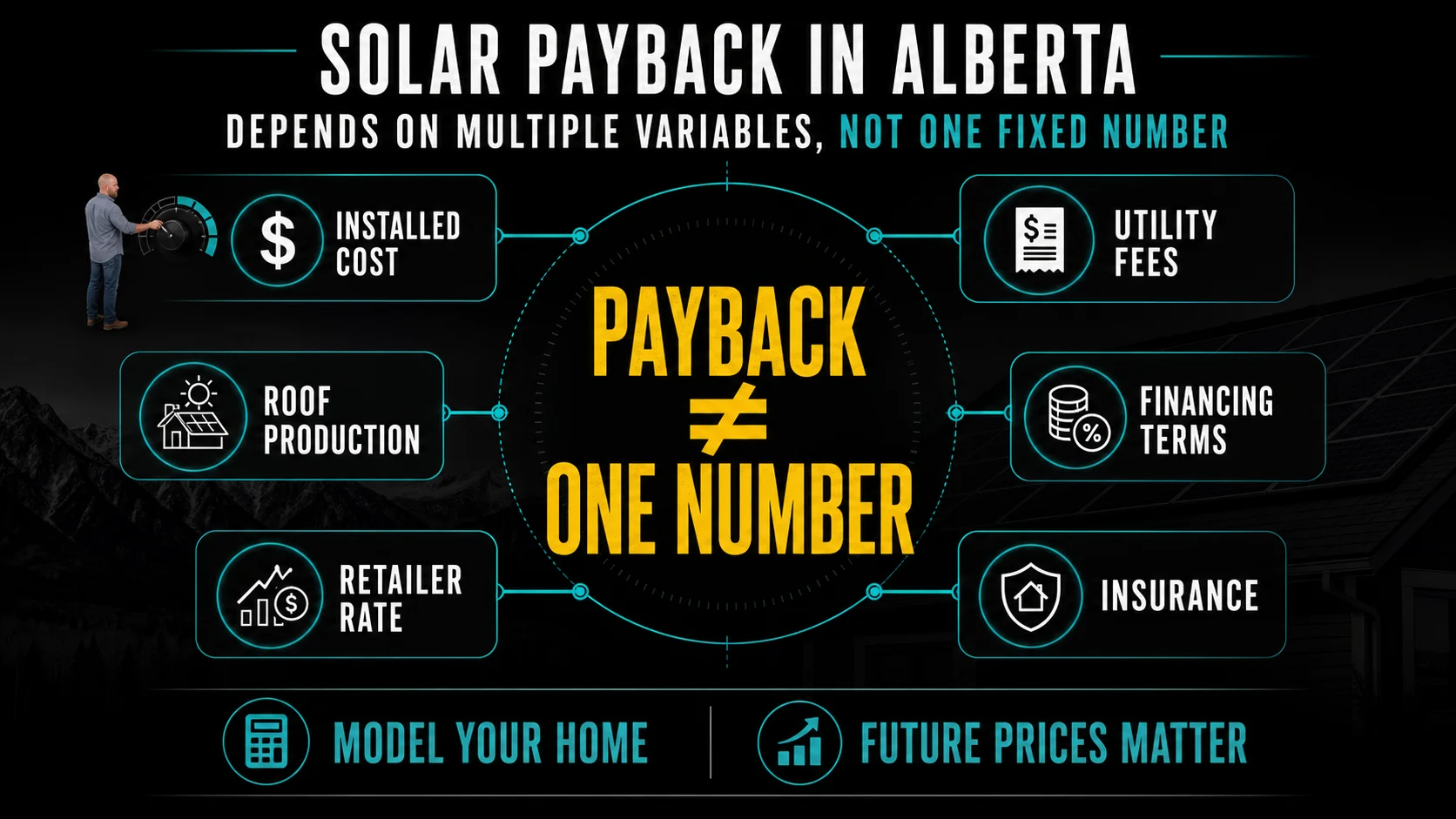
This article is general education, not financial advice. Solar payback depends on installed cost, retailer rate, roof production, fees, financing terms, insurance, and future electricity prices.
What About Carbon Pricing, EVs, and Batteries?
Older Alberta solar content often linked savings to rising consumer carbon charges. That needs updating. The federal government says the federal fuel charge stopped applying effective April 1, 2025. Solar can still reduce your exposure to electricity price volatility, but a rising federal consumer carbon price should not be used as the main 2026 homeowner savings argument.
EVs can improve the case for solar if they increase your annual electricity consumption and you can charge during the day or offset that usage through annual production. But an EV charger may trigger load calculations, electrical upgrades, or permit steps. Treat it as part of the home energy plan, not a simple add-on.
Batteries are useful for backup power and energy independence. They are not required for most grid-tied Alberta solar panel systems, and they usually lengthen financial payback unless outages, backup loads, or future rate design make storage more valuable for your home.
How to Choose a Solar Installer in Alberta
A good solar installer should make the process clearer, not fuzzier. They should explain your production estimate, system size, micro-generation application, permit path, warranty, and retailer credit assumptions in plain language.
Ask these questions before signing:
- How many kWh will this system produce in year one, and what assumptions are used?
- Does the proposed production exceed my 12-month electricity use?
- Which utility or wires owner application applies to my address?
- Which permits are required in my municipality?
- What panel, inverter, racking, and monitoring brands are included?
- Who handles warranty claims if the installer is no longer operating?
- What is excluded from the quote?
- What happens if my electrical panel or roof needs upgrades?
Tip for quote comparison: ask each company for the same system size or the same annual production target. Comparing a 6.2 kW quote to a 9.8 kW quote without adjusting for production is where homeowners get confused.
Final Verdict: Should You Go Solar in Alberta in 2026?
Yes, if the numbers are built on 2026 facts.
Alberta still has strong solar potential, useful micro-generation credits, and a mature installer market. What changed is the incentive and process layer. The Canada Greener Homes Loan is not a fresh option for new applicants, municipal programs vary by city, retailer export credits are not a government feed-in tariff, and permitting details are local.
That does not make solar a bad investment. It just means the quote has to stand on real production, real financing, current permits, and a retailer plan that matches how your home uses and exports power.
Start with your annual usage, test the rough economics with the SolarEnergies.ca online solar calculator, then compare a few detailed quotes before choosing an installer. That is the cleanest way to decide whether solar panels in Alberta are worth it for your home in 2026.
FAQ: Alberta Solar Panels in 2026
Are solar panels worth it in Alberta?
Yes, solar panels are often worth it in Alberta if your roof has good sun, your electricity use is high enough, and the installed cost is fair. Alberta’s cold sunny climate is better for solar than many people expect.
The decision depends on your roof, system size, electricity rate, retailer credit arrangement, financing, and how long you plan to stay in the home. A strong quote should show annual kWh production, payback assumptions, and what utility fees remain after solar.
How much does it cost to install solar panels in Alberta?
For planning only, many Alberta homeowners see written quotes around $2.50 to $3.50 per installed watt before local incentives, financing, roof work, or electrical upgrades. That puts a 7.5 kW system around $18,750 to $26,250 as a planning range.
The final cost depends on roof complexity, equipment choice, inverter design, permit requirements, and whether the home needs electrical work first. Compare quotes by dollars per watt and expected annual kWh production so you can see whether a cheaper system is actually a better deal.
Are there Alberta solar panel rebates in 2026?
There is no single province-wide residential solar rebate that applies to every Alberta homeowner in 2026. Federal Greener Homes grant and loan programs are closed to new applicants, so the live opportunities are mainly municipal programs, CEIP financing, retailer products, and smaller local incentives where available.
Check your municipality shortly before applying. Calgary, Edmonton, Banff, Canmore, Medicine Hat, Airdrie, St. Albert, Lethbridge, and other communities may have different programs, intakes, or funding limits.
How does net metering work for solar in Alberta?
Alberta’s official system is better described as micro-generation and net billing. Your home uses solar power first. Extra electricity goes back to the grid, and your retailer credits you according to your retail agreement and Alberta’s micro-generation rules.
Small micro-generators under 150 kW generally receive bill credits through their retailer, but the credit rate and settlement details depend on the retail agreement and applicable metering setup. You still need to confirm billing, seasonal solar rates, and unused credit treatment with your retailer.
Do I still get a power bill with solar in Alberta?
Yes. Solar can reduce the energy portion of your electricity bill, and summer credits can be powerful, but delivery charges and other fixed or partly fixed fees often remain.
A good proposal should separate energy savings from unavoidable utility charges. If a quote says your bill will disappear completely, ask for a bill-by-bill explanation.
How many solar panels do I need for a house in Alberta?
Many Alberta homes need roughly 13 to 24 modern panels, but the correct number depends on annual electricity use, panel wattage, roof direction, shading, and micro-generation sizing rules.
For example, a home using about 7,200 kWh per year may need around 5.5 kW to 6.5 kW of solar in a strong roof location. With 430 W to 460 W panels, that is roughly 13 to 16 panels. Larger homes or homes with EV charging may need more.
What is the 33% rule in solar panels?
There is no single Alberta homeowner “33% rule” that decides every solar project. Homeowners sometimes use that phrase when talking about electrical limits, breaker sizing, or local design rules, but Alberta solar sizing is mainly shaped by annual consumption, service capacity, code requirements, roof layout, and utility approval.
For micro-generation, the safer rule of thumb is this: design the system to meet all or part of your site’s annual electricity needs, and do not assume you can oversize the system just because the roof has room.
Can hail damage solar panels in Alberta?
Yes, severe hail can damage solar panels, although quality panels are tested for impact resistance and many survive normal storms. Alberta homeowners should still take hail seriously because storm size and angle can vary.
Ask your installer for the panel’s hail and mechanical load specifications, and ask your home insurer how rooftop solar is covered. It is much better to confirm coverage before the system is installed.
Why are some people removing solar panels?
Most removals happen because of roof replacement, home renovations, poor original installation, insurance work, or system upgrades. Some people also remove older equipment when inverter or roof work makes replacement more practical than reinstallation.
That is why roof age matters. If your shingles are near the end of their life, deal with the roof before installing solar panels. Removing and reinstalling panels later adds labour cost.
Should I install a battery with solar panels in Alberta?
A battery is optional for most grid-tied Alberta solar systems. It can help with backup power and energy independence, but it usually makes the payback longer if your only goal is bill savings.
Consider a battery if outages are a major concern, you have critical loads, or you want more control over your home energy system. For pure return on investment, panels alone usually come first.
What is the best next step before installing solar panels in Alberta?
Start with your last 12 months of electricity use, check whether your roof is in good condition, and run a rough estimate with a solar calculator. Then compare several quotes from qualified Alberta solar installers.
The best quote is not always the cheapest one. Choose the company that gives you the clearest production model, current permit path, realistic payback, strong equipment, and clean warranty support.