
Solar Panels Ontario Installation Cost Guide 2026
August 11, 2025
Yukon Solar Panels: the 1.9-Megawatt Beaver Creek Project
August 14, 2025Last Updated on June 23, 2026 by Vitaliy
How Much Do Solar Panels Cost in BC?
Let’s get right to it. The biggest question is always about the price. In British Columbia, the cost to install solar panels isn’t a simple one-size-fits-all number. It moves around based on where you are, who you hire, and what you put on your roof.
Key Takeaways
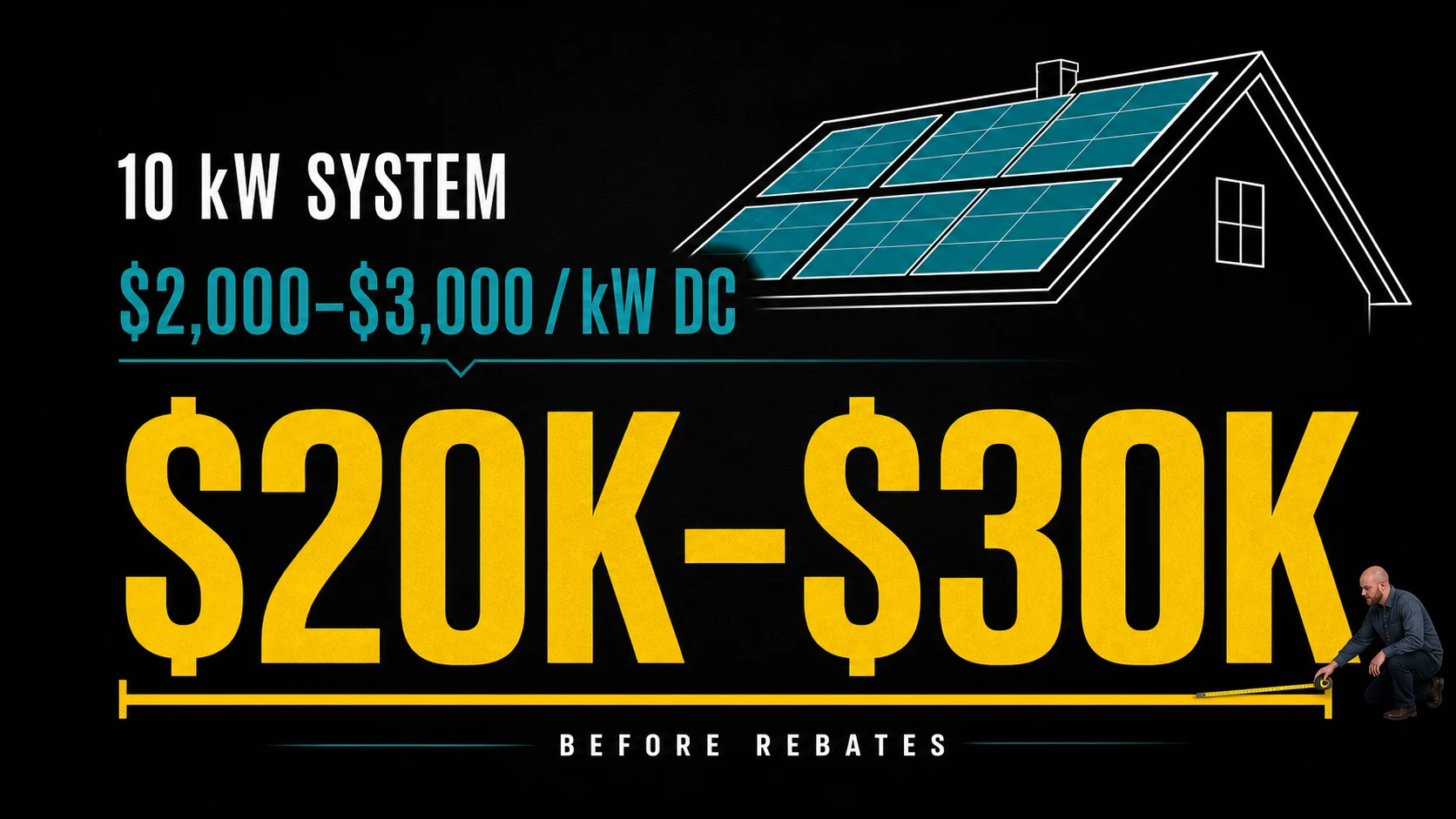
- Solar panels in BC typically cost about $2,000 to $3,000 per kW DC installed, according to BC Hydro’s current solar cost guidance. A 10 kW residential solar panel system often lands around $20,000 to $30,000 before rebates.
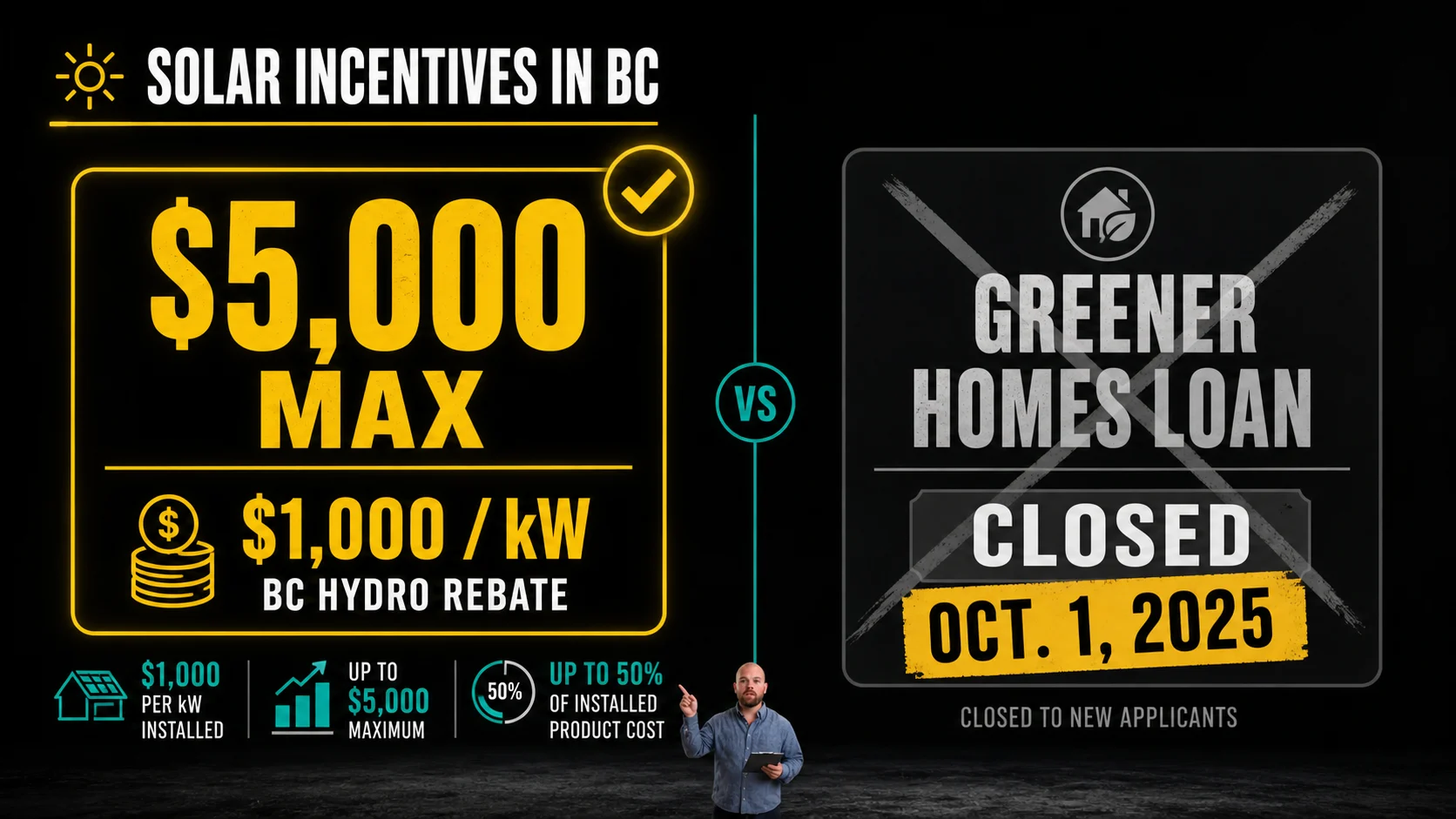
- The BC Hydro solar rebate can reduce the upfront cost by $1,000 per kW, up to $5,000, and up to 50% of eligible installed product costs.
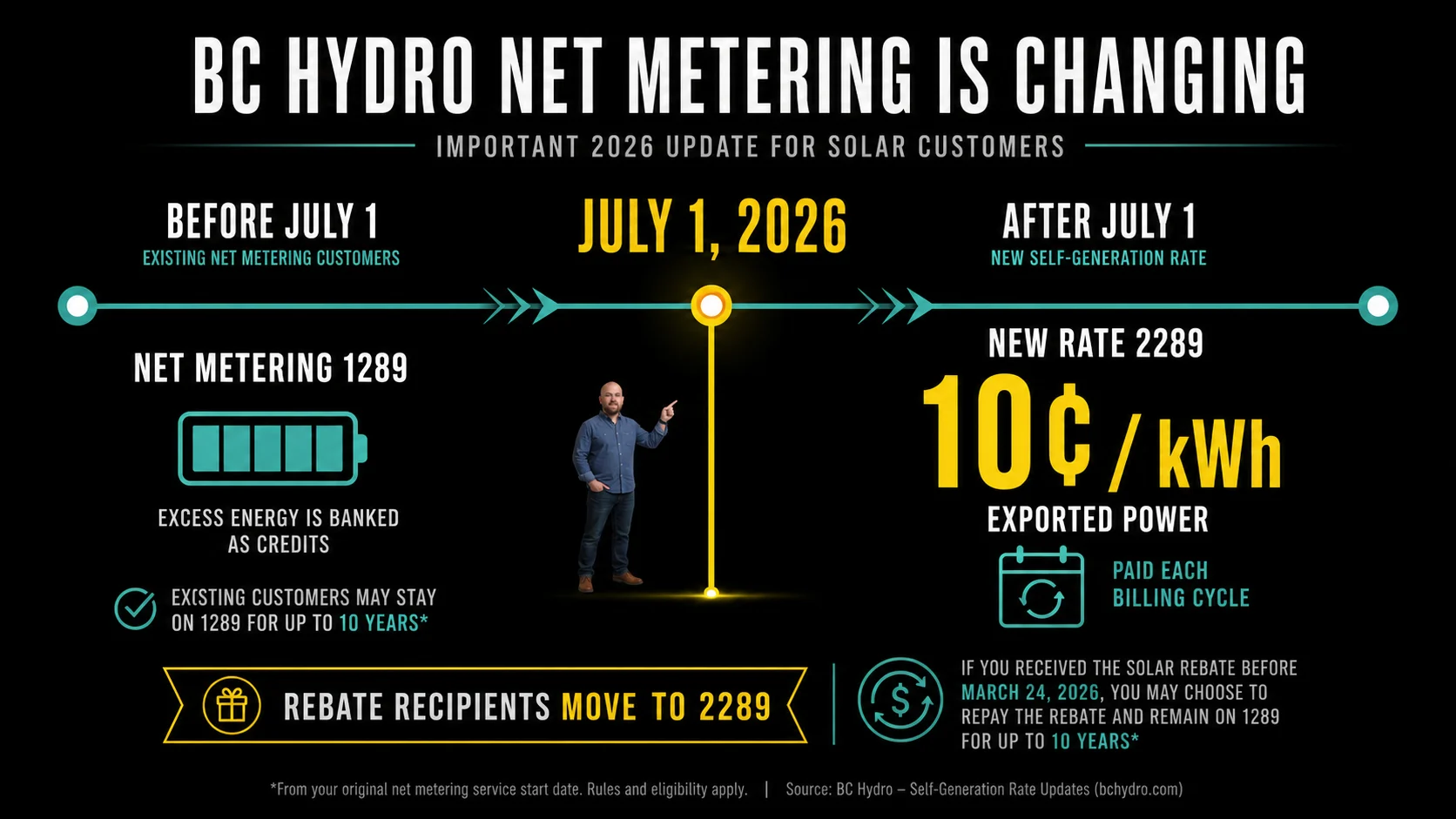
- BC Hydro net metering changes on July 1, 2026. New self-generation customers move to Rate Schedule 2289, with exported electricity credited at 10 cents per kWh.
- The Canada Greener Homes Loan is closed to new applicants. New BC solar shoppers should plan financing without assuming the federal $40,000 interest-free loan is available.
- Solar panels are worth it in BC when the system is right-sized. Your payback depends on your electricity use, roof condition, solar installation cost, BC Hydro rate plan, and whether battery storage is part of the project.
2026 BC Hydro Net Metering Update
Before you compare quotes, know this: BC Hydro’s current net metering service rate closes to new customers on July 1, 2026. After that, the new self-generation rate, Rate Schedule 2289, applies and pays 10 cents per kWh for exported electricity. Customers who accepted the BC Hydro solar rebate move to the new rate when it starts, unless they qualify for and choose the one-time rebate repayment option.
What is the Average Cost of Solar Panels?
Based on current BC Hydro cost guidance, residential solar PV projects typically cost about $2,000 to $3,000 per kW DC installed, including material and labour.
So, what does that mean for your wallet? A 10 kW residential system would often land around $20,000 to $30,000 before rebates or incentives. A smaller 5 kW system may cost less, but your actual quote depends on roof layout, electrical work, equipment, permits and installer pricing.
I’ve seen real-world invoices where a 7 kW system ends up costing closer to $20,000 after necessary extras are factored in. Things like upgrading an old electrical panel or dealing with complex wiring can add 10-20% to the initial quote. It’s a common frustration and something to be aware of from the start.
Factors Influencing Solar Panel Costs
Several things determine the final price of your solar panel system:
- System Size: The more power you need, the more solar panels you’ll have to install, and the higher the cost. A larger home or one with an electric vehicle will need a bigger system.
- Panel Quality: High-efficiency solar panels from premium brands cost more upfront but generate more power over their lifespan, which can lead to better long-term savings.
- Inverter Type: You’ll choose between string inverters, which are cheaper, and micro-inverters, which are more expensive but perform better, especially if your roof has some shading.
- Roof Condition: If your roof is old or needs repairs, you’ll have to fix that before installing solar panels, adding to the overall project cost. The complexity of your roof (steepness, number of angles) also plays a part.
- Installer: Prices vary between installers. Large national companies might have higher overhead, while smaller local outfits could have longer wait times. It’s crucial to get multiple quotes.
Is Solar Power Worth It in British Columbia?
This is the million-dollar question, isn’t it? With BC Hydro’s electricity rates being some of the lowest in North America, the financial argument for solar can seem thin at first glance.
BC Hydro’s current residential tiered rate is 11.87 cents per kilowatt-hour (kWh) for Tier 1, with Tier 2 at 14.08 cents per kWh for use above the Tier 1 threshold. When you compare that to places like Ontario, where rates can be much higher at peak times, the immediate savings from avoiding your utility bill are smaller. This stretches out the payback period for a solar investment, often to 12 years or more, especially with higher interest rates on loans.
However, the picture is changing. BC Hydro’s residential bills are increasing in 2026, and FortisBC electricity rates increased 3.63% on January 1, 2026. This signals a trend of rising energy costs that makes generating your own power more attractive.
But looking only at the simple payback misses the point. The real value is in controlling your own power. When you have a solar PV system, you’re protected from the next rate hike. You decide where your energy comes from.
What are the BC Solar Incentives and Rebates?
Incentives can significantly shorten your payback period and make the upfront cost of installing solar panels much more manageable. Here’s what’s available in British Columbia.
Overview of Solar Rebates in BC
The main incentive for homeowners in BC is the BC Hydro Solar Rebate Program. This program offers a rebate for installing a solar photovoltaic (PV) system. It’s pretty straightforward: you get $1,000 for every kilowatt (kW) of solar you install, capped at $5,000 and up to 50% of the installed product cost.
| System Size | Rebate Amount |
| 3 kW | $3,000 |
| 4 kW | $4,000 |
| 5 kW or more | $5,000 (Max) |
This means a 5 kW system or larger would be eligible for the full $5,000 solar rebate. If you also install a battery storage system, the battery rebate rules now depend on whether the battery is paired with solar and enrolled in Peak Saver.
Tip for Rebates: The BC Hydro rebate program requires pre-registration. You must get your eligibility confirmed before you install anything. Beginning June 1, 2026, rebate-eligible solar and battery installations must also be completed by a Home Performance Contractor Network member.
Canada Greener Homes Program
The federal Canada Greener Homes Grant officially closed to new applicants on March 31, 2024. The Canada Greener Homes Loan also closed to new applicants on October 1, 2025. If you already had an active application, follow the deadlines in your program account, but new BC solar shoppers should not count on this loan as available financing.
How the PST Exemption Works in BC
British Columbia gives you a break on the Provincial Sales Tax (PST) for qualifying solar equipment. Under BC’s energy conservation PST rules, solar photovoltaic panels and related wiring, controllers and inverters can be exempt when they are obtained with and as part of the solar PV system. For a typical system, that can still save hundreds of dollars on eligible hardware.
How Net Metering Works in BC
BC Hydro’s solar credit system is changing. Traditional net metering under Rate Schedule 1289 is closing to new customers on July 1, 2026. Existing net metering customers can generally stay on that structure for up to 10 years from their original interconnection date.
Under the current BC Hydro self-generation billing system, excess annual credits are paid at a market price. BC Hydro says that market price has ranged from about 3 cents to 10 cents per kWh and has averaged 6 cents per kWh. Starting July 1, 2026, the new self-generation rate pays 10 cents per kWh for exported electricity, with compensation each billing cycle instead of once per year.
If you received the BC Hydro solar rebate, you will be moved to Rate Schedule 2289 when it begins. If you received your rebate before the BCUC decision on March 24, 2026, BC Hydro says you will have a one-time opportunity to repay the rebate and remain on Rate Schedule 1289 for up to 10 years from your original net metering service start date.
Tip for System Sizing: The goal is still to size your solar system around your own electricity use, not to make a profit. Right-sizing your array ensures you get the most value from your solar investment.
How to Apply for Solar Incentives in BC
- Quote and system design: Get a proper solar design and quote from a qualified installer before you apply.
- Pre-Registration: For the BC Hydro rebate, you must pre-register and get approval before installation.
- Installation: Hire a qualified installer to set up your solar panel system. For BC Hydro rebates, check the Home Performance Contractor Network requirement.
- Documentation: Submit your final invoice, product details, permits and interconnection documents to the program that approved your rebate.
How Does Solar Panel Installation Work in British Columbia?
The process of installing solar panels on your home is fairly straightforward, but it involves several key steps and coordination with different parties.
Steps for Installing Solar Panels in BC
- Consultation and Quote: The first step is to contact a few reputable solar installers. They’ll assess your home’s suitability for solar, discuss your energy needs, and provide a detailed quote.
- Design and Permitting: Once you choose an installer, they will design a solar PV system tailored to your roof and energy goals. They will also handle the municipal permits, which can sometimes be a lengthy process depending on your location.
- Installation: The physical installation of the solar panels, racking, and inverters usually takes just a few days.
- BC Hydro Interconnection: Your installer will submit an interconnection request to BC Hydro. This process can take several weeks, as BC Hydro needs to review the system to ensure it’s safe to connect to the grid.
- Inspection and Commissioning: A certified electrician will inspect the installation. Once it passes, the system is commissioned, and you can start generating your own clean energy.
Choosing the Right Solar Panel System
The right solar system for you depends on your budget, energy needs, and roof characteristics. High-efficiency solar panels are great for homes with limited roof space. If you have trees that cast shadows, micro-inverters are a better choice than a string inverter because they optimize the output of each individual panel.
Understanding Grid-Tied Solar Systems
Nearly all residential solar systems in British Columbia are grid-tied. This means your home is still connected to the BC Hydro grid. When your solar panels are producing power, your home uses that first. If you need more power than your panels are generating (like at night), you seamlessly draw it from the grid. When you produce excess power, it flows back to the grid.
What is the Role of BC Hydro in Solar Energy?
BC Hydro is central to the experience of going solar in the province. They manage the grid, handle interconnection, run the self-generation rules, and provide the main rebate for eligible customers.
Explaining BC Hydro’s Net Metering Program
For existing customers, the net metering program allows you to “bank” excess solar energy as credits. These credits offset the cost of electricity you use from the grid when your panels aren’t producing. For new customers after July 1, 2026, the new self-generation rate pays for exported electricity each billing cycle instead.
How Solar Energy Affects Your BC Hydro Bill
Once your solar panel system is running, you’ll see a significant change in your BC Hydro bill. For many months of the year, your usage charges can drop sharply, and your exported power may create credits. You’ll still pay basic charges to stay connected to the grid, and the exact bill impact depends on your rate plan, system size and how much solar power you use inside the home.
Managing Excess Energy Production
Because exported energy is credited below the retail electricity rate, it’s best to use more of the energy yourself when you can. One way to do this is by adding an electric vehicle or a heat pump, which increases your home’s electricity consumption and allows you to use more of your own solar power.
Why Should You Switch to Solar in British Columbia?
Even with the unique economic factors in BC, there are powerful reasons to make the switch to solar energy.
Benefits of Solar Energy in BC
- Lower Energy Bills: Solar power will reduce your monthly electricity costs.
- Protection from Rising Rates: You lock in your energy costs for the 25+ year lifespan of your solar panels.
- Increased Home Value: Homes with solar panels can have higher property values.
- Environmental Impact: Canada’s clean electricity snapshot for British Columbia shows the province already gets most of its electricity from renewable resources, especially hydro. Solar still adds local renewable generation and can reduce reliance on backup fuel in some homes.
Achieving Energy Independence with Solar
One of the most compelling reasons to go solar is to gain a degree of energy independence. While a grid-tied system doesn’t take you completely off-grid, it gives you control over your power generation. You are less reliant on a large utility and the fluctuating costs of electricity.
I remember helping a family in the Kootenays who were tired of the frequent power outages in their area. We installed a solar system with a small battery backup. The next time a storm knocked out the power, their lights stayed on. That feeling of security and self-sufficiency is something you can’t put a price on.
Contributing to Clean Energy and Sustainability
By installing solar panels, you become part of the solution to climate change. British Columbia is already a leader in clean energy, with most of its power coming from hydro. Adding distributed solar energy from homes and businesses across the province makes the grid more resilient and reduces the need for large-scale, centralized power generation. Your solar investment is a direct contribution to a more sustainable future for BC.
FAQ About Solar Panels in BC
How much does it cost to install solar panels in BC?
BC Hydro estimates residential solar PV projects usually cost about $2,000 to $3,000 per kW DC installed, including material and labour. That puts a typical 10 kW residential solar power system around $20,000 to $30,000 before rebates.
Your final cost depends on system size, roof condition, inverter type, permitting, electrical upgrades and installer pricing. A simple roof with good sun exposure usually costs less than a steep, shaded or electrically complicated home.
Are solar panels worth it in BC?
Solar panels can be worth it in BC when the system is sized around your own electricity use instead of oversized for export. BC Hydro electricity is still relatively low-cost, so the best solar projects usually combine reasonable installation cost, good roof exposure, long-term ownership and available rebates.
The July 1, 2026 BC Hydro self-generation change also matters. Exported electricity will be credited at 10 cents per kWh under the new rate, so using more of your solar power inside the home can improve the value of the system.
Are solar panels worth it in Vancouver or the Lower Mainland?
Yes, solar panels can still work in Vancouver and the Lower Mainland, but the cloudy climate makes system design more important. A good solar installer should model your roof, shading, pitch and expected annual production before promising savings.
Homes with south, east or west-facing roof space and limited shade usually perform better. Heavy tree cover, small roof planes or an old roof that needs replacement can weaken the financial case.
What is the BC Hydro rebate for solar panels?
The BC Hydro solar rebate is $1,000 per kW, up to a maximum of $5,000, and up to 50% of eligible installed product costs. You need pre-approval before installation, and BC Hydro’s program rules can change, so check the rebate page before you sign a contract.
Battery storage may also qualify for a rebate, but the rules depend on whether the battery is paired with solar and enrolled in Peak Saver.
Can I use solar power during a blackout in BC?
Not with a standard grid-tied solar system by itself. Most grid-tied systems shut down during a power outage to protect utility workers and equipment.
If backup power is part of your goal, ask about solar panels and battery storage. A properly designed solar battery system can keep selected loads running during an outage, but it adds cost and needs to be sized carefully.
Can I go completely off-grid with solar panels in BC?
Most BC homeowners should not plan to go fully off-grid unless they have a remote property or a very specific reason. Off-grid solar usually requires more solar panels, more battery storage, backup generation and careful energy management through winter.
For most homes, a grid-tied solar panel system gives a better balance: lower electricity bills, grid backup when solar production is low, and the option to add battery storage if outages are a concern.
Can I install solar panels on a shaded or north-facing roof in BC?
You can sometimes install solar panels on a partly shaded or less-than-perfect roof, but production will be lower. Shading from trees, chimneys, dormers or nearby buildings can reduce solar energy production and lengthen payback.
Micro-inverters or optimizers may help when only part of the solar array is shaded. A north-facing roof is usually a harder case in BC, so get a proper production model before moving ahead.
Do solar panels need much maintenance in BC?
Solar panels usually need very little maintenance. Rain helps keep panels reasonably clean in many parts of British Columbia, but pollen, moss, dust, wildfire residue or heavy debris can still reduce output.
The bigger maintenance issue is monitoring. Check your inverter or app a few times a year so you know the solar panel system is producing normally. If output drops sharply, call your installer before a small issue turns into months of lost production.
Canada goes Solar. Vitaliy Lano, SolarEnergies.ca
Related BC Hydro 2026 Guides