
Solar Panels Nunavut Guide 2025
August 5, 2025
Solar Panels Quebec Guide 2026: Cost, Hydro-Quebec Grant, Net Metering and Payback
August 6, 2025Last Updated on May 21, 2026 by Vitaliy
Newfoundland and Labrador is still a challenging province for residential solar, but that does not mean solar panels are a bad idea here. A good system can produce useful clean energy for decades. The financial case just depends heavily on whether the home is on the Island Interconnected system, the Labrador Interconnected system, or a diesel-served grid.
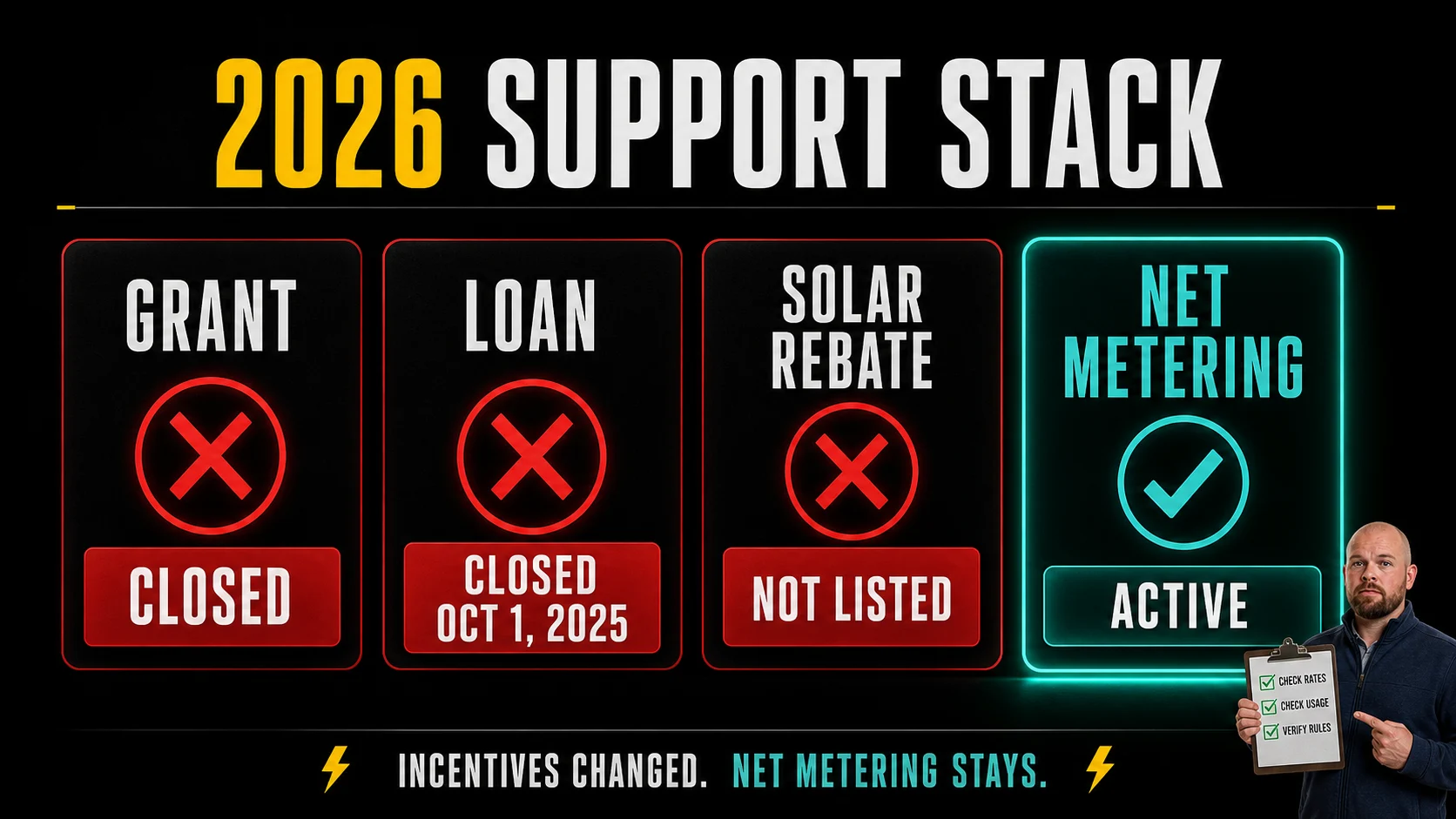
The big 2026 update is simple: the old incentive assumptions need to go. The Canada Greener Homes Grant is closed to new applicants, new Canada Greener Homes Loan applications closed on October 1, 2025, and current takeCHARGE residential program listings do not show a mainstream residential solar panel rebate. That makes your roof, utility rate, installed price per watt, and net metering outcome more important than ever.
If you size the system badly or assume old incentives still apply, you can lock yourself into a long payback and miss better first-step upgrades like insulation, air sealing, or heat-pump work.
Key Takeaways
- Solar panels in Newfoundland and Labrador are technically viable in 2026, especially on the Island Interconnected system, but the payback is usually long compared with higher-rate provinces.
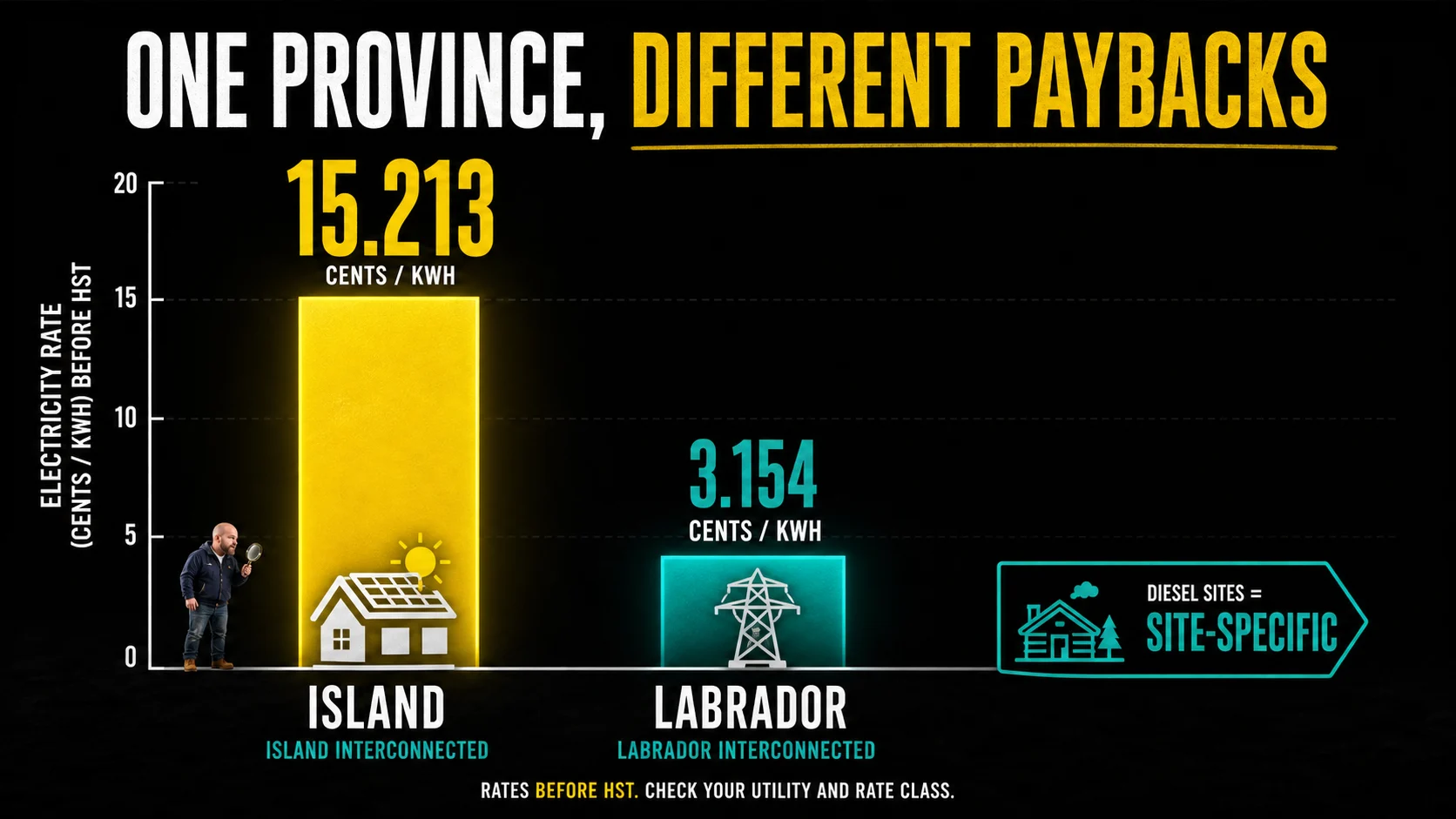
- Newfoundland and Labrador Hydro’s current rates page lists 15.213 cents/kWh for Island Interconnected customers, L’Anse au Loup, and the first block for isolated diesel systems, while Labrador Interconnected customers are listed at 3.154 cents/kWh. Those figures are before HST.
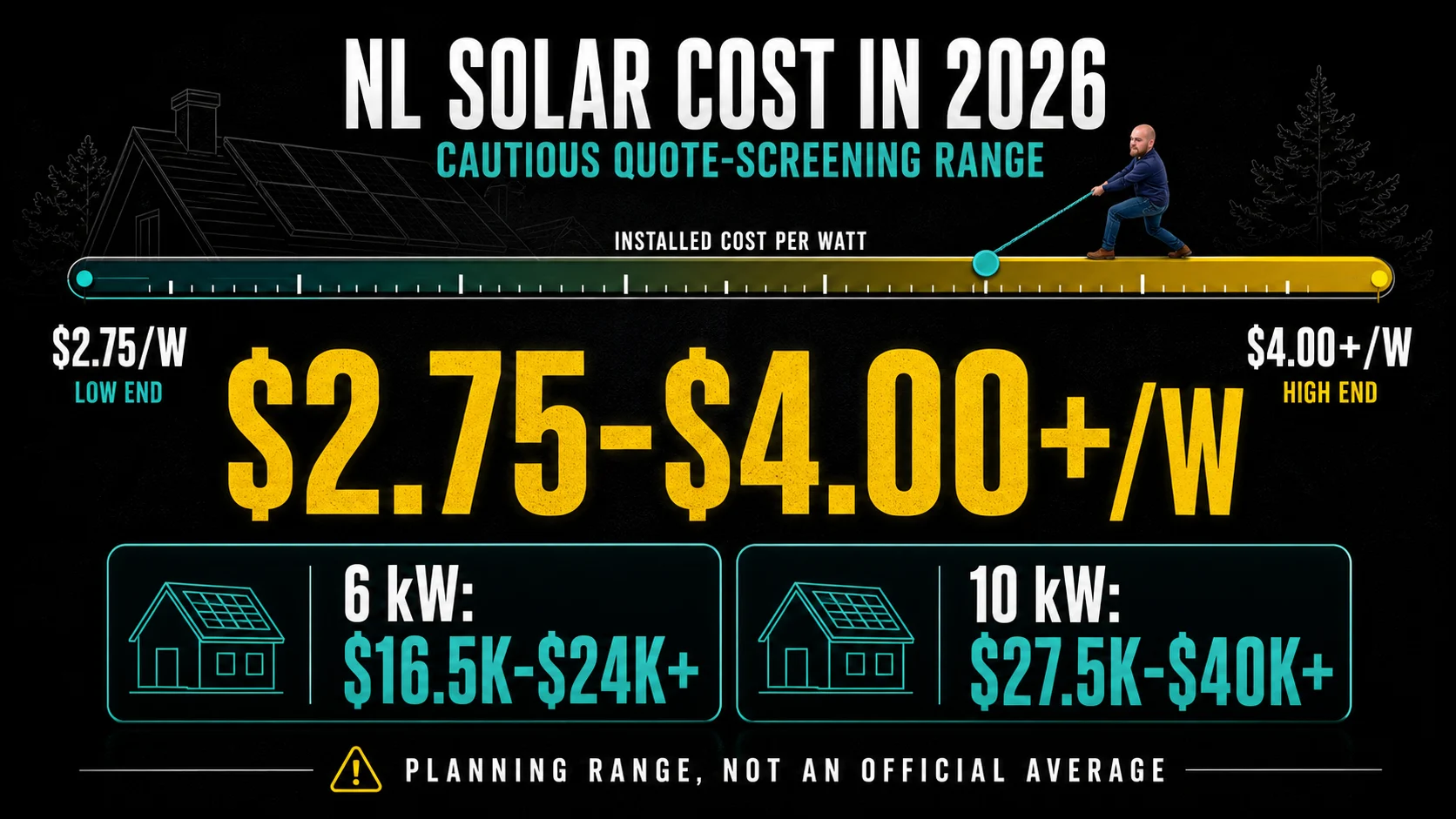
- A cautious planning range is about $2.75/W to $4.00+/W installed, but this is not an official market average. Treat it as a quote-screening range until you have site-specific prices.
- Net metering is the main support mechanism now. It can credit exported energy, but it is not the same as a cash rebate, and annual surplus should not be treated like guaranteed profit.
- The best NL solar candidates are homes with high annual electricity use, a simple unshaded roof, clean interconnection conditions, and a system sized close to yearly consumption.
- Batteries can make sense for backup power, but they usually weaken simple payback under current island electricity rates.
- Before you go solar, compare several detailed quotes. Look at the equipment, warranty, production estimate, permit holder, financing terms, and interconnection experience side by side.
Are Solar Panels Worth It in Newfoundland and Labrador in 2026?
The honest answer is: sometimes, but not for every home.
On the island, solar can make sense when the installation cost is reasonable and the system is sized carefully. Natural Resources Canada solar-resource material has long put St. John’s around 933 kWh per installed kW per year, and current NL market estimates are in the same range for St. John’s and Corner Brook. A planning assumption of roughly 940 kWh/kW/year is fair for a decent, unshaded, south-biased island roof.
That output is useful, but NL is not Alberta. The solar resource is lower, and the financial case leans heavily on your installed cost and net metering outcome. A solar system can lower your power bill, but it usually does not create a fast payback unless your site is strong, your electricity use is high, and your installed price is sharp.
Labrador Interconnected homes are a different story. Hydro lists Labrador Interconnected energy at 3.154 cents/kWh before HST, so the value of each solar kWh is very low. A grid-tied rooftop system there is usually hard to defend as a pure investment. In isolated diesel areas, higher tariffs can improve the math, but those projects are more site-specific and often involve battery backup, off-grid design, or resilience planning.
If you want a quick first screen, use the SolarEnergies.ca online solar calculator before collecting quotes. It helps you test whether the roof, system size, and electricity use are likely to support the project.
Solar Panels Newfoundland and Labrador Cost in 2026
There is no official NL residential solar price tracker, so the safest way to discuss cost is by range, not fake precision.
For 2026 planning, use about $2.75/W to $4.00+/W installed as a cautious screening range for solar panels in Newfoundland and Labrador, not as an official provincial average. A simple grid-tied rooftop project in a more accessible island community may land in the low-to-high $3/W range. A remote property, complex roof, ground mount, battery-heavy system, structural issue, or low-competition area can push the total cost higher.
| System size | Lower estimate at $2.75/W | Mid estimate at $3.40/W | Higher estimate at $4.00/W+ | Practical fit |
|---|---|---|---|---|
| 3 kW | $8,250 | $10,200 | $12,000+ | Small offset system, but higher cost per watt is common |
| 6 kW | $16,500 | $20,400 | $24,000+ | Realistic partial-bill system for many island homes |
| 10 kW | $27,500 | $34,000 | $40,000+ | Larger home or electric-heated home, but oversizing risk matters |
Those numbers are before any site-specific extras. Ask each installer to break out panels, inverter, racking, monitoring, electrical work, permitting, interconnection support, HST, and any battery storage systems. If a quote only gives you one round number, ask for more detail.
Sample Island Payback Math
Here is a simple island example using four assumptions:
- 940 kWh/kW/year production
- 15.213 cents/kWh avoided energy value before HST
- $3.40/W installed cost
- A system sized close enough to annual use that little energy is wasted at the annual reset
| System size | Upfront cost | Year-one production | Year-one bill savings | Simple payback |
|---|---|---|---|---|
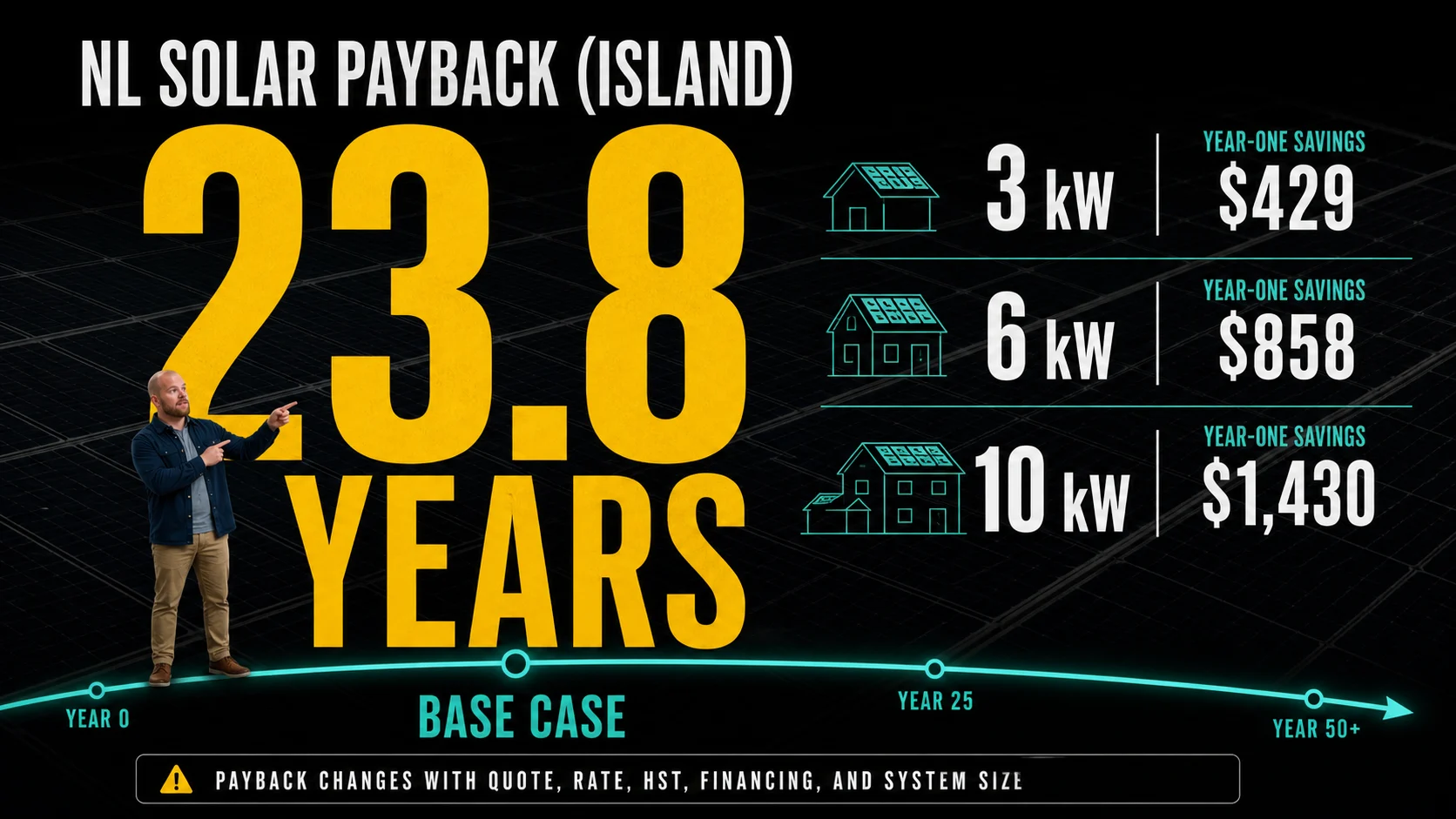
| 3 kW | $10,200 | 2,820 kWh | About $429 | 23.8 years |
| 6 kW | $20,400 | 5,640 kWh | About $858 | 23.8 years |
| 10 kW | $34,000 | 9,400 kWh | About $1,430 | 23.8 years |
This is not a promise that every solar system will pay back in 23.8 years. It is a base-case model. If your installed cost is lower, future electricity rate hikes are higher, or your final bill savings are better than this before-HST estimate, the payback improves. If you finance at a high rate, oversize the system, add batteries for backup, or need major service work later, the payback gets worse.
Fixed monthly charges do not disappear, and HST treatment can affect final bill savings. Ask the installer to show the calculation using your real utility bill, not just a generic kWh estimate.
Tip for island homeowners: do not let anyone sell you a system based only on roof space. The size of the system should be tied to your annual electricity use, net metering rules, roof conditions, and budget.
Current Electricity Rates Matter More Than Panel Hype
NL’s rate structure creates three different solar answers inside one province.
According to Newfoundland and Labrador Hydro’s current rates, customers on the Island Interconnected system, L’Anse au Loup, and the first block for isolated diesel systems are listed at 15.213 cents/kWh, while Labrador Interconnected customers are listed at 3.154 cents/kWh. Hydro’s January 2026 schedule of rates shows the broader rate rules and diesel domestic block charges.
| Area | Solar value from bill savings | What it means |
|---|---|---|
| Island Interconnected | Moderate | Solar can work if the quote is good and the roof is strong |
| Labrador Interconnected | Very weak | Low electricity rates make grid-tied solar hard to justify financially |
| Diesel-served or remote sites | Site-specific | Higher energy value can help, but design, logistics, backup power, and maintenance matter more |
This is why I do not like one-size-fits-all NL payback claims. A solar power setup that is defensible in Mount Pearl may be a poor deal in Labrador City if the buyer only cares about bill savings.
Rebates, Incentives and Financing in 2026
The old incentive story needs a clear update.
The Canada Greener Homes Grant is closed to new applicants. NRCan’s current loan information also states that new Canada Greener Homes Loan applications closed on October 1, 2025. Current takeCHARGE residential listings focus on oil-to-electric conversion, insulation, air sealing, HRVs, income-qualified efficiency, and related home energy programs, not a mainstream residential solar incentive.
| Program | Status in 2026 | Solar relevance | What to do with it |
|---|---|---|---|
| Utility net metering | Active | High | Treat it as the core support mechanism |
| Canada Greener Homes Grant | Closed to new applicants | Formerly high | Do not present it as a live rebate |
| Canada Greener Homes Loan | Closed to new applications | Formerly useful | Do not present it as a live federal financing option |
| Oil to Electric Incentive Program | Active | Indirect | May be a better first upgrade for oil-heated homes |
| Home Energy Savings Program | Active | Indirect | Helps eligible homes with efficiency, not standard solar panels |
| CMHC Eco programs | Active for eligible insured borrowers/builds | Indirect | Useful only in specific mortgage situations |
| Installer financing | Market-based | Varies | Compare the rate, term, fees, and cash price carefully |
This does not mean solar is dead in NL. It means the buying decision has to stand on real production, real electricity rates, and real installed cost. If financing is offered, compare the cash price, interest rate, fees, lien terms, early-payment rules, and total cost over the full term.
How Net Metering Works in Newfoundland and Labrador
Net metering is the main reason grid-connected residential solar still has a practical path in NL.
Newfoundland and Labrador Hydro and Newfoundland Power both describe net metering as a way for approved customers to generate renewable energy, use what they need on site, and receive credits for eligible excess energy sent to the grid. Your meter tracks energy flowing both ways. When your panels produce more than your home uses, the surplus is credited. When your home needs more than the panels produce, you draw from the grid.
The details matter. Hydro tells customers to discuss plans with the utility before purchasing or installing equipment, because requirements can vary by capacity, technology, location, and distribution infrastructure. Hydro also says there are no application fees, but customers can be responsible for costs beyond standard connection costs, including possible metering changes, line upgrades, line extensions, or poles.
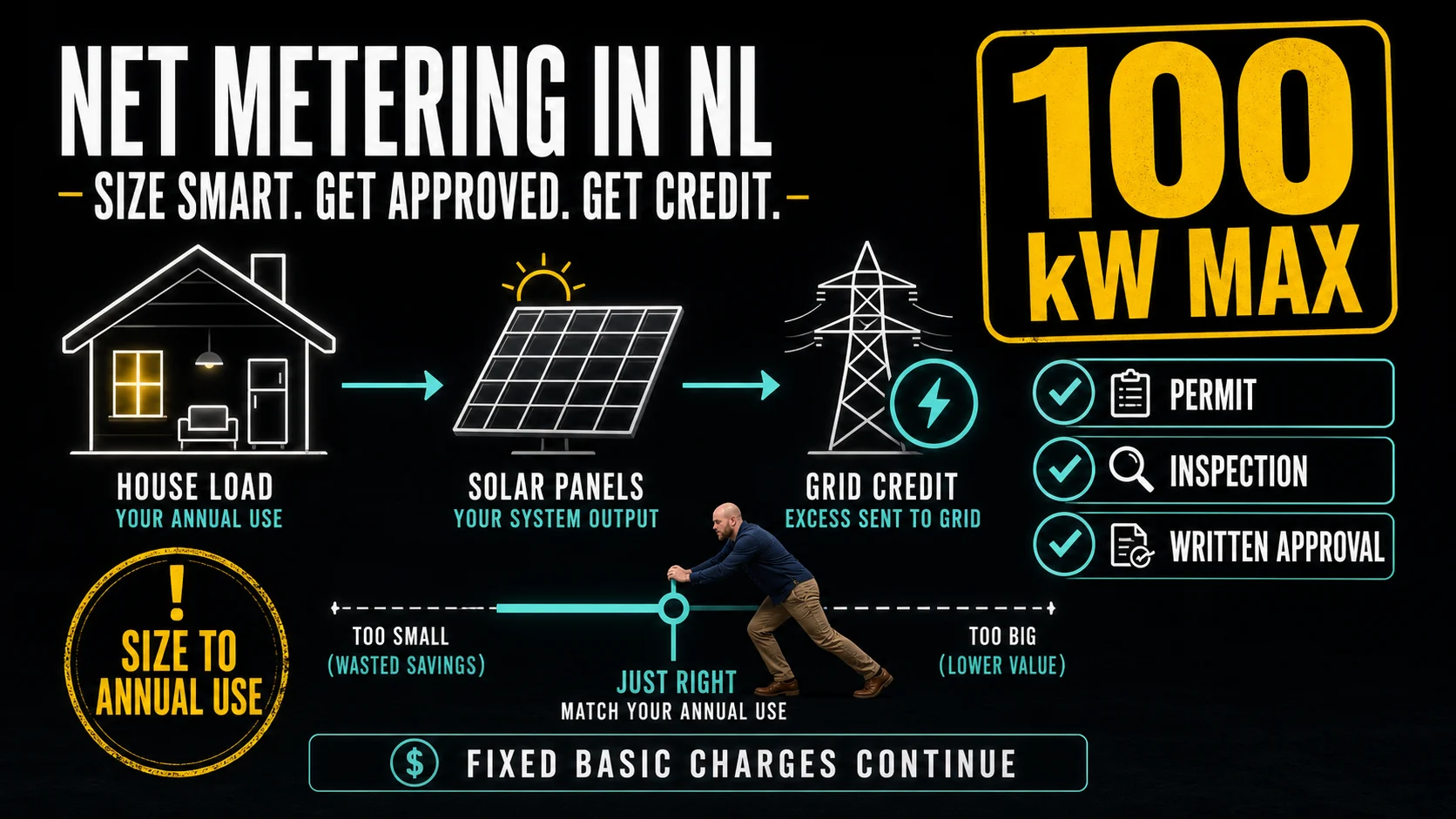
Newfoundland Power’s net metering page adds several useful buyer checks: small-scale renewable systems can be up to 100 kW, the customer-owned generation facility must be sized to not exceed the annual energy requirements of the serviced premises, the electrician or installer must obtain an electrical permit, and interconnection proceeds only after inspections are passed and written approval is provided. Newfoundland Power also says fixed basic customer charges continue, surplus can be banked and applied to future bills, and remaining annual surplus is credited at the rate Newfoundland Power pays to purchase power from Newfoundland and Labrador Hydro.
That is why the net metering program should not be treated like a casual paperwork step. It is part of the project design.
Tip for net metering: size close to annual consumption. If you produce far more than you use, you may not recover full value from the extra kWh at the annual settlement.
Installation Process and Permitting
The installation process should start before you buy equipment.
- Check your annual electricity use and roof fit.
- Ask the serving utility about net metering requirements.
- Confirm municipal or local planning requirements if your property has unusual zoning, protected-road issues, or a ground-mount plan.
- Use a registered electrical contractor.
- Get the electrical permit before installation begins.
- Complete inspection and utility approval before parallel operation with the grid.
Newfoundland and Labrador’s electrical permitting rules are strict. Government Services says electrical approval must be issued before installation or repair of electrical equipment begins, and permits are issued to registered electrical contractors. Hydro’s interconnection requirements also say customer facilities must meet applicable codes and that the customer cannot begin parallel operation until final written approval is granted.
For a homeowner, the practical point is simple: ask who is pulling the permit. If the sales rep cannot name the registered electrical contractor of record, slow down.
Solar Equipment That Fits NL Conditions
For NL homes, the best equipment choice is not always the most expensive product. It is the product that fits the roof, climate, budget, and backup-power goal.
High-efficiency panels can help where roof space is tight, but the layout, inverter design, workmanship, and warranty support matter more than a trendy panel label. A good design with suitable panels, clean racking, and a strong inverter plan beats a flashy panel name on a poor layout.
Inverters matter more than many buyers expect. Microinverters or other module-level power electronics can help on roofs with shade, snow patterns, mixed orientations, or many small roof planes. A string or hybrid inverter can be better value on a simple, open, south-facing roof.
Battery storage is mostly about resilience in NL. A battery backup system can keep selected loads running during outages if it is designed with the right transfer and isolation equipment. A normal grid-tied solar system without that equipment will shut down during a grid outage for worker safety.
Tip for backup power: ask the installer to show exactly which loads will run during an outage, for how long, and whether the solar array can recharge the battery while disconnected from the grid.
Should You Do Solar Before Efficiency Upgrades?
Many NL homes should look at efficiency first, then solar.
That is not anti-solar advice. It is just better sequencing. If your home is leaky, poorly insulated, or still heated by oil, upgrades like insulation, air sealing, heat pumps, or oil-to-electric conversion may reduce bills faster per dollar than solar panels. Current provincial and takeCHARGE support is also stronger around those categories than around residential solar.
After the building envelope and heating system are in better shape, solar sizing becomes cleaner. You are not buying a larger solar system just to feed waste.
Choosing an Installer in Newfoundland and Labrador
NL is a small market, so installer due diligence matters.
Look for a company that can show local electrical registration, recent NL solar installations, utility interconnection experience, and clear warranty handling. Because public installer data in Newfoundland and Labrador can be thin, do not rely on directory listings or brand names alone. Verify the licensed electrical contractor of record before signing.
Ask each installer for:
- Three recent local references
- Exact panel, inverter, racking, and battery model numbers
- A written production estimate in kWh per year
- A roof layout drawing
- Net metering application support details
- The registered electrical contractor name
- Workmanship warranty terms
- Manufacturer warranty documents
- Cash price and financing price, shown separately
- A clear answer on who services warranty claims in NL
Before choosing an installer, compare at least three detailed quotes. The cheapest number is not always the best deal if the production estimate, equipment, warranty, or installation support is weaker. SolarEnergies.ca can help you compare installer options and ask better quote questions before you sign.
Verify Before Signing
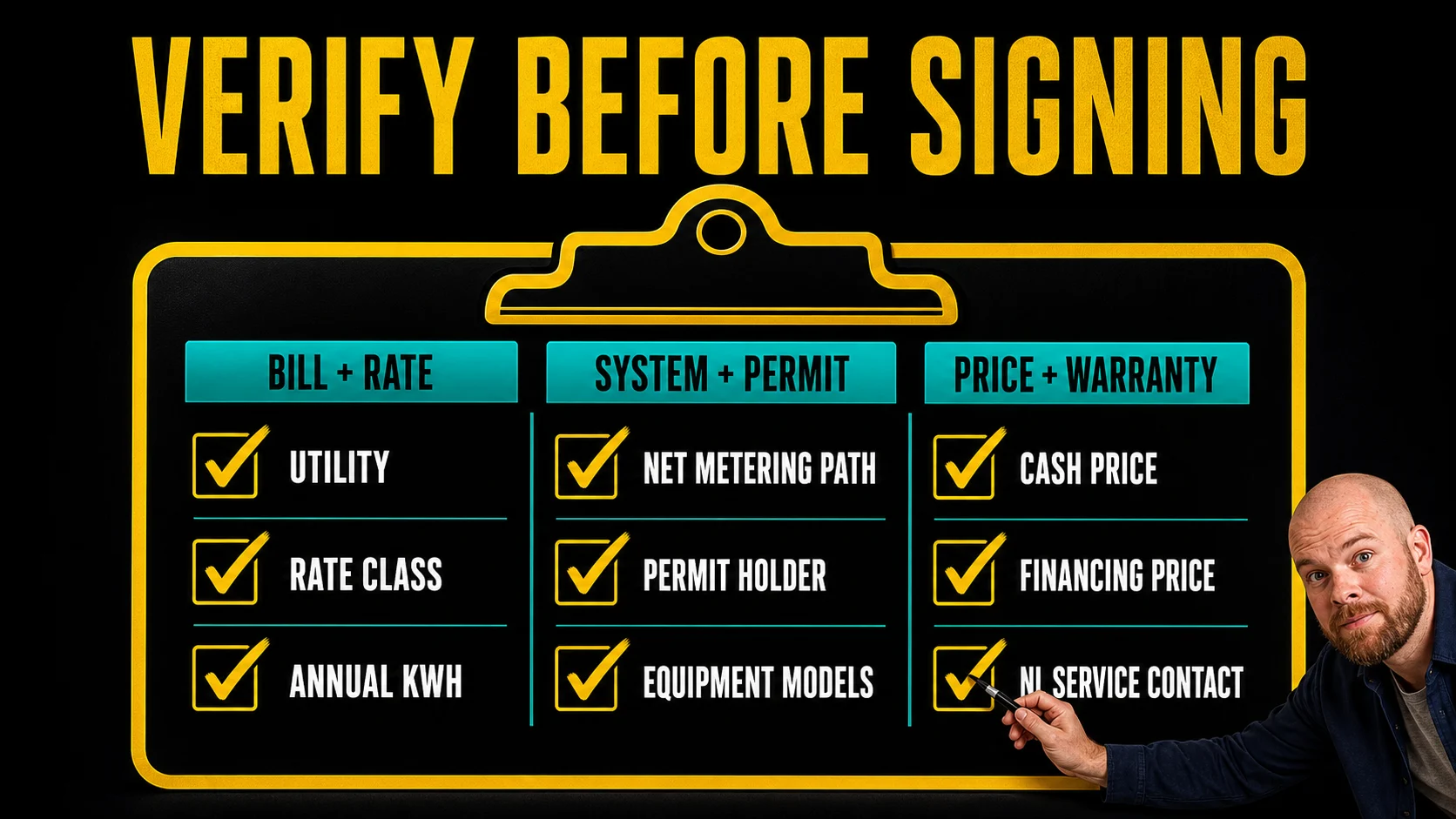
Before signing, confirm your utility, rate class, annual kWh use, net metering approval path, electrical permit holder, exact equipment models, annual production estimate, cash price, financing price, and warranty service contact in NL.
Common Mistakes to Avoid
Oversizing the System
Bigger is not automatically better. In a net metering setup, the goal is usually to offset your own use, not to turn your roof into a power plant. Oversizing can leave value stranded if annual surplus is settled at a lower rate than retail.
Assuming Solar Means Backup Power
Grid-tied solar panels usually shut down during an outage unless the system includes the right inverter, transfer equipment, isolation, and often battery storage. If backup power is part of your reason for going solar, say that at the first quote meeting.
Comparing Quotes Only by Total Cost
Total cost matters, but it is not enough. A $28,000 system that produces more energy with better warranty support may be better than a $24,000 system with weak equipment and vague service terms.
Using Old Federal Incentive Information
Do not base a 2026 budget on the Canada Greener Homes Grant or a new Canada Greener Homes Loan application. Those are not live options for new solar shoppers.
Bottom Line
Solar in Newfoundland and Labrador is real, but it is not easy money in 2026.
For many island homeowners, solar can be a long-term bill hedge and clean-energy upgrade if the roof is good, the installation price is fair, and the system is sized carefully. For Labrador Interconnected customers, standard grid-tied solar is usually difficult to justify on bill savings alone because the electricity rate is so low. For remote and diesel-served sites, solar may be more compelling, but the design needs more care.
My advice is to run the numbers before you fall in love with the idea. Check your annual kWh, use the SolarEnergies.ca calculator, compare several quotes, and ask hard questions about net metering, equipment, permits, and backup power. If the numbers work after that, you can go solar with much more confidence.
FAQ
Are solar panels worth it in Newfoundland?
Solar panels can be worth it for some island homeowners, especially those with high electricity use, a strong unshaded roof, and a competitive installation price. The payback is usually long, so the project has to make sense as a long-term bill hedge, clean-energy choice, or resilience upgrade.
For Labrador Interconnected customers, the low domestic electricity rate makes a normal grid-tied solar system much harder to justify financially.
How much do solar panels cost in Newfoundland and Labrador in 2026?
A cautious 2026 planning range is about $2.75/W to $4.00+/W installed, but treat that as a quote-screening range rather than an official provincial average. A 6 kW system might land around $16,500 to $24,000+, while a 10 kW system might land around $27,500 to $40,000+.
The real price depends on roof complexity, access, community, electrical upgrades, inverter choice, battery storage, HST, and installer competition.
Are there solar rebates in Newfoundland and Labrador?
Current takeCHARGE residential program listings do not show a mainstream residential solar panel rebate. Net metering is still active and important, but it is not an upfront rebate.
The Canada Greener Homes Grant is closed to new applicants, and new Canada Greener Homes Loan applications closed on October 1, 2025.
How does net metering work in NL?
Net metering lets approved customers use their own renewable energy and receive bill credits for eligible excess energy sent to the grid. Your meter tracks energy imported from and exported to the grid.
You should speak with your utility before buying equipment because interconnection requirements can vary by site, capacity, and local infrastructure.
Will solar panels work in Newfoundland’s cloudy climate?
Yes, solar panels still work in cloudy weather, but output is lower than on clear days. The bigger issue in NL is seasonal production: winter days are short, storms are common, and heating loads can be high.
That does not make solar useless. It just means the system should be designed with realistic annual production assumptions.
Will my solar system work during a power outage?
Not unless it is designed for backup power. A standard grid-tied system shuts down during an outage for safety.
If outage protection matters, ask for a battery backup or backup-capable inverter design and confirm exactly which circuits will stay powered.
Is battery storage worth it in Newfoundland and Labrador?
Battery storage can be worth it if outages, rural reliability, or critical loads matter to you. It usually does not improve simple payback much under current island electricity rates.
Buy a battery for resilience first. Do not buy one expecting it to magically make the financial return stronger.
What size solar system do I need?
The right size depends on annual electricity use, roof space, shading, net metering rules, and budget. Many homes start quote discussions around 6 kW to 10 kW, but the correct answer should come from your actual power bill and roof layout.
Avoid sizing only by square footage. Two 2,000-square-foot homes can have very different electricity use.
Who installs solar panels in Newfoundland and Labrador?
Start by checking whether the installer or electrical contractor can legally do the work in Newfoundland and Labrador, then ask for recent local references. Public review data is limited, so verify the registered electrical contractor, recent solar references, utility interconnection experience, and warranty service process before signing.
Should I install solar or upgrade insulation first?
If your home is drafty, poorly insulated, or still oil-heated, efficiency or heating upgrades may come first. In many NL homes, reducing waste before sizing solar leads to a smaller, cleaner, better-value solar system.
Sources
- Newfoundland and Labrador Hydro current rates
- Newfoundland and Labrador Hydro January 2026 schedule of rates
- Newfoundland and Labrador Hydro net metering
- Newfoundland Power net metering
- takeCHARGE residential programs
- NRCan closed Canada Greener Homes Grant
- NRCan eligible products and Canada Greener Homes Loan closure note
- NRCan photovoltaic potential maps
- NL electrical permits and contractor registration
- NL Hydro interconnection requirements