
Solar Panels Newfoundland and Labrador Guide 2026: Cost, Net Metering, Rebates and Payback
August 5, 2025
Solar Panels Prince Edward Island cost Guide 2026: Rebates, Net Metering, Permits, and What Is Available Now
August 6, 2025Last Updated on May 27, 2026 by Vitaliy
Quebec used to be one of the hardest provinces in Canada for residential solar math. Electricity was cheap, hydro power was already clean, and most homeowners needed a long time to recover the upfront cost. In 2026, the answer is more interesting. Solar panels in Quebec can make sense now, but only if the system is sized carefully, the Hydro-Quebec grant is handled properly, and the net metering rules are understood before anyone signs a contract.
A poor design can still waste money. The biggest risk in Quebec is oversizing a system, banking too many surplus credits, and watching unused credits reset at a much lower value than the normal retail rate.
Key Takeaways
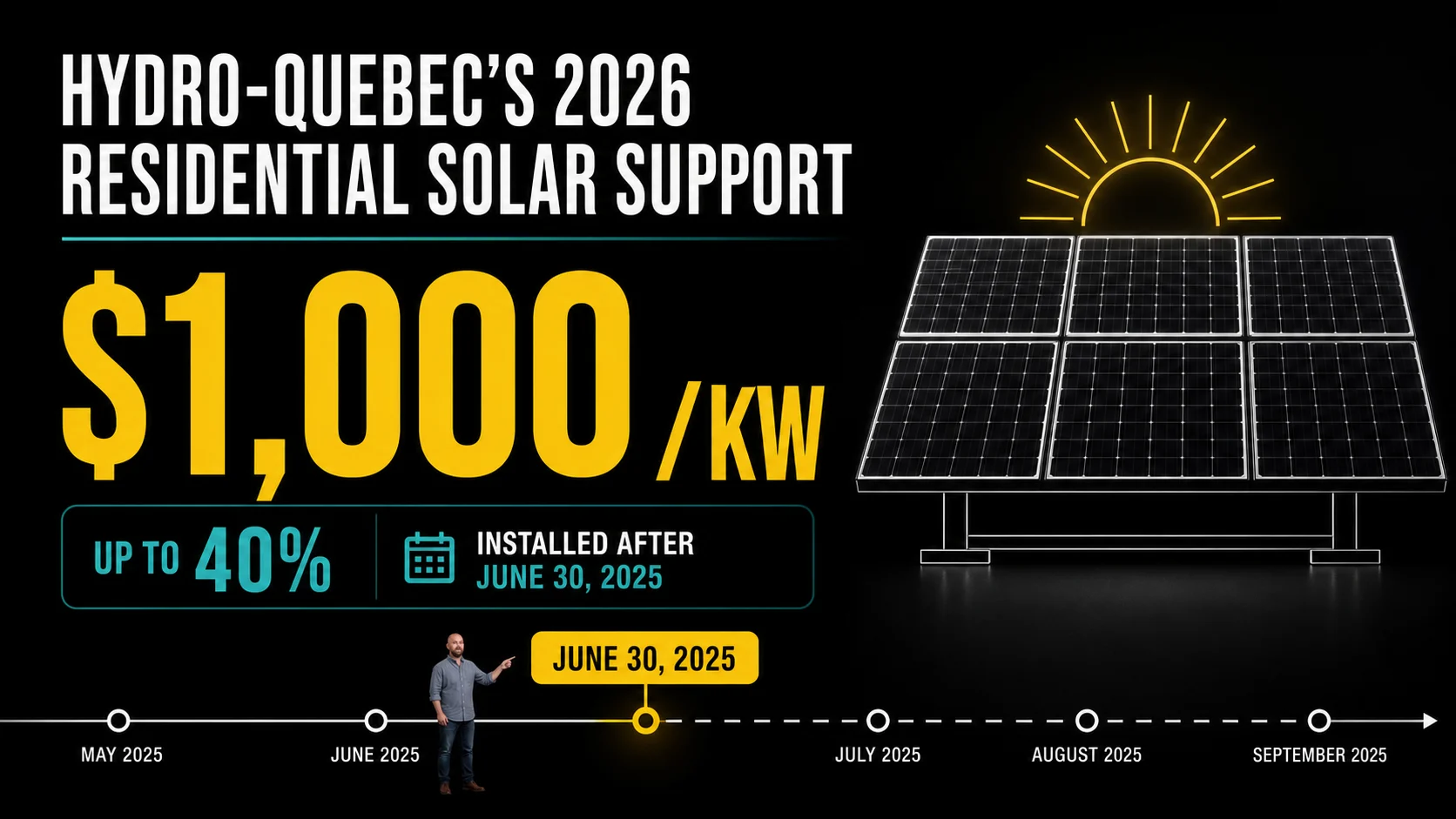
- As of May 2026, Hydro-Quebec offers residential solar financial assistance through LogisVert at $1,000 per installed kW, up to 40% of purchase and installation costs. Solar panels must have been installed on or after June 30, 2025. Source: Hydro-Quebec LogisVert residential program and Hydro-Quebec solar grant announcement.
- Business solar projects fall under OSE 6.0 rules when the project start date is on or after March 31, 2026. Hydro-Quebec defines the project start date as the earlier of the first contractor contract date or the first equipment purchase date. Source: Hydro-Quebec Efficient Solutions transitional rules.
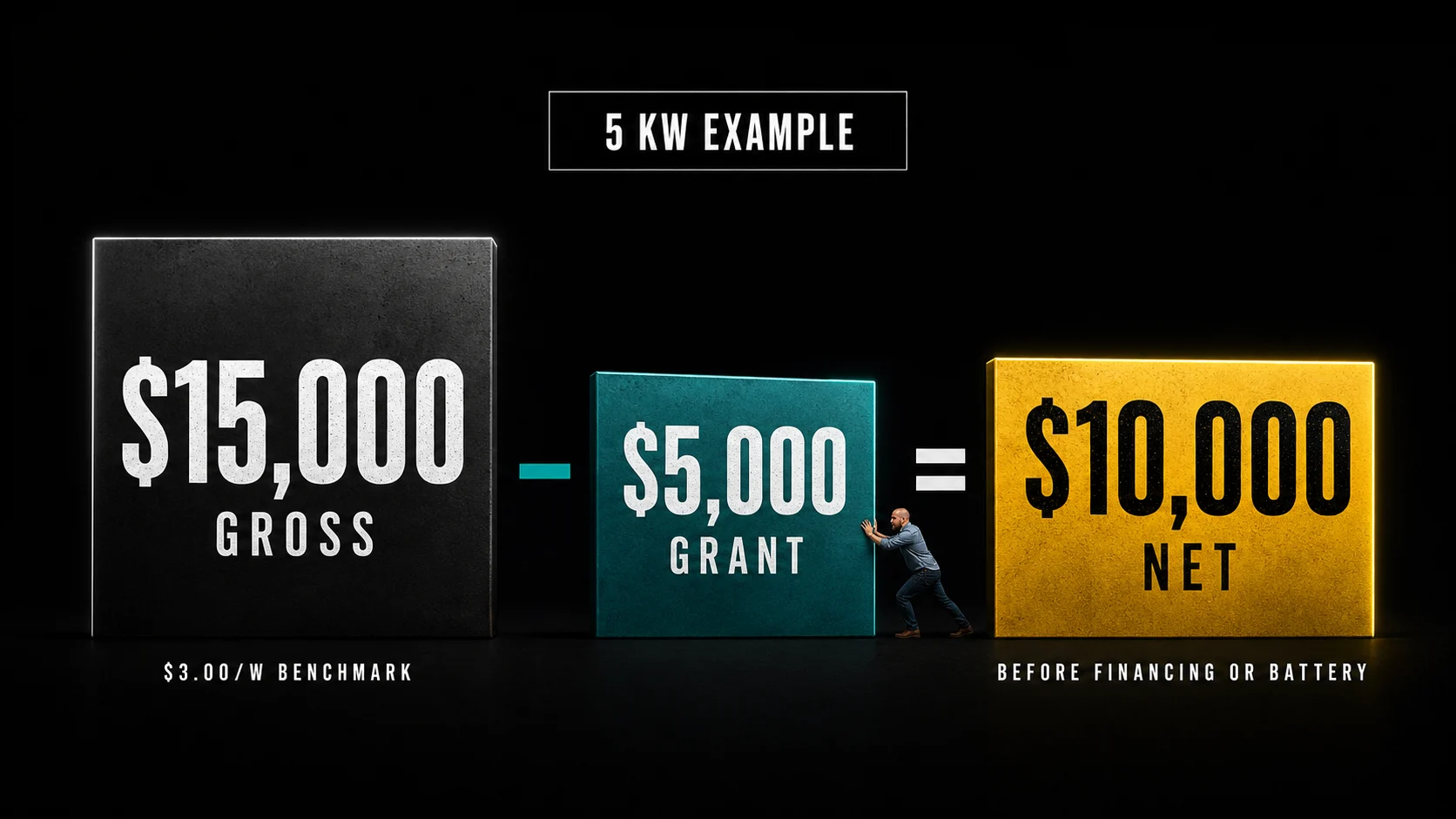
- Hydro-Quebec’s residential simulator uses a default installed cost of $3.00/W, which is a useful benchmark for 2026 estimates. Source: Hydro-Quebec solar panel savings simulator.
- Net metering credits are banked in kWh, not dollars. The credit bank resets every 24 months, and unused balances are credited at the average cost of electricity supply, listed in the 2026 rate chart at 4.730 cents/kWh. Source: Hydro-Quebec Net Metering Option I and Hydro-Quebec 2026 rates chart PDF.
- The federal Canada Greener Homes Grant is closed. New Quebec homeowners should not treat it as a live solar funding path in 2026. Source: NRCan Canada Greener Homes Grant status.
Is Solar Worth It In Quebec In 2026?
For many Quebec homeowners, solar is now worth a serious look. That is a different answer from a few years ago.
The new Hydro-Quebec grant changes the upfront cost. The 2026 rate schedule changes the savings calculation. The updated net metering cap also gives larger homes and businesses more room to build meaningful systems. Hydro-Quebec says the maximum self-generation capacity for the main-grid net metering option increased from 50 kW to 1 MW, although approval still depends on the site, the customer’s demand, and grid hosting capacity. Source: Hydro-Quebec grant announcement.
That does not mean solar panels are automatically a fast-payback investment in Quebec. Residential electricity is still inexpensive compared with many other provinces. In 2026, Rate D energy is 7.065 cents/kWh for the first 40 kWh per day and 11.142 cents/kWh above that threshold, with a system access charge of 46.154 cents/day. Source: Hydro-Quebec 2026 rates chart PDF.
The practical answer is this: solar panels in Quebec make the most sense for homes with good roof exposure, higher electricity use, an EV, a heat pump, or a long-term plan to stay in the home. The numbers become weaker for shaded roofs, small bills, old roofs, or systems that are oversized just to chase a larger rebate.
If you want a quick first check, use the SolarEnergies.ca solar panels calculator to estimate whether your roof, usage, and local assumptions support a quote.
Why Quebec Solar Changed
Quebec’s grid is still built around hydroelectricity, but the province’s electricity needs are growing. More homes are moving to heat pumps. More drivers are buying EVs. Businesses are electrifying equipment. At the same time, Hydro-Quebec is publicly planning for a larger role for solar, with a goal of integrating 3,000 MW of solar power in Quebec by 2035. Source: Hydro-Quebec solar strategy announcement.
Statistics Canada also reported that persistent dry conditions kept hydroelectric generation muted in 2025, while Quebec’s electricity imports rose sharply and exports fell. That does not make rooftop solar a fix for every grid issue. It does show why Hydro-Quebec is treating customer self-generation as part of a broader diversification strategy. Source: Statistics Canada 2025 electricity year in review.
How Much Do Solar Panels Cost In Quebec In 2026?
For a simple 2026 benchmark, use $3.00/W before incentives. That is the default installed cost in Hydro-Quebec’s residential solar simulator, so it is a stronger starting point than a random market average.
| System size | Gross cost at $3.00/W | Hydro-Quebec grant | Estimated net cost | Estimated annual production |
|---|---|---|---|---|
| 5 kW | $15,000 | $5,000 | $10,000 | 6,000 kWh |
| 8 kW | $24,000 | $8,000 | $16,000 | 9,600 kWh |
| 10 kW | $30,000 | $10,000 | $20,000 | 12,000 kWh |
| 12 kW | $36,000 | $12,000 | $24,000 | 14,400 kWh |
These production estimates are planning examples only. Final output depends on the Hydro-Quebec simulator assumptions, roof direction, tilt, shading, snow cover, inverter design, and local conditions.
Tip for sizing: start with your last 12 months of Hydro-Quebec bills. Your goal is usually to offset the electricity you can actually use or bank inside the net metering window, not to install the largest system your roof can hold.
Quebec Solar Rebates And Incentives In 2026
Residential LogisVert Solar Grant
For homeowners, the main 2026 solar incentive is Hydro-Quebec’s LogisVert solar measure.
| Item | 2026 rule |
|---|---|
| Administrator | Hydro-Quebec |
| Program | LogisVert Efficient Homes Program |
| Support level | $1,000 per installed kW |
| Cap | Up to 40% of purchase and installation cost |
| Key date | Solar panels must have been installed on or after June 30, 2025 |
| Application timing | Submit within nine months of the equipment installation date |
| Portal note | Hydro-Quebec says the LogisVert portal is available only in French |
The grant is valuable, but do not treat it as automatic cash in hand before the project. Keep invoices, technical sheets, proof of ownership, and contractor documentation organized from day one. Hydro-Quebec also requires official authorization before self-generation equipment is connected to the grid. It recommends waiting for conditional acceptance before purchasing self-generation equipment. Source: Hydro-Quebec self-generation process.
Federal Greener Homes Grant Status
The old federal Canada Greener Homes Grant should not be presented as a current 2026 path for new solar applicants. NRCan lists the program as closed, with applications having been open from May 2021 to February 2024 and a final document deadline for existing applicants on December 31, 2025. Source: NRCan closed Canada Greener Homes Grant page.
Business Solar Incentives
Businesses get a different path. Hydro-Quebec added solar panels as a measure under Efficient Solutions / OSE 6.0. The OSE page describes the tool as a Windows-based PC application used to calculate and submit financial support requests. Hydro-Quebec also says projects are submitted after the work has been completed, although OSE can estimate support in advance. The OSE 6.0 rules apply based on the project start date, which Hydro-Quebec defines as the earlier of the first contractor contract date or the first equipment purchase date. Source: Hydro-Quebec OSE calculation tool and Hydro-Quebec Efficient Solutions transitional rules.
For taxable Canadian corporations, the federal Clean Technology Investment Tax Credit may also matter. CRA lists the regular Clean Technology ITC rate as up to 30% for eligible property available for use from March 28, 2023, to December 31, 2033. If labour requirements are not elected into, the rate is reduced by 10 percentage points. Clean Technology ITC eligibility is not the same as a homeowner rebate. It applies to eligible claimants and eligible property, and the final credit rate depends on CRA rules, labour requirements, and filing details. Source: CRA Clean Technology ITC and CRA reduced credit rate rules.
How Net Metering Works In Quebec
Hydro-Quebec’s main-grid net metering program is Option I. It allows eligible customer-generators to send surplus electricity to the grid and receive credits in kWh. That kWh detail matters. Quebec’s net metering is not a simple cash buyback program.
- Your solar panels power your home or business first.
- Surplus electricity goes to the Hydro-Quebec grid.
- Hydro-Quebec adds kWh credits to your account.
- You use those credits later when your system produces less than you consume.
- The surplus bank resets every 24 months.
- Unused credits at reset are valued at the average cost of electricity supply, which is 4.730 cents/kWh in the 2026 rates chart.
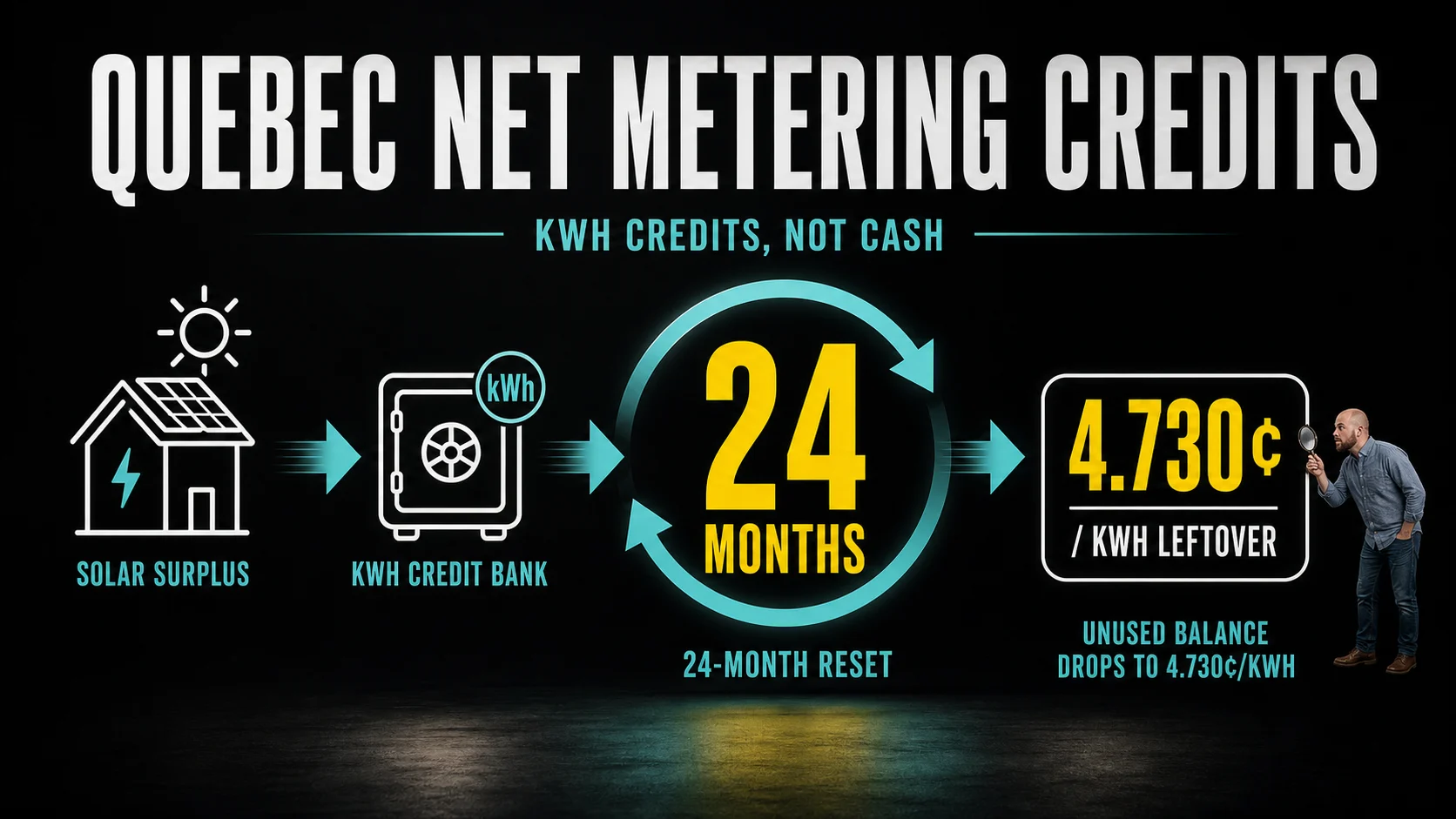
This is why oversized systems are risky in Quebec. A kWh you use to avoid buying electricity at 11.142 cents/kWh is much more valuable than a leftover kWh that resets at 4.730 cents/kWh. Ask your installer to model self-consumption, credit usage, and expected leftover credits at reset. If the quote only shows annual production and a simple rebate, it is missing a major Quebec-specific detail.
2026 Payback Examples
Payback depends on the value of the electricity your solar production offsets. In Quebec, that depends heavily on your rate tier, usage pattern, system size, and whether credits expire unused.
Here is a simple residential example using a 5 kW system: gross cost $15,000, LogisVert grant $5,000, net cost after grant $10,000, and year-1 production of 6,000 kWh.
| Avoided electricity value | Year-1 savings | Simple payback before grant | Simple payback after grant |
|---|---|---|---|
| 7.065 cents/kWh | $424 | 35.4 years | 23.6 years |
| 9.104 cents/kWh blended | $546 | 27.5 years | 18.3 years |
| 11.142 cents/kWh | $669 | 22.4 years | 15.0 years |
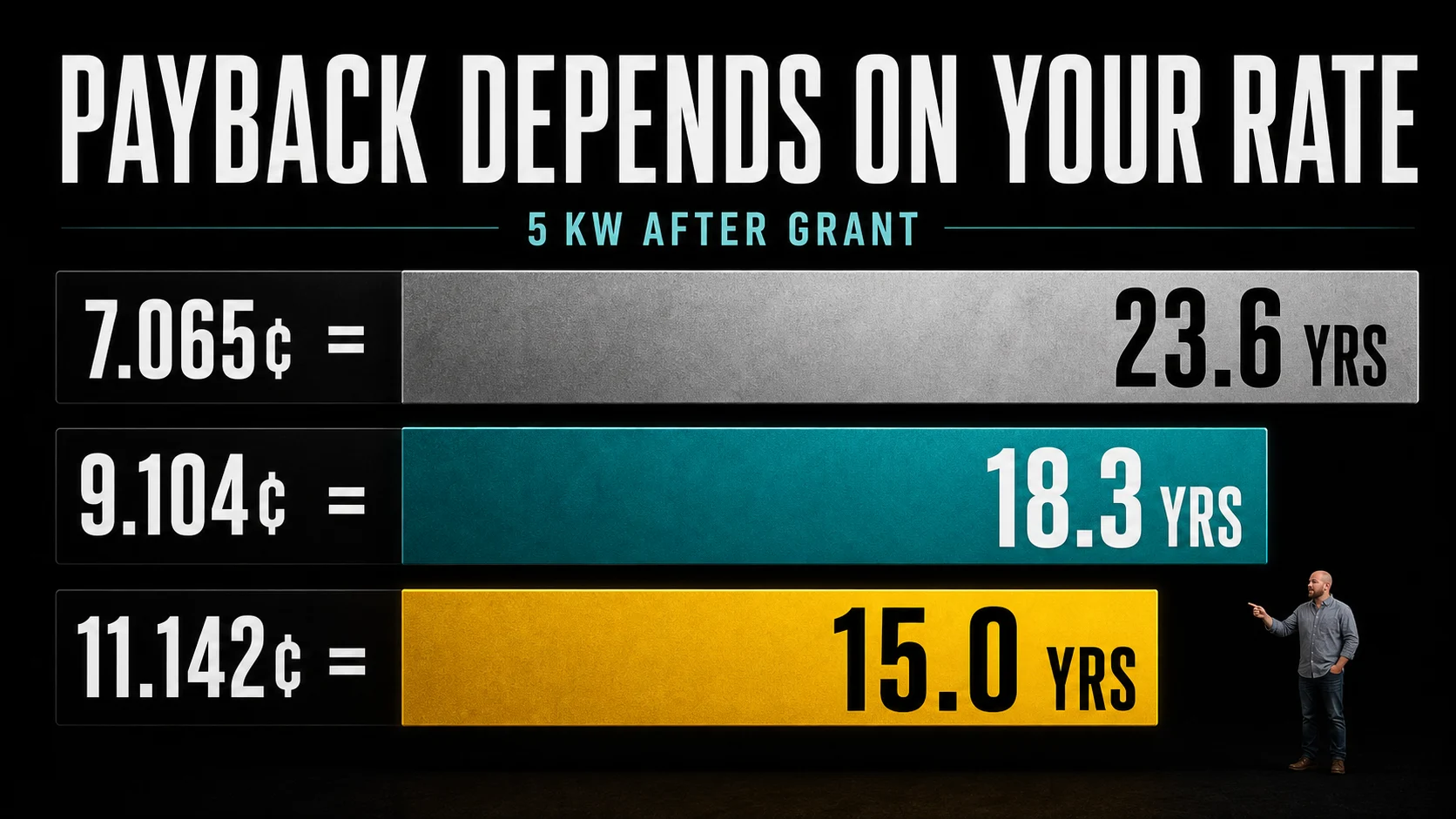
These payback examples are simple first-year estimates. They do not include taxes, financing, rate changes, insurance, maintenance, inverter replacement, roof replacement, battery cost, or the effect of unused net metering credits. They also assume the production has retail value, which may not be true for unused credits at the 24-month reset.
What About Small Businesses?
Commercial solar can look stronger than residential solar because businesses may use more daytime electricity, may be able to use more of the solar production directly, and may have access to both Hydro-Quebec support and federal tax incentives.
Example: a 30 kW Rate G small-business system at $3.00/W has a gross cost of $90,000, Hydro-Quebec support of $30,000, net cost after Hydro-Quebec support of $60,000, and estimated year-1 production of 36,000 kWh. If all year-1 production offsets Rate G first-tier energy at 12.388 cents/kWh, year-1 bill savings are about $4,460.
| Scenario | Net capital basis | Year-1 savings | Simple payback |
|---|---|---|---|
| No incentive | $90,000 | $4,460 | 20.2 years |
| Hydro-Quebec support only | $60,000 | $4,460 | 13.5 years |
| Hydro-Quebec support plus 20% CT ITC | $48,000 | $4,460 | 10.8 years |
| Hydro-Quebec support plus 30% CT ITC | $42,000 | $4,460 | 9.4 years |
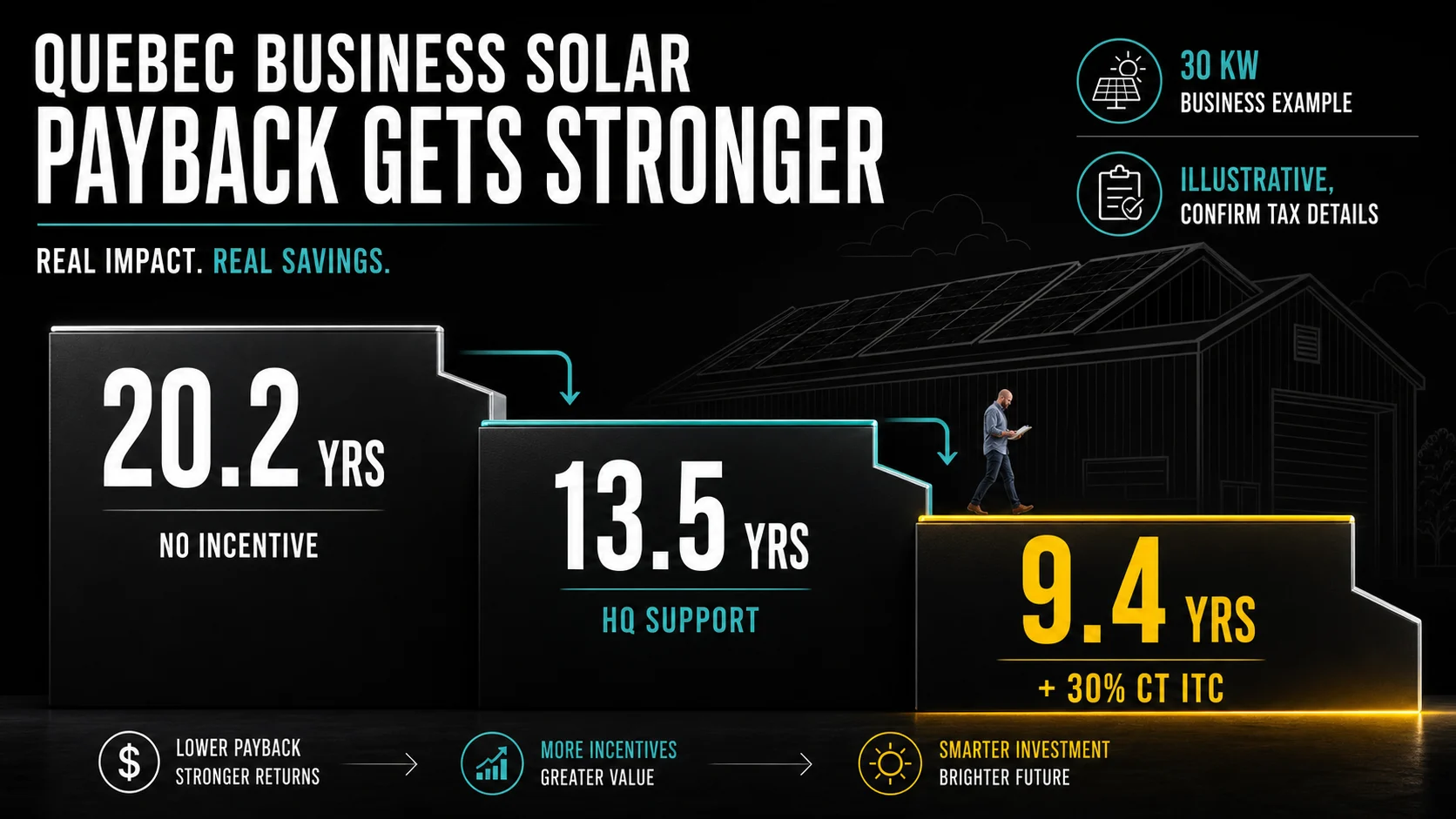
This is an illustration, not tax advice. The 30% scenario assumes the claimant elects into the CRA labour requirements and meets the other applicable rules. The 20% scenario reflects CRA’s 10-percentage-point reduction when the claimant does not elect into the labour requirements. Government assistance can also reduce the capital cost used to calculate the Clean Technology ITC. Confirm the numbers before you treat the tax credit as part of the final project return.
Steps To Install Solar Panels In Quebec
- Check the site first. Review roof condition, shading, usable area, structural limits, electrical panel capacity, and municipal rules.
- Hire a qualified electrical contractor. Hydro-Quebec says self-generation equipment must be connected by an electrical contractor.
- Have the contractor submit the connection request to Hydro-Quebec.
- Wait for Hydro-Quebec’s review. The utility may carry out a hosting-capacity analysis and can put applications on hold in areas with high customer-generator concentration.
- Wait for conditional acceptance before buying equipment. Hydro-Quebec recommends this.
- Install the system and complete compliance testing.
- Get official authorization from Hydro-Quebec before connecting to the grid. Hydro-Quebec says this authorization is mandatory.
- Submit the LogisVert or business incentive application with the correct documents.
Source: Hydro-Quebec self-generation process. A good installer will build this sequence into the project plan. A weak installer will push equipment first and paperwork later. In Quebec, that order can create delays.
Best Solar Equipment For Quebec Homes
For many homes, monocrystalline panels are commonly quoted because they offer strong output per square metre, but the final choice should be based on roof space, equipment specs, warranty, and installer design.
- Microinverters can be useful when panels face different directions or have partial shading.
- String inverters can work well on simpler, unshaded roofs.
- Hybrid inverters make sense when battery storage is part of the plan.
Battery backup is a separate decision. It usually does not improve payback in Quebec if the only goal is bill savings. It can still be valuable if outages are a concern, if the home has critical loads, or if the owner wants more energy independence.
Before choosing an installer, compare a few detailed quotes. Look at the equipment, system size, production estimate, warranty, financing terms, interconnection plan, and final net cost side by side. SolarEnergies.ca can help readers compare installer options, but installer experience claims should be checked against the quote, references, licences, and written project documents.
If upfront cost is the sticking point, ask installers or lenders to show written financing terms, including interest rate, fees, repayment period, approval conditions, and total cost.
Quebec Climate And Solar Performance
Cold weather does not stop solar panels from working. Panels often operate more efficiently in cold temperatures than in extreme heat. The bigger winter challenges are short days, low sun angle, snow cover, and cloudy stretches.
That is why annual production matters more than one January bill. A system in Quebec will usually produce much more in spring and summer than in winter. Net metering helps smooth that seasonal pattern, but only if the system is sized so the credit bank is used well before reset.
FAQ
Are solar panels worth it in Quebec in 2026?
Yes, solar panels can be worth it in Quebec in 2026, but the system has to be sized carefully. The Hydro-Quebec grant improves the math, but low electricity rates still make Quebec more sensitive to bad assumptions than provinces with higher power prices.
What is the solar panel grant in Quebec?
For residential customers, Hydro-Quebec’s LogisVert program offers $1,000 per installed kW, up to 40% of purchase and installation costs. Panels must have been installed on or after June 30, 2025, and the application must be submitted within nine months of installation. Business customers use the Efficient Solutions / OSE pathway, with solar support added in 2026 for eligible projects.
How much does a 5 kW solar system cost in Quebec?
Using Hydro-Quebec’s $3.00/W simulator benchmark, a 5 kW system costs about $15,000 before incentives. The Hydro-Quebec grant would be about $5,000, bringing the estimated net cost to about $10,000 before financing, roof work, batteries, or special electrical upgrades.
Does Hydro-Quebec buy back extra solar power?
Hydro-Quebec’s main-grid net metering option credits surplus production in kWh. Those credits can be used later, but the bank resets every 24 months. Any unused balance at reset is credited at the average cost of electricity supply, listed at 4.730 cents/kWh in the 2026 rate chart. That is not the same as selling all extra electricity at the full retail rate.
Is the Canada Greener Homes Grant available for Quebec solar in 2026?
No. NRCan lists the Canada Greener Homes Grant as closed. Existing files had deadlines, but new homeowners should not plan a 2026 solar project around that federal grant.
What is the next step?
Start with your address, your roof, and your last 12 months of Hydro-Quebec usage. Then compare quotes using the same assumptions. The SolarEnergies.ca calculator can give you a first estimate, and a certified installer can confirm the roof, electrical details, Hydro-Quebec process, and grant paperwork.