
B.C.’s Gas Power U-Turn Shows Why Solar Without Batteries Isn’t Enough
June 5, 2026
Off-Grid Solar in BC: Costs, Rebates, Batteries, Permits, and DIY vs Hiring a Pro
June 10, 2026Last Updated on June 9, 2026 by Vitaliy
Solar in B.C. can be confusing because the province already has a clean, hydro-heavy electricity grid. So when a small village like Keremeos installs solar on a wastewater treatment plant and approves another system for municipal offices, the big question is not just "how much carbon does it save?" The better question is: "Does solar still reduce long-term power costs in B.C.?"
Choose solar for the wrong reason and you may be disappointed. Choose it for the right building, the right load, the right utility rules, and the right funding, and it can still make solid financial sense.
Keremeos does not prove every B.C. home should install solar. It proves something narrower and more useful: solar can work in a hydro-heavy province when the building has steady electricity use, funding reduces upfront cost, and the savings math is shown clearly.
Key Takeaways
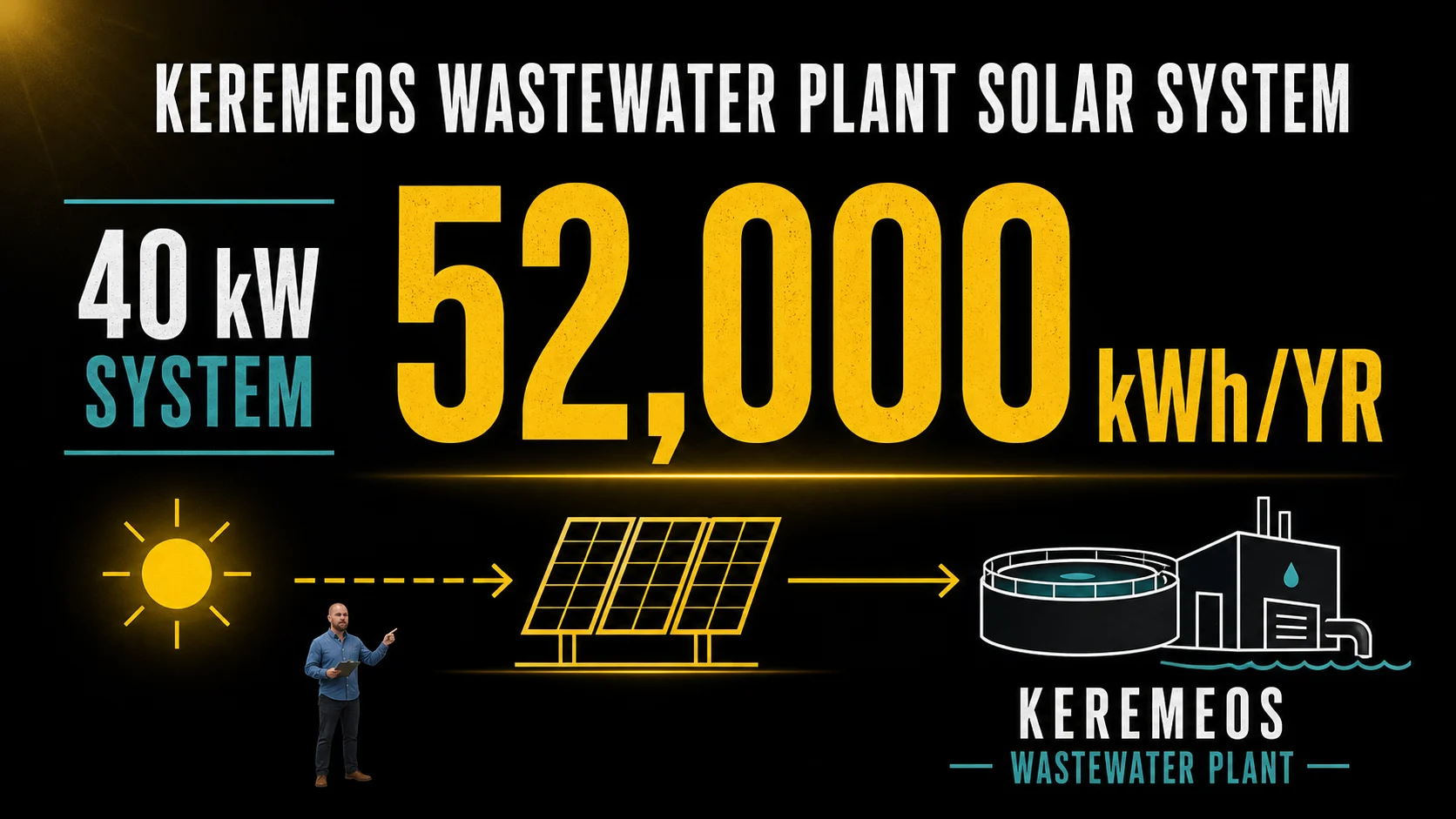
- Keremeos installed a 40 kW solar system at its wastewater treatment plant, expected to generate up to 52,000 kWh per year.
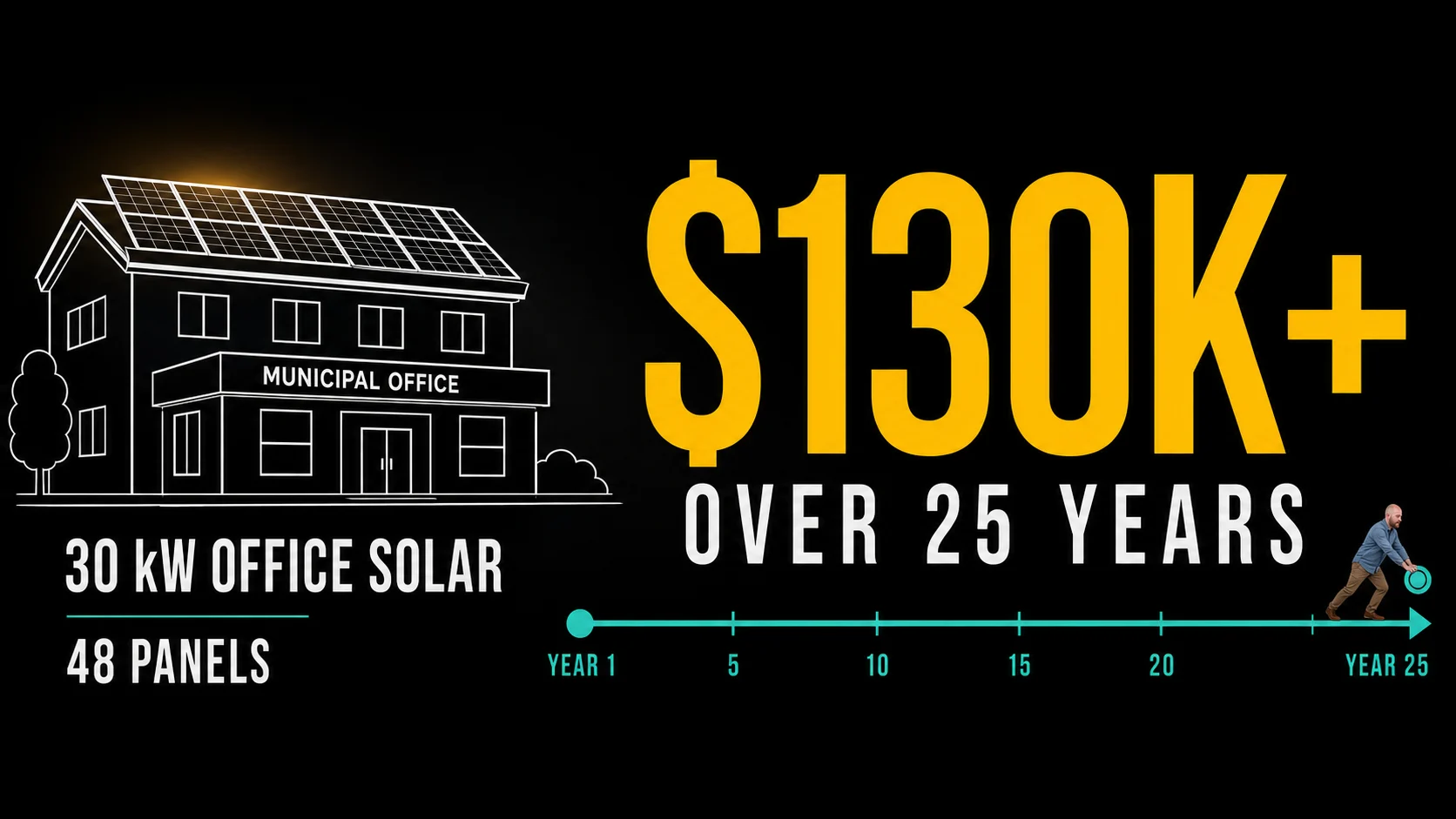
- A second 30 kW solar project for the municipal offices will use 48 panels and is expected to save more than $130,000 over 25 years.
- The carbon savings are modest because B.C.’s electricity grid is already low-carbon.
- The real lesson is cost control: solar works best when the system is matched to the building, utility rules, and electricity-use pattern.
- For homeowners, the Keremeos case is a useful example, not a direct payback model.
What Happened In Keremeos?
According to local reporting from Keremeos Review / Today in B.C., Keremeos recently brought a new solar power system online at its wastewater treatment plant. The system was reported as fully grant funded, has a 40 kW capacity, and can generate up to 52,000 kWh of electricity per year.
Village council also approved another solar project for the municipal offices. That system will use 48 panels, has a 30 kW capacity, and is expected to save more than $130,000 over 25 years.
The municipal office solar project appears in Village budget documents with Local Government Climate Action Program funding applied. Local news also reported that the wastewater treatment plant solar system was fully grant funded. That distinction matters. A grant-funded municipal solar project is not the same payback calculation as a homeowner paying out of pocket.
B.C.’s Local Government Climate Action Program supports local governments and Modern Treaty Nations with climate-related work. The Province says the program has delivered about $120.5 million to date for local climate action, including climate infrastructure and capital costs. Source: B.C. Local Government Climate Action Program funding.
This is not a giant solar farm. That is what makes it interesting.
Keremeos is showing how smaller public buildings can use solar to reduce operating costs over time.
Why The Carbon Savings Are Modest
The wastewater plant solar system was reported locally as saving about 0.3 to 0.4 tonnes of CO2 emissions annually. That should be treated as the project’s estimate, not a universal B.C. solar emissions figure.
Using B.C.’s official integrated-grid emission factors, a 52,000 kWh/year solar system would avoid roughly 0.5 to 1.2 tonnes CO2e per year, depending on the reporting year and methodology. B.C.’s official emission-factor page lists different factors by year and grid region, so the calculation depends on which reporting year and method is used. Source: B.C. emissions quantification methods.
The point still holds: in B.C., where electricity is already low-carbon, the bigger solar argument is usually cost control, not dramatic emissions reduction.
The Canada Energy Regulator notes that B.C. generated 71.7 TWh of electricity in 2021, with hydroelectricity making up the largest share of generation. Source: Canada Energy Regulator B.C. energy profile.
That changes the solar conversation.
In Alberta or Saskatchewan, replacing grid power with solar can cut more carbon because the grid has more fossil fuel generation. In B.C., solar may still help, but the emissions reduction is usually not the main financial argument.
The stronger case is reducing purchased electricity.
The Real Lesson: Solar Works Best When The Rate Rules Fit
A wastewater treatment plant is a practical solar site because it uses electricity as part of daily operations. Municipal offices are also a good example because they use power during daylight hours, when solar panels are producing.
Daytime usage helps, especially under rates where exported solar power is worth less than power used onsite. But this is not the same across every B.C. utility.
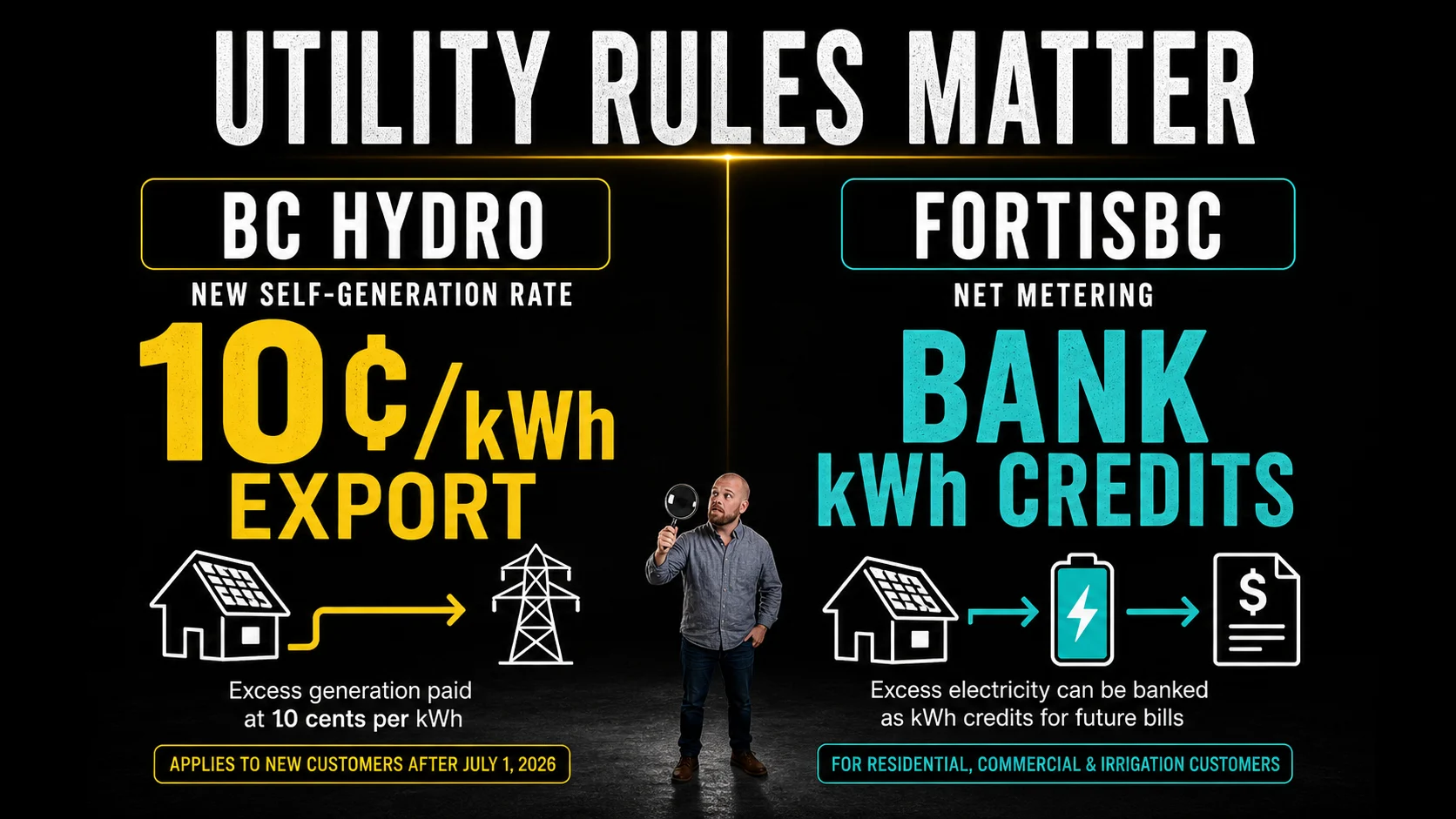
Under FortisBC net metering, excess electricity can be banked as kWh credits for future billing periods, so evening usage may still work financially if the system is sized properly. FortisBC says its net metering program is available to residential, commercial, and irrigation customers who generate electricity from clean or renewable resources. FortisBC caps net-metered systems at 50 kW and says systems should be sized to offset expected annual use. Source: FortisBC net metering program.
For BC Hydro customers, timing now matters more than it used to. BC Hydro says its old net metering service rate closes to new customers on July 1, 2026. Under the new self-generation rate, excess generation sent to the grid is paid at 10 cents per kWh. Source: BC Hydro customer generation rate updates.
That can change payback. A system that works under one export-credit structure may look different under another. Self-use, system size, and annual production estimates all matter.
Tip for homeowners: If most of your electricity use happens in the evening, solar can still work, but the math depends on your utility. FortisBC banking rules and BC Hydro’s new self-generation rate are not the same thing.
What The Keremeos Numbers Tell Us
The 40 kW wastewater treatment plant system is expected to produce up to 52,000 kWh per year. That works out to about 1,300 kWh per kW per year.
That is a reasonable solar production figure for a good B.C. site.
The municipal office project is expected to save more than $130,000 over 25 years. That is about $5,200 per year in estimated savings.
If the 30 kW municipal office system performs similarly to the wastewater system, it may produce around 39,000 kWh per year. That would put the implied electricity value near 13 cents per kWh.
That is the kind of simple math homeowners and business owners should ask for before signing a solar contract:
| Keremeos solar detail | Reported number | Why it matters |
|---|---|---|
| Wastewater plant system size | 40 kW | Shows the scale of a small municipal solar system |
| Expected annual production | Up to 52,000 kWh | Gives a realistic production benchmark |
| Estimated yield | About 1,300 kWh per kW per year | Useful for comparing B.C. production estimates |
| Municipal office system size | 30 kW | Closer to a small commercial building than a house |
| Municipal office panels | 48 panels | Helps readers picture the project size |
| Expected office savings | More than $130,000 over 25 years | Shows the long-term cost-control argument |
Do not accept vague promises. Ask for expected annual production, utility assumptions, rebate assumptions, and total savings over time.
If you want a quick first check, use the SolarEnergies.ca online solar calculator to see whether solar makes sense for your property before you start collecting quotes.
Why Grant Funding Changes The Payback
Keremeos had a major advantage: grant funding.
That means the village did not have to evaluate the projects the same way a homeowner paying full upfront cost would. A grant-funded solar system can make sense much faster because the capital cost is reduced or removed.
For homeowners and businesses, the same principle applies. Rebates, tax treatment, financing, and utility credits can change the numbers.
BC Hydro currently offers up to $5,000 for eligible grid-connected solar panels. Battery rebates are more specific: as of April 1, 2026, batteries paired with solar but not enrolled in Peak Saver are capped at $1,500, while eligible batteries enrolled in Peak Saver can qualify for up to $5,000. BC Hydro also says solar and battery installations must be completed by a Home Performance Contractor Network member beginning June 1, 2026 to qualify for rebates. Source: BC Hydro solar and battery rebates.
BC Hydro’s self-generation program is available to eligible customers who generate electricity from clean or renewable resources, with systems up to 100 kW. BC Hydro said more than 17,000 customers were participating as of February 2026, mostly using solar PV. Source: BC Hydro self-generation program.
Tip for B.C. solar buyers: Do not assume your neighbour’s rebate applies to your home. B.C. solar incentives and rules can change based on whether you are with BC Hydro, FortisBC, or another utility.
What Homeowners Should Learn From Keremeos
Keremeos does not prove every B.C. home should install solar.
It proves solar can make sense in B.C. when the project is sized properly, the building uses enough electricity, the funding works, and the savings estimate is realistic. For more context on B.C.’s current solar policy timing, see this guide to BC Hydro’s July 1 net metering deadline.
Before installing solar panels, ask these questions:
- How much electricity do I use per year?
- How much of that use happens during daylight hours?
- Is my roof large enough and in good condition?
- Does shading reduce my solar production?
- Which utility serves my property?
- What net metering or self-generation rules apply?
- Am I eligible for rebates?
- What is the expected annual production in kWh?
- What is the payback with and without financing?
- What warranty covers panels, inverters, and labour?
Before choosing an installer, compare a few detailed quotes. The cheapest number is not always the best deal if the equipment, warranty, production estimate, or financing terms are weaker. This solar quote comparison guide explains what to check before signing.
SolarEnergies.ca can connect you with certified installers who have completed 14,000+ installs across Canada, so you can compare real options instead of guessing.
Solar In B.C. Is More About Cost Control Than Carbon
This is the key point.
In B.C., solar is not always about huge emissions cuts. The grid is already clean compared with many other provinces.
That does not make solar useless. It just changes the reason to install it.
For many B.C. homeowners and businesses, the reasons may be:
- Lower long-term electricity costs
- Protection from future rate increases
- Better use of sunny roof space
- Support for EV charging
- Reduced operating costs for businesses
- More energy independence
- Battery backup when paired with storage
- Better building value and energy planning
If battery backup is part of your decision, this related article explains why solar without batteries may not be enough in B.C.
Keremeos is a good case study because it is not flashy. A wastewater treatment plant and municipal office are everyday buildings. That is exactly why the story matters.
If solar can quietly reduce operating costs for a small village, it may also work for a home, farm, shop, or office with the right conditions.
The Bottom Line
Keremeos did not install solar because B.C. has a dirty grid. It installed solar because electricity costs money, public buildings use power, and grant funding made the projects practical.
That is the honest solar story in B.C.
Solar panels are not automatically a perfect investment for every property. But they are not just a carbon gesture either. With the right site, the right utility rules, and a serious savings estimate, solar can be a long-term cost-control tool.
If upfront cost is the sticking point, ask about available financing options, including 0% financing with $0 down payment where approved. Just make sure the monthly payment, production estimate, warranty, and payback period all make sense together.
FAQ
Does solar make sense in B.C. if the grid is already clean?
Yes, solar can still make sense in B.C., but the main benefit is often financial rather than carbon reduction. B.C.’s grid is already hydro-heavy, so replacing grid electricity with solar may not cut as much CO2 as it would in Alberta or Saskatchewan.
The better question is whether solar can reduce your electricity bill enough to justify the cost. That depends on your roof, utility, annual usage, daytime usage, rebates, installation price, and export-credit rules.
Why were Keremeos’ carbon savings so small?
The Keremeos wastewater plant system was reported locally as saving about 0.3 to 0.4 tonnes of CO2 emissions per year. That appears to be the project’s own estimate.
Using B.C.’s official integrated-grid emission factors, 52,000 kWh of avoided grid electricity would be closer to roughly 0.5 to 1.2 tonnes CO2e per year, depending on the reporting year and methodology. Either way, the carbon benefit is modest because B.C.’s grid is already low-carbon.
How much electricity can a 40 kW solar system produce in B.C.?
The Keremeos wastewater treatment plant system is expected to generate up to 52,000 kWh per year from 40 kW of capacity. That equals about 1,300 kWh per kW per year.
Actual production depends on roof angle, shading, location, equipment, snow, maintenance, and system design. A good installer should give you a site-specific production estimate, not just a generic number.
Are B.C. homeowners eligible for solar rebates?
Some are, but eligibility depends on the utility and program rules. BC Hydro offers solar and battery rebates for eligible customers, but the battery rebate depends on the setup. Batteries paired with solar but not enrolled in Peak Saver are capped at $1,500 under current BC Hydro rules, while eligible Peak Saver-enrolled batteries can qualify for up to $5,000.
FortisBC customers need to check FortisBC rules instead. Do not assume BC Hydro rebate numbers apply if you are not a BC Hydro customer.
Is net metering available in B.C.?
Yes, but the details depend on your utility. FortisBC has a net metering program where excess generation can be banked as kWh credits and used in future billing periods.
BC Hydro is moving new customers from the old net metering service rate to a new self-generation rate starting July 1, 2026. Under that rate, excess generation is paid at 10 cents per kWh.
What type of B.C. property is best for solar?
Solar is often strongest for properties that use electricity during the day. That includes offices, farms, shops, municipal buildings, irrigation loads, and homes with daytime occupancy or EV charging.
Homes that use most of their power at night can still benefit, but the payback depends on the utility. FortisBC kWh banking can treat exports differently than BC Hydro’s new self-generation rate.
Should I install solar panels or a battery first?
Most homeowners should start by checking whether solar panels make financial sense on their property. A battery can add backup power and improve self-use, but it also adds cost.
If outages are a major concern, or if your utility rules make exporting less valuable, a battery may be worth considering. If your main goal is payback, compare solar-only and solar-plus-battery quotes side by side.
What should I ask a solar installer before signing?
Ask for the system size, expected annual kWh production, installed cost, rebate assumptions, warranty details, equipment brands, roof work requirements, payback estimate, and financing terms.
Also ask what happens if the system produces less than expected. A serious quote should help you understand the numbers clearly before you commit.
Sources
- Keremeos Review / Today in B.C., Brennan Phillips, "As one solar project starts, another wraps up in Keremeos," published June 8, 2026. Article text provided by user.
- B.C. Local Government Climate Action Program funding
- B.C. emissions quantification methods
- Canada Energy Regulator B.C. energy profile
- FortisBC net metering program
- BC Hydro customer generation rate updates
- BC Hydro solar and battery rebates
- BC Hydro self-generation program