
Ever paid for roof moss removal and then spotted green patches again before the next season was even over?
In Victoria, BC, roof moss removal is rarely a “one-and-done” job. If your roof sits in shade and your gutters collect debris, that moss is coming back. Regular maintenance, such as cleaning gutters and trimming overhanging trees, can help reduce moss growth over time. Many homeowner experiences with roof moss highlight the importance of preventive measures, as proactive care can save time and money in the long run. Additionally, using eco-friendly treatments can minimize harm to your roof while effectively managing moss buildup.
I’m Vitaliy Lano, a solar energy consultant with 12+ years working on residential projects across Canada. I see roof moss turn into a real problem once homeowners start planning solar.
You clean it. It looks good for a winter. Then it returns.
Below, I’ll show you why moss returns so fast in Greater Victoria, what roof cleaning services typically include, and how to shift from repeat cleanings to a prevention-first roof care plan.
Key Takeaways
- Victoria is wet enough for moss: With around 150+ wet days a year, moss will return if you don’t change the conditions.
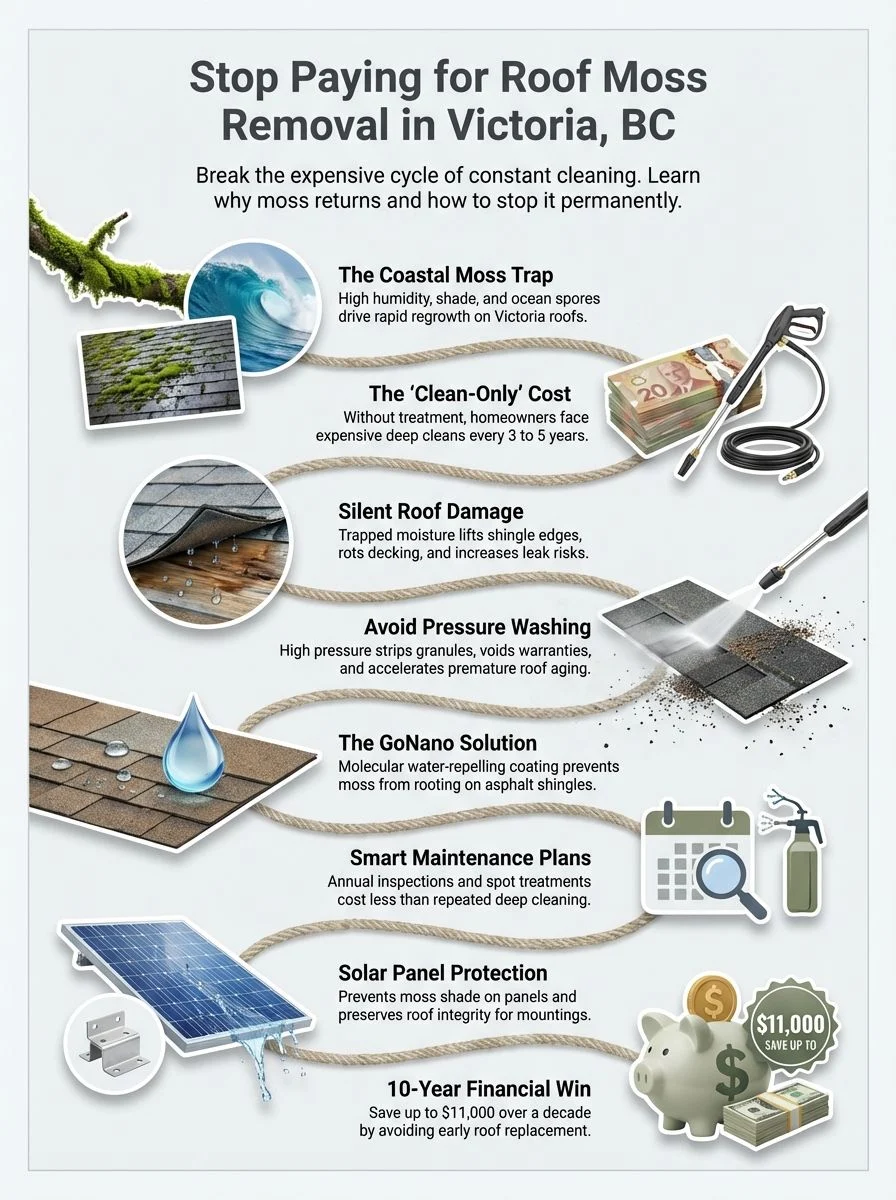
- Cleanings are temporary: Without prevention, expect a deep clean every 3-5 years.
- Soft wash is safer: Avoid high pressure and scrubbing to protect shingle granules.
- Solar needs a clean roof: Soiling can reduce output by 4-7%, so maintenance isn’t just cosmetic.
- Prevention pays off: Treatments like GoNano or regular maintenance plans reduce the need for heavy, expensive cleanings.
Why does roof moss come back so fast in Victoria?
Victoria’s coastal moisture and tree cover create the perfect setup for moss on asphalt shingles. Your roof stays damp longer, especially on north-facing slopes and under overhanging branches.
Victoria racks up a lot of roof-wet days each year. In some recent years, the area has seen around 150+ days with measurable precipitation, which is plenty of time for moss to re-establish if shade and debris stay the same.
That is a lot of time for spores to take hold.
Here is the part most homeowners miss: a cleaning removes what you can see. It does not remove the conditions that made moss thrive in the first place.
If your roof stays damp and shaded, moss will treat a “clean roof” like fresh real estate.
To slow regrowth, you have to focus on moisture control and sunlight, not just scraping.
- Keep water moving: Stay on top of gutter cleaning and downspout flow so water does not back up onto shingles and fascia.
- Clear the “sponge layer”: Remove needles, leaves, and seed pods from valleys and behind chimneys before the rainy stretch.
- Cut shade where it matters: Trim branches that block morning sun on the roof. Early sun dries shingles fastest.
- Reduce re-seeding: If nearby roofs are mossy, expect faster return. Plan prevention, not surprise cleanings.
- Think solar early: Shade and bio-growth do not just affect curb appeal. They can reduce solar output and complicate installs, especially if you have moss under solar panels.
How coastal moisture and debris create the perfect moss conditions
Moss loves a roof that stays wet. On asphalt shingles, debris acts like a sponge. It holds moisture against the surface after rain and fog.
Shade does the rest. Even if the main part of your roof dries, shaded areas around dormers, skylights, and tree-lined edges can stay damp enough for moss to spread.
It is also common to see dark streaks on shingles. While many people call this “mildew,” it is usually algae, not mould. Roofing manufacturers have long noted that biological growth is a moisture and maintenance issue. The best strategy is to make the roof dry faster, not to just blast it cleaner.
Start with the gutters. If your eavestroughs overflow, your roof edge stays wet. That is moss-friendly territory.
Watch valleys and transitions. These collect debris first and stay wet longest.
Check north slopes. If you only have budget for partial work, treat the shadiest slope first.
How much does roof moss removal cost in Victoria, BC right now?
Pricing in Victoria, BC depends on roof size, pitch, storeys, access, and how established the moss is.
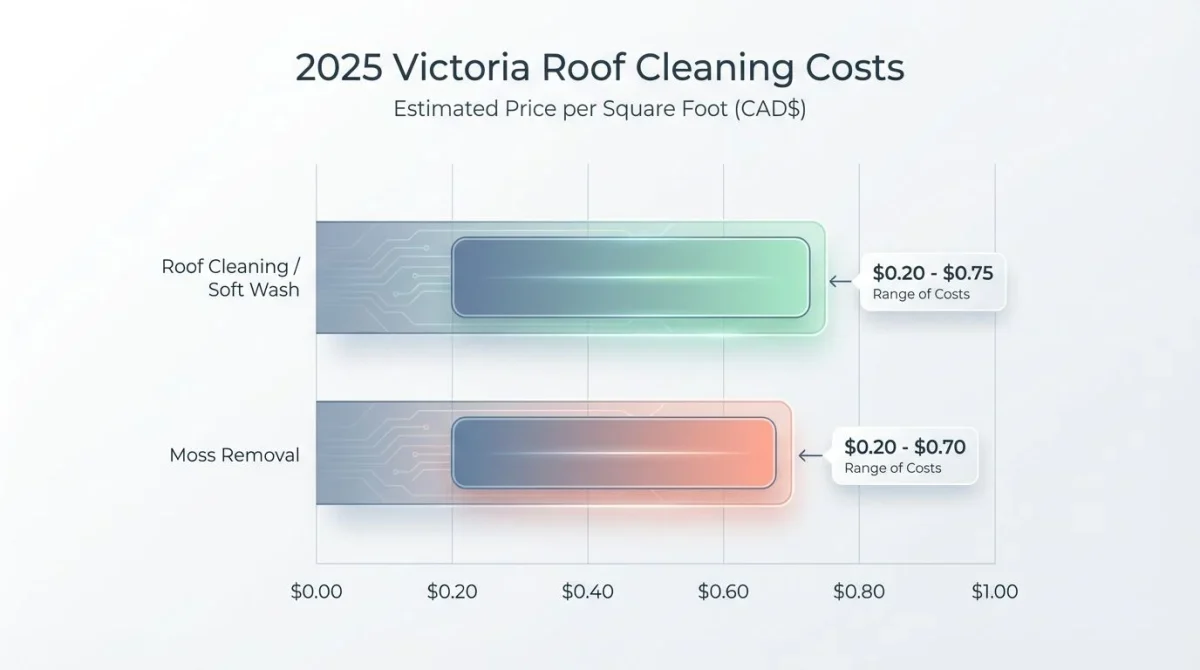
Based on published 2025 pricing from several Victoria-area roof cleaning services, you will often see roof cleaning costs quoted around $0.20 to $0.75 per square foot.
Moss removal commonly lands around $0.20 to $0.70 per square foot depending on the method and severity.
| Item | How it’s commonly priced | What to ask before you say yes |
|---|---|---|
| Roof cleaning / soft wash | $0.20 to $0.75 per sq ft (higher on steep roofs) | Confirm “soft wash” means low pressure on shingles, plus a post-treatment plan. |
| Moss removal | $0.20 to $0.70 per sq ft | Ask whether they remove moss by hand first, and whether treatment is included. |
| Gutter cleaning | Often an add-on or per linear foot | Ask if they flush downspouts and show you blockages (photos help). |
| Solar panel cleaning | Common add-on for solar owners | Ask how they avoid scratching glass and if they check for bird nesting. |
If you are comparing quotes across Greater Victoria—Langford, Colwood, Oak Bay, Sooke, and Sidney—get the scope in writing. Two quotes can look similar on price but include totally different levels of prevention.
What one-time visits usually include
A solid one-time roof cleaning visit prioritizes shingle safety and cleanup, not just speed.
- Manual removal where needed: Careful brushing or hand removal on heavy patches, especially in valleys and along edges.
- Low-pressure wash or rinse: Enough flow to rinse, but not enough pressure to strip granules.
- Targeted treatment: A roof-friendly solution that keeps working after the crew leaves. Spores you cannot see are the real reason moss returns.
- Gutter and valley attention: Debris in valleys and gutters is one of the fastest ways to invite regrowth.
- Access and safety setup: Steep pitches, multi-storey homes, skylights, and tight yards increase setup time.
- Solar panel care: If you have panels, confirm the crew plans access without stepping on modules or snagging wiring.
What “maintenance plans” look like
After a one-time cleaning, a maintenance plan is how you stop the “pay again” cycle.
Many Victoria roof cleaning services advertise moss-free guarantees in the 12- to 24-month range when treatment is included. The fine print often depends on shade, nearby trees, and roof design.
- Annual inspection: A quick check for new colonies, clogged gutters, and areas that stay damp.
- Spot-treatments: Small regrowth gets treated early before it turns into a full roof de-mossing job.
- Clear service timing: Scheduling around fall leaf drop and the wetter months helps you get more value from each visit.
- Defined guarantees: Ask what “counts” as regrowth. Do return visits cover the whole roof or only affected areas?
- Solar-friendly coordination: If you plan solar panel installation, ask the right questions to your solar company to align roof maintenance so you are not cleaning aggressively around new mounting hardware.
How often do homeowners end up paying again with the clean-only approach?
In Victoria, the clean-only approach usually turns into repeat visits. Moss regrowth is fast once conditions return.
A common pattern is a full removal every 3 to 5 years, plus lighter preventive treatments in between. This is especially true on shaded roofs in Langford, Sooke, and other tree-heavy parts of Vancouver Island.
If you want to spend less over time, you need fewer “heavy” cleans. That usually means pairing roof cleaning with a prevention treatment and keeping gutters clear. You don’t want water sitting where moss wants it.
What a 3-5 year deep-clean cycle looks like over 10 years
This is the part most homeowners never map out. Once you add up deep cleans, interim visits, and a few “surprise” call-backs, the long-term spend can be higher than you expect.
| Year Range | Service | Frequency | Typical Outcome | Notes |
|---|---|---|---|---|
| Year 0 | Deep clean + treatment | One major visit | Visible moss removed, roof looks better, regrowth slowed. | Without treatment, regrowth can start quickly in shaded areas. |
| Years 1-2 | Preventive spray or spot work | Every 12-24 months | Small colonies stay small. | Most cost-effective visits tend to be early interventions. |
| Years 3-5 | Second deep clean window | Often needed on clean-only plans | Heavier regrowth returns in valleys and shaded slopes. | If gutters and debris are ignored, this window arrives faster. |
| Years 6-9 | Repeat prevention | Ongoing | Costs add up, but roof stays more stable. | Solar owners often add panel cleaning to these visits. |
| Year 10 | Third deep clean | Depends on prevention | Another major visit is common if you relied on clean-only cycles. | At this point, wear from repeated aggressive cleaning starts to matter. |
What is the real damage risk if moss keeps growing?
Moss holds water like a sponge. When it grows under and around shingles, it can lift edges, keep seams wet, and increase leak risk over time.
For solar-minded homeowners, there is a second cost. Roof issues do not stay isolated. A roof that needs repairs can force solar removal and reinstallation. Even a “small” roof problem can turn into a bigger project once panels are in the way.
On the solar performance side, soiling and biological buildup are real production factors. A September 2025 fact sheet from the IEA PVPS program notes that soiling is responsible for average global energy losses of about 4% to 7%. Keeping your roof and array area cleaner is not just cosmetic.
- Less moisture trapped: Shingles dry faster. This slows moss and algae cycles.
- Fewer forced cleanings: Less brushing and rinsing means less chance of granule loss.
- Cleaner solar environment: Less debris and biological material around the array helps reduce performance losses.
Trapped moisture, lifted shingle edges, and leak risk
If you want a practical way to judge risk, look for “water staying put.” Anywhere water lingers is where moss turns into roof wear.
- Valleys that stay dark and damp: Usually a debris and drainage problem.
- Granules in gutters: A sign the shingle surface is wearing, sometimes from age, sometimes from harsh cleaning.
- Lifted tabs or exposed seams: Moss can wedge into edges and make this worse.
- Recurring moss in the same strip: Often caused by shade patterns or a blocked downspout.
If you see these signs and you are planning solar, deal with the roof first. A stable, moss-managed roof is one of the best “pre-solar upgrades” you can do.
Which moss removal methods can shorten roof life?
Some methods remove moss fast. But they can also remove the protective surface of your shingles.
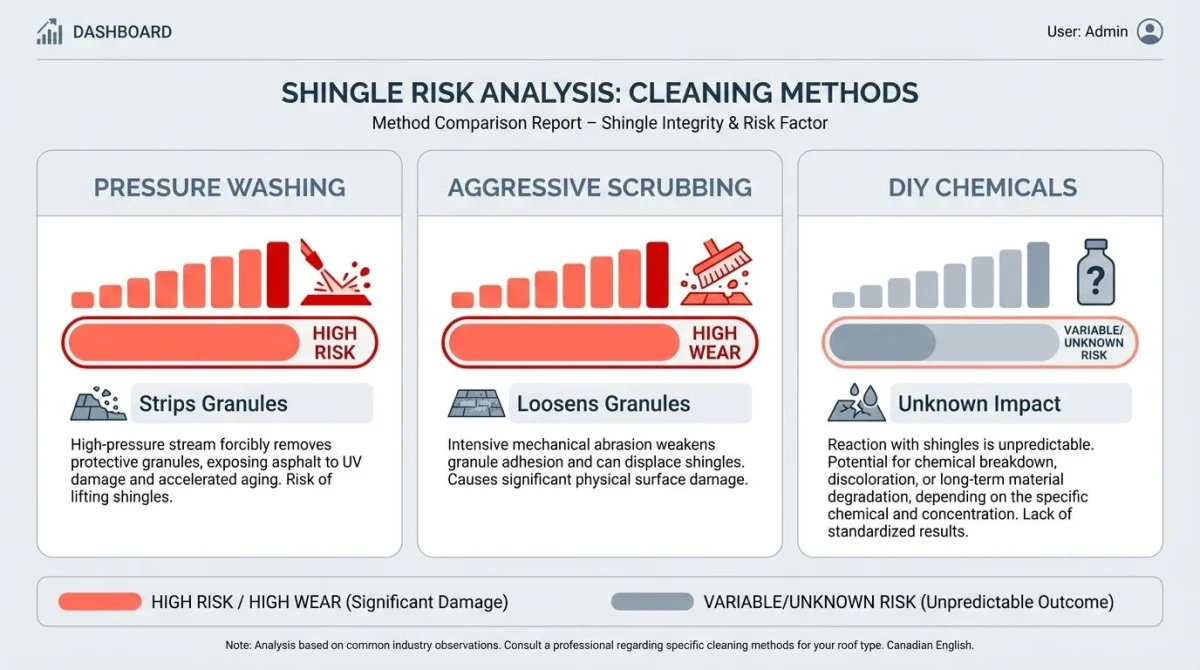
Roofing industry guidance typically pushes “gentle” methods. They warn against aggressive scrubbing that can loosen granules and avoid blasting shingles with high pressure.
| Method | Why it’s tempting | Why it can backfire on shingles |
|---|---|---|
| Pressure washing | Looks instantly “clean” | Can strip granules, force water under shingles, and increase future wear. |
| Aggressive scrubbing | Feels thorough | Friction can loosen granules and shorten roof lifespan. |
| Random DIY chemicals | Cheap upfront | Can damage plants, metals, and roofing materials if misapplied. |
Why pressure washing is risky on asphalt shingles
Roof-safe crews treat moss like biology, not like dirt. They remove what they can gently, then use a treatment approach that keeps working after the visit.
- Manual removal where needed: Careful work around edges, valleys, and roof features.
- Soft wash mindset: Low pressure. The solution does the heavy lifting.
- Post-treatment plan: The goal is to reduce regrowth intervals so you schedule fewer heavy cleans.
- Solar-aware access: If you have panels, crews should plan routes and staging so they do not step on modules or snag wiring.
What’s different about the “free cleaning + GoNano treatment” strategy?
This strategy pairs a standard roof cleaning with a GoNano application. The aim is to make the shingle surface repel water more effectively so the roof dries faster after rain.
The cleaning isn’t “free” in the literal sense—it’s included in the package price so you’re not paying twice.
GoNano pricing is commonly advertised anywhere from about $0.90 to $1.80 per sq ft, depending on the dealer, roof access, pitch, and condition.
- Cleaning resets the roof surface: You remove debris and established growth so the treatment can contact the shingle properly.
- Treatment targets moisture retention: A drier shingle surface tends to slow moss regrowth.
- Solar planning gets easier: Fewer repeat cleanings can mean less disruption around racking and roof penetrations.
How a water-repelling treatment slows moss regrowth
Moss needs moisture contact time. If water beads and sheds faster, shingles often dry sooner. That breaks the moss cycle.
GoNano sellers also commonly state that rain is not an issue shortly after application, but specific cure times vary. Cure and rain timing depends on temperature and roof moisture. Ask the installer what conditions they require for application and drying.
For Victoria roofs, the result is simple: faster drying usually means fewer moss-friendly days on the shaded parts of your roof.
Does GoNano actually help roof life?
This is the right question to ask. Cosmetic cleaning looks good, but it does not automatically reduce wear.
A treatment has a better shot at helping roof life if it reduces how often you need disruptive cleaning. It also helps if it supports drier shingle conditions where moss would otherwise lift edges and hold water.
- Ask for the warranty in writing: GoNano marketing often mentions warranties up to 15 years for asphalt shingle products. Your coverage depends on the specific product and installer terms.
- Confirm compatibility: If your shingles are newer and still under manufacturer warranty, ask whether the installer provides documentation on compatibility. Consider if a nanotech option for old roofs is right for you.
- Get realistic about shade: Even a great treatment struggles if gutters clog and tree debris stays on the roof all winter.
The 10-year cost comparison: Clean-only vs GoNano
Here is a simple way to compare options. Use your own roof size and your own quotes, then swap the numbers.
A key reminder before you do the math: a “2,000 sq ft home” does not always mean a 2,000 sq ft roof surface. Pitch adds area. Use the roof area your contractor quotes.
| Item | Clean-only (example) | Clean + GoNano (example) |
|---|---|---|
| Roof area | 2,000 sq ft (roof surface) | Same |
| Major moss removal | Every 3-5 years | Less frequent if roof stays drier |
| Deep clean budget | $500 to $1,500 per visit | Often bundled into treatment package |
| Preventive visits | Every 12-24 months | Still recommended, often spot-checks |
| GoNano treatment | $0 | $0.90 – $1.80/sq ft ($1,800 – $3,600) |
| Roof replacement | Can run into five figures | Potential to delay replacement |
The goal is not to “win” with one perfect number. The goal is to see whether a prevention-first plan reduces repeat roof moss removal visits enough to justify the treatment cost.
Inputs that matter
If you want your comparison to feel real, lock down these inputs first:
- Cleaning frequency: If your roof needs heavy work every 3 years instead of every 5, your 10-year spend changes fast.
- Quoted method: A soft wash approach and a pressure-based approach may not have the same impact on shingle life.
- Gutter performance: Clogged gutters can erase the benefit of any roof treatment by keeping the roof edge wet.
- Solar plans: If you will install solar panels soon, check a Victoria solar cost calculator to see how roof prep fits your budget.
How long does each option take?
Most roof cleaning work is a “same day” job. The disruption depends on how aggressive the cleaning is and how tight the site access is.
A heavy moss removal visit is louder and messier than a light preventive visit. Crews are physically moving material off the roof and cleaning up debris.
- Noise: Scraping, blowing, and cleanup are the noisiest parts. Ask for a daytime schedule that fits your household.
- Mess and runoff: Moss debris will land somewhere. An organized crew should tarp and clean up carefully.
- Access limits: Ladders and safety lines can block driveways and walkways for a few hours.
- Solar care: If you have panels, confirm the plan for safe access around the array.
Questions to ask before the crew arrives
Ask these questions before the crew arrives. They reduce surprises.
- What is the cleanup standard? Ask if they bag moss, clear valleys, and flush downspouts.
- How do you control runoff? Ask how they control runoff so dirty wash-water and debris don’t end up where they shouldn’t.
- Where are the work zones? A good crew will tape off or clearly mark areas under eaves where debris can fall.
- What about plants and patios? If any treatment is used, ask what they do to protect landscaping and outdoor furniture.
- How do you work around solar? Confirm they will not step on modules and that they understand safe clearances and cable routing.
Stop paying for roof moss removal in Victoria, BC
If you want to stop paying for roof moss removal over and over in Victoria, BC, your best lever is not “a harder clean.” Instead, consider investing in preventive measures that can significantly reduce the frequency of roof moss removal. By choosing a consistent maintenance plan, you can effectively lower your roof moss removal cost victoria bc in the long run. Regular inspections and treatments will help keep your roof clean and extend its lifespan, saving you money and hassle.
It is fewer wet days on the roof. Less debris. And a prevention plan you actually keep.
Start with gutters and shade. Then choose roof cleaning services that use roof-safe methods (soft wash, not pressure). Finally, decide if a roof treatment makes sense for your roof age, solar plans, and budget.
If you are planning solar, treat moss as a performance and maintenance issue, not just a cosmetic one. A cleaner, drier roof is simply easier to own. And easier to build on.
FAQs
1. Why should I stop paying for roof moss removal in Victoria, BC? You can save money by doing simple upkeep and low-cost prevention. Roofs in Victoria, BC get moss fast because of our mild, wet weather. Prevention breaks the regrowth cycle.
2. How can I remove moss safely myself? Use a soft brush and a roof-safe product, then a gentle rinse if needed. Avoid pressure washing asphalt shingles. Work from the ridge down so you do not lift shingles. In this city, many homeowners find these steps cut the need for professional moss removal.
3. When should I call a pro instead of handling it myself? Call a contractor if your roof is steep, has broken shingles, or moss covers large areas. Safety on wet roofs is serious business.
4. What cheap fixes reduce future roof moss removal costs? Keep gutters clear, trim overhanging branches, and fit zinc or copper strips near the ridge. These steps lower moss growth and cut long-term moss removal bills. For more details on local maintenance, check our Vancouver Island solar questions guide.