
Solar Panels Richmond 2026: Cost, Rebates, Roof Risks And Quote Math
June 20, 2026
Solar Panels Saanich 2026: Cost, Rebates, Permits And Quote Checks
June 21, 2026Last Updated on June 22, 2026 by Vitaliy
If you are pricing solar panels in Surrey in 2026, the real question is not whether solar works here. It is whether the quote fits your roof, your BC Hydro usage, Surrey’s permit process and the new self-generation rules.
A weak quote can still look polished. It may use a high system size, assume old net metering economics, skip roof work, bury permit costs, or treat a battery like automatic whole-home backup. That is where Surrey homeowners can lose money before the first panel is installed.
Key Takeaways
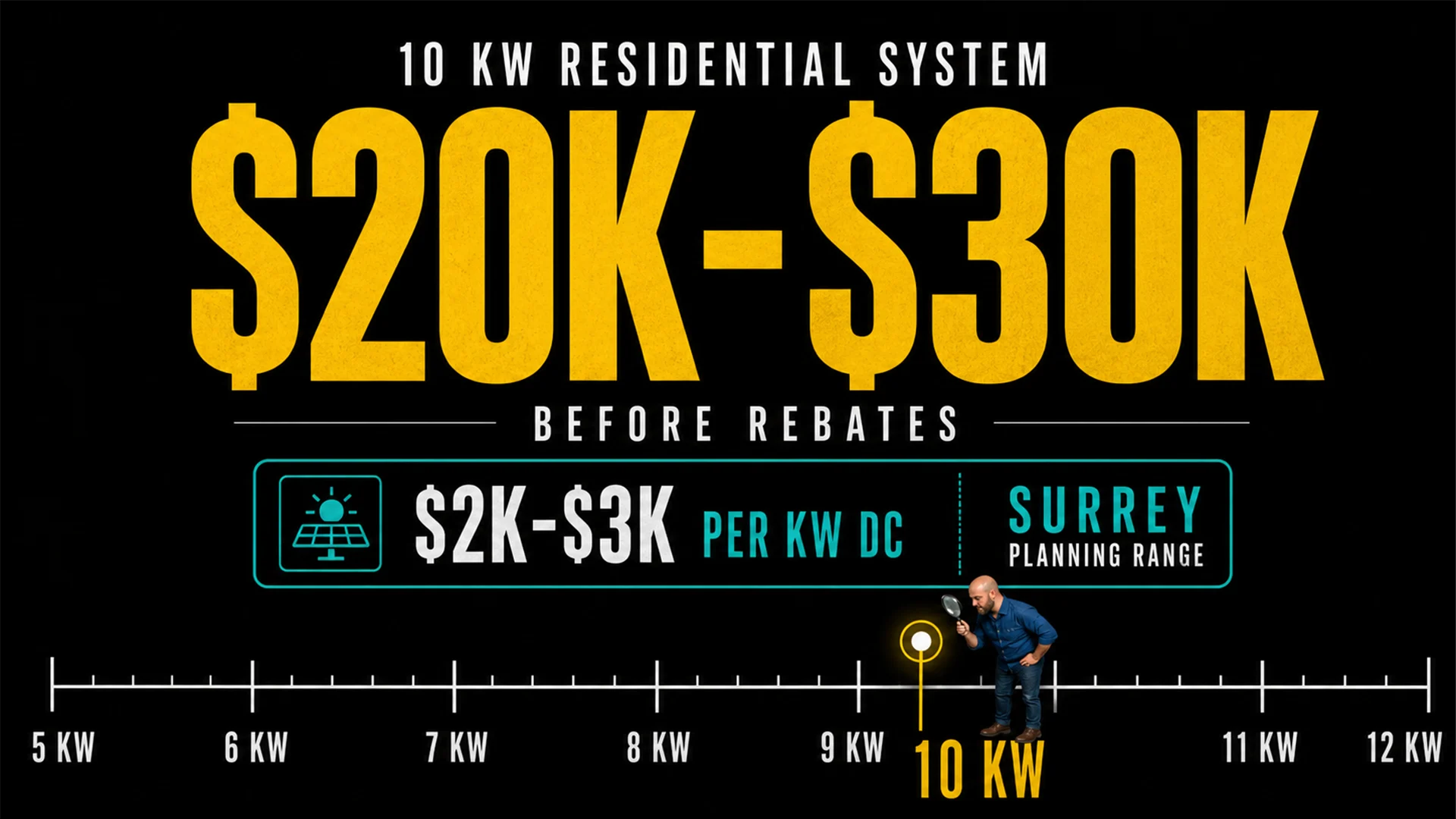
- BC Hydro says typical B.C. solar PV project costs range from about $2,000 to $3,000 per kW DC installed, with a 10 kW residential system typically costing $20,000 to $30,000 before rebates. See BC Hydro’s solar panel cost guidance.
- The City of Surrey requires a building permit for solar panels on existing buildings, and an electrical permit is required for all solar panel installations. See Surrey’s solar panel installation permit requirements.
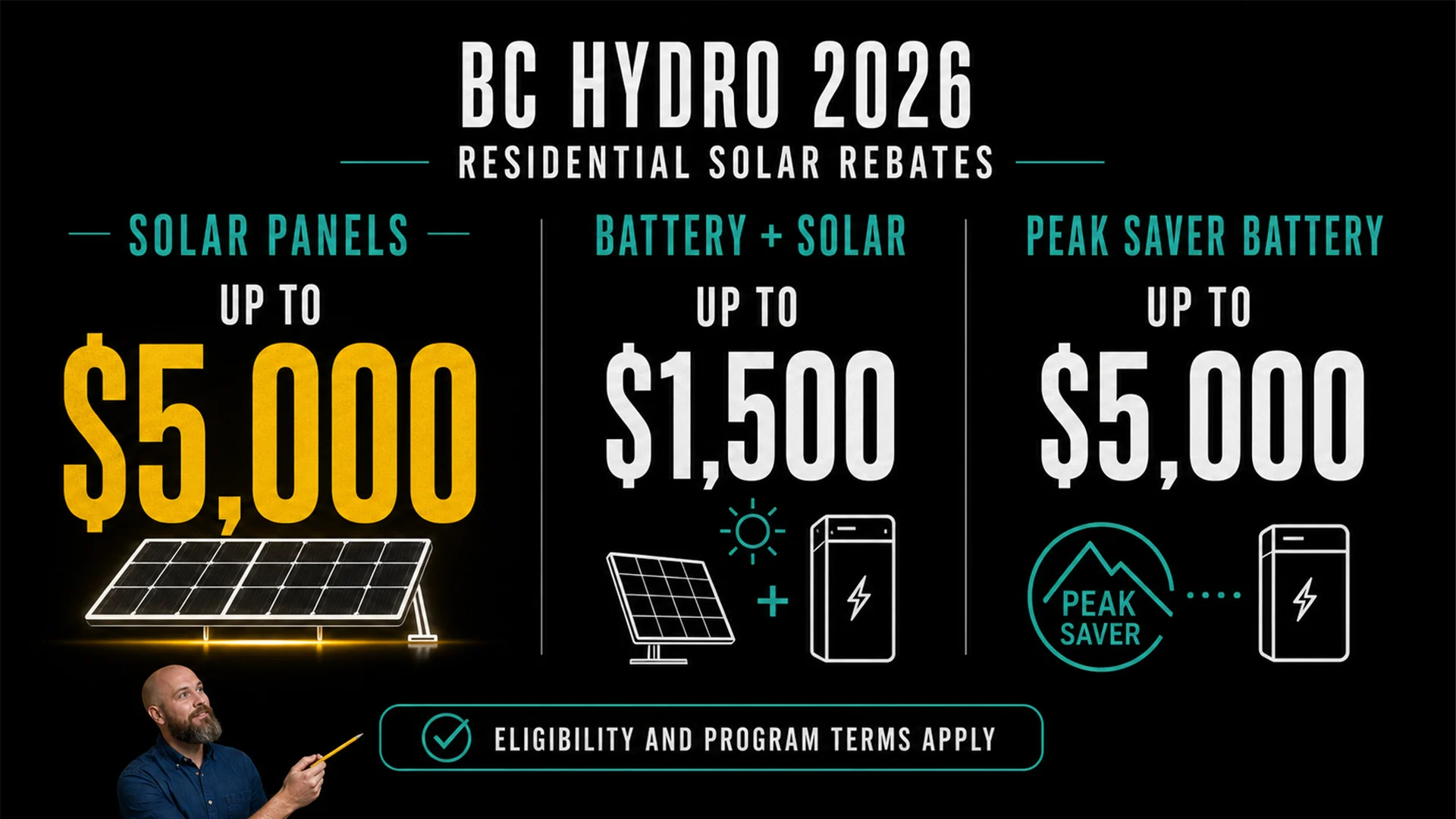
- BC Hydro currently lists residential rebates of up to $5,000 for eligible solar panels, with separate battery rebate rules. See BC Hydro solar and battery rebates.
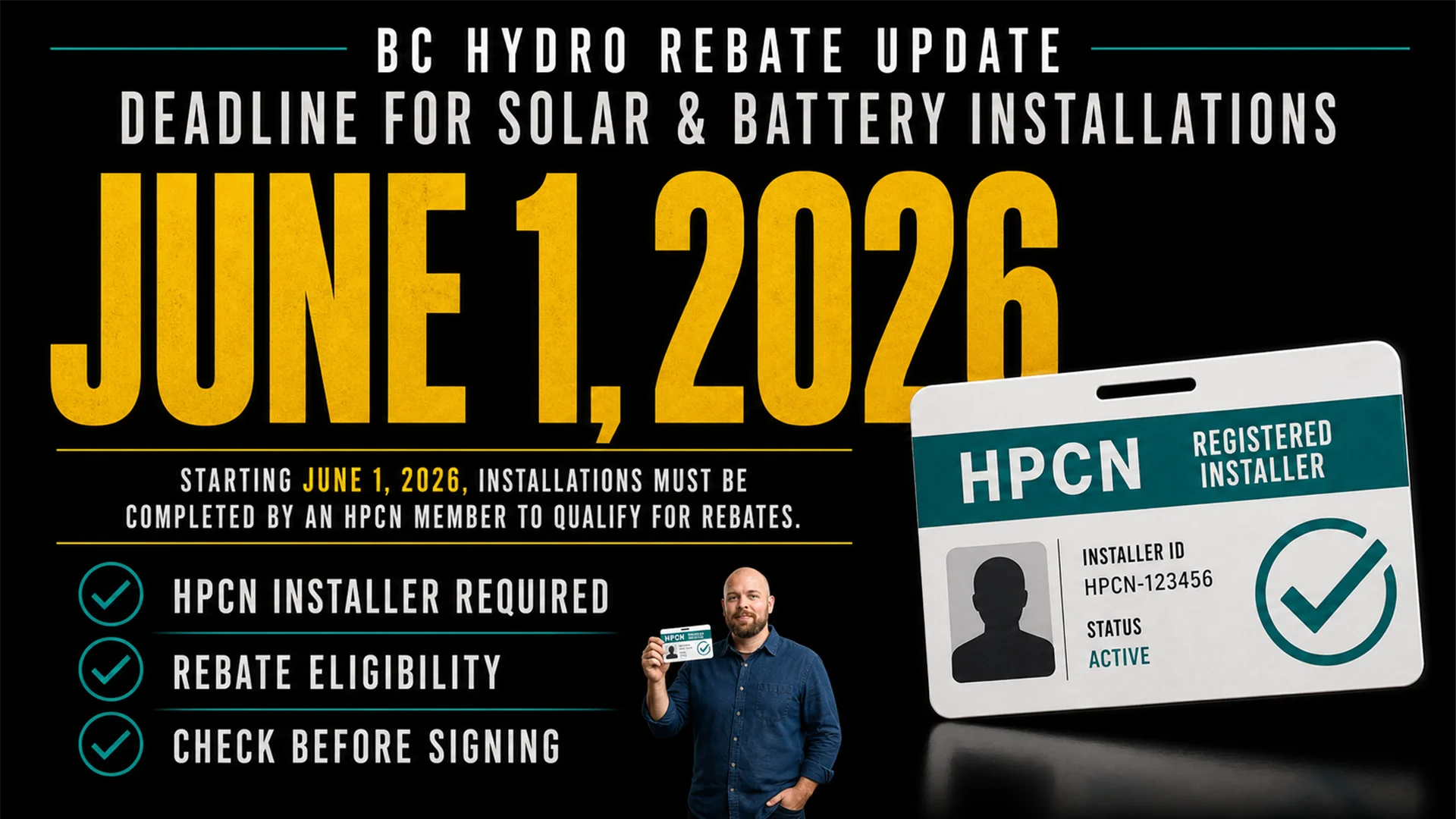
- Beginning June 1, 2026, BC Hydro says solar and battery installations must be completed by a Home Performance Contractor Network member to qualify for rebates. Check BC Hydro’s contractor requirement.
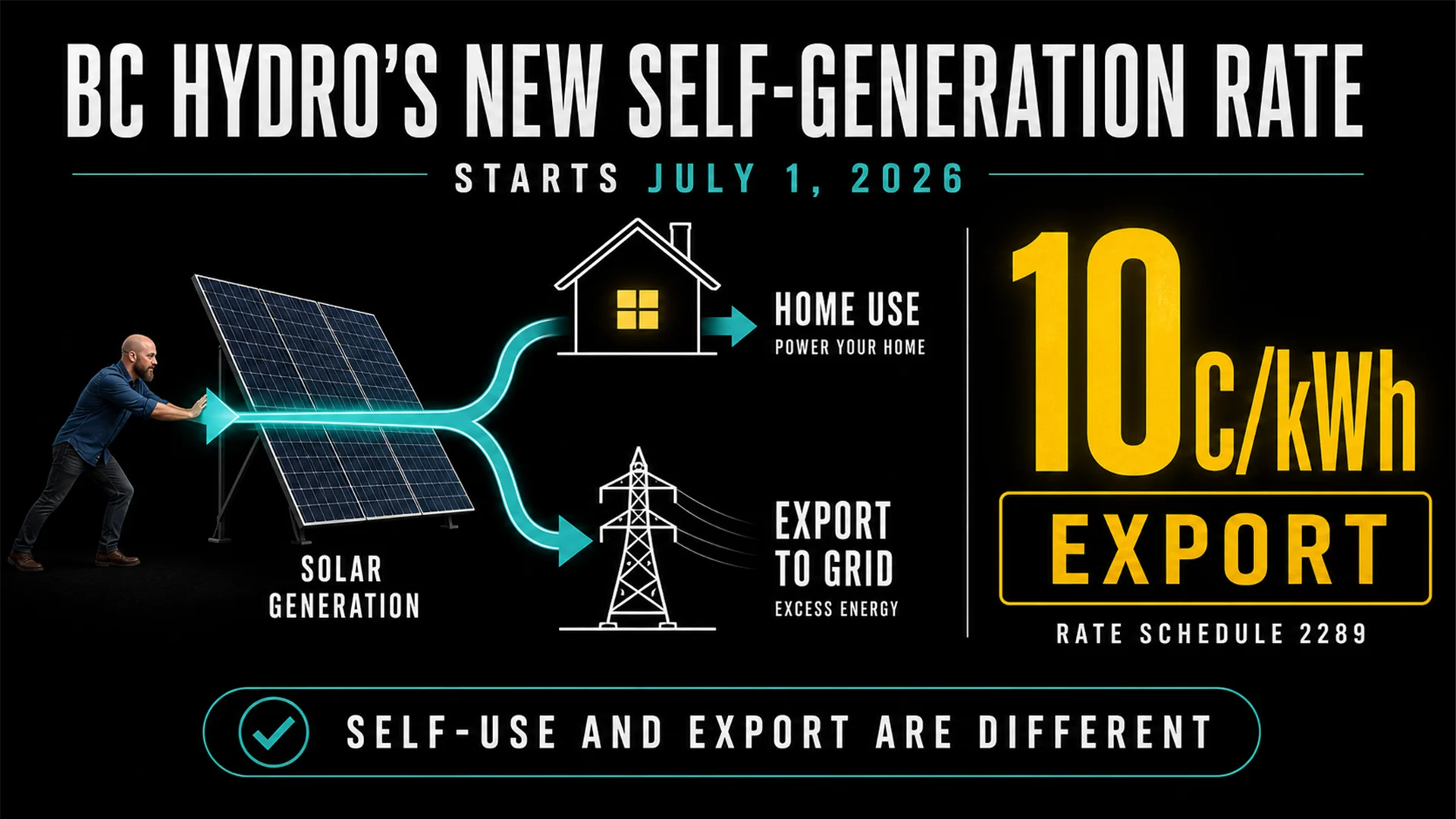
- Effective July 1, 2026, BC Hydro says new self-generation customers move under Rate Schedule 2289, where exported excess energy is purchased at 10 cents per kWh and credited each billing cycle. See BC Hydro’s self-generation rate update.
Is Solar Worth It In Surrey?
Solar can be worth it in Surrey when three things line up: you have enough electricity use, the roof is ready for a long-term installation, and the quote is sized for your actual bill instead of a sales target. Many residents in Victoria are taking advantage of free solar panel programs in Victoria to reduce their energy costs. These initiatives not only promote renewable energy but also contribute to lower carbon footprints. As a result, communities are becoming more sustainable while saving money on electricity bills.
The best Surrey candidates are usually homes with EV charging, heat pumps, air conditioning, electric hot water, secondary suites, hot tubs, home offices or larger family loads. These homes have more electricity to offset directly. A smaller home with low BC Hydro bills, a shaded roof or older shingles may still be a poor fit, even if the rebate looks attractive.
A common concern is that Surrey and the Lower Mainland are too cloudy for solar. The concern is fair, but the better question is not “Does Surrey get sunshine like Kelowna?” It is “What annual production does this specific roof support?” A bright, cool day can still produce useful solar energy, while shade from trees, roof faces, chimneys and neighbouring buildings can hurt the numbers more than general rain does.
Tip for Surrey homeowners: Pull 12 months of MyHydro data before talking to installers. Ask each company to size the system from your actual kWh use, not from an average Surrey household.
Solar Panels Surrey Cost In 2026
Using BC Hydro’s published B.C. cost guidance, a Surrey homeowner can use this as a planning range before project-specific adders.
| System size | Good fit in Surrey | Gross planning range | Possible solar rebate | Net planning range |
|---|---|---|---|---|
| 5 kW | Smaller detached home, lower usage | $10,000 – $15,000 | Up to $5,000 | $5,000 – $10,000 |
| 8 kW | Typical detached home with moderate usage | $16,000 – $24,000 | Up to $5,000 | $11,000 – $19,000 |
| 10 kW | EV, heat pump, suite or larger family | $20,000 – $30,000 | Up to $5,000 | $15,000 – $25,000 |
| 12 kW | High-use home with strong roof space | $24,000 – $36,000 | Up to $5,000 | $19,000 – $31,000 |
Surrey-specific adders can include structural drawings, roof work, main panel upgrades, service upgrades, permit fees, battery backup equipment and extra labour on complicated roofs. A lower quote is not always better if it leaves those items vague.
If you want a quick first check, use the SolarEnergies.ca online solar calculator before collecting quotes. Then compare at least a few detailed proposals side by side so you can see system size, equipment, warranty, production estimate, financing terms and permit scope in one place. Solar panel costs in Saanich 2026 are expected to vary based on regional demand and available incentives. Homeowners should stay informed about local grants and subsidies that could significantly reduce expenses. As technology continues to evolve, the efficiency of solar panels may improve, further impacting overall costs.
Rebates, Batteries And BC Hydro Self-Generation Rules
BC Hydro lists the residential solar rebate as $1,000 per kW of installed generator capacity, capped at 50% of installed product cost, with a maximum solar rebate of $5,000. Program terms can change, so confirm the current rebate page before signing.
Battery rebate rules changed April 1, 2026:
| Battery setup | 2026 BC Hydro rebate |
|---|---|
| Battery paired with solar | Up to $1,500 |
| Battery enrolled in Peak Saver | Up to $5,000 |
| Battery only, not enrolled in Peak Saver | Not eligible |
Beginning June 1, 2026, BC Hydro requires solar and battery installations to be completed by an HPCN member for rebate eligibility. This should be one of your first installer questions, not something checked after the contract is signed.
BC Hydro’s self-generation rules also change on July 1, 2026. Rate Schedule 1289 closes to new customers once Rate Schedule 2289 starts. Under the new self-generation rate, exported excess energy is purchased at 10 cents per kWh and credited each billing cycle.
That makes right-sizing more important. A 12 kW solar system can look impressive, but it may not beat an 8 kW or 10 kW system if the extra production mostly gets exported instead of offsetting power you would otherwise buy from BC Hydro.
The rebate detail also matters. BC Hydro says customers who receive the solar rebate will be transitioned to Rate Schedule 2289 when it begins. If you are comparing a quote that assumes old-style kWh banking, ask the installer to show the math under the 2026 self-generation rate.
Surrey Permits And Roof Fit
Surrey has a specific solar panel permit process. The City says solar panels on existing buildings require a building permit, and all solar panel installations require an electrical permit. The building permit package can include roof plans, elevations, structural drawings, electrical drawings and signed professional schedules.
This is why the roof conversation has to happen early. If your shingles are near the end of life, solar may need to wait or the roof should be replaced first. Removing and reinstalling panels later can be expensive, and a quote that ignores roof age is not giving you the full project cost.
A fair worry is roof penetrations and leaks. The practical answer is not to avoid the question. Ask what mounting system will be used, who is responsible for flashing, whether the installer has experience with your roof type, how roof warranty issues are handled, and whether standing-seam metal roof options make sense if you are already planning a roof replacement.
Tip for Surrey homeowners: Take photos of your roof, attic access, electrical panel and meter before your quote calls. It helps installers flag roof, structural and electrical issues before they price the system.
What A Good Surrey Solar Quote Should Include
A proper Surrey quote should show who handles:
- City of Surrey building permit
- Electrical permit
- Structural review or engineering, if required
- BC Hydro self-generation application
- Rebate documentation
- Final inspection and commissioning
- Roof exclusions, if any
- Electrical panel or service upgrade assumptions
The quote should also show expected annual kWh production, expected self-consumption, expected export, the rate assumptions used, and whether the system is sized for current use or future upgrades.
If a system is sized around a future EV, heat pump or suite, ask for two cases: your current load and the future-load case. That keeps the decision honest if the upgrade is delayed.
Project Numbers And Bill Context
The current Surrey example in the draft is a 10.0 kW residential system. That is a useful planning size because BC Hydro also uses 10 kW as its typical residential cost example in B.C.
Here is the conservative way to think about bill value. Exported excess under Rate Schedule 2289 is worth 10 cents per kWh. Electricity you use directly from your own solar can be worth more because it offsets power you would otherwise buy from BC Hydro. The exact value depends on your residential rate choice, your usage pattern and how much solar you use at home instead of exporting.
For a rough comparison, 10,000 kWh exported at 10 cents per kWh would be worth about $1,000. If more of that generation offsets higher-value household consumption, the value can rise. That is why the quote should split production into self-use and export instead of giving one broad savings number.
This is also where many homeowners get stuck on payback. A 15- to 20-year payback may be unacceptable for one household and fine for another if the family plans to stay, wants lower long-term energy costs, has an EV or heat pump, or values backup options. The right answer depends on the real quote, not the average.
Batteries, Backup And Off-Grid Expectations
Battery storage can be useful, but it is not automatically worth it for every Surrey home. A battery can help with backup power or shifting solar use into evening hours. It can also add a lot of cost.
Ask exactly what the battery backs up during an outage. Whole-home backup, selected critical loads and limited backup for a few circuits are different designs. A battery quote should name the backed-up loads, expected runtime, whether the system can recharge from solar during an outage, and which rebate path is being assumed.
Going fully off-grid in Surrey is usually not the practical goal for a normal grid-connected home. Most homeowners are comparing grid-tied solar, maybe with battery storage, against their current BC Hydro bill. If an installer talks about energy independence, ask for the actual backup-load design and costs.
What Can Go Wrong With A Solar Quote In Surrey?
The most common problems are practical:
- The quote ignores roof age or shade.
- The proposal assumes outdated export economics.
- The installer is not an HPCN member after the June 1, 2026 rebate requirement.
- The battery is sold without a backup-load plan.
- Permit, engineering, electrical upgrade or service upgrade costs are missing.
- The quote uses an average household instead of your MyHydro data.
- The financing terms hide a higher installed price.
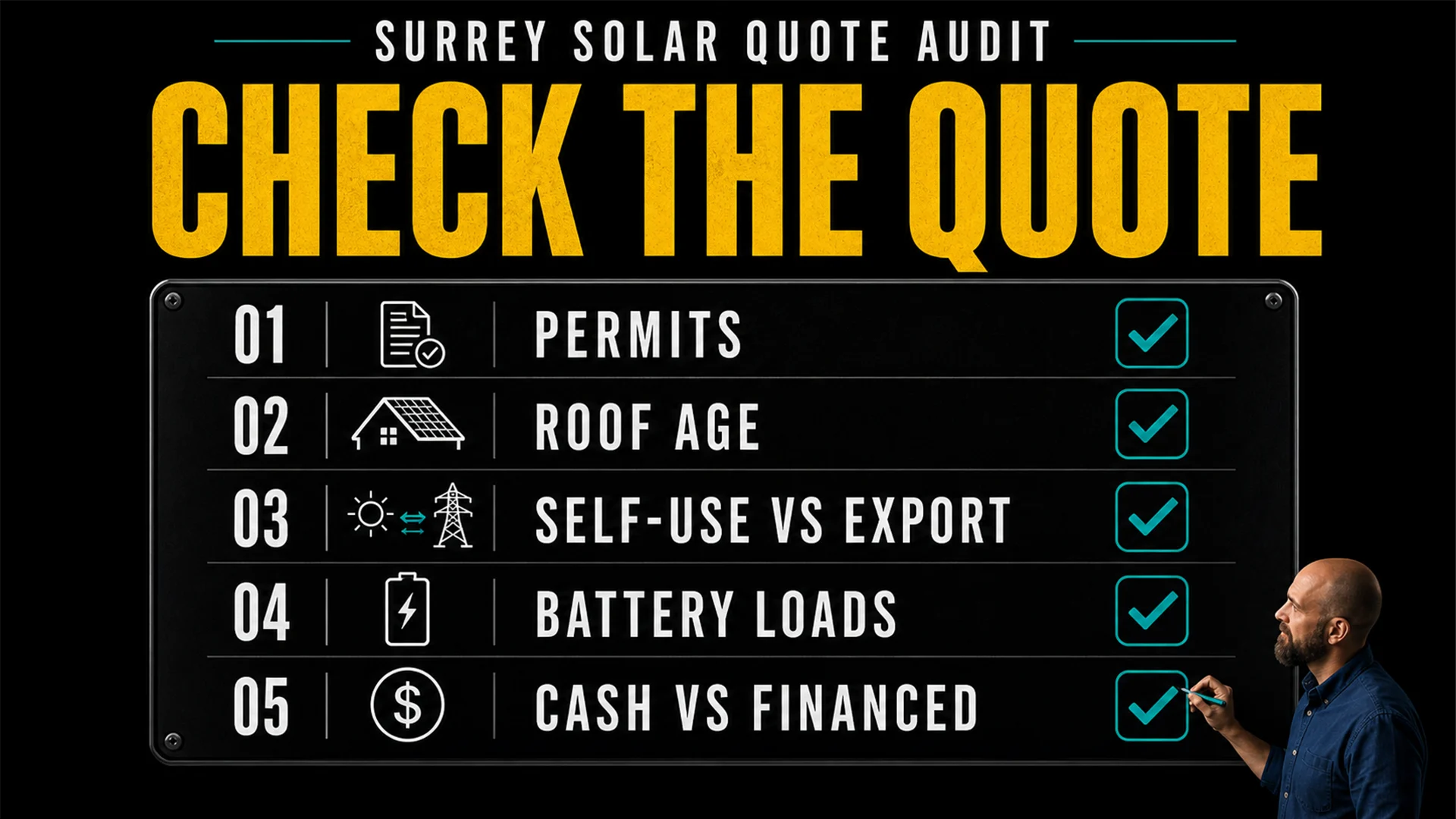
Tip for comparing quotes: Ask for the cash price and financed price separately. Available financing options may include 0% financing with $0 down payment where approved, but the proposal still needs to show the real installed cost, payment terms and assumptions.
How To Choose A Surrey Solar Installer
Ask these before signing:
- Are you an HPCN member, and will that remain true at installation?
- Who handles the Surrey building permit and electrical permit?
- What annual kWh production are you estimating?
- How much of that production do you expect me to use directly?
- How much do you expect me to export under Rate Schedule 2289?
- What roof condition assumptions are in the quote?
- What happens if structural review or electrical inspection finds extra work?
- Is battery storage optional, and what loads does it back up?
- What is the cash price versus financed price?
- Can you show recent Lower Mainland or Surrey solar installations with similar roof conditions?
For a deeper contractor screen, use these questions to ask solar companies before your installation goes wrong.
SolarEnergies.ca can connect you with certified installers who have completed 14,000+ installs across Canada, so you can compare real options instead of guessing.
Final Surrey Quote Review
Before signing, compare every Surrey proposal against your own BC Hydro bill, not against a generic savings chart. A credible quote should show your annual usage, estimated annual solar production, expected self-consumption, expected export, the rate assumptions used for each and the permit path.
Surrey homeowners should also check the permit path early. Because the City has a specific solar permit process, a quote that leaves “permits by owner” vague is not ready. Ask whether structural drawings are included, whether the electrical permit is included and whether the installer will coordinate the BC Hydro self-generation application.
Finally, ask what happens if rebate timing changes, the roof fails review or the electrical panel needs work. The answer should be practical. Solar can be a good fit in Surrey, but it should be priced like a construction project with paperwork, inspections and clear numbers.
FAQ
Are solar panels worth it in Surrey?
They can be, especially for homes with EV charging, heat pumps, suites, air conditioning, electric hot water or high daytime use. Low-use homes with shaded roofs may see slower payback.
The best first step is to check 12 months of BC Hydro usage and compare that against a roof-specific production estimate.
How much do solar panels cost in Surrey?
Using BC Hydro’s B.C. guidance, plan around $2,000 to $3,000 per kW DC before rebates. A 10 kW residential system typically costs about $20,000 to $30,000 gross before project-specific adders.
Surrey costs can increase if the project needs roof work, structural drawings, main panel upgrades, service upgrades, batteries or more complicated permitting.
Does Surrey require permits for solar panels?
Yes. The City of Surrey says solar panels on existing buildings require a building permit, and an electrical permit is required for all solar panel installations.
Ask the installer to state in writing who handles the building permit, electrical permit, structural documents and final inspection process.
What rebate can Surrey homeowners get in 2026?
BC Hydro currently lists up to $5,000 for eligible residential solar panels. Battery rebates depend on the battery setup and Peak Saver enrollment. Solar panel costs in British Columbia can vary based on various factors such as the type of installation and local incentives. In addition to the rebates offered by BC Hydro, some municipalities have their own programs that may further lower the overall expenses. Understanding all available financial assistance options is essential for homeowners considering solar energy solutions.
Do not treat the rebate as automatic. Eligibility depends on current program terms, documentation, contractor requirements and the timing of your application and installation.
Do I need an HPCN installer?
For BC Hydro rebate eligibility after June 1, 2026, yes. BC Hydro says solar and battery installations must be completed by an HPCN member.
Ask for the contractor’s current HPCN status before signing and again before installation if your project timeline stretches out.
Do solar panels work in Surrey’s cloudy climate?
Yes, solar panels can still produce electricity in Surrey, but roof-specific production matters more than general weather talk. Shade, roof direction, roof pitch and annual kWh use can change the result.
Ask for a production estimate based on your roof, not a broad Lower Mainland average.
Should I add a battery?
Only if backup power, Peak Saver participation or evening self-use is worth the extra cost for your home. A battery is not automatically whole-home backup.
Ask which loads are backed up, expected runtime, whether solar can recharge the battery during an outage and which rebate assumption is included.
What is the biggest Surrey solar quote mistake?
Accepting a quote without checking permits, roof condition, self-generation rate assumptions, HPCN eligibility, electrical upgrade costs and financing terms.
The cheapest quote can become expensive if it leaves out work you will still need.
Should I size solar for a future EV or heat pump?
Yes, if the upgrade is realistic and likely soon. Ask the installer to show both your current-load case and future-load case.
If the future EV or heat pump is only a maybe, oversizing too far can push more generation into export at the lower self-generation credit.
Can I go off-grid with solar panels in Surrey?
Most Surrey homeowners should think in terms of grid-tied solar, not full off-grid living. A true off-grid setup usually needs more panels, more battery capacity, backup planning and lifestyle compromises.
If backup power is the goal, ask for a battery design that lists the exact circuits and appliances that stay on.
What should Surrey homeowners prepare before getting quotes?
Have 12 months of BC Hydro usage, roof age, roof photos, main electrical panel photos, planned EV or heat-pump upgrades and any suite or laneway-load details ready.
That gives installers enough information to quote the real property instead of guessing.