13,000 Nova Scotia Solar Customers Can’t All Be Wrong: Why Rooftop Solar Keeps Growing in Atlantic Canada
April 12, 2026
How to Spot a “Fuck-Off” Solar Quote in Canada Before You Sign Anything
April 20, 2026Last Updated on April 14, 2026 by Vitaliy
Bad roof. Wrong angle. Too much shade. Too many vents. Too small. If that sounds familiar, our look at older B.C. roofs and solar fit is worth a read too. That’s where a lot of solar conversations in B.C. die, and most homeowners never even get a second option. Science World just shoved that old thinking aside. Vancouver’s landmark science centre has installed B.C.’s first vertical solar array as part of a major retrofit, and that matters because it proves one simple point: a roof is useful, but it’s not the only surface that can earn its keep. (BC Hydro)
Key takeaways
- Science World’s vertical array is real, measurable, and local, with 76 vertical panels expected to generate about 15,000 kWh a year. (BC Hydro)
- Vertical solar is strongest on difficult sites, not on perfect roofs. Shading, layout, and orientation decide whether it works. (ScienceDirect)
- BC Hydro’s July 1, 2026 rate change makes self-consumption more important, which can improve the case for morning-and-afternoon production profiles. (BC Hydro)
- Permits and contractor rules matter more for wall, yard, and detached vertical layouts, especially in Vancouver. (City of Vancouver)
What Science World actually installed
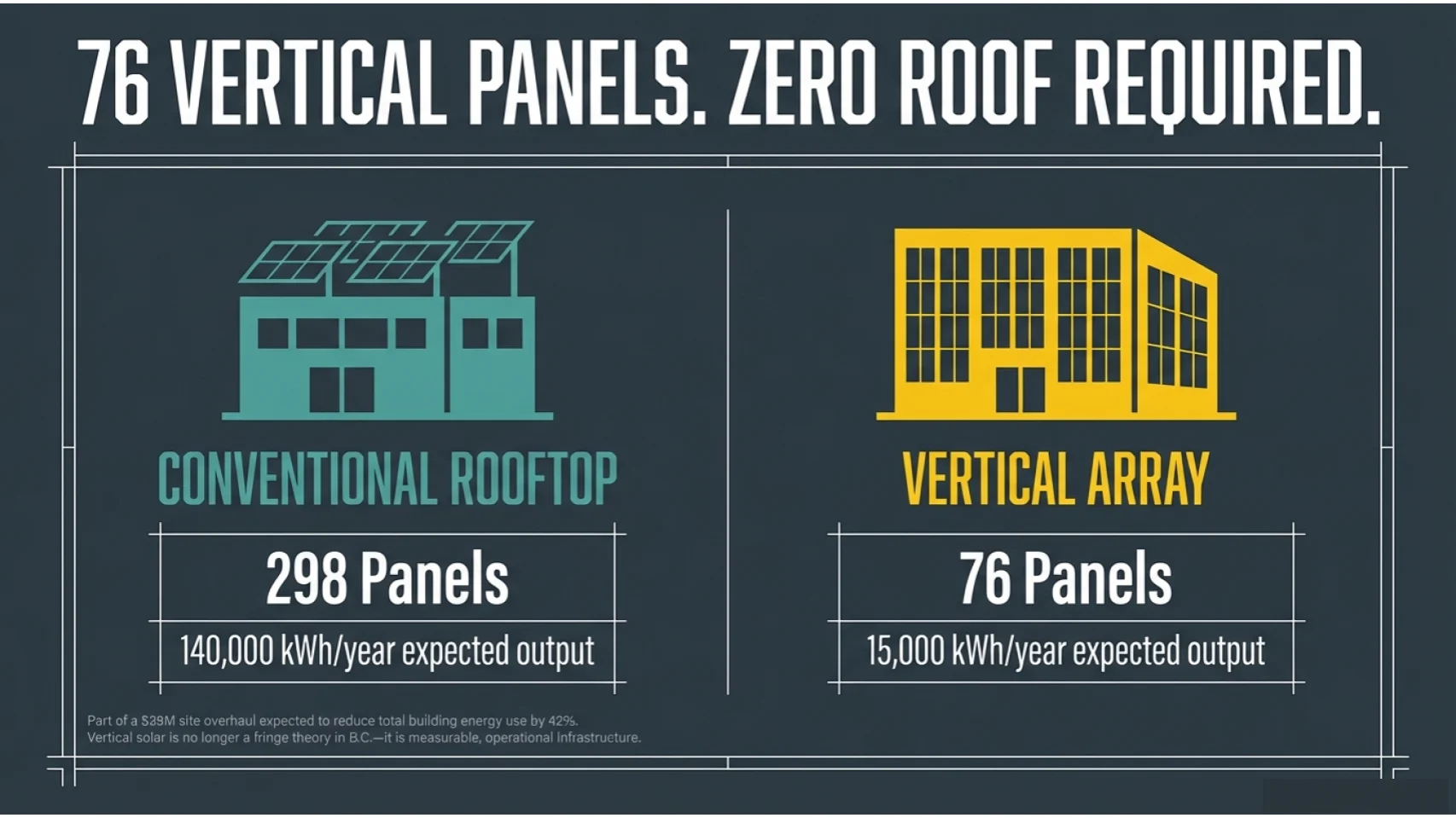
Science World’s retrofit is not a tiny demo stuck in a corner for headlines. BC Hydro says the site now includes 76 vertical panels and 298 conventional rooftop solar panels inside a broader $39 million overhaul, and the whole project is expected to cut building energy use by about 42%. Better yet, BC Hydro’s feature story says the new standard rooftop array is expected to produce about 140,000 kWh a year, while the vertical system is expected to add another 15,000 kWh a year. That’s not a gimmick. That’s measurable production. (BC Hydro)
| Science World solar fact | Verified figure |
|---|---|
| Vertical panels | 76 |
| Rooftop PV panels | 298 |
| Expected vertical output | 15,000 kWh/year |
| Expected new rooftop output | 140,000 kWh/year |
| Expected energy-use reduction | 42% |
| Total retrofit budget | $39 million |
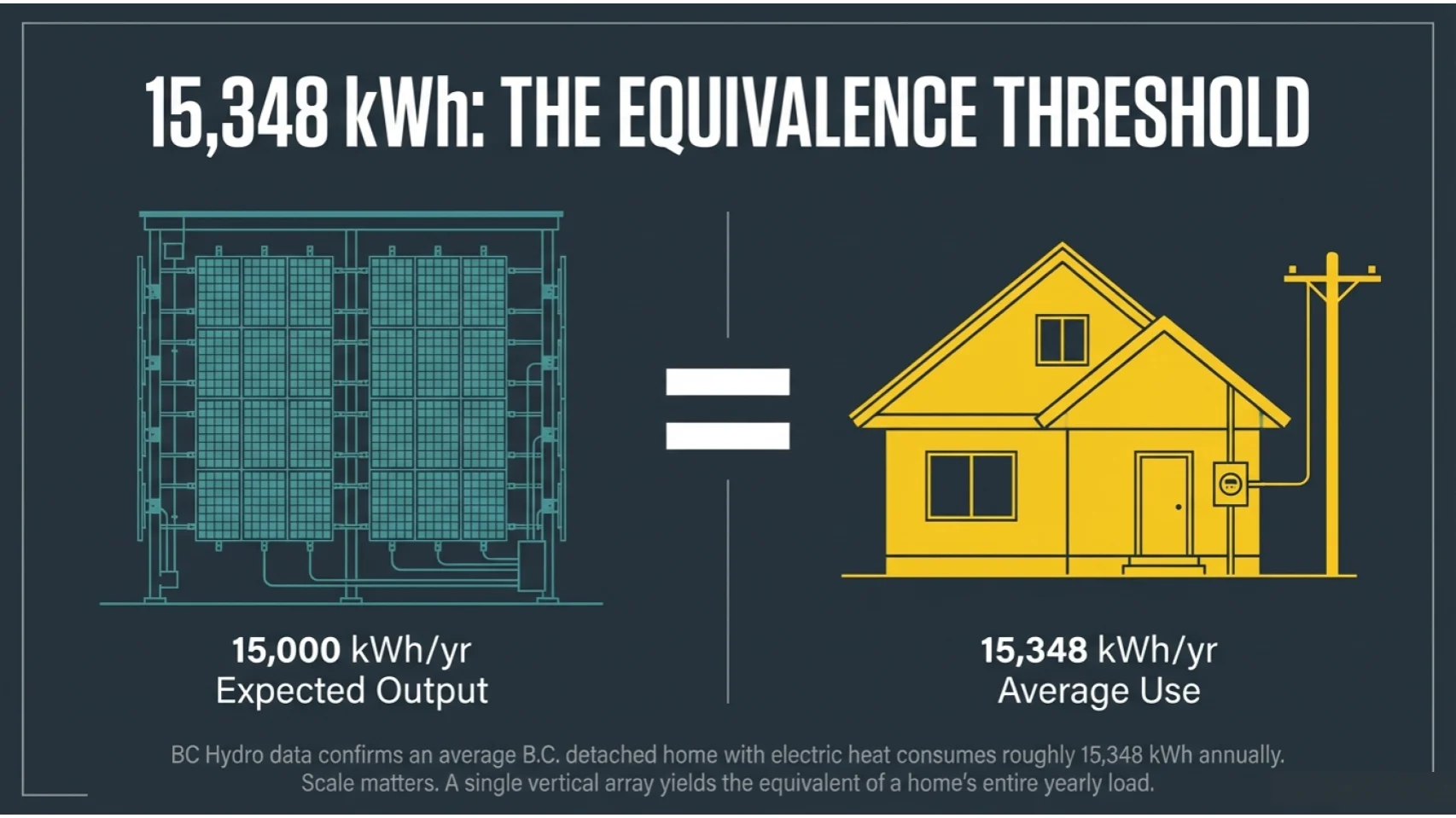
One more number matters. BC Hydro says a detached single-family home in B.C. with electric heat uses an average of 1,279 kWh a month, or roughly 15,348 kWh a year, which means the projected output from Science World’s vertical array lands in the same rough range as a year of electricity use for one electric-heated house. Scale matters. So does context. (BC Hydro)
Why vertical solar changes the conversation
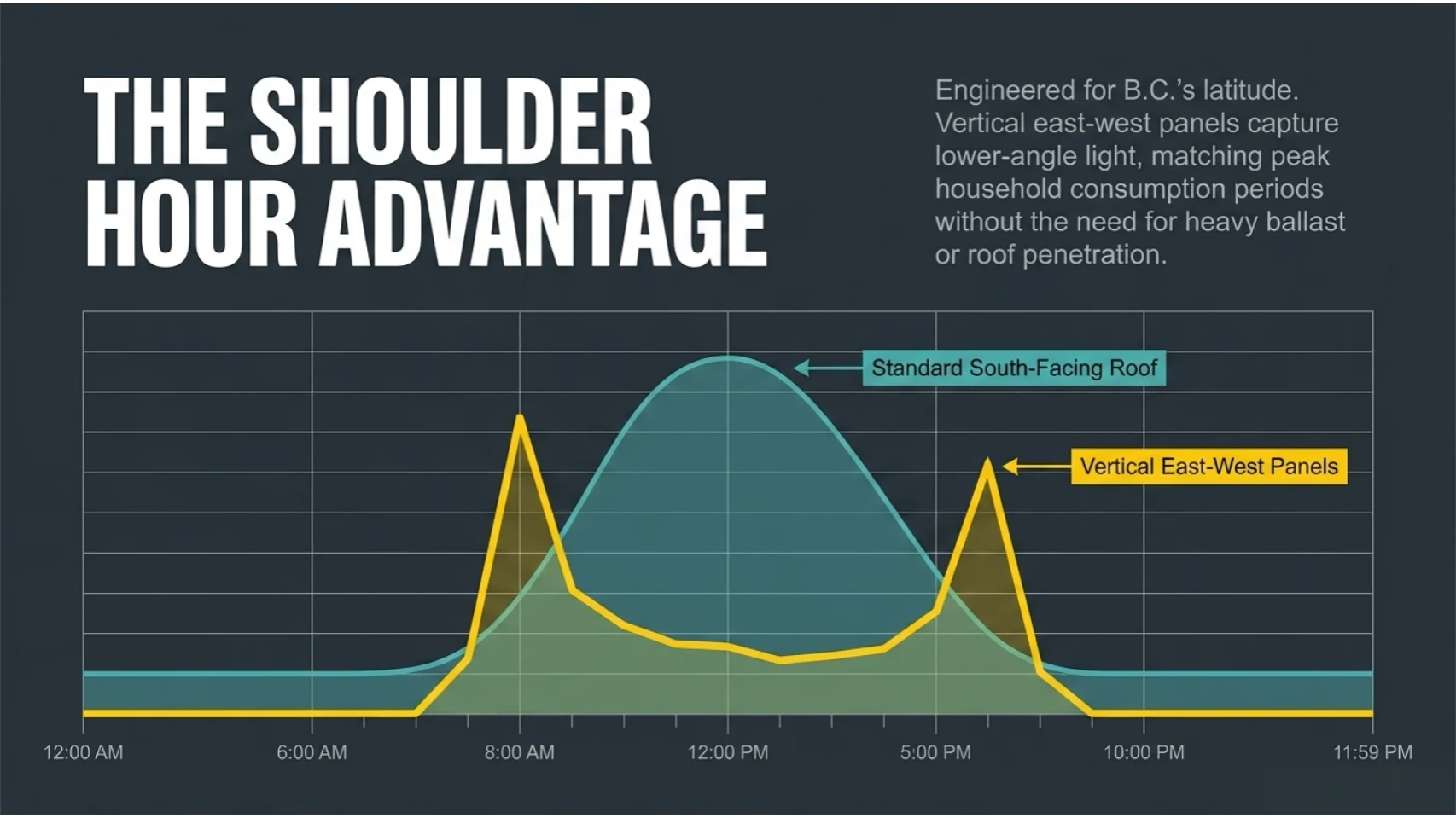
Science World’s vertical panels face east and west to catch lower-angle light in the morning and late afternoon. That design choice is the whole story. BC Hydro says the pilot is meant to test performance in low-sunlight, low-angle sun, and snowy conditions, and its innovation team adds that these modules are being studied because they can reduce the need for roof penetration, heavy ballast, and expensive structural work. (BC Hydro)
That’s useful in B.C. Fast.
A lot of homes in Vancouver, Burnaby, North Van, Victoria, and new infill areas don’t have that clean, wide, south-facing roof installers like to show in sales decks. Plenty have chopped-up rooflines, partial tree cover, skylights, dormers, or roofs facing the wrong direction. Commercial buildings run into a different problem: flat roofs packed with HVAC gear, vents, access paths, and load concerns. Vertical solar won’t fix every one of those limits. It does give designers another tool. That alone makes it worth taking seriously. (BC Hydro)
I’ve seen this go sideways more than once. A homeowner gets one quote, the installer glances at the roof, says the site is weak, and that’s the end of it. No wall option. No detached structure option. No alternate layout. That same problem shows up in our piece on solar siding and cladding options for Canadian homes. Just a dead project. That’s poor design work. Science World makes it harder for lazy quoting to hide.
Research says vertical solar can work. It also says don’t get careless.
Published research on vertical bifacial solar is actually pretty clear. A long-cited global analysis found that vertical east-west bifacial performance depends heavily on latitude, diffuse light, and ground reflectivity, which fits B.C. far better than the old “cloudy means pointless” line. Another study focused on high-latitude urban neighborhoods found that vertical bifacial systems can match household consumption better during the day, but shading from nearby buildings and trees can crush results if the site is wrong. (ScienceDirect)
That means two things are true at the same time.
Vertical solar can be smart in B.C. (ScienceDirect)
Vertical solar can also be a bad buy on the wrong property. (Frontiers)
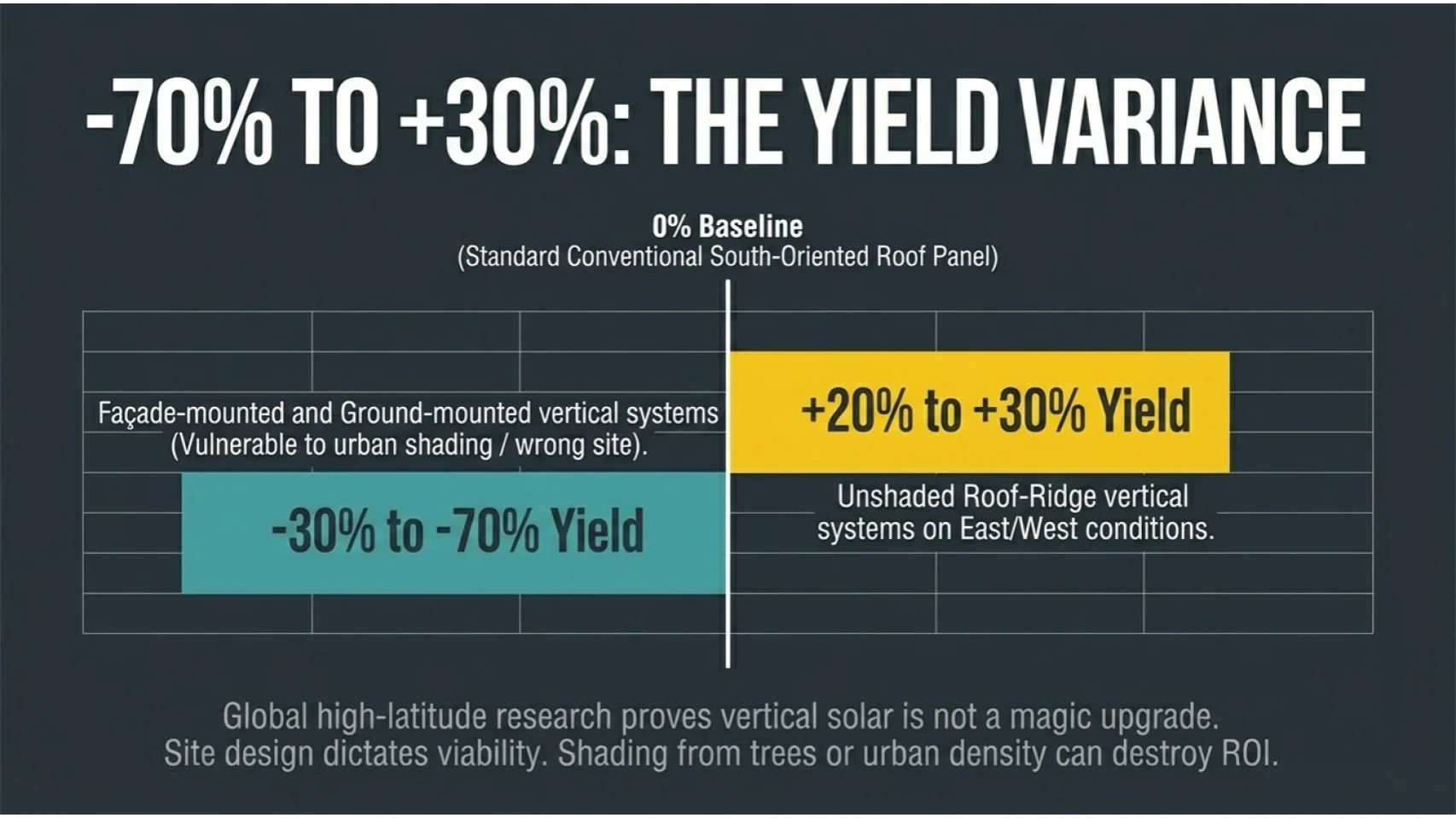
Research from the Helsinki study is blunt: façade-mounted and ground-mounted vertical systems can lose 30% to 70% compared with roof-ridge vertical systems depending on where they’re installed, while unshaded roof-ridge vertical systems on certain east-west roof conditions can outperform conventional south-oriented systems on east- and west-facing roofs by 20% to 30%. Translation: site design decides everything. (Frontiers)
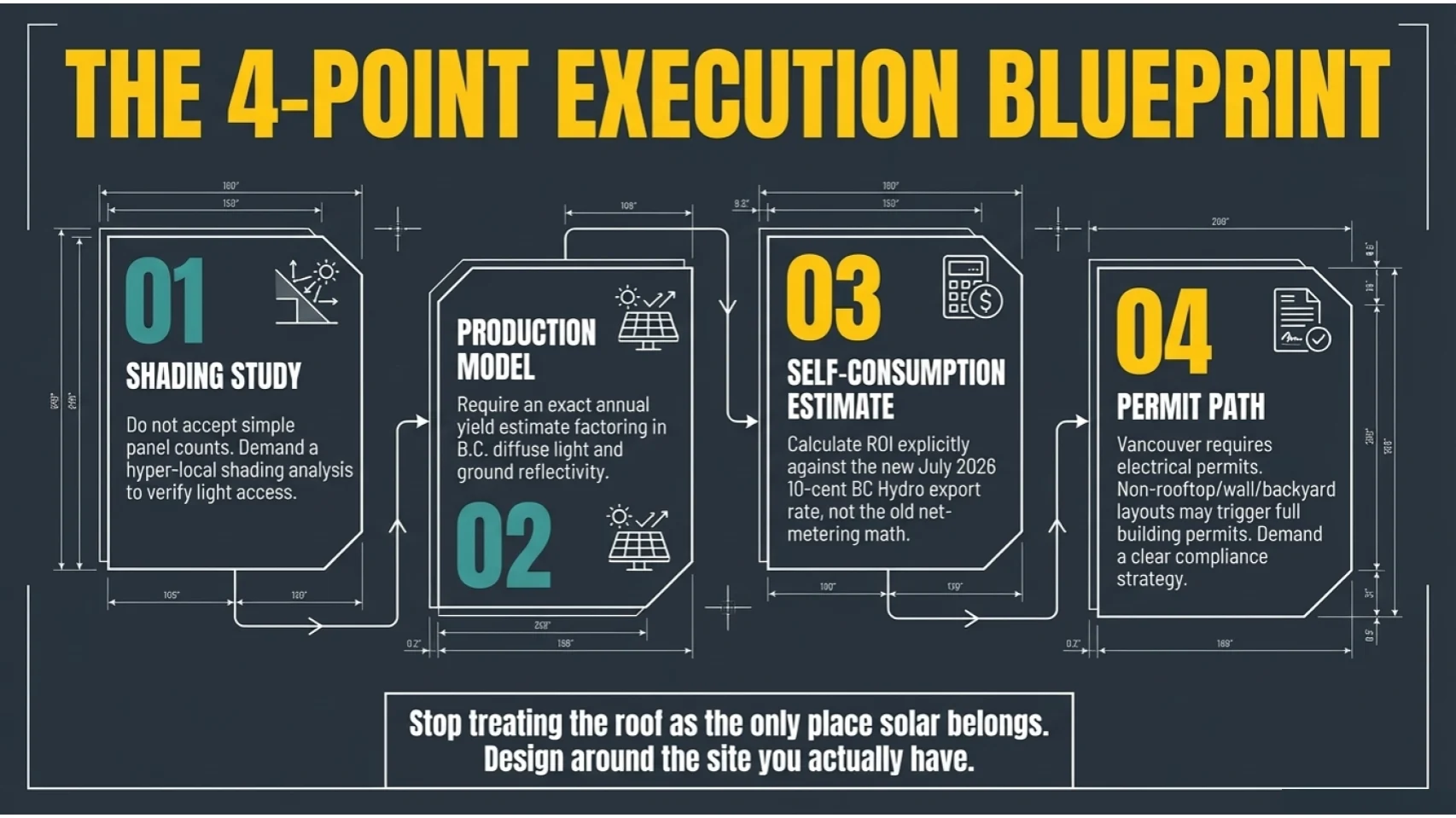
Tip for homeowners: don’t ask an installer only, “How many panels fit?” Ask for a shading study, a production model, and an alternate layout that includes wall-mounted, fence-line, or detached vertical options if your roof is weak.
B.C.’s new rate design makes timing more important
This part is easy to miss. It also changes the buying decision.
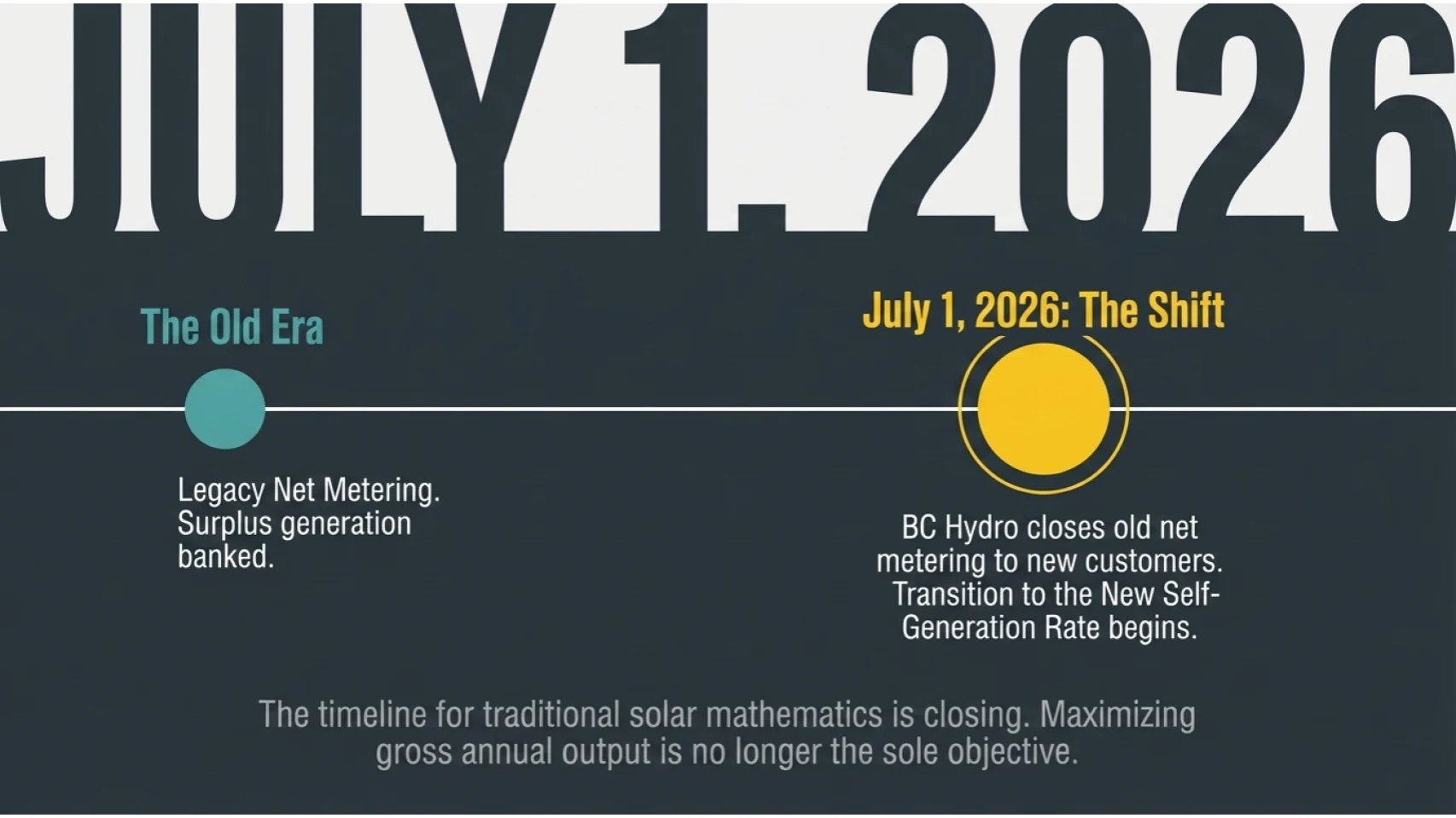
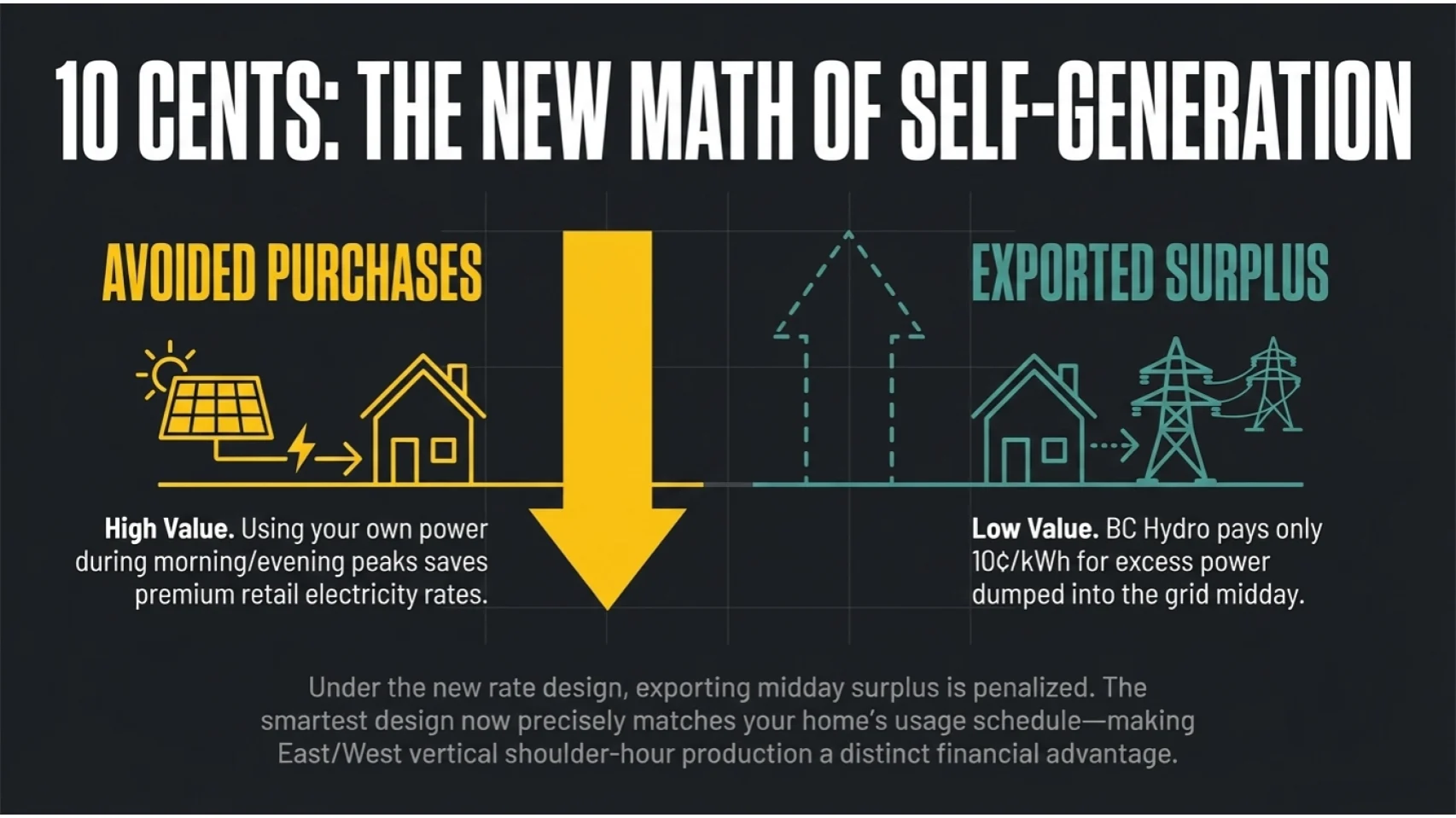
BC Hydro is closing the old net metering service rate to new customers on July 1, 2026 and shifting new solar customers to a new self-generation rate. That also ties into our recent breakdown on whether waiting for new 2026 solar tech makes sense in Canada. Under that setup, customers can still self-supply a bigger share of their own power, but exported surplus is purchased at 10 cents per kWh and paid out on each billing cycle instead of being banked the old way. (BC Hydro)
That pushes the market in a different direction. Fast.
If exported power is worth less than the power you avoid buying at home, then the best solar design is no longer just the one with the biggest annual number. The smarter design is often the one that matches your own use better. Morning use. Afternoon use. Shoulder-hour use. That’s exactly where vertical east-west production starts to look more attractive for some homes and some businesses. (BC Hydro)
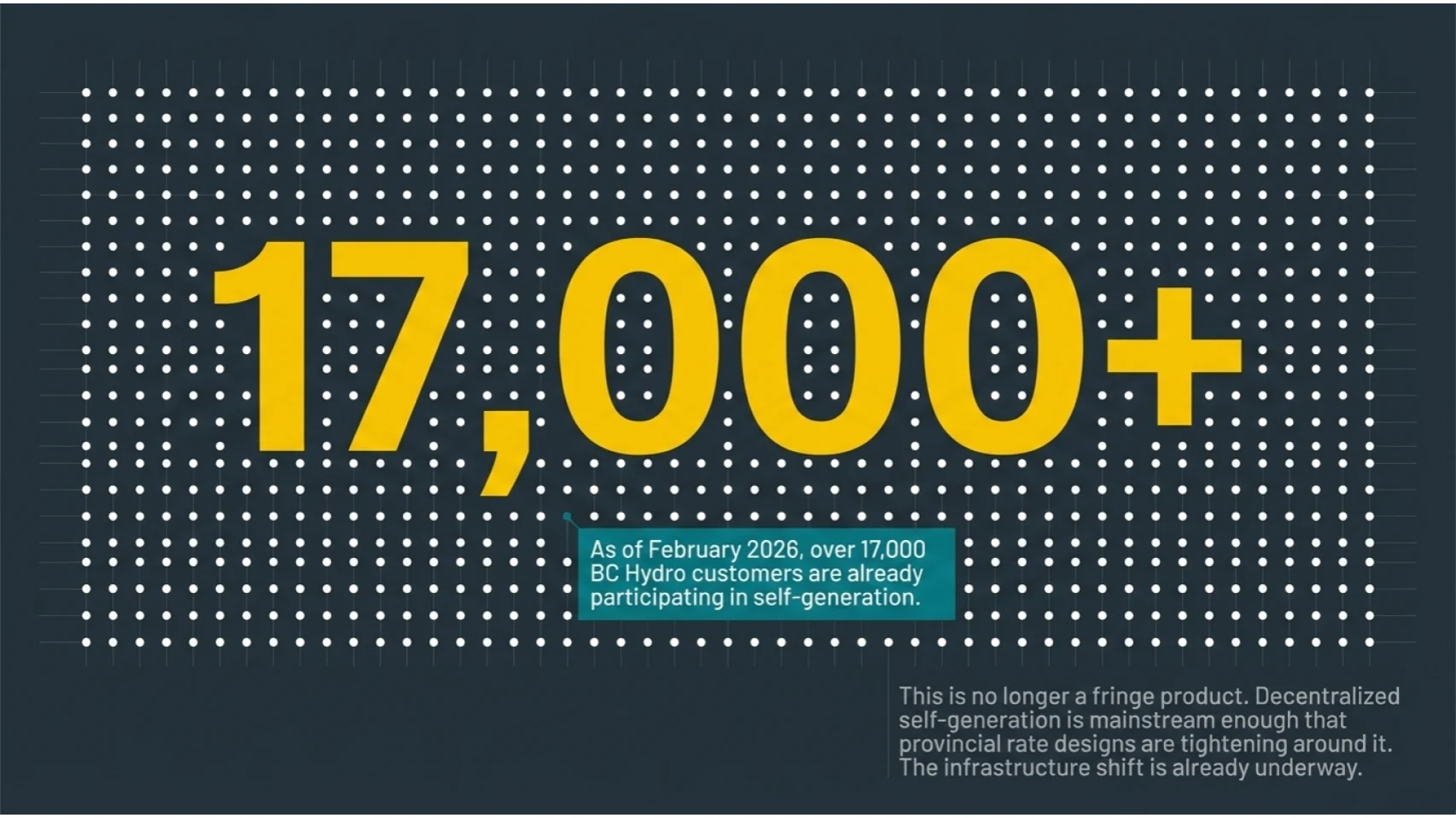
BC Hydro also says that, as of February 2026, more than 17,000 customers were already participating in self-generation, most of them with solar PV. That tells you this is no fringe product anymore. It’s mainstream enough that rate design is now being tightened around it. (BC Hydro)
Where vertical solar makes sense in B.C.
Townhouses and infill homes
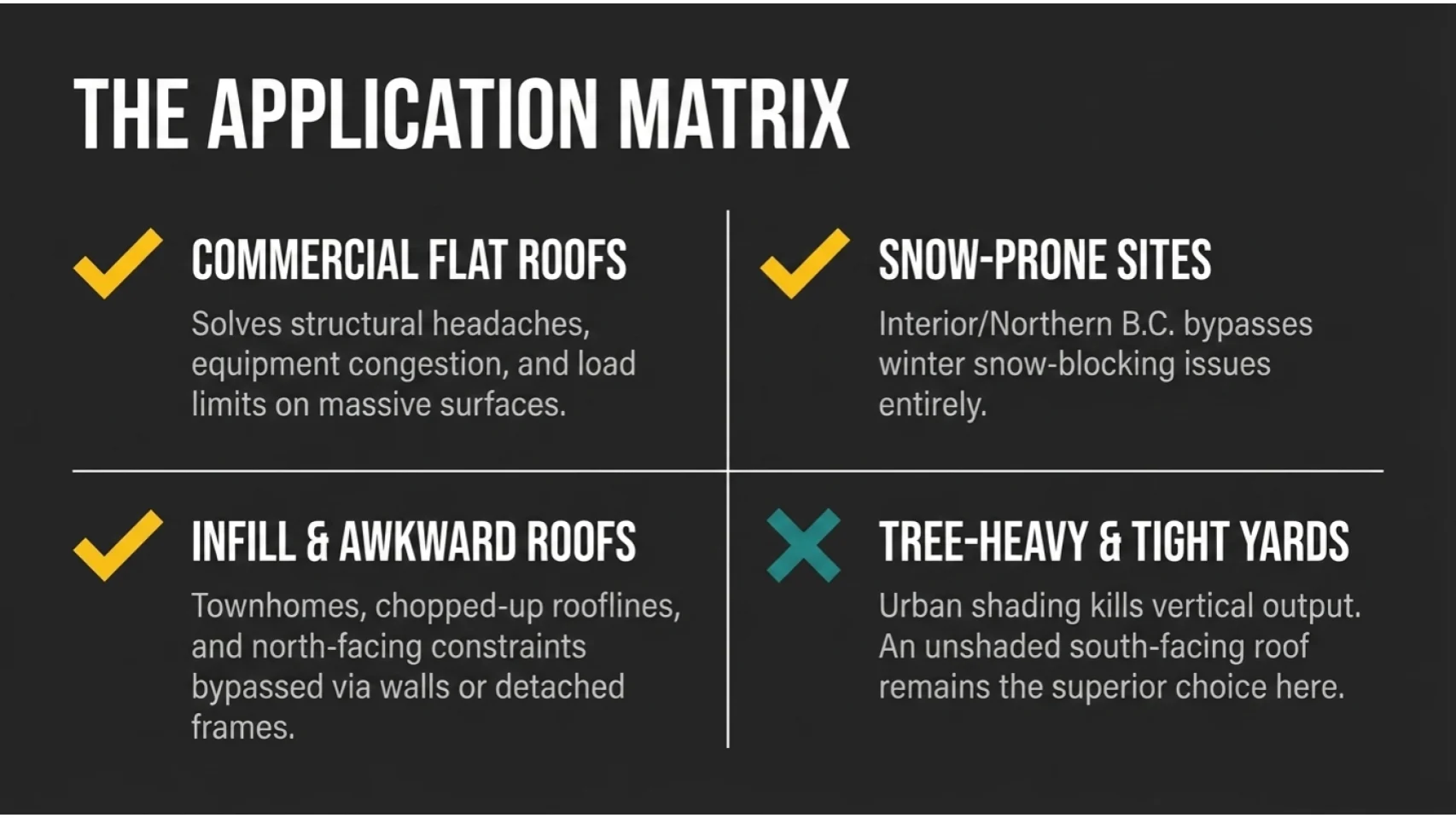
Small roofs get boxed in quickly. A wall, privacy structure, or detached frame can sometimes do useful work where the roof can’t. This won’t fit every lot. It opens the door on more sites than people assume. (BC Hydro)
Homes with poor roof orientation
If the main roof plane faces north or is split into awkward sections, a properly placed vertical system may be the better second option instead of forcing a weak rooftop layout. Science World already had older south-wall panels before this pilot, and BC Hydro says those original wall panels still produce about 3,000 kWh a year. Small, yes. Worthless, no. (BC Hydro)
Flat-roof commercial buildings
Commercial properties often have bigger surface area and more design freedom, and BC Hydro’s business rebate program offers up to $20,000 for eligible solar and battery projects. Add the fact that vertical systems may reduce structural headaches on some roofs, and the commercial case gets interesting very quickly. (BC Hydro)
Snow-prone Interior and Northern sites
BC Hydro’s own demonstration program says vertical modules are being assessed for northern B.C. because snow blocking is less of a problem and winter output may compare well against traditional panels in those conditions. That doesn’t mean rooftop solar stops making sense. It means winter-heavy sites deserve a second design path. (BC Hydro)
Where vertical solar does not make sense
Let’s keep this honest.
If you’ve got a large, clean, unshaded south- or southwest-facing roof, standard rooftop solar will usually stay the stronger choice for total annual production. Vertical solar is not a magic upgrade over a good roof. It’s a useful answer to a bad or limited roof. Research says the performance gap depends on local conditions, and urban shading is one of the biggest killers of vertical output. (ScienceDirect)
North walls are usually poor choices. Tight yards can be poor choices. Fence-line concepts can turn into permit problems. Tree-heavy urban lots can kill the economics before the first bracket goes in. Don’t buy vertical solar because it looks different. Buy it because the production model beats your alternatives.
A few years back I reviewed a property where the roof looked decent from the street and terrible once the measurements came out. Vents everywhere. Two roof planes fighting each other. Partial afternoon shade. A detached structure in the yard ended up being the only design I’d take seriously. That kind of site is exactly why this Science World story matters.
Permits in Vancouver and across B.C. are not optional
A lot of people want to skip this part. Bad idea.
The City of Vancouver says an electrical permit is required for residential solar PV systems, and its permit criteria specifically flag systems that are not on a rooftop — including wall-mounted and backyard-mounted panels — as cases where a full building permit may be required. Outside certain municipalities, Technical Safety BC generally handles electrical installation permits, though some cities, including Vancouver, issue their own. (City of Vancouver)
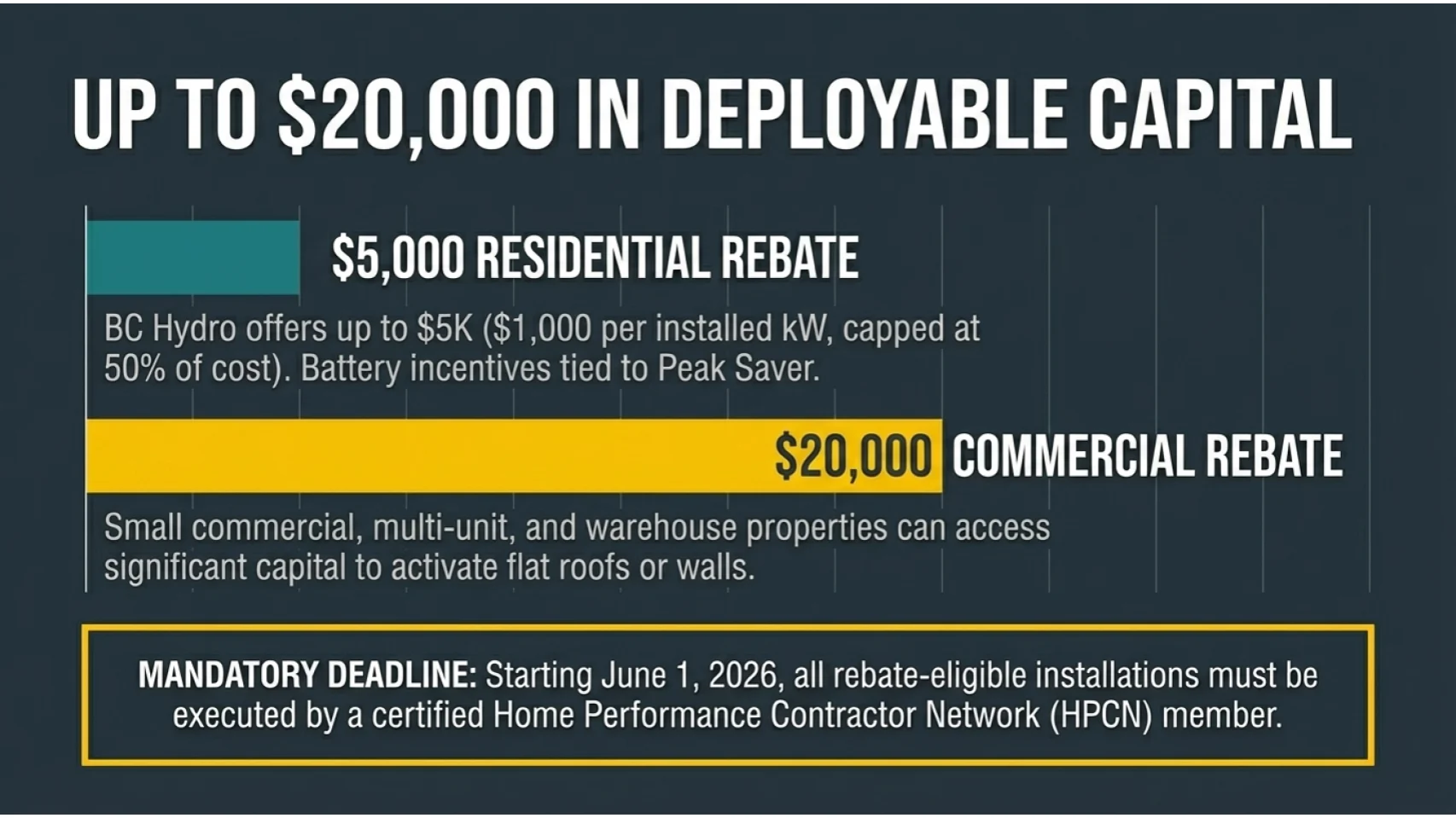
So no, this is not a “buy some panels and bolt them to a fence” project. Grid-tied solar needs permits, inspections, interconnection approval, proper electrical work, and a layout that respects your local rules. BC Hydro’s rebate program also now requires solar and battery installs to be done by a Home Performance Contractor Network member starting June 1, 2026 if you want rebate eligibility. (BC Hydro)
Rebates still matter. So does project type.
For residential customers on BC Hydro territory, solar rebates are still up to $5,000, based on $1,000 per installed kW, capped at 50% of installed cost. We also covered the rebate side in more detail in our B.C. solar rebates guide. Battery incentives changed in April 2026, and the higher battery rebate is now tied to Peak Saver enrollment. For businesses, BC Hydro advertises solar and battery incentives of up to $20,000. (BC Hydro)
That means this article is not just for detached homeowners. Small commercial properties, multi-unit buildings, schools, warehouses, and nonprofits should be paying attention too. Science World is a public example of a bigger design shift: use more surfaces, design around the site you have, and stop treating the roof as the only place solar belongs.
FAQ
Do vertical solar panels make more power than rooftop panels?
Usually, no. A strong south-facing roof still tends to win on raw annual production. Vertical solar earns its value on weak roofs, awkward sites, snow-prone areas, and situations where morning and late-day production is more useful. (ScienceDirect)
Can vertical solar work in Vancouver?
Yes. Science World proves the concept in Vancouver’s climate, and the City of Vancouver already has permit rules that account for non-rooftop solar systems. Still, site shading and permit requirements matter a lot. (BC Hydro)
Are wall-mounted or fence-style systems allowed in Vancouver?
Possible, yes. Automatic, no. Vancouver says an electrical permit is required, and its permit criteria flag wall-mounted or backyard systems as cases that may need fuller review. (City of Vancouver)
Does BC Hydro still offer net metering?
Existing customers can remain under older terms for a period, but for new customers the old net metering service rate closes on July 1, 2026, and the new self-generation rate pays 10 cents per kWh for excess generation. (BC Hydro)
Are rebates still available for solar in B.C.?
Yes. BC Hydro still offers up to $5,000 for eligible residential solar, and business projects can qualify for higher amounts. Starting June 1, 2026, rebate-eligible installs must be completed by an HPCN member. (BC Hydro)
Is vertical solar a good option for commercial buildings?
Often, yes. Flat roofs with structural limits, equipment congestion, or snow concerns can make vertical layouts worth studying, and BC Hydro’s business rebate program makes the commercial math more interesting. (BC Hydro)
What should I ask an installer before I buy?
Ask for four things: shading study, annual production estimate, self-consumption estimate under the new BC Hydro rate, and the permit path for your exact layout. Get those first. Then compare prices.
Sources used
- BC Hydro: Science World vertical solar array announcement
- BC Hydro: Science World energy makeover
- BC Hydro: active innovation demonstrations
- ScienceDirect: vertically mounted bifacial PV analysis
- Frontiers: high-latitude vertical bifacial PV study
- BC Hydro: self-generation rate updates
- City of Vancouver: solar photovoltaic permit page