
Is A Federal Tariff About To Kill Your Canadian Solar Savings? What Homeowners Need To Know Now
December 7, 2025
Get Paid To Own A Battery: How VPPs Are Changing Solar Payback In Nova Scotia And Beyond
December 9, 2025
Fact Checked By
The Yukon government has officially announced plans to restart the renewable energy rebate program. For residents, this likely brings a mix of relief and skepticism.
For a while, everything was frozen. Homeowners in Whitehorse were told the grid couldn’t handle their panels. Installers were left shrugging their shoulders.
Key Takeaways
- Money is there: The $800/kW rebate is active, but access depends on your grid connection status.
- Geography is key: Whitehorse is paused for grid-tie. Remote communities are open.
- The Date to Watch: The pause is extended until January 15, 2026, with new rules expected then.
- Prepare now: Upgrade your electrical panel and fix your roof so you are ready for the January update.
- Watch the Study: The “Intermittent Renewable Integration Study” will dictate the new rules.
But recent statements from the government and the Yukon Energy Corporation suggest the doors are creaking open again.
I have tracked solar markets across Canada for over a decade, and I see a familiar pattern here. This isn’t going to be a free-for-all. It will be calculated, slow, and rule-heavy. If you want to be first in line when the applications officially update, you need to understand what changed, where the money is, and where the grid is still locked down. For a broader look at the territory’s energy landscape, check out my full guide to solar panels in the Yukon.
Let’s break down the numbers and the strategy so you aren’t wasting time on paperwork destined for the rejection pile.
Why the Rebate Stalled in the First Place
To fix a problem, you have to understand what broke. The pause wasn’t really about the rebate money running out; it was about physics.
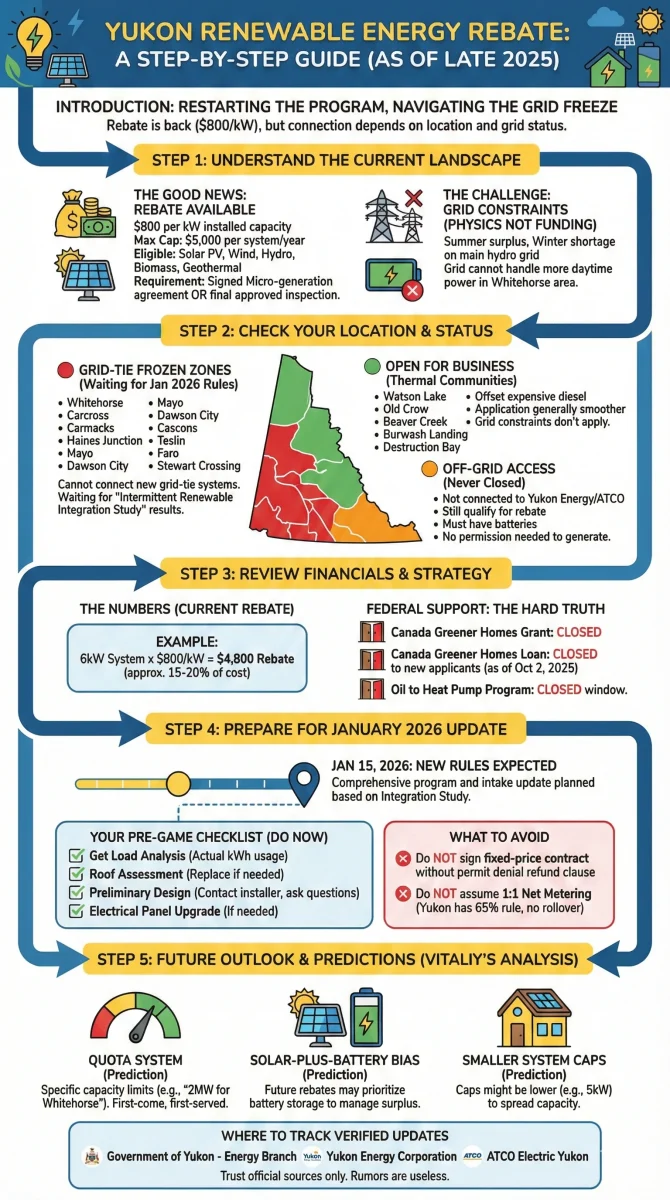
The Yukon grid (specifically the main hydro grid serving Whitehorse) is an isolated system with limited storage capacity. Solar panels produce maximum power in June and July. Unfortunately, Yukoners use maximum power in January and February for heating.
The Mismatch:
- Summer: Solar generation exceeds local demand. Hydro dams are already full. Surplus energy has nowhere to go.
- Winter: Solar produces very little. The grid is strained.
The utility companies effectively said, “Stop sending us power we can’t use.” This led to the Micro-generation program pause. Without permission to connect to the grid, the rebate for buying the panels became useless for most people.
What’s Officially Available Right Now
Despite the freeze news, there is money on the table today. The Good Energy Renewable Energy Rebate is the primary mechanism. You don’t have to wait for a new law to pass to see these numbers; they are the current framework.
The Numbers:
| Feature | Details |
|---|---|
| Rebate Amount | $800 per kilowatt (kW) of installed capacity |
| Maximum Cap | $5,000 per system per year |
| Eligible Technology | Solar PV, Wind, Hydro, Biomass, Geothermal |
| Requirement | Must have a signed Micro-generation agreement OR a final approved electrical inspection |
Vitaliy’s Take: $800/kW is a decent chunk of change. A standard residential system is usually between 5kW and 10kW.
If you install a 6kW system, the math is simple: 6 x $800 = $4,800.
You are getting nearly the full $5,000 cap. This covers roughly 15-20% of the total installation cost depending on your contractor. If you are curious about costs in similar northern climates, look at how solar performs in the Arctic to set your expectations.
Important Note: The rebate is available, but approval to connect is the bottleneck. You can buy the equipment and apply for the rebate, but if the utility won’t let you turn the switch on because you don’t have that Micro-generation agreement, that investment remains unusable.
Where Grid-Tie Solar Is Still Frozen
This is where the confusion happens. The government says “we support solar,” but the utility map says “no entry.”
If you live in Whitehorse or any community connected to the main Yukon Integrated System, the pause on new grid-tie micro-generation approvals is still in effect.
Communities Impacted by the Freeze:
- Whitehorse
- Carcross
- Carmacks
- Haines Junction
- Mayo
- Dawson City
- Teslin
- Faro
- Stewart Crossing
If you are in these zones, you cannot simply install panels and spin your meter backward right now. You are waiting for the results of the “Intermittent Renewable Integration Study,” which will dictate the new rules in 2026.
Where Applications Are Actually Open Today
The freeze doesn’t apply to everyone. The Yukon isn’t just one big grid; it has “thermal communities” that run on diesel generators. In these areas, every kilowatt of solar power saves expensive diesel fuel, regardless of the season.
The utility companies want you to install solar here.
Open for Business:
- Watson Lake
- Old Crow
- Beaver Creek
- Burwash Landing
- Destruction Bay
Tip: If you own property in these thermal communities, stop waiting. We have already seen success in these regions, such as the 1.9 Megawatt Beaver Creek project. The grid constraints that hurt Whitehorse do not apply to you. The application process is generally smoother because your solar energy offsets high-cost fossil fuels directly.
Off-Grid Solar: The One Path That Never Closed
I talk to a lot of people who think the “solar ban” applies to everyone. It doesn’t.
If you are Off-Grid (not connected to Yukon Energy or ATCO Electric Yukon lines), you have been free to build this whole time.
- Rebate Access: You still qualify for the $800/kW rebate.
- No Permission Needed: You don’t need the utility’s permission to generate power because you aren’t sending it to them.
- Battery Necessity: You obviously need batteries. The rebate structure traditionally focused on generation (panels), but keep an eye out for changes that might subsidize storage more heavily.
Federal Solar Support: The Hard Truth for 2025
We used to stack the Yukon rebate with federal money. That situation has shifted drastically in the last few months. I need to be blunt here so you don’t budget for money that doesn’t exist.
The Canada Greener Homes Grant ($5,000)
- Status: Closed. You can no longer apply.
The Canada Greener Homes Loan (Up to $40,000 interest-free)
- Status: Closed to new applicants as of October 2, 2025.
- Strategy: If you missed the window, you need a new plan. Read my analysis on what to do now that the Greener Homes Loan is gone. Do not let a contractor tell you “just apply for the loan”—they might be working off old info.
Oil to Heat Pump Affordability Program
- Status: Application window Closed as of October 1, 2025.
- Relevance: Only relevant if you are already in the system.
What the New Government Is Discussing
The Yukon government and the NDP recently agreed to “restart the renewable energy rebate program.” But what does that actually mean?
Based on official briefings, they aren’t just going to flip the switch back to 2020 rules. They are discussing a managed intake.
The “Intermittent Renewable Integration Study” This is the boring-sounding document that controls your fate. The utilities are studying exactly how much solar the grid can take before it destabilizes.
- The Pause: The official pause on micro-generation has been extended until January 15, 2026.
- The Update: A comprehensive program and intake update is planned for January 2026.
Vitaliy’s Industry Analysis: What to Expect
Note: The points below are my analysis based on industry trends and how other grid-constrained markets operate. These are not confirmed government rules yet.
1. The Quota System (Prediction) Don’t expect unlimited approvals. I anticipate they will release a specific capacity quota—for example, “2 Megawatts for Whitehorse.” Once that fills, the doors close again.
2. Solar-Plus-Battery Bias (Prediction) The utility hates pure solar but loves solar with batteries. Future rebates or approvals might prioritize homeowners who install batteries to store that summer surplus.
3. Smaller System Caps (Prediction) Instead of approving a 15kW system that covers your whole winter heating bill (but fries the grid in summer), they might cap systems at 5kW or 6kW to spread the available capacity to more people.
Who Stands to Benefit First
If you are waiting for the green light, understand the hierarchy. The government will prioritize projects that help them solve their problem.
- First Priority: Remote diesel communities (Watson Lake, etc.).
- Second Priority: Off-grid residential.
- Third Priority: Grid-tied homes with battery storage (Self-consumption focus).
- Last Priority: Simple grid-tied homes in Whitehorse looking to sell power back.
What Homeowners Can Safely Do Right Now
You are in a holding pattern, but you shouldn’t be idle. If you wait until the official “We are Open” announcement, local installers will be booked solid for 18 months.
Your Pre-Game Checklist:
- Get Your Load Analysis: Don’t guess how much power you need. Download your last 12 months of utility bills. Calculate your actual kWh usage.
- Roof Assessment: Solar lasts 25 years. Is your asphalt shingle roof 15 years old? You need to replace the roof before the panels go up. Do that work now.
- Preliminary Design: Contact an installer. Make sure you know the right questions to ask solar companies so you don’t get stuck with a system you can’t connect.
- Electrical Panel Upgrade: Older homes often need a panel upgrade to handle solar back-feed. You can hire an electrician to do this upgrade now. It adds value to your home regardless of solar.
What to Avoid Until Rules Are Finalized
Do not sign a fixed-price contract for equipment delivery unless the contract has a “refund upon permit denial” clause. I have seen homeowners buy $15,000 worth of panels that are now sitting in a garage because the utility said “No.”
Do not assume 1:1 Net Metering. This is a critical correction. Yukon does not offer unlimited banking. To understand how this compares to other provinces, read my breakdown on net metering in Canada.
- The 65% Rule: They will only reimburse you for exports up to 65% of your system’s annual modeled generation.
- No Rollover: Credits do not carry over to the next year.
Run your financial calculations assuming you get zero value for exported power beyond your immediate usage. If the numbers still make sense (due to self-consumption), then solar is a safe bet.
Where to Track Verified Updates
Rumors are useless. Only trust these three sources:
- Government of Yukon – Energy Branch: Look for updates on the official Good Energy rebate page.
- Yukon Energy Corporation: Check their “Current Projects” or Renewables section for the Integration Study release.
- ATCO Electric Yukon: They manage the distribution for many specific communities.
FAQ: Quick Answers
Q: Is the $5,000 rebate guaranteed? A: It is subject to funding availability. It is “first-come, first-served.” Apply as soon as your project is eligible.
Q: Can I get the federal interest-free loan? A: Only if you applied before October 2, 2025. If you are starting today, that program is closed.
Q: Are batteries covered by the rebate? A: The current Good Energy rebate wording focuses on renewable generation (the panels). However, watch this space closely. Incentivizing batteries is the only logical way for Yukon to solve its grid problem.
Q: Why is Watson Lake different from Whitehorse? A: Whitehorse runs on hydro (water). Watson Lake runs on diesel. Diesel is expensive and dirty. The utility saves money every time a solar panel works in Watson Lake. In Whitehorse, surplus solar is just a headache for them.
Disclaimer: I am an industry observer, not a government official. Program rules change without notice. Always verify eligibility with the Yukon Energy Branch before spending money.