
P.E.I. Closes Solar Rebate Program: What’s Next?
September 6, 2025
Don’t Get Burned: 15 Solar Panel Myths Canadians Still Believe in 2025
September 9, 2025Last Updated on June 30, 2026 by Vitaliy
If you are pricing solar panels in Dartmouth in 2026, the first thing to know is simple: the old rebate math is gone.
Solar can still be worth it here. Dartmouth has Nova Scotia Power net metering, high enough electricity rates to make self-generation matter, local access to Halifax’s Solar City financing, and enough solar production to make rooftop solar a serious option for many homes.
But the easy headline incentives have changed. The homeowner SolarHomes program is closed to new applications. The federal Canada Greener Homes Grant is closed. The Canada Greener Homes Loan is also now marked closed by NRCan, with funding fully committed.
That does not make solar a bad idea. It just makes the question more honest:
Can your Dartmouth home produce enough electricity, at a fair installed price, to lower long-term power costs without creating a roof, financing, insurance, or resale headache?
For many Dartmouth homeowners, the answer is yes. For others, the better move is to replace the roof first, reduce electricity waste, install a heat pump, add an EV load before sizing solar, or wait for clearer financing.
Use the online solar calculator for a quick first estimate, then use this guide to sanity-check the quote before you sign.
Key Takeaways
- Solar panels in Dartmouth usually make the most sense for homeowners with high annual electricity use, a simple unshaded roof, and a system sized close to real consumption.
- A practical 2026 quote-screening range is about $2.75/W to $3.75/W installed for many straightforward grid-tied residential projects, before major roof work, electrical upgrades, battery backup, premium financing costs, or unusual site conditions.
- A 10 kW Dartmouth solar system might land around $27,500 to $37,500 before site-specific extras. A smaller 5 kW system might land around $13,750 to $18,750. Always ask whether HST is included.
- The SolarHomes homeowner rebate is closed to new homeowner applications. Efficiency Nova Scotia says new applications stopped on April 17, 2025, and approved homeowner projects had to be completed by March 31, 2026.
- Dartmouth property owners may be able to use Halifax Solar City municipal financing. Halifax lists a 10-year payment period at a fixed 4.75% interest rate through a voluntary Local Improvement Charge.
- Nova Scotia Power’s 2026 tariff book lists the Domestic Service energy charge at 18.324 cents/kWh, before riders such as FAM, DSM, and storm cost recovery.
- A normal grid-tied solar system does not keep your home powered during an outage unless it is designed with the right backup equipment, transfer/islanding setup, and usually a battery.
Is Solar Worth It In Dartmouth In 2026?
Solar is worth considering in Dartmouth, but it is not an automatic yes.
The strong case looks like this:
- You use a lot of electricity every year.
- Your roof has 15 to 25 useful years left.
- The roof faces south, southwest, southeast, east, or west with limited shade.
- Your electrical panel and service can handle the system without a painful upgrade.
- You are not counting on expired grants or old 0% federal loan language.
- You plan to stay in the home long enough to benefit from lower power bills.
- The installer gives you a clear production estimate, not just a pretty savings chart.
The weak case looks like this:
- The roof is near replacement.
- Big trees or nearby buildings shade the best roof planes.
- You use very little electricity.
- You plan to sell soon and do not want a Local Improvement Charge or financing conversation at closing.
- The quote only works if electricity rates rise aggressively every year.
- The installer avoids questions about monitoring, warranty service, roof penetrations, insurance, or net metering.
The best Dartmouth solar projects usually start with boring details: 12 months of power bills, a roof-age check, shade review, electrical inspection, and a quote comparison. The exciting part comes later, when the system is actually producing and your power bill is lower.
Solar Panels Dartmouth Cost
For a normal residential grid-tied system in Dartmouth, use $2.75/W to $3.75/W installed as a 2026 planning range before major extras.
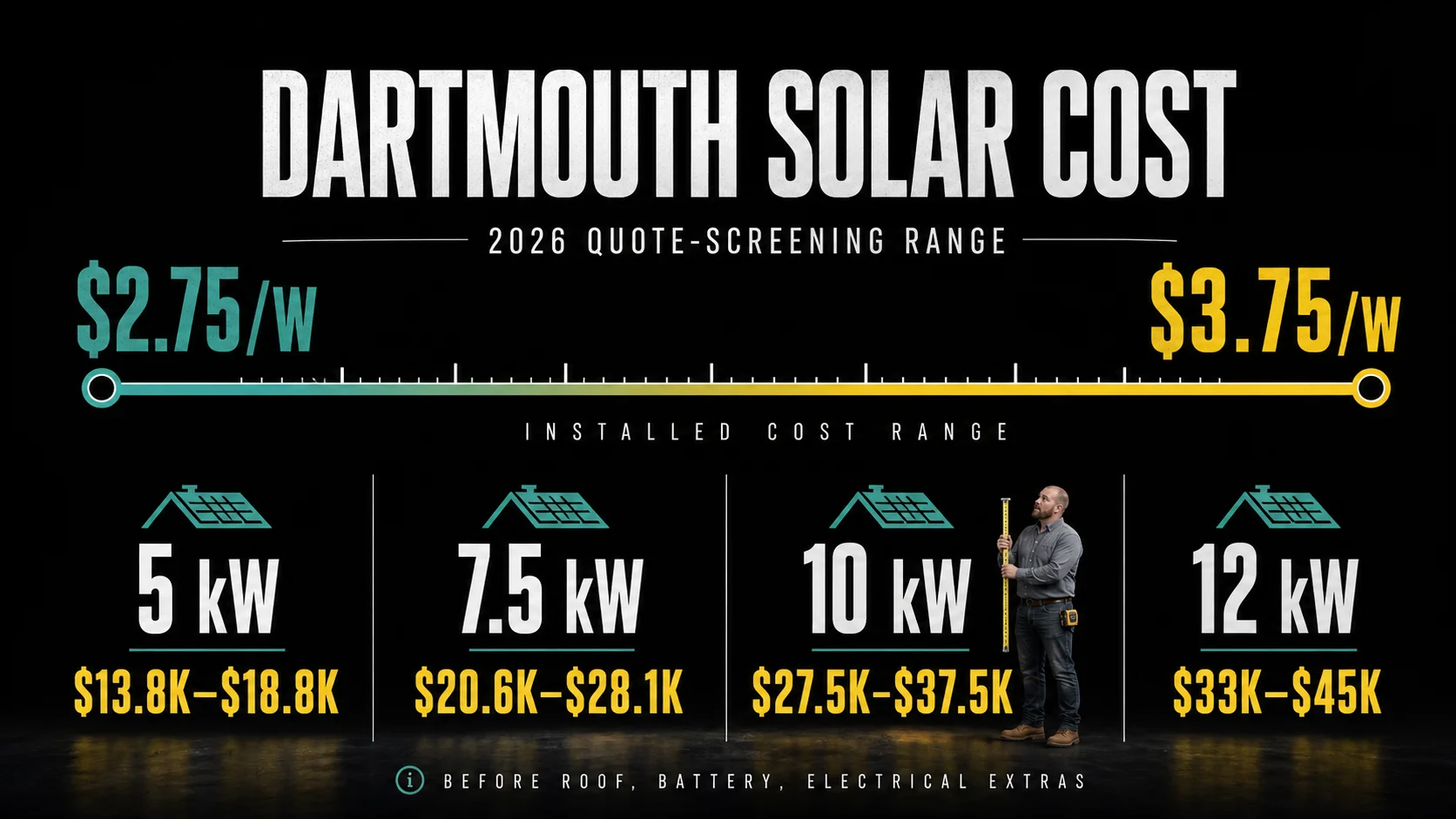
That range is not an official average. It is a quote-screening range. EnergyHub’s older Nova Scotia guide listed a lower average installed cost and a range around $2.51/W to $3.16/W, but that page is stale on incentives and was last updated before the current rebate and federal loan closures. For 2026 planning, I would rather give you a wider number than pretend every Dartmouth roof is simple.
| System size | Rough 2026 installed-cost screen | Typical fit |
|---|---|---|
| 5 kW | $13,750-$18,750 | Smaller home, modest electric use, limited roof space |
| 7.5 kW | $20,625-$28,125 | Medium home, heat pump or moderate annual use |
| 10 kW | $27,500-$37,500 | Larger electric load, heat pump, EV planning, good roof space |
| 12 kW | $33,000-$45,000 | High annual use, strong roof layout, careful net-metering sizing |
The biggest price drivers are:
- Roof complexity and pitch.
- Panel and inverter choice.
- Microinverters versus string inverter design.
- Main panel capacity and electrical upgrades.
- Roof condition and shingle age.
- Whether trenching, a detached garage, or ground mount is involved.
- Monitoring equipment and warranty support.
- Battery storage or backup loads panel.
- Financing fees, interest, and whether HST is included.
When comparing solar panels Dartmouth cost estimates, do not just pick the lowest sticker price. A cheap quote can become expensive if the roof work is vague, the production estimate is optimistic, or after-install service is weak.
Use compare detailed solar quotes and ask each contractor to show the same numbers: system size in kW DC, estimated first-year kWh, installed price before and after tax, cost per watt, monitoring platform, warranty terms, roof attachment method, and what happens if production is lower than promised.
How Much Power Can Solar Produce In Dartmouth?
Dartmouth is not Alberta-sunny, but it has enough solar resource for residential PV to work.
EnergyHub’s solar map data, based on Natural Resources Canada photovoltaic potential data, estimates Dartmouth at about 1,076 kWh per kW per year for a reasonably oriented system. In plain language, a 10 kW system might produce roughly 10,000 to 11,000 kWh per year before site-specific losses, depending on shade, roof angle, snow, equipment, and inverter design.
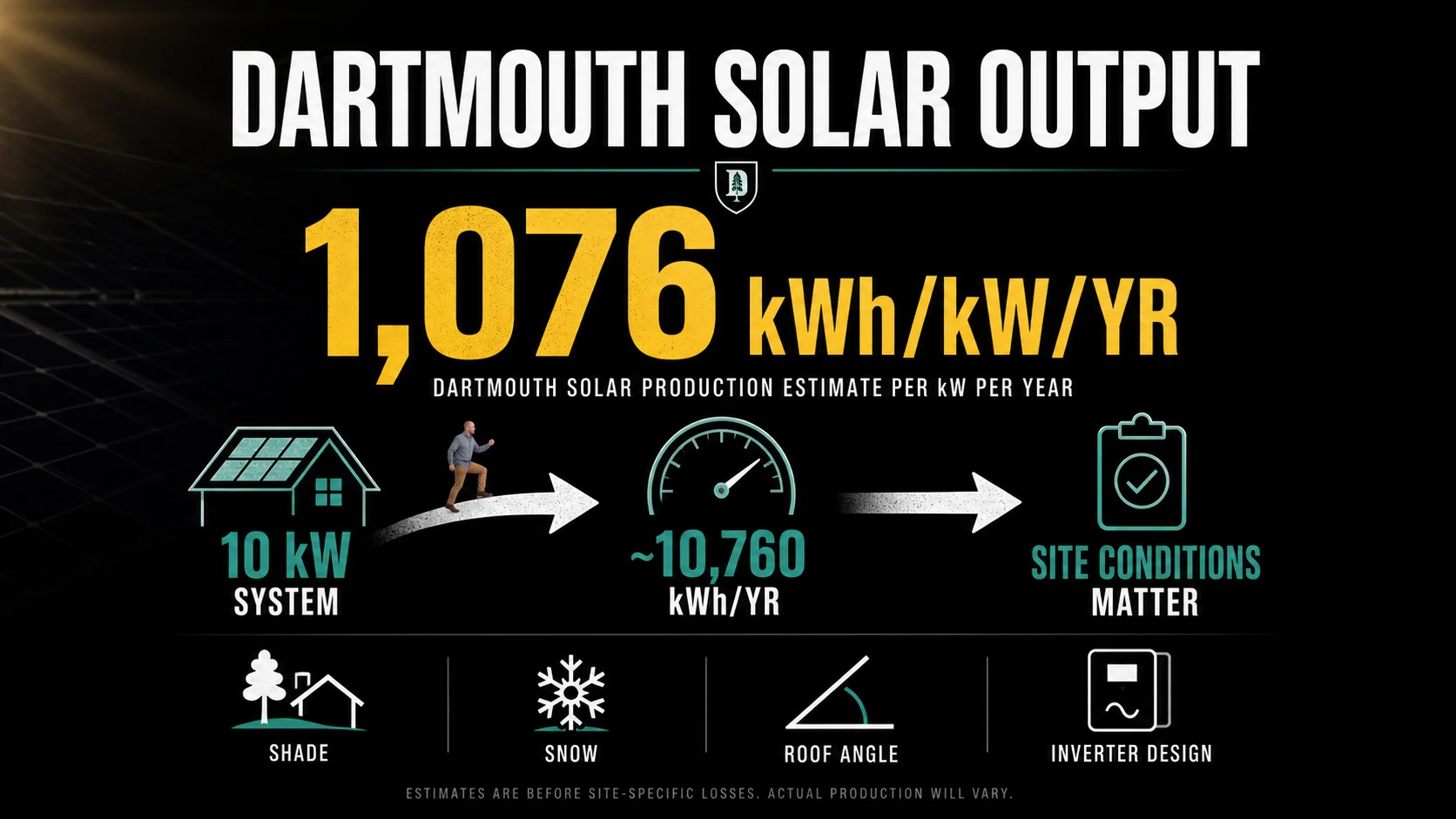
That is why your annual power bill matters more than your square footage.
If your home uses 9,000 kWh per year, a 10 kW system might be too large unless you are planning a future EV, heat pump, hot tub, or other load. If your home uses 18,000 kWh per year, a 10 kW system may only offset part of your usage.
This is also where one Reddit concern from Halifax and Dartmouth homeowners is valid: future loads matter. If you are about to add an EV or switch from oil heat to a heat pump, tell the installer before they size your system. A solar array designed only around last year’s bill may be undersized for the home you are about to create.
Grants, Rebates, And Solar Incentives In Dartmouth
This section is where many older solar pages now mislead people.
SolarHomes homeowner rebate
The Efficiency Nova Scotia SolarHomes page says the homeowner program is closed. New applications stopped on April 17, 2025, and approved homeowner projects had to be completed by March 31, 2026 to remain eligible for financial incentives.
For a new Dartmouth homeowner shopping today, do not build your 2026 payback around the old $0.30/W homeowner rebate.
Solar for Non-Profit Organizations
Efficiency Nova Scotia still lists a Solar for Non-Profit Organizations pilot. The page says eligible registered non-profits and charities installing grid-tied solar PV may qualify for $0.60/W DC, up to 25% of system costs before HST, capped at $15,000.
That is useful for a Dartmouth charity, church, co-op, or community organization. It is not a homeowner rebate.
Halifax Solar City financing
Dartmouth is part of Halifax Regional Municipality, so the municipal Solar City program matters.
Halifax says Solar City offers property owners in the municipality financing for solar energy options and a navigation service. The financing is placed on the property as a voluntary Local Improvement Charge. Halifax lists payments over 10 years at a fixed 4.75% interest rate, with the option to pay the balance in full and remove the lien without penalty.
This can help with upfront cost, but read the resale language carefully. Halifax says the charge is applied to the property, not the individual. If you sell before it is repaid, you may pay it off at sale or transfer it to the next owner if both parties agree.
That may be manageable. It just needs to be discussed before you sign, not discovered when you list the home.
Canada Greener Homes Grant and Loan
NRCan says the Canada Greener Homes Grant is closed. NRCan also now marks the Canada Greener Homes Loan as closed, with funding fully committed and new loan applications unable to be approved.
This is a big 2026 change. A Dartmouth quote that still leans on new federal 0% loan approval should be questioned.
Financing may still be available through municipal, bank, home-equity, installer, or other private options. Use solar financing options to compare the real monthly payment, total interest, lien/resale effect, and what happens if you pay off early.
Net Metering And Electricity Rates In Dartmouth
Dartmouth homes are generally served by Nova Scotia Power.
Nova Scotia’s renewable electricity regulations say an NSPI customer with a renewable low-impact generator of 27 kW or less is automatically classified as a residential net-metering customer. That does not mean every home should install 27 kW. It means the legal residential cap is much higher than the typical rooftop system.
Most Dartmouth homes will be sized around annual consumption, roof space, and budget, not the absolute cap.
Nova Scotia Power’s 2026 tariff book lists the Domestic Service customer charge at $20.08/month and the Domestic Service energy charge at 18.324 cents/kWh, before additional riders such as fuel adjustment, demand-side management, and storm cost recovery. The same tariff lists January 1, 2027 rates of $21.04/month and 19.067 cents/kWh.
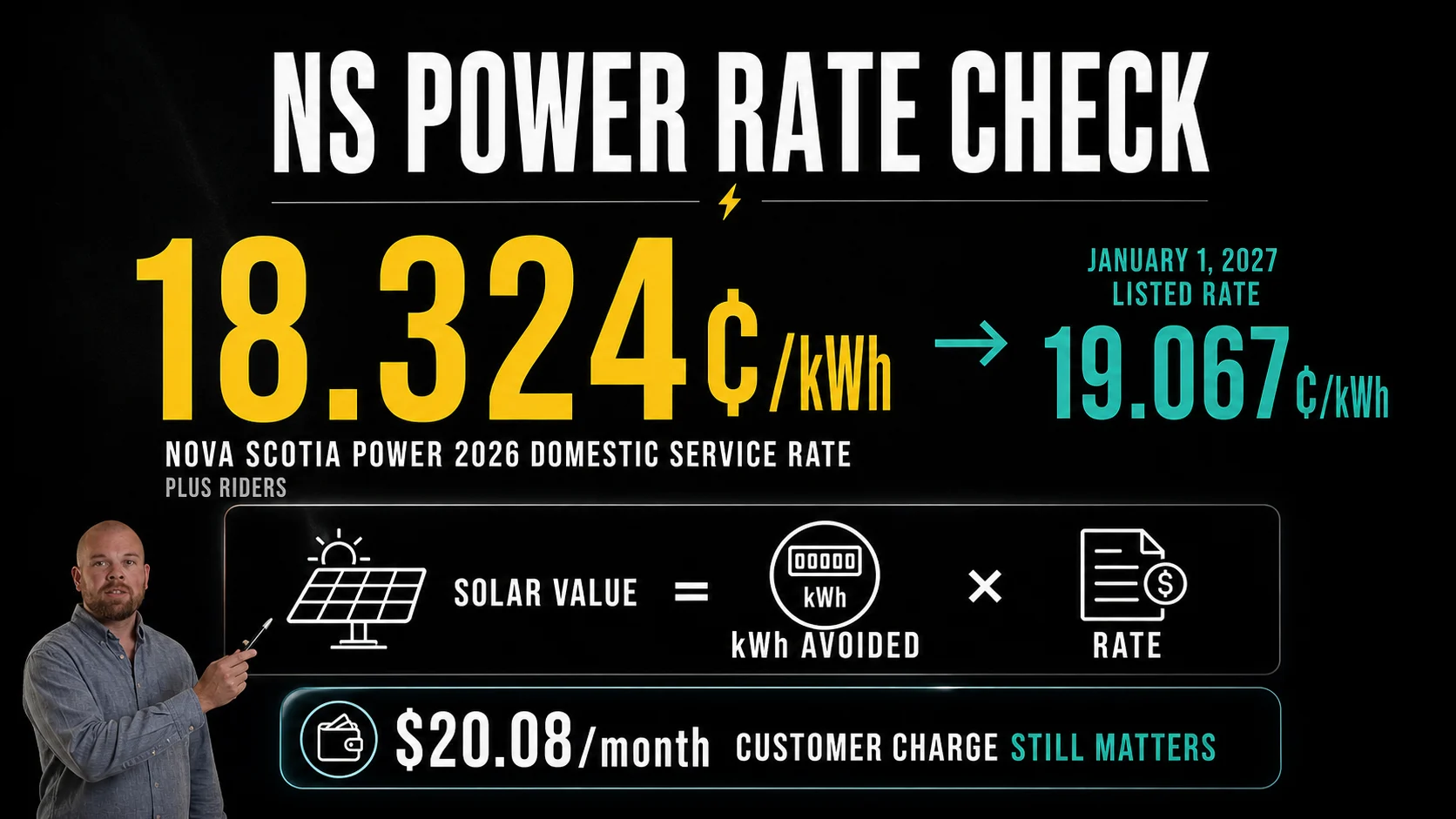
Why does this matter?
Solar saves the most when it offsets energy you would otherwise buy from the grid. It usually does not erase every fixed charge. Even a strong solar system may leave you with monthly customer charges, riders, taxes, and winter bills.
Before signing, ask the installer:
- What annual kWh production are you assuming?
- What NS Power rate are you using in the payback calculation?
- Are riders, fixed charges, and HST included or ignored?
- How are exported credits treated in the model?
- What happens if my winter use is higher than expected?
- Are you assuming future rate increases? If yes, what percentage?
Do not reject solar just because the bill does not go to zero. But do reject sales math that pretends the bill always disappears.
What Affects Payback In Dartmouth?
The payback period for solar panels in Dartmouth depends on the installed cost, production, electricity rate, system size, financing, and whether your roof or electrical panel needs work.
A clean, simple, fairly priced project may pencil out well. A shaded roof plus a battery plus roof replacement plus high-interest financing may not.
Use this as a rough screening example:
| Assumption | Example |
|---|---|
| System size | 10 kW |
| Installed price | $32,500 |
| First-year production | 10,760 kWh |
| Value of avoided energy at 18.324 cents/kWh | About $1,971/year before riders, HST, and fixed charges |
| Simple payback before financing and rate changes | About 16.5 years |
That is not a quote. It is a sanity check.
If the installed price is lower, payback improves. If electricity rates rise, payback improves. If your system produces less than expected, payback gets worse. If you add financing interest, roof work, or a battery, payback gets longer unless those upgrades solve a separate problem you already needed to solve.
The better question is not only “What is the payback?” It is:
What am I paying per kWh over the life of the system, and what risks am I accepting to get there?
That question leads to better decisions.
What Dartmouth And Halifax Homeowners Worry About
I looked at a local r/halifax discussion about solar experiences as concern-mining, not as proof. The thread includes Dartmouth and Halifax-area homeowners talking about real quotes, production, monitoring, insurance, financing, and outage expectations.
Here are the concerns worth answering before you buy:
| Concern from local homeowners | Practical answer |
|---|---|
| “Will the system really produce what the installer says?” | Ask for first-year kWh, shading assumptions, roof plane production, and whether the estimate uses conservative losses. Compare multiple quotes. |
| “My power bill plus solar payment might just equal my old bill.” | That can happen in the early years. The bet is long-term savings after financing is paid down, especially if rates rise. Check total cost, not just monthly payment. |
| “Should I install before adding an EV, heat pump, or hot tub?” | Usually, include future loads in the design. If the load is certain, tell the installer. If it is vague, avoid oversizing on a guess. |
| “What if the roof is old?” | Fix the roof first if it is near replacement. Removing and reinstalling panels later can eat into savings. |
| “Will solar work in a power outage?” | Standard grid-tied solar usually shuts down during outages for safety. You need proper backup equipment and often a battery for outage power. See solar battery backup. |
| “Are batteries worth it?” | Batteries are usually about resilience first and payback second. In Dartmouth, they may make sense if outage backup matters, but they can stretch the financial payback. |
| “What about insurance?” | Tell your insurer before installation. Ask whether the roof attachment method, replacement value, and electrical work are covered. Local homeowners specifically warned not to assume coverage automatically adjusts. |
| “What if monitoring breaks or the installer disappears?” | Ask who monitors the system, what alerts you receive, who handles warranty claims, and how service calls are priced after year one. |
| “Is net metering policy risk real?” | Yes, policy can change over a 25-year equipment life. That is why conservative payback math matters. Do not buy a system that only works under perfect policy assumptions. |
This is the part sales pages often skip. Solar can be a good investment and still require sober questions.
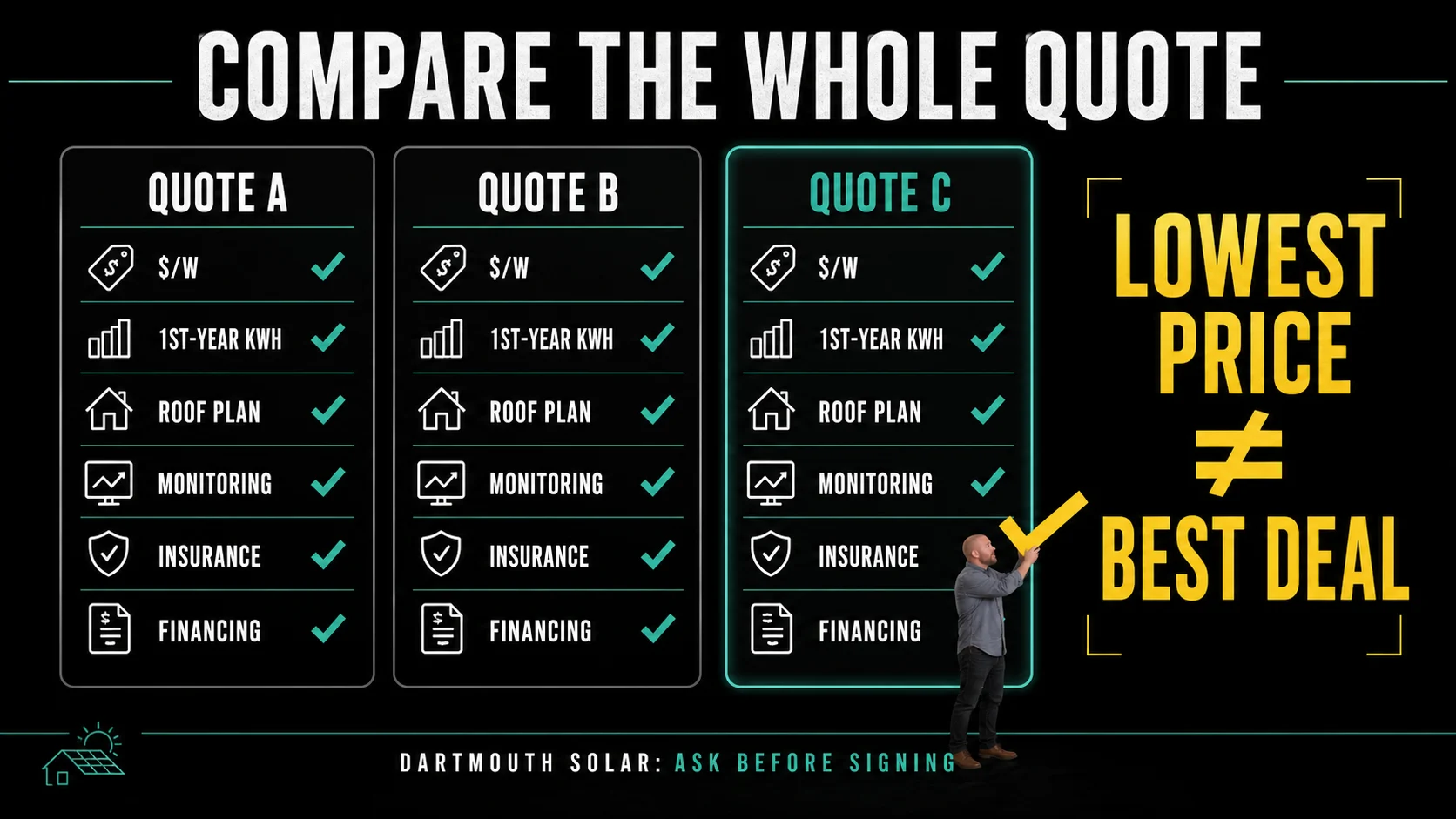
At minimum, ask every solar installer for:
- Proof of electrical qualifications and WCB standing.
- General liability insurance. Halifax suggests a minimum of $1,000,000.
- A roof attachment plan.
- Equipment specification sheets.
- Inverter and panel warranty details.
- Monitoring setup and who responds to alerts.
- Production estimate by roof face.
- A clear explanation of net metering and NS Power paperwork.
- A realistic installation timeline.
- A line-item quote with HST and financing separated.
SolarEnergies.ca can connect readers with a certified solar installer network with 14,000+ installs across Canada. Still, compare quotes. A good installer should welcome informed questions.
Do Batteries Make Sense In Dartmouth?
Batteries are worth discussing in Dartmouth because Atlantic storms and outages are real. But do not confuse battery backup with solar payback.
A grid-tied solar system without backup equipment normally shuts down when the grid is out. That protects utility crews and prevents unsafe islanding. If you want backup power, you need a system designed for it. Nova Scotia Power’s solar PV page also points homeowners toward professional battery storage when they want to pair solar with dispatchable clean energy.
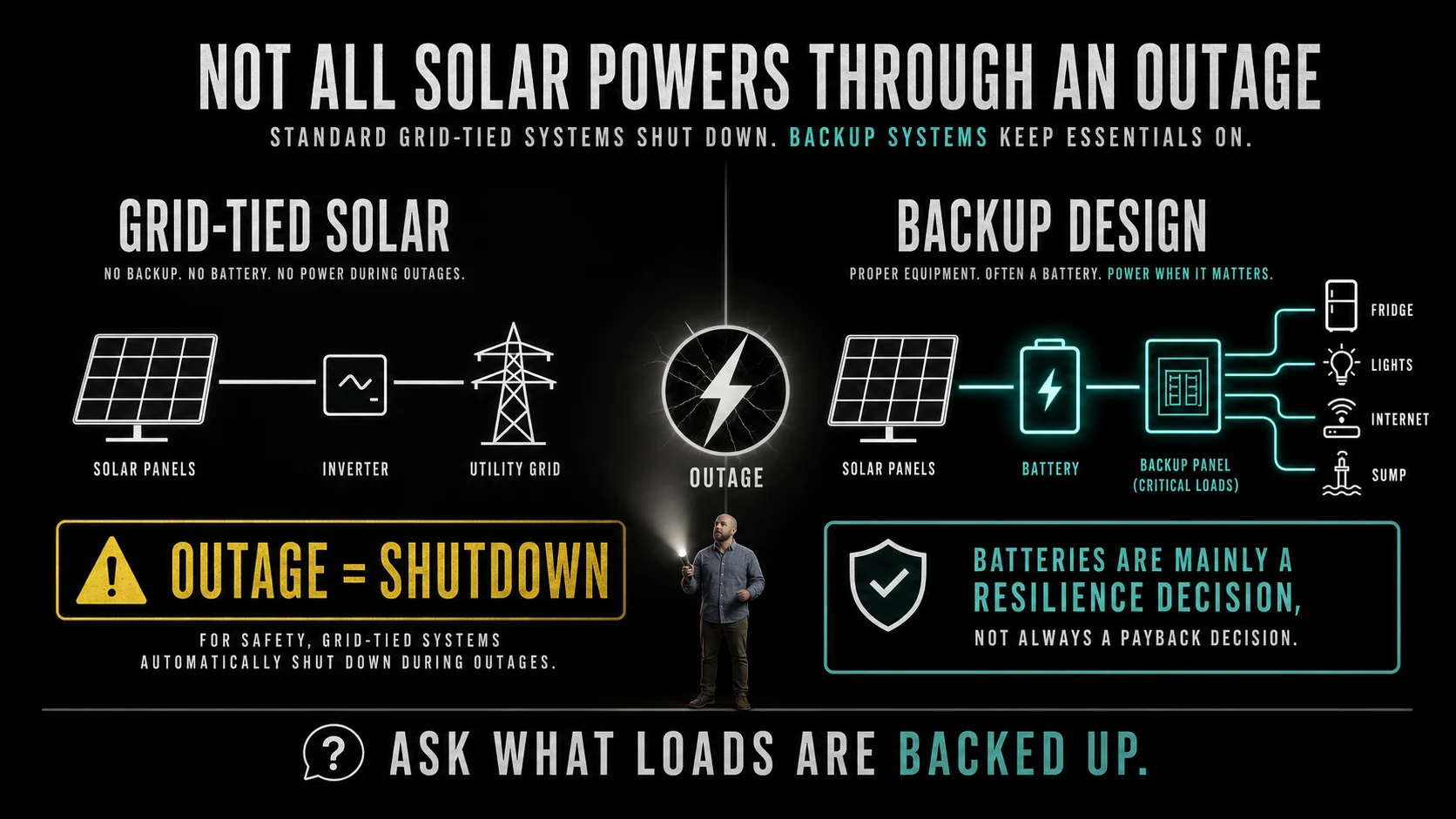
A battery can help run selected loads during an outage: fridge, internet, lights, sump pump, medical equipment, or a small heat-pump load depending on design. It may not run the whole house for days unless the system is sized and wired for that job.
Ask:
- Which loads will be backed up?
- How many hours of backup are expected?
- Can solar recharge the battery during a long outage?
- Is there a critical loads panel?
- What is the battery warranty and usable capacity?
- How much does the battery add to the quote?
If your main goal is lower electricity cost, start with solar-only math. If your main goal is resilience, battery storage may make sense even when the simple payback is weaker.
Next Steps For Dartmouth Homeowners
Here is the order I would use:
- Pull 12 months of Nova Scotia Power usage.
- Check roof age, roof direction, and shade.
- Decide whether EV, heat pump, hot tub, or other loads are coming soon.
- Run a first-pass estimate with the online solar calculator.
- Get at least two detailed quotes.
- Ask each installer to separate solar, battery, roof, electrical, HST, and financing costs.
- Check Solar City financing if you want a municipal option.
- Confirm insurance before installation.
- Compare payback using conservative production and rate assumptions.
The best outcome is not “maximum panels.” It is the right system at the right price, with no surprise roof, insurance, financing, or utility problem.
Relevant City Guides:
Solar Panels Yarmouth Cost Guide: Is It Worth It?
Solar Panels Nova Scotia: Your Guide to Going Solar
FAQ
Are solar panels worth it in Dartmouth in 2026?
They can be. Solar panels in Dartmouth are most likely to be worth it if you use a lot of electricity, have a good roof, can get a fair installed price, and do not rely on expired rebates or closed federal loan programs. The math is weaker for shaded roofs, low-usage homes, old roofs, or short ownership timelines.
What is the average solar panels Dartmouth cost in 2026?
Use about $2.75/W to $3.75/W installed as a planning range for many straightforward residential projects. That puts a 10 kW system around $27,500 to $37,500 before unusual roof, electrical, battery, or financing extras. Get a real quote before making a decision.
Is the SolarHomes rebate still available for Dartmouth homeowners?
No, not for new homeowner applications. Efficiency Nova Scotia says the SolarHomes homeowner program is closed, new applications stopped on April 17, 2025, and approved homeowner projects had to be completed by March 31, 2026.
Can Dartmouth homeowners use Halifax Solar City financing?
Yes, Dartmouth is in Halifax Regional Municipality, and Halifax Solar City is for property owners in the municipality. Halifax describes 10-year financing at a fixed 4.75% interest rate through a voluntary Local Improvement Charge. Confirm eligibility and resale details before using it.
Does the Canada Greener Homes Loan still help with solar panels?
Not for new applications. NRCan now marks the Canada Greener Homes Loan as closed, with funding fully committed and new loan applications unable to be approved. If a quote still assumes new federal 0% loan approval, ask the installer to update the financing math.
How does net metering work for solar panels in Dartmouth?
Nova Scotia regulations classify an NSPI customer with a renewable low-impact generator of 27 kW or less as a residential net-metering customer. In practice, your installer should size the system around your annual usage, roof, and budget, then handle the utility application details with Nova Scotia Power.
Will solar panels work during Dartmouth winters?
Yes. Solar panels generate from light, not heat, so they still work in winter. Production is lower because days are shorter and snow or storms can reduce output. The important number is annual production, not one dark week in January.
Will solar panels power my house during an outage?
Usually not by themselves. A standard grid-tied solar system shuts down during outages unless it has proper backup equipment and often a battery. If outage power matters, ask for a backup design, not just a solar quote.
Should I replace my roof before installing solar?
If the roof is near the end of its life, yes. Solar panels can last 25 years or more, and removing/reinstalling them for roof work can be expensive. A roof with only a few years left can weaken the payback.
What is the “20 rule” for solar panels?
There is no special Dartmouth or Nova Scotia net-metering rule commonly called the “20 rule.” People may be talking about roof age, panel efficiency, or leaving margin in system sizing. For a Dartmouth homeowner, the practical rule is clearer: do not put a 25-year solar array on a roof that needs replacement soon, and do not size a system from a single month of electricity use.
How many quotes should I get?
Get at least two, preferably three. Compare cost per watt, first-year kWh production, equipment, roof attachment method, warranties, monitoring, insurance requirements, and financing. A slightly higher quote can be better if the design and after-support are stronger.