Why Canadian Utility Bills Could Rise After the Strait of Hormuz Crisis
May 8, 2026
BC Microgrid Investment: What Ottawa’s $4.5M Energy Push Means for Solar in B.C.
May 12, 2026Last Updated on May 11, 2026 by Vitaliy
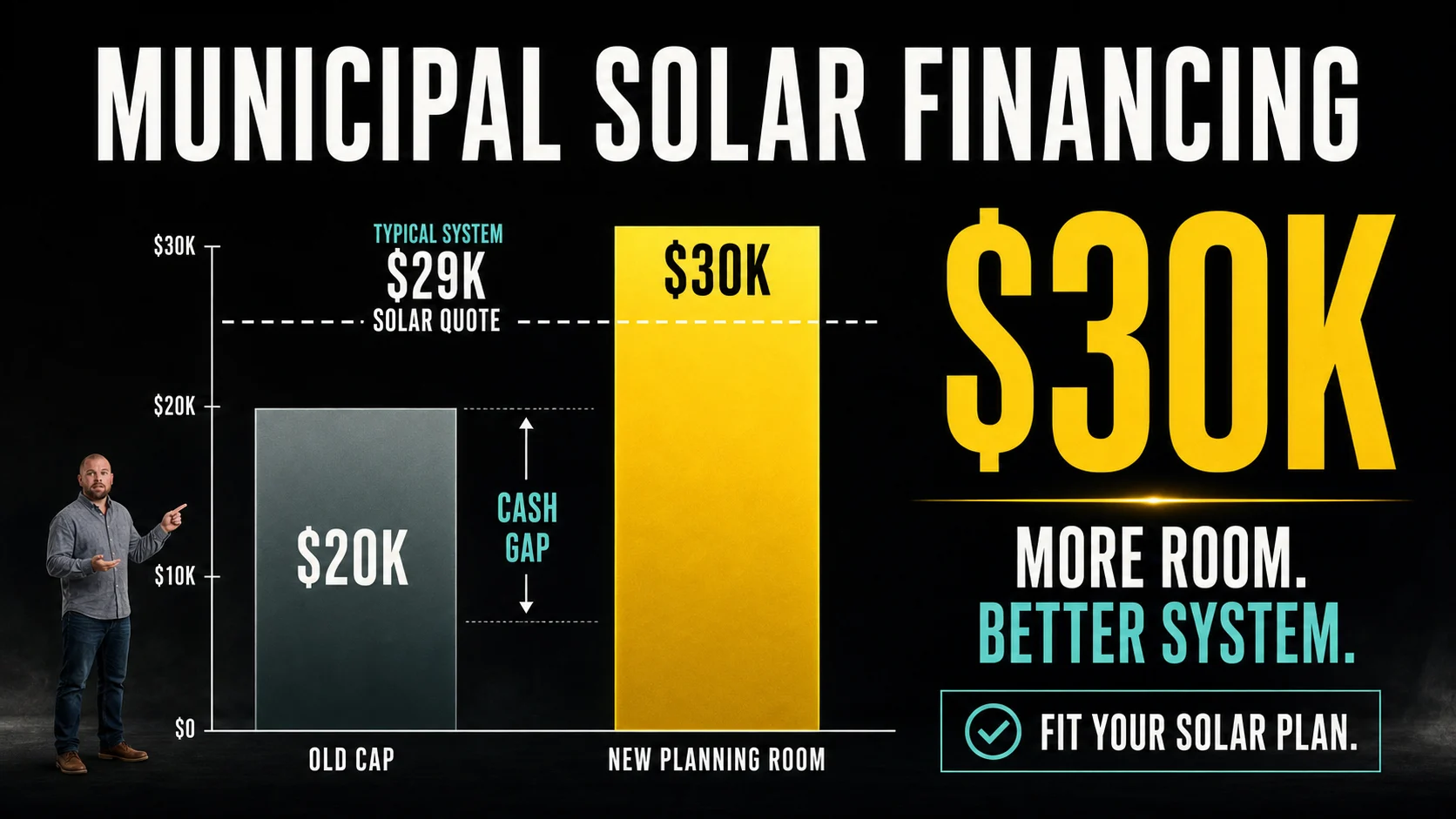
If you’re pricing solar panels in Nova Scotia, the financing question matters almost as much as the roof. A $25,000 solar quote can already feel like a big decision. Add a home battery, and the project can jump past what many homeowners want to pay in cash.
That’s why Nova Scotia’s municipal solar financing programs deserve a close look in 2026. Some programs now allow financing up to $30,000 or more, including Colchester’s listed $30,000 PACE options and other municipal programs with different caps. This is not one universal provincial loan for every homeowner. It’s a group of local programs, and the rules depend on your municipality.
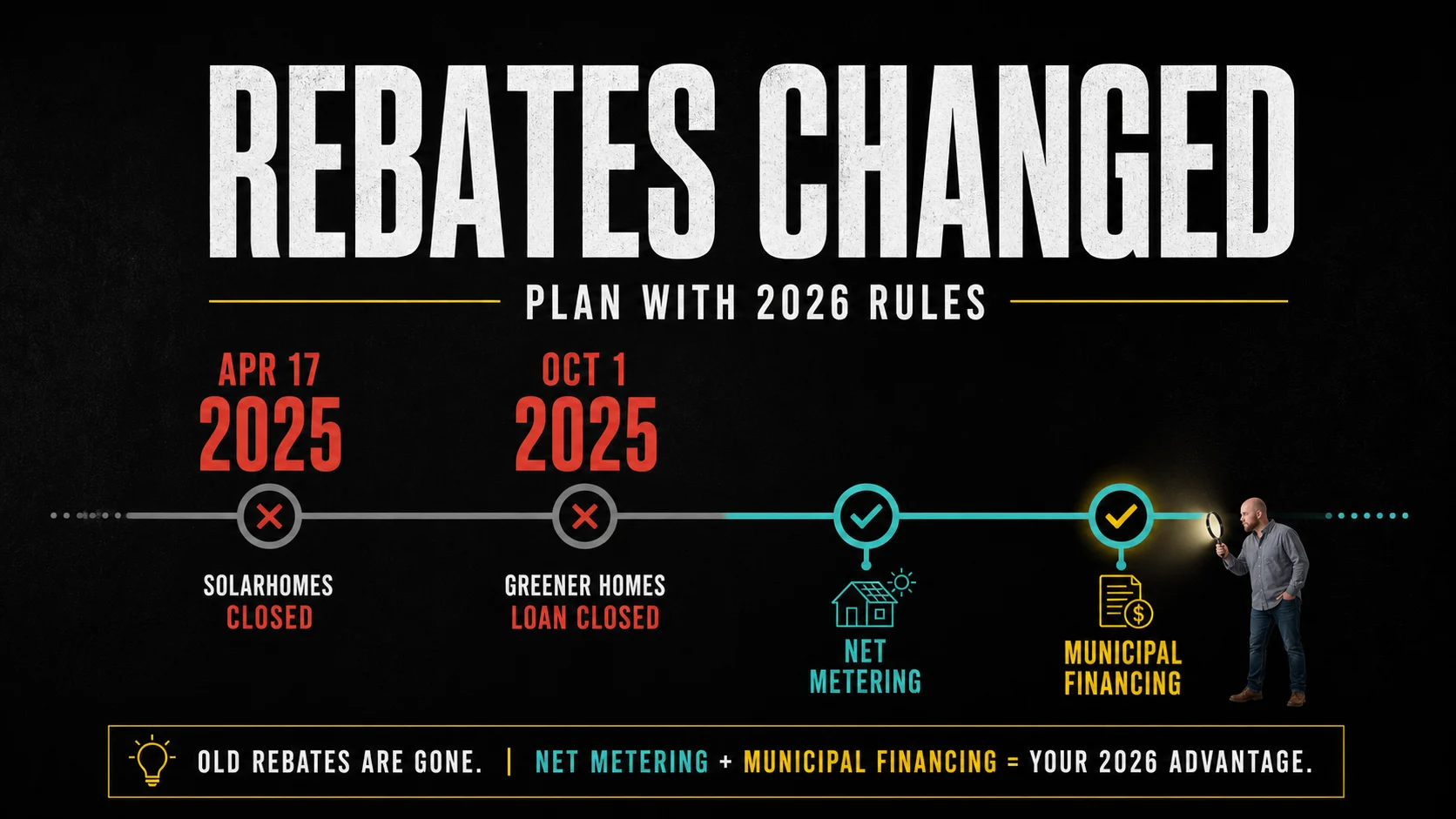
Waiting too long or using old rebate numbers can make your budget wrong from the start, because the big federal and provincial solar rebates that shaped the market a few years ago are mostly gone.
Key Takeaways
- The SolarHomes rebate is not available for new homeowner applications based on the current program administrator page. For government-only sourcing, confirm this against an accessible Nova Scotia Legislature or provincial government page before citing it as a government fact.
- The Canada Greener Homes Loan is closed to new applicants. Natural Resources Canada says October 1, 2025 was the last day to apply.
- Municipal PACE-style financing is now one of the most important solar funding tools in Nova Scotia.
- Halifax Solar City uses Local Improvement Charge financing at 4.75% over 10 years.
- Colchester has municipal programs with financing up to $30,000 or 25% of property value, 2.75% interest, and a 5% admin fee.
- A $30,000 cap can cover many standard solar-only projects, but solar plus battery storage still needs careful sizing.
- Batteries matter in Nova Scotia because standard grid-tied solar shuts off during outages unless the system includes battery backup and proper isolation equipment.
What Is the Nova Scotia Solar Loan?
The “Nova Scotia solar loan” people talk about is usually municipal financing, not a single province-wide loan.
Programs such as Halifax Solar City, Clean Energy Financing, Solar Colchester, Cozy Colchester, and SwitchPACE-style programs help homeowners pay for approved upgrades over time. Nova Scotia PACE programs describe the basic model this way: the municipality pays upfront, then the homeowner repays over a set period through a property-based structure.
Clean Energy Financing Nova Scotia also lists participating Nova Scotia municipalities and says the program supports upgrades such as heat pumps, insulation, solar, and more.
The key idea is simple. Instead of paying the whole solar cost upfront, you spread the cost across years. In many programs, the charge is attached to the property rather than working like a normal unsecured personal loan.
Why the $30,000 Limit Matters Now
A $20,000 financing limit used to go further. Solar prices were lower, rebates were stronger, and many homeowners were only thinking about panels.
That changed.
Residential electricity rates changed in 2026 after the Nova Scotia Energy Board’s general rate decision, so homeowners should check the current approved tariff before calculating solar payback.
At the same time, the old incentive stack is weaker. Natural Resources Canada says the Canada Greener Homes Loan is closed to new applicants, with October 1, 2025 as the last day to apply: Canada Greener Homes Loan closure. The SolarHomes rebate is not available for new homeowner applications based on the current program administrator page.
So the 2026 solar decision is less about chasing a grant and more about asking, “Can I finance the right system without overpaying?”
That’s where $30,000 helps.
A typical Nova Scotia solar system can land in the mid-$20,000s depending on size, roof layout, equipment, and electrical work. SolarEnergies.ca’s current Nova Scotia guide estimates a standard 9.17 kW system around $23,000 to $29,000 before financing: solar panels in Nova Scotia cost guide.
With a $20,000 cap, many homeowners still had a cash gap. With $30,000, a properly sized solar-only system becomes much easier to finance.
Which Nova Scotia Programs Offer Solar Financing?
Program rules change by municipality, so always confirm before signing a contract.
Here are the big categories.
| Program type | Example | What to check |
|---|---|---|
| Halifax Solar City | HRM solar financing | 4.75% fixed, 10-year term, LIC structure |
| Clean Energy Financing | Multiple NS municipalities | Municipality cap, term length, eligible upgrades |
| Solar Colchester / Cozy Colchester | Colchester | Municipality of Colchester programs with financing up to $30,000 or 25% of property value, 2.75% interest, and a 5% admin fee. |
| SwitchPACE-style programs | Select municipalities | Cap, rate, admin fee, eligible project types |
Halifax states Solar City financing is repaid over 10 years at 4.75% through a Local Improvement Charge, and the charge is applied to the property: Halifax Solar City program.
Colchester is a good example of why homeowners should check the municipal page before signing anything. The Municipality of Colchester’s current Solar Colchester page lists financing through the property at 2.75% interest, with an up to 15-year term, a one-time 5% admin fee, and financing up to $30,000 or 25% of property value, whichever is less. Low-income households may qualify for an admin fee exemption.
Tip for homeowners: don’t assume your neighbour’s financing terms apply to you. Your municipality, tax status, property type, project scope, and installer paperwork all matter.
Does $30,000 Cover Solar Plus Battery Storage?
Sometimes. Not always.
A $30,000 solar loan can often cover a good solar-only project. It may also cover a smaller solar plus battery design if the system is sized carefully. But a full whole-home backup setup can still go beyond $30,000.
Here’s a practical way to think about it.
| Project type | Typical budget pressure | Fit with $30,000 financing |
|---|---|---|
| Standard solar-only system | Panels, inverter, racking, permits, electrical | Often a strong fit |
| Solar plus small battery | Smaller array or limited backup loads | Possible, but design matters |
| Solar plus larger battery | More storage, backup panel, hybrid inverter | May exceed the cap |
| Whole-home backup | Larger battery bank and more electrical work | Usually needs more capital |
A battery changes the project. You’re not just buying a box on the wall. You may need a hybrid inverter, backup gateway, critical load panel work, permits, and commissioning.
Still, batteries are becoming more relevant in Nova Scotia. Standard grid-tied solar shuts down during a blackout for safety. If you want your fridge, internet, heat pump, sump pump, or medical equipment to keep running, you need storage and proper backup wiring.
Efficiency Nova Scotia has promoted home battery storage as a way to support both homeowners and the grid.
Why Batteries Matter More in Nova Scotia Than People Think
Nova Scotia has a serious grid transition ahead.
The province’s Clean Power Plan says Nova Scotia is phasing out coal and targeting 80% clean electricity by 2030. It also says the plan includes nearly 2,000 MW of wind, solar, and battery storage: Nova Scotia Clean Power Plan.
Canada Energy Regulator data shows why this matters. In 2023, coal still supplied 47.3% of Nova Scotia’s electricity generation, while renewables supplied 29.5%. More wind and solar on the grid means more need for storage. Utility-scale batteries help, but home batteries can also reduce pressure during peak hours and outages.
Nova Scotia Power offers time-based rate options, but those options are not open to every household, and program availability can change. A battery can sometimes help shift energy use, but only if the rate plan, equipment, and homeowner habits line up.
Tip for battery buyers: size backup around critical loads first. Whole-home backup sounds nice, but it can eat your budget fast.
How to Decide If Municipal Solar Financing Makes Sense
Start with the project, not the loan.
A weak solar design doesn’t become good because the payment is spread out. A strong design can become easier to act on when the financing terms are fair.
Ask these questions before applying:
- How much electricity did the home use over the last 12 months?
- Is the roof shaded, aging, or broken into too many small sections?
- Will the system be solar-only or solar plus battery?
- Does your municipality offer PACE, Solar City, Clean Energy Financing, or SwitchPACE?
- What is the interest rate, admin fee, term, and repayment method?
- Does the financing transfer when the home sells?
- Is the installer pricing the cash job and financed job clearly?
I like municipal financing when it helps a homeowner install the right system without draining savings. I don’t like it when the monthly payment hides a poor roof, oversized system, or inflated quote.
That’s the honest line.
If you are still comparing the broader funding landscape, SolarEnergies.ca also has a practical guide on how to finance solar panels after the Greener Homes Loan, plus a dedicated breakdown of Nova Scotia solar rebates and a newer look at the Nova Scotia battery rebate.
The Bottom Line
The $30,000 Nova Scotia solar financing conversation is important because it fills part of the gap left by closed rebates and closed federal loans.
For many homeowners, $30,000 can turn solar from “maybe later” into a serious plan. It can cover many well-sized solar projects and may help with a modest battery setup. But it isn’t magic. Larger solar plus storage systems can still cost more, and each municipality has its own rules.
If you’re in Nova Scotia, the next step is simple: confirm your local financing program, get a system sized from your real power bills, then compare the total financed cost against the expected bill savings.
Solar still makes sense for many Nova Scotia homes. The key is doing the math with 2026 numbers, not old rebate-era assumptions.
FAQ
Is there really a $30,000 Nova Scotia solar loan?
There is not one universal $30,000 provincial solar loan for every Nova Scotia homeowner. The $30,000 figure applies to specific municipal PACE-style programs, such as the Municipality of Colchester’s Solar Colchester and Cozy Colchester programs.
Other municipalities may offer lower or higher caps. Halifax Solar City, for example, uses its own Solar City structure with a 4.75% fixed rate over 10 years.
Did the Canada Greener Homes Loan close?
Yes. Natural Resources Canada says the Canada Greener Homes Loan is closed to new applicants, and October 1, 2025 was the last day to apply.
Existing approved applicants may still be processed under program rules, but new 2026 solar shoppers should not build their budget around that federal loan.
Is the Nova Scotia SolarHomes rebate still available?
The SolarHomes rebate is not available for new homeowner applications based on the current program administrator page.
Some older solar pages still mention the rebate as if it is active. Treat that as outdated unless Efficiency Nova Scotia or your municipality confirms otherwise.
Can I use municipal financing for a battery?
It depends on the program and municipality. Some clean energy financing programs include energy upgrades beyond panels, while others have more specific rules.
Before designing the battery system, ask the program administrator whether battery storage, backup panels, hybrid inverters, and related electrical work are eligible costs.
Will solar panels work during a power outage?
A standard grid-tied solar system will not power your home during an outage. It shuts down automatically so it does not send electricity back onto power lines while crews are working.
To keep power during an outage, you need a battery backup system and the correct electrical equipment to isolate your home from the grid.
Is $30,000 enough for solar panels in Nova Scotia?
For many homes, yes. A standard solar-only system can often fit near or under $30,000, depending on size and site conditions.
Solar plus battery storage is tighter. A smaller battery design may fit, but a larger whole-home backup system can exceed the cap quickly.
What should I check before signing a solar financing agreement?
Check the cash price, financed price, interest rate, admin fees, repayment term, prepayment rules, and what happens if you sell the home.
Then check the solar design itself. A good financing plan cannot fix heavy shade, an old roof, poor equipment choices, or a system that is oversized for your actual usage.