
Is Canada’s Solar Future At Risk? What The Ottawa-Alberta Deal Means For Your Home Solar Rebate
November 30, 2025
Canadian Solar’s Big US Manufacturing Move: Will It Make Your Next Battery Cheaper?
December 2, 2025Last Updated on December 2, 2025 by Vitaliy
You read the headlines. Someone claims they drive a massive electric truck, power their house, and the utility company pays them at the end of the year. It sounds like a scam or a specialized program for the wealthy. It is neither.
Key Takeaways
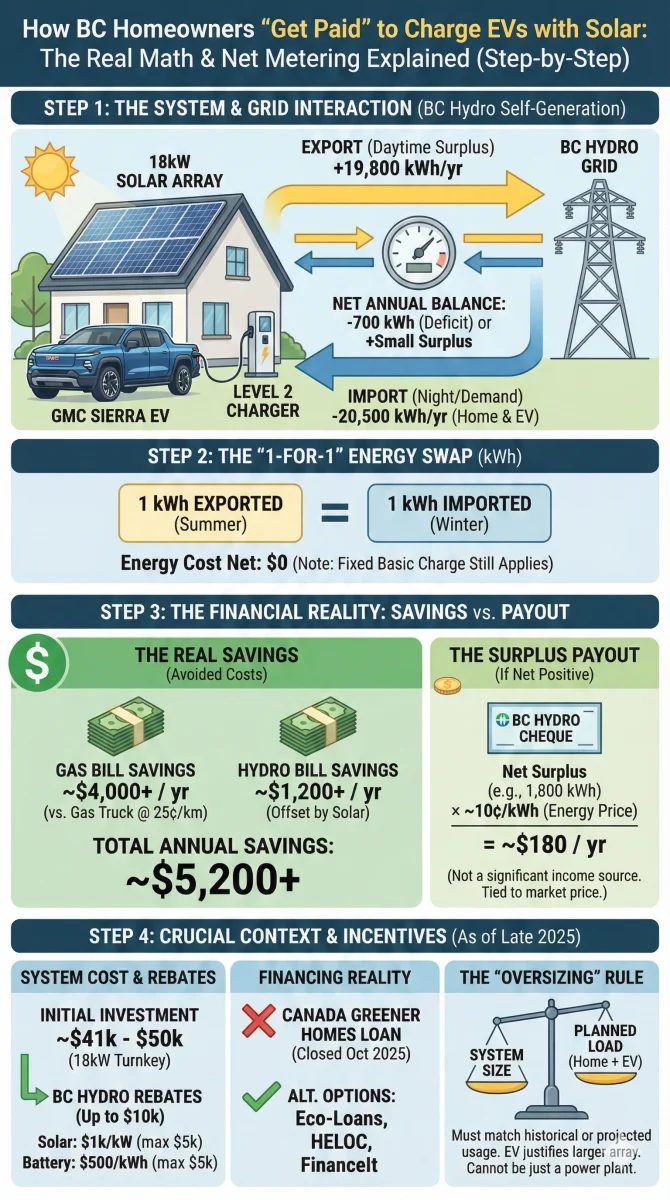
- Grid as a Battery: BC Hydro’s Self-Generation program lets you trade electricity 1-for-1. You export in summer, import in winter. The energy cost nets to zero, but you still pay the daily basic connection charge.
- The “Profit” is Savings: While BC Hydro cuts you a check for any net surplus at roughly 10 cents/kWh, the real financial win is avoiding $4,000+ in annual gas and electricity bills.
- Big Truck = Big Solar: To offset a heavy EV like a GMC Sierra (30 kWh/100km), you need a massive system (around 18kW). A standard 8kW home system won’t cover that driving load.
- Funding Has Changed: The federal interest-free Greener Homes Loan is closed (as of Oct 2025). However, BC Hydro now offers robust rebates up to $10,000 if you install both solar and batteries.
- Don’t Oversize for Cash: Installing extra panels just to sell power to BC Hydro is a bad investment. You pay ~$2.50/watt to install, but they only pay you ~10 cents/kWh. Size for your usage, not for export.
I see this request come across my desk weekly. Homeowners want to know if they can eliminate their gas bill and their hydro bill simultaneously. The answer is yes, but it requires understanding how BC Hydro actually counts your electrons. We are looking at a case where a driver uses a high-consumption EV—like a GMC Sierra EV—and a large 18kW solar array to turn a profit.
Let’s look at how this works in our solar panels BC guide, what it costs to set up, and why BC Hydro allows it under their “Self-Generation” program.
The Concept: Net Metering vs. Self-Generation
You cannot understand the financial return without understanding the mechanism. In British Columbia, we operate under a program now legally referred to as Self-Generation (formerly Net Metering).
Here is the simple version: BC Hydro treats the electrical grid as your personal battery.
When your solar panels produce energy during a sunny July afternoon, your home consumes what it needs first. If your AC is running and your fridge is on, that power comes straight from the roof. But an 18kW system produces far more than a typical home uses in real-time.
The excess electricity flows out of your house and into the grid. BC Hydro credits your account for every kilowatt-hour (kWh) you export. At night, when you plug in your EV, you pull energy back from the grid. This is the core concept of selling solar energy back to the power company.
The “1-for-1” Reality Check
The exchange rate is where people get confused. For the energy portion of your bill, it is effectively a 1-for-1 swap.
- You give them 1 kWh in the summer.
- You take back 1 kWh in the winter.
- Energy Cost: $0.
However, do not expect your bill to be literally zero. You still pay the Basic Charge (roughly $0.20 to $0.25 per day) and other small riders. Solar wipes out the usage fees, not the connection fee.
The Payout
You only get “paid” if you have a Net Surplus at the end of your billing year (your anniversary date). If you generated more total energy than you consumed over 12 months, BC Hydro pays you for that extra power.
They do not pay you the retail rate (what you pay them). They pay you the Energy Price, which reflects the market value.
- Current Payout Rate: Approximately 9.99 cents per kWh.
This rate is set by BC Hydro and tied to market pricing, so it can fluctuate. It’s not a lottery win; it’s a fair market settlement.
Case Study: The GMC Sierra EV and the 18kW System
Let’s look at the numbers from the Torque News report regarding the GMC Sierra EV owner and adapt it to our local BC context with realistic efficiency numbers.
The owner has a massive daily commute of roughly 135 km (85 miles). He installed an 18kW solar system.
The Energy Demand
A large EV like the Sierra or a Ford F-150 Lightning is heavy. Real-world tests in Canada show these trucks consume about 26 to 32 kWh per 100km. Let’s use 30 kWh/100km to be safe.
- Daily Commute: 135 km.
- Daily Energy Required: ~40.5 kWh.
- Annual EV Consumption: ~10,500 kWh (assuming 5 days/week commuting + some weekend errands).
The Energy Production
An 18kW system is huge. Most BC homes install 8kW to 10kW.
- System Size: 18kW (approx. 40 to 45 panels).
- Average BC Production: ~1,100 kWh per 1 kW of solar installed.
- Total Annual Production: ~19,800 kWh.
The Balance Sheet
| Item | Energy (kWh/Year) |
|---|---|
| Solar Generation | + 19,800 kWh |
| Average Home Usage (Heat Pump/Lights) | – 10,000 kWh |
| EV Charging (Sierra EV) | – 10,500 kWh |
| Net Balance | – 700 kWh (Deficit) |
Wait. This isn’t a bad thing. In fact, this is perfect sizing. You are offsetting your high-cost usage without over-investing in panels just to sell power at a discount.
If you drive a more efficient car, like a Tesla Model Y or Hyundai Ioniq 5 (roughly 18 kWh/100km), the EV consumption drops to ~6,300 kWh.
- New Balance: +3,500 kWh Surplus.
- The Check: 3,500 kWh * $0.0999 = $349.65.
You are not funding your retirement with this check. The “payment” is not the $350. The payment is the $4,000 to $5,000 you saved by not buying gas and not paying BC Hydro for electricity.
How Much Does This Setup Cost?
This is where we need to talk about money upfront. An 18kW system is an industrial-sized investment for a residential roof.
Here are the current market rates based on our cost of solar panels in BC calculator for a turnkey installation (equipment, labor, permits).
| Component | Cost Estimate (CAD) |
|---|---|
| 18kW Solar Array (Panels + Inverters) | $40,000 – $48,000 |
| EV Charger Installation (Level 2) | $1,000 – $2,000 |
| Total Investment | $41,000 – $50,000 |
Government Incentives: The Good and The Bad
The landscape for rebates changed drastically in late 2025.
The Bad News: Greener Homes Loan is Closed
For years, I told clients to grab the Canada Greener Homes Loan—$40,000 interest-free. That door is shut. Applications closed in October 2025. You can read more about what happened now that the Canada Greener Homes Loan and Grant are gone.
However, many banks (like Vancity or RBC) offer specific ‘Eco-Loans’. If you are wondering how to finance your solar panels now, it is worth asking your lender specifically about green home renovation financing or checking if FinanceIt solar loans fit your budget.
The Good News: BC Hydro Rebates
BC Hydro stepped up. Their current rebate structure is significant, especially if you add batteries. You can see the full breakdown of solar power BC rebates here, but the summary is:
- Solar Rebate: They offer $1,000 per kW of installed capacity, up to a maximum of $5,000.
- Battery Rebate: If you add energy storage, you can get another $5,000 (roughly $500 per kWh of storage).
- Total Potential: Up to $10,000 back.
Note: Always check the official BC Hydro Rebate page as these funds have caps and eligibility rules.
BC Hydro’s Involvement: The “Oversizing” Rule
BC Hydro is supportive, but they verify your intent. The program is called “Self-Generation” for a reason.
You cannot install a 50kW solar farm on your roof just to sell power at 9.99 cents. BC Hydro expects your system to match your historical or planned annual load.
This is where the EV is critical. When we submit the interconnection request, we list the EV charger and the vehicle specifications. This “planned load” justifies the massive 18kW system. Without the EV, BC Hydro might reject an 18kW application for a standard home because it looks like a commercial power plant disguised as a house.
Similar Cases Across Canada
Is this 1-for-1 math unique to British Columbia? No, but the rules change at the provincial border.
Alberta: The “Solar Club” Advantage
Alberta is arguably the best place in Canada for this right now financially. If you look at our solar panels Alberta guide, you’ll see why:
- Solar Clubs: You can join energy co-ops that offer high export rates.
- The Strategy: In summer, you switch to a “High Export” rate (sometimes over 30 cents/kWh) and sell your excess.
- Result: You can make actual cash profit in Alberta, not just break even.
Ontario: Use It or Lose It
Our solar panels Ontario guide explains that utilities there generally operate on a strict Net Metering basis. You build credits during the summer. You use them in winter.
- The Catch: If you still have credits left over at the end of the 12-month cycle, they often expire. They are wiped to zero. There is usually no cash check.
Saskatchewan: The 7.5 Cent Credit
SaskPower has a net metering program, but the math is tighter. As noted in our solar panel Saskatchewan guide, they credit you roughly 7.5 cents/kWh for excess power. Since you buy power at roughly 14 cents, it is not a 1-for-1 trade. It is much harder to “profit” here.
Critique: Is Bigger Always Better?
I want to be honest with you. Just because you can build an 18kW system doesn’t mean you should.
I worked with a client recently who wanted to cover his entire north-facing roof to maximize his “sales” to BC Hydro. I stopped him.
The cost to add those last 5kW of panels was roughly $12,000. The return he would get from BC Hydro for that specific extra chunk of power was only about $500 a year (5,000 kWh x $0.10). ROI: 24 years.
It makes no sense to spend $2.50/watt to install solar if BC Hydro only pays you 10 cents/kWh for the excess. You lose money on the hardware.
My Advice: Size the system to eliminate your bill and power your car. Stop there. Do not try to become an Independent Power Producer unless you just hate having money in your savings account.
The Verdict
Can you get paid to charge your EV? Technically, yes. If you produce slightly more than you drive, BC Hydro sends you a check for the difference at the market energy price.
But the real win is simpler.
- Solar Cost: ~9 cents per kWh (amortized over 25 years).
- EV Efficiency: ~30 kWh/100km.
- Your Cost to Drive: 2.7 cents per km.
Your neighbor in a gas truck pays 25 cents per km.
You are locking in your fuel price for the next 25 years at a 90% discount. That is a profit in my book. If you are still wondering do solar panels pay for themselves in Canada, the answer with an EV is almost always yes.
Action Plan for Homeowners
- Calculate Your Mileage: Know exactly how many km you drive annually.
- Check Your Panel: You need a 200 Amp service panel to handle a house + extensive solar + EV charger.
- Apply for Self-Generation: Do this before you buy the panels to ensure your system size is approved.
- Buy the EV: It validates the larger solar array application.
- Vet Your Installer: Look for the best solar companies in Vancouver or your local area to ensure quality work.
Solar is not about getting rich quick. It is about stopping the bleeding from your bank account to the utility and gas station.
FAQ: Let’s Answer Your Solar & EV Questions
Q: Can I install a massive solar system just to sell power to BC Hydro and make passive income? A: No. BC Hydro approves systems based on your actual or projected annual usage. If you apply for an 18kW system on a small home with no electric vehicle or heat pump, they will likely reject it. You need to prove the load exists (like showing them the specs for your GMC Sierra EV).
Q: Is the Canada Greener Homes Loan really gone? A: Yes, for new applicants. The portal closed in October 2025. If you didn’t get an application in before then, you cannot access the interest-free $40,000. I recommend asking your bank about “Eco-Loans” or green mortgage additions, which often have lower rates than standard lines of credit.
Q: Why does BC Hydro only pay ~10 cents/kWh when I pay them ~14 cents? A: When you buy power, you pay for the energy plus the transmission, poles, and wires. When you sell it back, they only pay you for the raw energy value (market price). It feels unfair to some, but that is the standard utility model across most of North America.
Q: What happens if I move? Do I take the system with me? A: You leave it. Solar is a fixture. It increases the property value, but you generally cannot unbolt it and move it to a new house cost-effectively. The labor to remove, patch the roof, and reinstall elsewhere eats up any savings.
Q: Can I charge my EV directly from the panels if the grid goes down? A: Only if you have a specialized inverter (like the Sunlight Backup) or a home battery system. Standard grid-tied inverters shut down immediately during a blackout for safety. If grid independence is your goal, you must budget for batteries, which adds $15,000+ to the project cost.
Q: Is 18kW the limit? A: For residential “Self-Generation,” the cap is generally 100kW, but you are limited by your main service panel. Most homes have a 200 Amp service, which maxes out around 15-20kW of solar back-feed without expensive electrical upgrades.