
What To Do If Your Solar Panels Underperform in Canada
February 24, 2026
Quebec Solar Subsidy: How Hydro-Québec’s New Grant Cuts Installation Costs by Up to 40%
April 10, 2026Last Updated on February 28, 2026 by Vitaliy
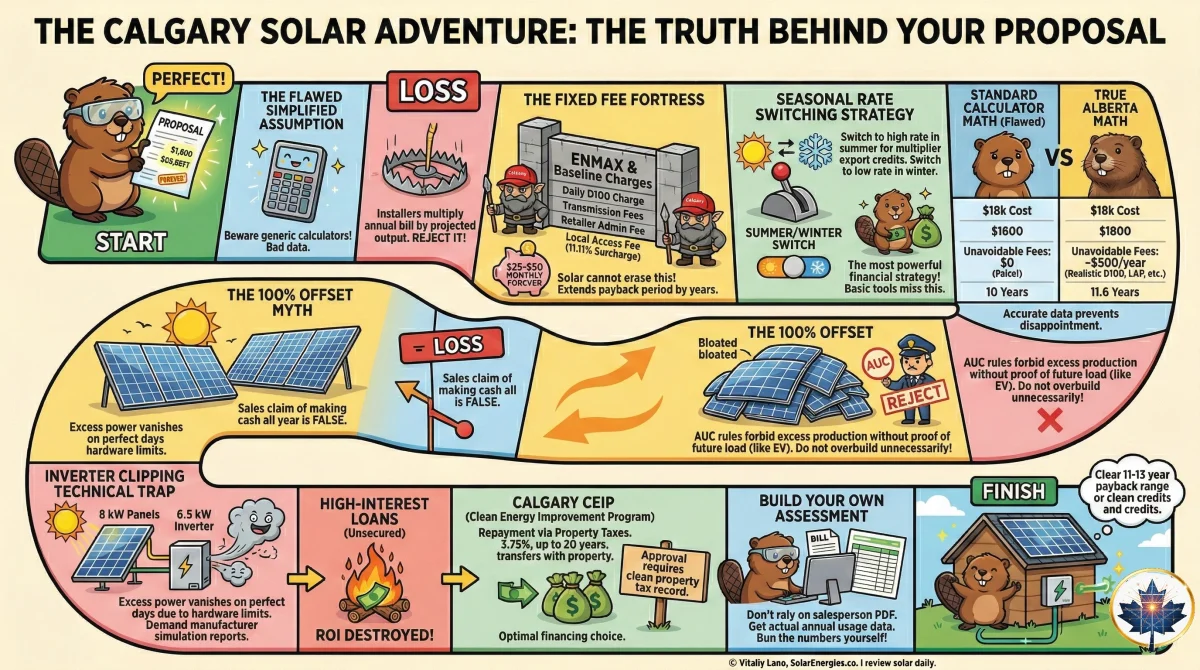
You look at a solar proposal for your Calgary home and the math seems suspiciously perfect. It is mathematically flawed. Installers frequently multiply your total annual electricity cost by the projected output to give you a fast payback period. Reject simplified assumptions immediately.
Key Takeaways
- Fixed Fees Never Leave: You will always pay $35 to $50 monthly for grid connection, retailer administration, and local access fees regardless of solar production.
- Seasonal Switching Works: If you export a lot in summer, Solar Club-style rate switching is often the biggest ROI factor available in Alberta.
- Over-sizing Gets Denied: The AUC restricts micro-generators from consistently producing more energy annually than they consume historically.
- Inverter Clipping is Real: Demand manufacturer simulation reports to see exactly how much peak power you will lose during summer months due to hardware limits.
- CEIP Financing is Optimal: High-interest unsecured loans ruin solar math, so utilize the Calgary CEIP tied to your property taxes instead.
Most generic solar panel calculators completely ignore the aggressive daily delivery charges baked into ENMAX energy bills alongside seasonal rate switching. The result? Bad data. I review solar proposals daily and see these blended-rate shortcuts misleading homeowners constantly across Alberta. Stop trusting web forms. Many proposals use simplified assumptions that drastically overstate your long-term financial savings. Let’s correct the math.
The Fixed Fee Reality on Your Calgary Power Bill
On a Calgary electricity bill in the ENMAX Power delivery area, delivery charges consume a massive chunk of your total. Fixed costs stay forever. You face an ENMAX Distribution Tariff daily charge plus per-kWh transmission fees, alongside a retailer administration fee billed per day. Solar cannot erase this. Even with a massive solar array, expect roughly $35 to $50 a month in charges you cannot fully zero out. Real households import power. The Calgary Local Access Fee acts as an 11.11% surcharge on both distribution wires and energy charges, complicating matters further. It is not flat. Missing this unavoidable baseline cost extends your true payback period by multiple years. Check your actual bills.
{Tip for Bill Reading: Grab your last three power bills and locate the daily basic charges under your delivery section. Subtract this combined permanent total from your installer’s projected annual solar savings instantly.}
Rate Switching: The Real ROI Strategy
Alberta’s Micro-Generation Regulation ties your export credits directly to your exact retail energy supply rate. Standard tools ignore this. Seasonal rate switching stands as the most powerful financial strategy you possess to accelerate your solar return on investment. You must switch rates. You choose a high energy rate during high-production summer months so your export credits multiply in value against your consumption. Switch to low later. Many Solar Club programs advertise $0.30/kWh for the high side and roughly $0.0877/kWh for the low winter side. This generates massive credits. I sat down with a homeowner in the deep south of Calgary last year to review his Alberta solar panel installation. He built huge credits. He generated a massive credit balance on his ENMAX account by late August using this exact seasonal switching method. Basic calculators miss this.
Real Numbers. True ROI.
Let’s run a realistic scenario for a standard detached home in Calgary using 7,500 kWh of energy annually. Review the table below. We will compare the flawed math pushed by basic calculators against the true math that includes ENMAX fixed fees. Numbers do not lie.
| Metric | Standard Calculator Math | True Alberta Math |
|---|---|---|
| System Size | 7.2 kW | 7.2 kW |
| Gross Cost | $18,000 | $18,000 |
| Assumed Annual Bill | $1,800 ($150/mo) | $1,800 ($150/mo) |
| Unavoidable Baseline Fees | $0 (Flawed assumption) | ~$500 ($41/mo average) |
| Export Structure | Flat rate all year | Seasonal rate switching |
| Actual Year 1 Savings | $1,800 | $1,550 |
| Payback Period | 10.0 Years | 11.6 Years |
Daily charges based on ENMAX D100 plus standard retailer admin fees. LAF calculated per the ENMAX formula.
A blended-rate shortcut makes the payback look much better than reality when homeowners ask if solar panels pay for themselves in Canada. Accurate data prevents disappointment. I want you to install solar panels on your property. Just use factual data.
The 100% Offset Myth
Installers often push for a system that offsets 110% of your historical usage to inflate the final invoice total. Stop oversizing your system. The Alberta Utilities Commission sets strict rules stating that systems producing more energy annually than historically consumed face rejection. Regulators enforce hard limits. You can only add extra capacity if you provide hard evidence of future load additions like a new electric vehicle. Do not overbuild unnecessarily. Five years ago, a homeowner in NW Calgary showed me a spreadsheet from a national installer proposing an 11 kW system. His home needed half. The sales representative falsely claimed the homeowner would make cash selling power back to the grid all year long. I stopped that deal.
{Tip for Sizing: Request a system that covers 90% to 100% of your historical 12-month usage, and refuse extra panels unless you have a signed purchase order for an EV or heat pump.}
Inverter Clipping and Realistic Production
Sales proposals show a perfectly smooth production curve, but your actual roof operates under different technical limitations over its 25-year lifespan. Hardware has hard limits. Installers use an active DC-to-AC ratio to pair your solar panels with an inverter possessing a lower maximum processing capacity. This causes energy clipping. On perfect June days, your 8 kW array might produce 7.8 kW of raw DC power while your inverter maxes out at 6.5 kW. That excess power vanishes. Most Calgary production lands in late spring through early fall, so you must use PVWatts for your exact roof to get the real monthly split. Demand raw simulation reports.
Financing Reality & The CEIP
Many homeowners rely on standard unsecured bank loans carrying heavy interest rates that absolutely destroy your solar return on investment. Financing changes the math. Calgary offers the Clean Energy Improvement Program where approval relies heavily on your clean property tax record and solid financial standing. Repayment happens via taxes. The CEIP rates sit around 3.75% with terms stretching up to 20 years, and the financing transfers directly with the property. Use the right loan. Adding high financing costs is one of the biggest mistakes I cover when discussing the top questions to ask solar companies. Ask about total borrowing.
Build Your Own Accurate Assessment
Do not rely on the glossy PDF the salesperson hands you to make a twenty-thousand-dollar financial decision. Build your own calculation. Get your total annual kWh usage directly from your energy provider’s online portal and separate your baseline daily charges. Run the numbers yourself. My name is Vitaliy Lano, and I run SolarEnergies.ca to ensure Canadians get real data before drilling holes in roofs. I review solar daily. I spend my days analyzing solar installers so you know exactly what delivers true long-term value. Do the actual math.
FAQ
Can I eliminate my Calgary power bill entirely with solar? No. You will always face ENMAX D100 daily charges, retailer admin fees, and local access fees. Expect roughly $35 to $50 a month in base charges you cannot erase.
How does the Solar Club actually work? It is seasonal rate switching. You choose a high energy supply rate during summer months to maximize your export credits, and then switch to a low rate during winter when you buy from the grid.
How long does it actually take to pay off solar panels in Calgary? With accurate math accounting for fixed baseline fees and seasonal rate switching, a standard residential system in Calgary takes between 11 to 13 years to pay for itself.
Should I buy a bigger solar system to make extra money selling to the grid? No. AUC guidelines prevent systems that produce more energy annually than historically consumed at the site from being approved without proof of incoming load additions.