
Nova Scotia Solar Financing: How $30,000 Municipal Loans Change Solar and Battery Planning
May 11, 2026
Why Canada’s Natural Gas Electricity Strategy Could Keep Hydro Bills High
May 14, 2026Last Updated on May 21, 2026 by Vitaliy
If you live in British Columbia and you are thinking about solar panels, the big question is no longer just “how much power can my roof make?” The better question is “how will my home fit into the grid B.C. is building next?”
On May 12, 2026, Natural Resources Canada announced more than $4.5 million through the Clean Energy for Rural and Remote Communities program for clean energy projects in British Columbia. The money is aimed at rural, remote, and Indigenous communities that want cleaner heat, power, and fuel from sources like solar, water, and biomass while cutting diesel use (Natural Resources Canada announcement).
That may sound far away from a homeowner in Victoria, Kelowna, Surrey, or Prince George. It is not. Those same ideas – local generation, storage, and demand control – are showing up across BC Hydro’s solar rules, battery rebates, and demand response programs. If you size a system using old net metering assumptions, you could leave real rebate money and bill savings on the table.
Key Takeaways
- Ottawa’s $4.5 million B.C. clean energy investment is another signal that local power, batteries, and microgrids are becoming normal.
- BC Hydro is closing legacy net metering to new customers on July 1, 2026, and replacing it with Rate Schedule 2289, where excess exported power earns 10 cents per kWh (BC Hydro rate update).
- The new rate makes self-consumption more important. Solar power used at home is usually more valuable than solar power exported.
- Current BC Hydro rebates can reach up to $5,000 for solar panels and up to $5,000 for battery storage, but the full battery rebate depends on Peak Saver enrollment (BC Hydro solar and battery rebates).
- Batteries are moving from “nice backup feature” to a core grid tool. BC Hydro’s virtual power plant pilot uses 200 home batteries in Sun Peaks and Harrison Mills to support local reliability (BC Hydro virtual power plant project).
May 2026 Power Smart update: BC Hydro’s $1B Power Smart 2.0 plan adds a new sizing checkpoint for BC solar projects. Efficiency upgrades can lower the system you need, while heat pumps, EV charging, battery storage and Peak Saver choices can push the design in the other direction. A good quote should model the home you are planning to run, not only last year’s bill.
Why a Remote Microgrid Announcement Matters to Homeowners
Remote communities have a hard energy problem. Many are not connected to the North American grid, so they rely on diesel for electricity and heat. Diesel can be reliable, but it is expensive to ship, vulnerable to supply problems, and hard on air quality. NRCan says the Clean Energy for Rural and Remote Communities program is meant to reduce fossil fuel use by increasing local renewable energy and efficiency (CERRC program details).
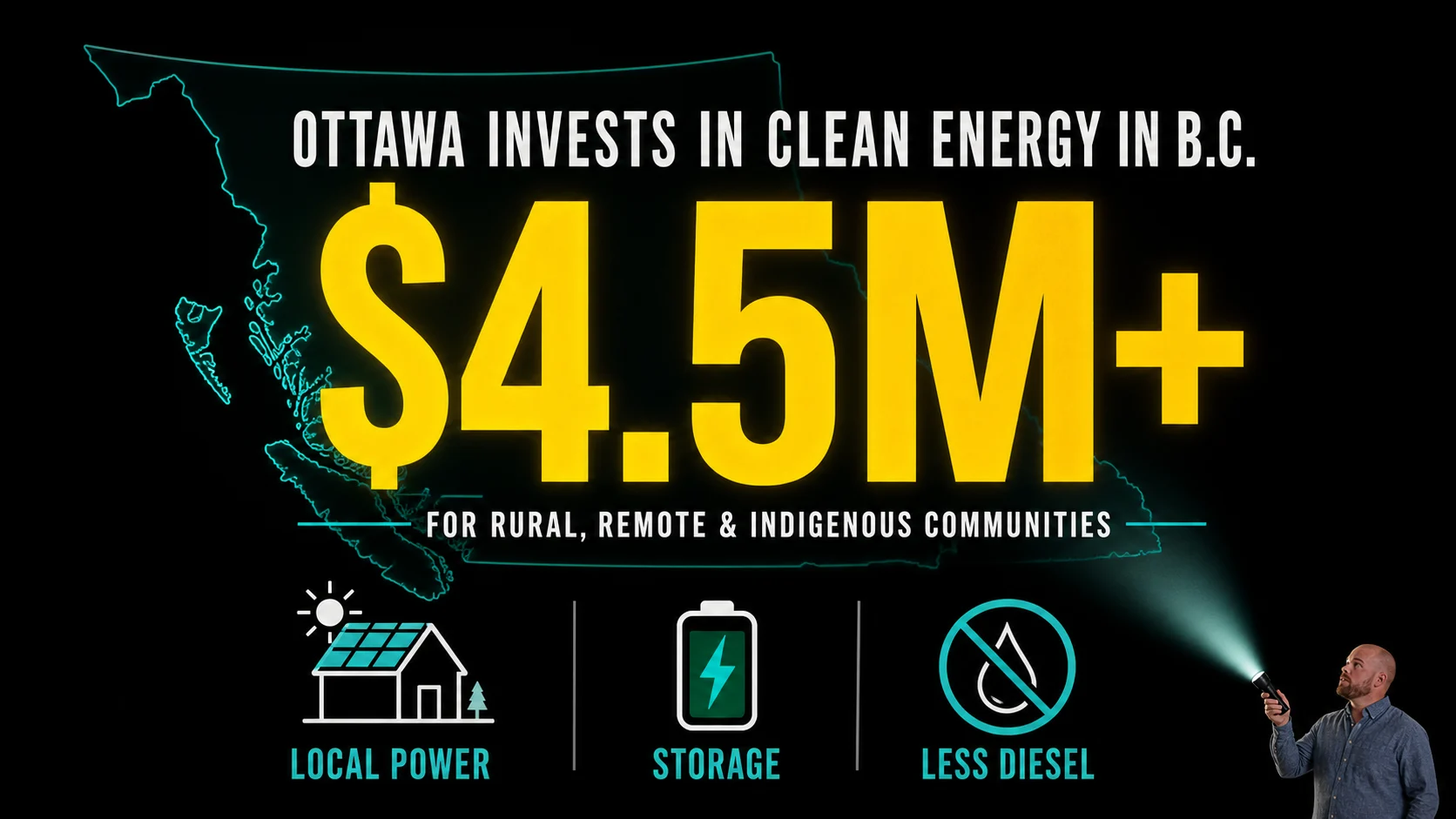
Microgrids solve a different version of the same problem homeowners care about: how do you make local power useful without making the electrical system unstable? Solar produces during daylight. Homes use power during morning, evening, heating, cooling, cooking, and EV charging peaks. Batteries and controls bridge that gap.
That is why rural microgrid funding matters. Remote projects help prove the value of local renewables, storage, controls, and training. BC Hydro’s own programs show similar tools are already moving into homes and communities.
The Big Shift: From Net Metering to Self-Generation
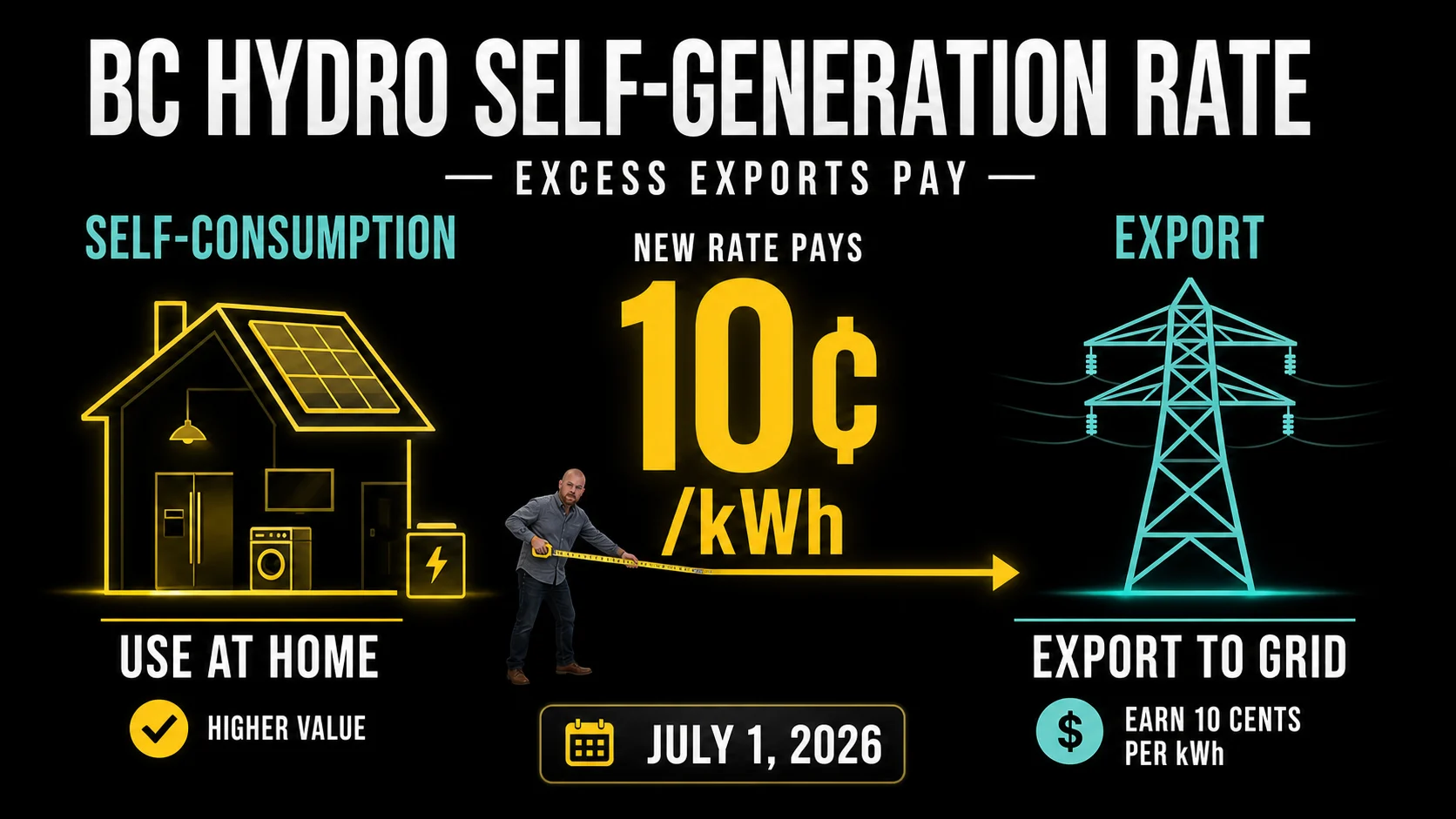
BC Hydro’s solar economics are changing on July 1, 2026. The old net metering service rate, Rate Schedule 1289, closes to new customers. The new self-generation rate, Rate Schedule 2289, will apply to new self-generation customers. Under the new structure, customers can send up to 100 kW per phase back to the grid and earn 10 cents per kWh for excess electricity (BC Hydro customer generation rate update).
Existing net metering customers have transition rules. BC Hydro says customers currently on Rate Schedule 1289 will stay on that rate until 10 years have passed from their initial net metering service start date. Customers who accepted a BC Hydro solar rebate are different: BC Hydro says they will automatically move to the new self-generation rate on July 1, 2026. If they received the rebate before the March 24, 2026 BCUC decision, they may have a one-time option to repay the rebate and remain on net metering for up to 10 years from their original start date. BC Hydro also says if a customer received both a solar rebate and a battery rebate, they only need to repay the solar panel rebate to remain on Rate Schedule 1289 (BC Hydro solar rebate repayment request).
Tip for existing solar owners: do not assume repaying a rebate is automatically smart. If your home uses most of its solar power directly, keeping the rebate may still be better than chasing the old credit structure.
Why Batteries Are Becoming More Valuable
Under the new self-generation rate, exported electricity has a clear value: 10 cents per kWh. That makes battery storage more important because a battery can store afternoon solar power and let you use it later.
BC Hydro’s current residential offer shows where policy is going. Solar systems can qualify for up to $5,000, calculated at $1,000 per kW and capped at 50% of installed product cost. Battery storage can also qualify for up to $5,000, calculated at $500 per kWh and capped at 50% of installed product cost. Batteries paired with solar but not enrolled in Peak Saver are capped at $1,500, and battery-only systems not enrolled in Peak Saver are not eligible (BC Hydro solar and battery rebate page).
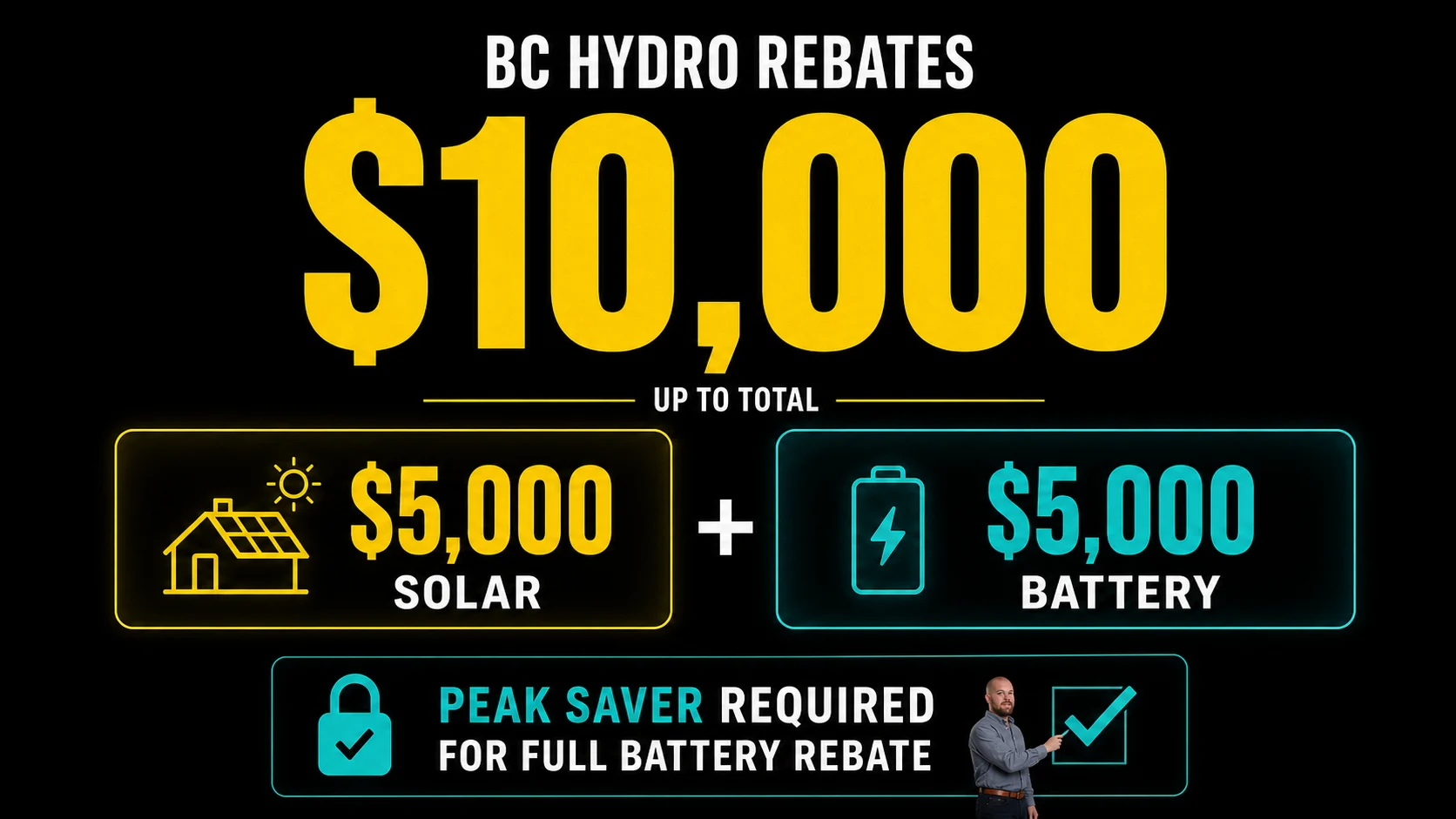
BC Hydro also says customers must enroll an eligible battery in Peak Saver no later than 14 days after interconnection approval to get the higher rebate. Starting June 1, 2026, eligible installations must be completed by a Home Performance Contractor Network member (BC Hydro rebate program notices).
| Choice | Why it matters now |
|---|---|
| Solar without a battery | Lower upfront cost, but more excess power may be exported at 10 cents per kWh. |
| Solar with a battery | Higher upfront cost, but better self-consumption and possible backup value. |
| Battery enrolled in Peak Saver | May unlock the higher battery rebate and help BC Hydro manage peak demand. |
| Oversized solar system | Needs careful math because excess exports are treated differently for new customers. |
Peak Saver Is the Bridge Between Your House and the Grid
Peak Saver is BC Hydro’s demand response program. It reduces strain during short peak events by coordinating flexible devices such as batteries, thermostats, water heaters, and EV charging. For batteries, that can mean using stored energy during high-demand periods so the home draws less from the grid.
BC Hydro’s virtual power plant pilot shows the same idea at a larger scale. In 2025, BC Hydro announced a project using 200 Eguana Technologies Evolve LFP 14 kWh/5 kW batteries in Sun Peaks near Kamloops and Harrison Mills in Mission. BC Hydro said Peak Saver had grown to more than 100,000 members and delivered 40 MW in demand savings, which it compared to charging more than 40,000 electric vehicles (BC Hydro virtual power plant project).
This is the homeowner version of the microgrid story. One battery is backup. Hundreds of batteries, managed properly, become a grid resource.
What This Means for Solar Payback in B.C.
Solar can still make sense in B.C., but the numbers now depend heavily on self-consumption, installation cost, rate choice, rebates, and battery use. The old mindset was simple: produce as much as possible, send extra power to the grid, and rely on credits. The new mindset is more practical: size around your load, increase daytime use where possible, and consider storage if you want better self-consumption, resilience, and access to the stronger battery rebate.
The market is already bigger than many people realize. Canada Energy Regulator data shows B.C. distributed solar generation reached 81.3 MW in 2023, and more than 12,000 customers were participating in BC Hydro’s net metering program as of January 2025 (Canada Energy Regulator B.C. renewable power profile).
Good solar design in B.C. now needs to answer these questions:
- How much electricity does the home use each year?
- How much of that use happens during solar production hours?
- How much power will likely be exported under the new 10 cent per kWh structure?
- Would a battery improve the economics enough after rebates?
Tip for homes with EVs or heat pumps: your load profile matters as much as your roof size. EV charging, electric heating, and smart controls can make solar more useful if they are planned together.
The Practical Next Step
Ottawa’s microgrid funding does not mean every B.C. home needs to become an island. It means the grid is changing into a more flexible network where homes, batteries, businesses, and remote communities all help balance supply and demand.
For B.C. homeowners, the practical takeaway is clear: solar is no longer just a panel decision. It is a system decision. The best projects will be sized around real electricity use, the new BC Hydro self-generation rate, rebate rules, and whether battery storage adds enough value.
If you are planning solar in B.C. in 2026, get the numbers checked before you buy equipment. A good proposal should show expected production, self-consumption, likely exports, rebate assumptions, battery options, and payback under the new rate.
FAQ
Does Ottawa’s $4.5 million microgrid investment directly pay for home solar rebates?
No. The May 12, 2026 federal announcement is for clean energy solutions in rural, remote, and Indigenous communities through the Clean Energy for Rural and Remote Communities program. Residential solar rebates for BC Hydro customers are separate. The connection is policy direction: more local renewable power, more storage, and less pressure on centralized energy systems.
Is BC Hydro net metering ending?
BC Hydro is closing Rate Schedule 1289, the legacy net metering service rate, to new customers on July 1, 2026. New self-generation customers move to Rate Schedule 2289, where excess generation earns 10 cents per kWh and customers can export up to 100 kW per phase.
Existing net metering customers have transition rules, including a 10-year period from their original service start date in many cases. Customers who accepted certain solar rebates should review the rebate repayment rules carefully.
Is a battery required for solar in B.C.?
No, a battery is not required for every solar project. Batteries are becoming more useful because exported power under the new self-generation rate has a fixed value, while stored solar can be used later in the home. A battery may make more sense if you want backup power, have evening loads, own an EV, use a heat pump, or can qualify for the higher Peak Saver rebate.
How much can a B.C. homeowner get in solar and battery rebates?
BC Hydro currently lists up to $5,000 for eligible grid-connected solar panels and up to $5,000 for eligible battery storage. Solar is calculated at $1,000 per kW and capped at 50% of installed product cost. Battery storage is calculated at $500 per kWh and capped at 50% of installed product cost.
For batteries, the full $5,000 depends on Peak Saver enrollment. Batteries paired with solar but not enrolled in Peak Saver are capped at $1,500, and battery-only systems not enrolled in Peak Saver are not eligible.
Should I oversize my solar system before the new rate starts?
Do not oversize based only on fear of missing out. A larger system can still be useful for homes with EV charging, heat pumps, future electrification plans, or large daytime loads. Under the new rate, excess exports are not valued the same way old net metering credits were for new customers, so model usage, production, self-consumption, and likely exports before deciding.
What is a virtual power plant?
A virtual power plant is a network of smaller energy devices coordinated like one larger resource. In a home setting, that can include batteries, EV chargers, smart thermostats, and other flexible loads. BC Hydro’s pilot in Sun Peaks and Harrison Mills uses 200 residential batteries to test how home storage can support backup power and peak demand management.