Solar Panels Surrey 2026: Cost, Rebates, Permits and Quote Checks
June 21, 2026
Solar Panels Halifax Cost Guide 2026: Is It Worth It?
June 30, 2026Last Updated on June 22, 2026 by Vitaliy
Solar panels in Saanich can be a smart upgrade, but only if the quote is built around your roof, your BC Hydro usage and the current 2026 rules. Saanich has the same BC Hydro math as the rest of the province, but the local decision is shaped by moss, mature trees, older roofs, coastal exposure, outage concerns and permit questions.
A weak quote can cost you twice: first through bad production or rebate assumptions, then again if roof work, permit responsibility or battery limits appear after you have already signed.
Key Takeaways
- BC Hydro says residential solar PV in B.C. typically costs about $2,000 to $3,000 per kW DC installed, and a 10 kW residential system typically costs $20,000 to $30,000 before rebates. See BC Hydro’s solar panel cost guidance.
- BC Hydro says a typical 10 kW residential rooftop solar system in B.C. can generate about 10,000 to 12,000 kWh per year, but Saanich homes still need site-specific shade, roof and seasonal modelling.
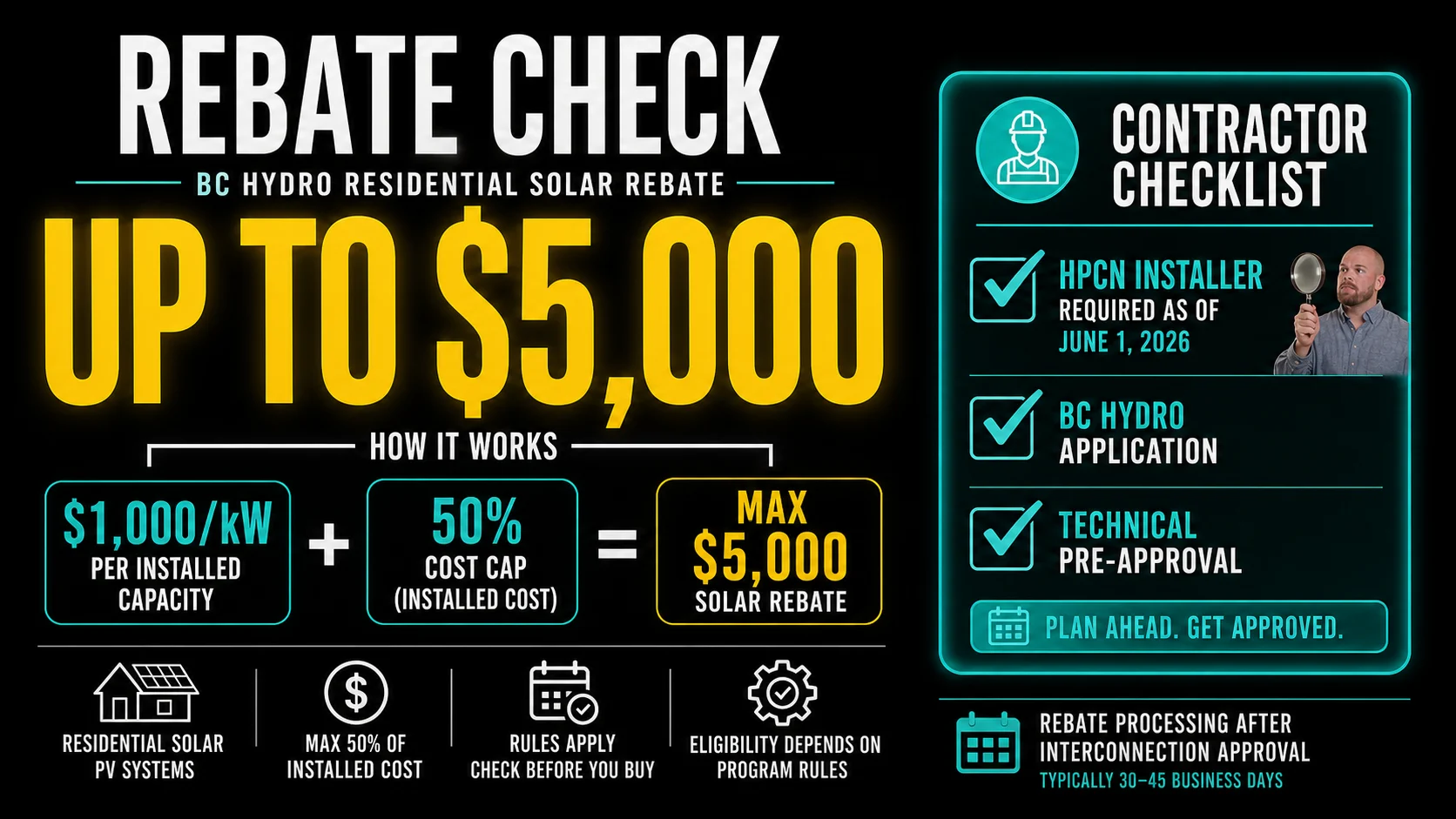
- BC Hydro’s residential solar rebate is $1,000 per kW of installed generator capacity, capped at 50% of installed product cost, with a maximum solar rebate of $5,000. See BC Hydro solar and battery rebates.
- Beginning June 1, 2026, BC Hydro says solar and battery systems must be installed by a Home Performance Contractor Network member for rebate eligibility. See BC Hydro’s contractor requirement notice.
- Effective July 1, 2026, BC Hydro is closing Rate Schedule 1289 to new customers and applying the new self-generation Rate Schedule 2289, where excess exported generation earns 10 cents per kWh. See BC Hydro self-generation rate updates.
Is Solar Worth It In Saanich?
Solar can be worth it in Saanich when the roof has useful sun exposure, the home uses enough electricity and the system is sized to serve the house first. EV charging, heat pumps, electric hot water, home offices and larger households can improve the case because solar has more load to offset.
Cloudy winter weather does not make solar pointless. Production is seasonal. A good proposal should show annual production and monthly production, not just one smooth savings estimate. Spring and summer usually carry more of the production, while winter output is lower.
Saanich’s harder checks are practical: roof age, moss, damp roof surfaces, mature tree shade, salt exposure near marine areas, inverter placement and whether a battery is being bought for backup. If those are missing from the proposal, the quote is not complete.
Solar Panels Saanich Cost In 2026
Using BC Hydro’s B.C. cost guidance, solar panels Saanich cost can be planned like this before site-specific adders: Solar panel costs in British Columbia can vary significantly based on location and installation conditions. Additionally, incentives and rebates offered by the provincial government can further influence overall expenses. It’s important to account for these factors when preparing a budget for your solar project.
| System size | Saanich fit | Gross planning range | Possible solar rebate | Net planning range |
|---|---|---|---|---|
| 5 kW | Smaller home or limited open roof | $10,000 to $15,000 | Up to $5,000 | $5,000 to $10,000 |
| 8 kW | Average detached home | $16,000 to $24,000 | Up to $5,000 | $11,000 to $19,000 |
| 10 kW | EV, heat pump or larger household | $20,000 to $30,000 | Up to $5,000 | $15,000 to $25,000 |
| 12 kW | High-use home with strong exposure | $24,000 to $36,000 | Up to $5,000 | $19,000 to $31,000 |
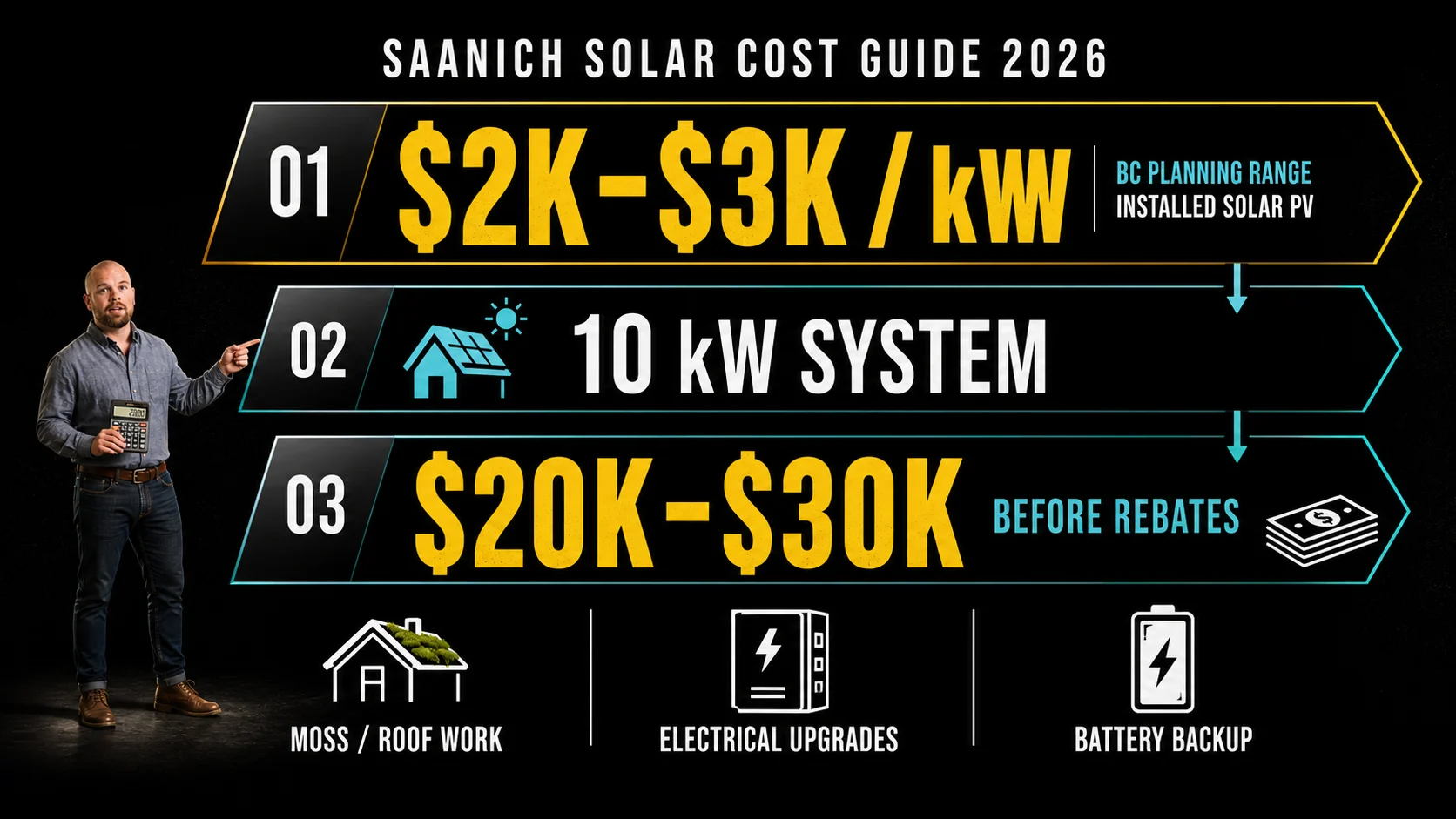
Those ranges are planning numbers, not final quotes. Saanich-specific adders can include moss cleaning, roof repair or replacement, corrosion-resistant racking, coastal-rated fasteners, electrical upgrades, battery backup, critical-load panels, extra shade modelling and permit support.
If you want a quick first check, use the SolarEnergies.ca online solar calculator before you start collecting quotes. Then ask each installer to show the assumptions behind system size, annual production, monthly production, self-use, export, roof work and rebate eligibility.
Tip for Saanich roofs
Do not use solar to hide a roof problem. If the roof needs moss removal, shingle repair, flashing work or replacement soon, price that before solar. Removing and reinstalling panels later can turn a cheap quote into an expensive project.
Rebates, Batteries And BC Hydro Rules
BC Hydro lists the residential solar rebate as $1,000 per kW of installed generator capacity, capped at 50% of total installed product cost, with a maximum solar rebate of $5,000. As sustainability initiatives grow, solar panel costs in Surrey 2026 are expected to decrease due to advancements in technology and increased competition among suppliers. Local government incentives may also play a significant role in making solar energy more accessible to homeowners. With these changes, residents can look forward to more affordable options for adopting renewable energy solutions. In addition, there are several free solar panel programs in Victoria designed to assist homeowners in making the transition to renewable energy. These initiatives not only provide financial support but also promote environmental sustainability in the region. As more residents enroll in these programs, the community can collectively move towards a greener future.
| Battery setup | 2026 BC Hydro rebate |
|---|---|
| Battery paired with solar, not enrolled in Peak Saver | Up to $1,500 |
| Battery enrolled in Peak Saver | Up to $5,000 |
| Battery only, not enrolled in Peak Saver | Not eligible |
BC Hydro also lists battery eligibility details that matter. Battery storage must meet certification requirements, the minimum storage size is 5 kWh, the rebate is capped at 50% of total installed product cost, and customers seeking the larger Peak Saver rebate must enroll an eligible battery within 14 days after interconnection approval.
The application order matters. BC Hydro says customers should review requirements before purchase, find an HPCN member, submit a self-generation application before installation, receive technical pre-approval before installation, submit final inspection documents for interconnection approval, and then wait for rebate processing if eligible. See BC Hydro’s rebate application steps.
That means you should not buy panels first and hope the paperwork works out later.
The 10-Cent Export Rate Changes The Quote Math
BC Hydro says Rate Schedule 1289 closes to new customers effective July 1, 2026. Under the new self-generation Rate Schedule 2289, excess generation sent back to the grid earns 10 cents per kWh.
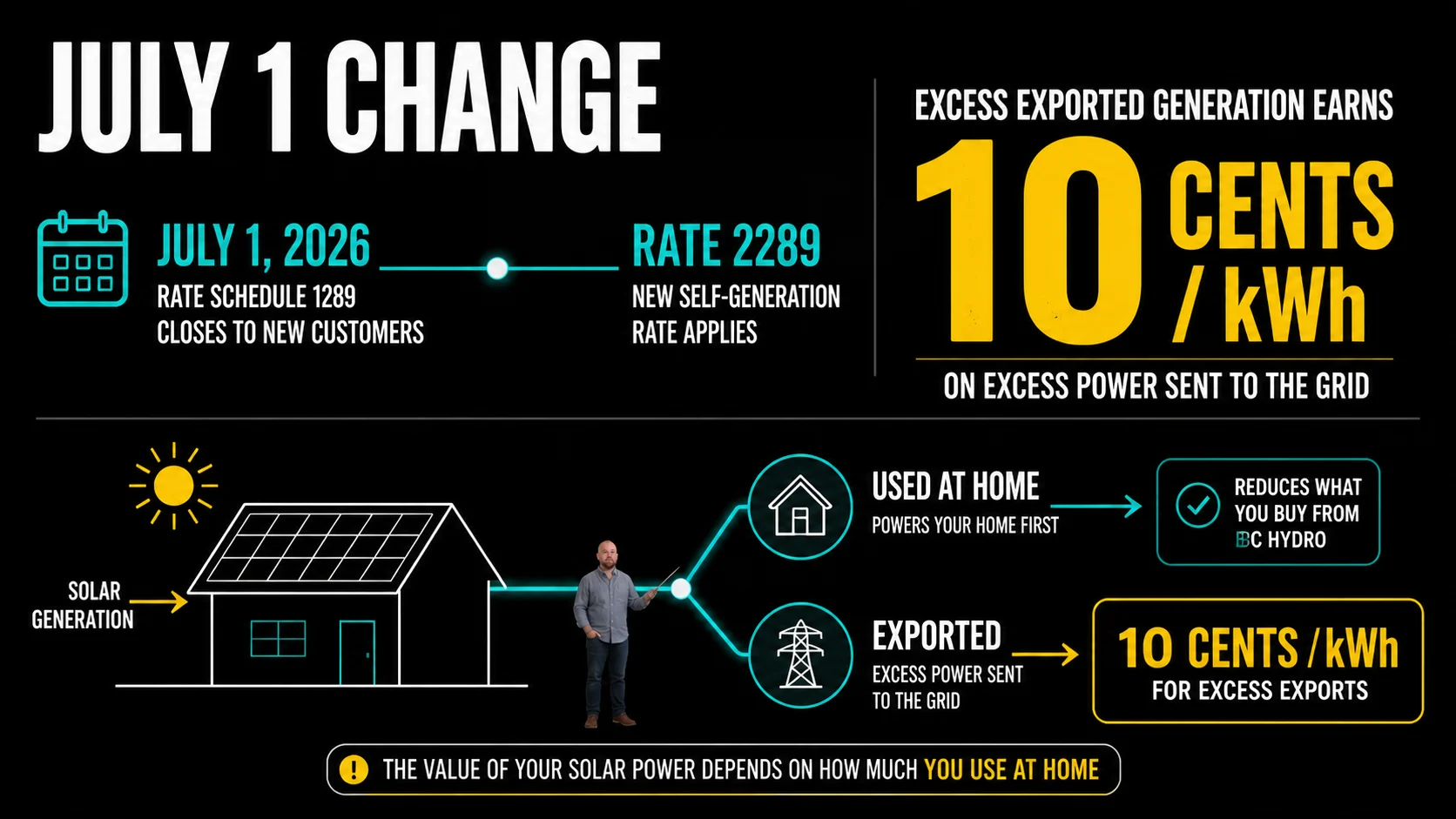
That does not mean every kWh from your panels is worth only 10 cents. Power used directly by your home can reduce what you buy from BC Hydro. Power exported after the home is already supplied is valued under the export rules. For Saanich homes that are empty during sunny weekday hours, this distinction matters.
BC Hydro’s residential rate notes also say the Tier 2 energy charge remains 14.08 cents per kWh, while customers may choose flat, tiered and optional time-of-day pricing. See BC Hydro residential rate notes.
Tip for export-heavy systems
Ask the installer for three numbers: annual production, estimated power used at home and estimated power exported. A large roof is useful, but the best system is not always the largest system that fits.
Permits, DIY And The Questions Saanich Homeowners Are Really Asking
A common worry in Saanich is not just “Do I need a permit?” It is: who is responsible if the roof leaks, the electrical work fails, the rebate does not qualify or BC Hydro does not approve the system?
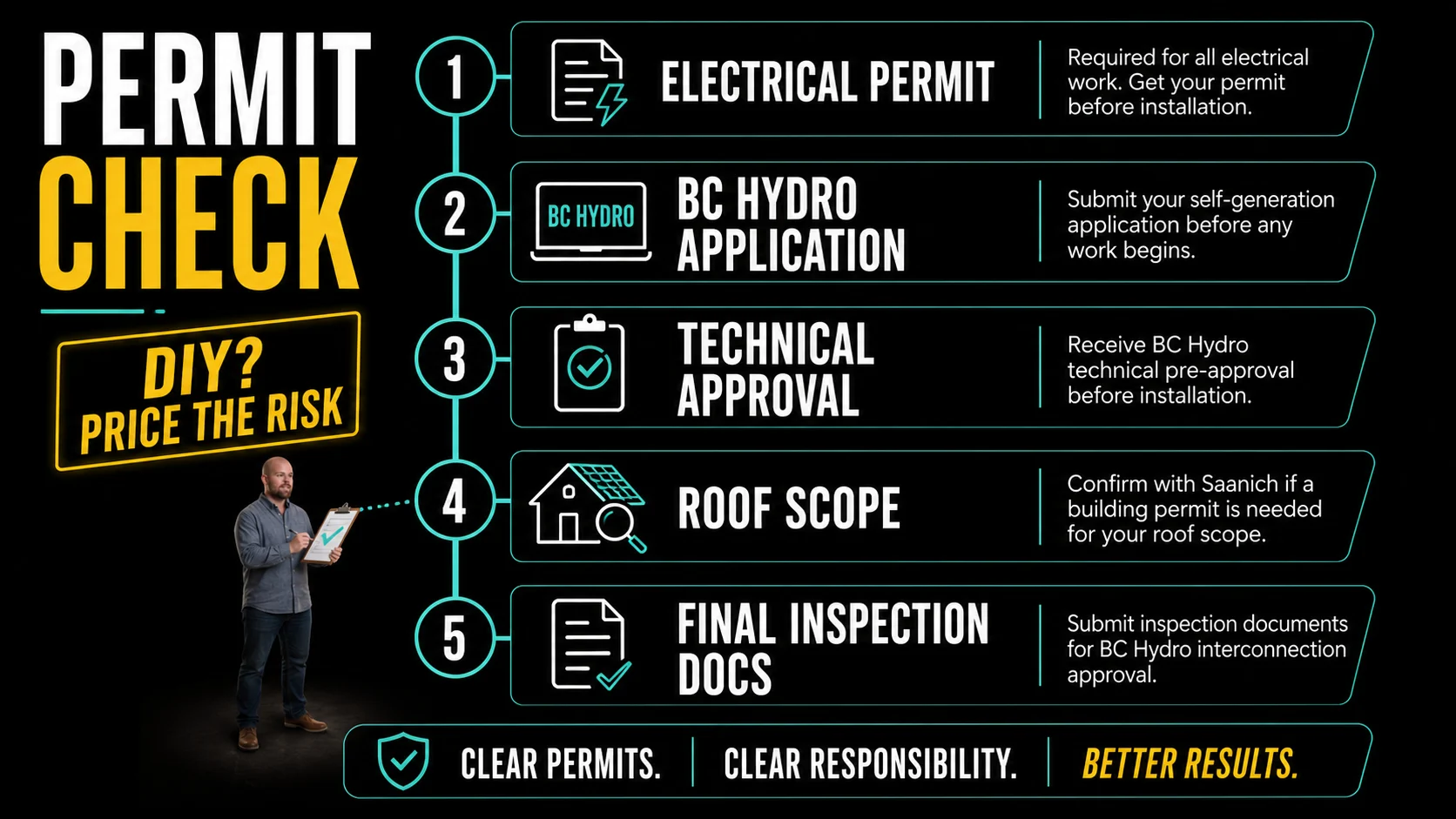
Start with what is clear. Technical Safety BC electrical permit guidance says both licensed contractors and homeowners installing electrical equipment require electrical installation permits, unless the work is in a listed municipality or district that issues its own permits. Saanich is not listed as an exception on that reviewed page. BC Hydro self-generation rules also say even small generation systems need application and approval before connecting to the grid.
The Saanich building-permit question is separate. I could not verify an official Saanich solar-specific public page during this research pass. Do not rely on a two-year-old forum comment or a casual installer answer for that. Ask Saanich Building Inspections about your exact roof scope, especially if the project involves penetrations, ballast, structural changes, setbacks, wind or snow load questions, heritage considerations or roof replacement work.
If you are thinking about DIY
The concern is fair. On a simple roof, DIY can look cheaper. The catch is that the savings only count if electrical permits, BC Hydro approval, roof waterproofing, structural loading, equipment warranty, monitoring and future service are all handled correctly.
Also ask who stands behind each part of the job. An electrician may only warranty the electrical connection, not owner-installed racking, roof penetrations or panel mounting. If you want to do part of the work yourself, get that responsibility in writing before equipment is bought.
If you think installers are keeping too much of the rebate
Do not guess from one quote. Compare at least three itemized proposals. BC Hydro also recommends getting at least three quotes in its rebate guidance.
Be careful with old loan or grant comments you find in public discussions. Federal, provincial and utility programs change. For this Saanich quote, keep the BC Hydro rebate separate from any financing claim, and verify current loan terms from the official program before you count them in your budget.
Ask each installer to separate:
- System size in kW DC
- Panel and inverter brands
- Racking and fastener details
- Roof cleaning, repair or replacement needs
- Electrical upgrades
- Permit and inspection responsibilities
- Annual and monthly production estimates
- Self-use and export assumptions
- Battery cost and backed-up loads
- Cash price, financed price, rebate assumptions and warranty terms
SolarEnergies.ca can connect Saanich homeowners with certified installers who have completed 14,000+ installs across Canada, so you can compare real options instead of trying to decode one proposal by yourself.
Project Numbers And Bill Context
BC Hydro says a typical 10 kW residential solar PV system in B.C. can generate around 10,000 to 12,000 kWh per year. Scaled examples can help with planning, but they are not Saanich results and they are not a promise.
| Example size | Scaled annual production range | Rough annual value at 10 cents/kWh | Rough annual value at 14.08 cents/kWh |
|---|---|---|---|
| 7.3 kW | 7,300 to 8,760 kWh | $730 to $876 | $1,028 to $1,234 |
| 9.2 kW | 9,200 to 11,040 kWh | $920 to $1,104 | $1,295 to $1,554 |
| 9.7 kW | 9,700 to 11,640 kWh | $970 to $1,164 | $1,366 to $1,639 |
| 10.0 kW | 10,000 to 12,000 kWh | $1,000 to $1,200 | $1,408 to $1,690 |
Use this table carefully. Real bill value depends on how much solar power the home uses directly, how much is exported, your BC Hydro rate plan, fixed charges, taxes, shade, roof output, inverter performance and whether you add loads like an EV charger or heat pump.
What Can Go Wrong With A Saanich Solar Quote?
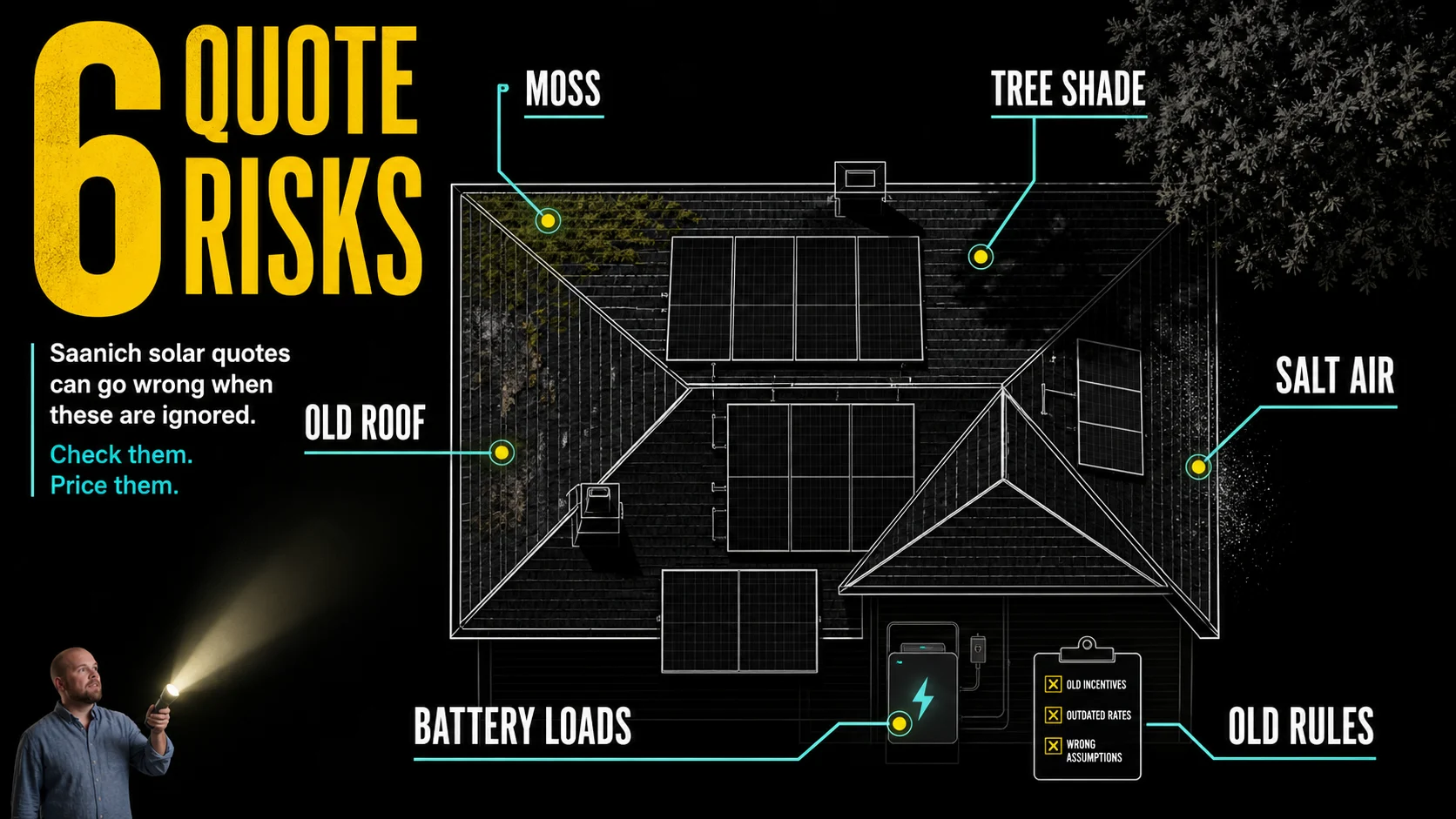
First, the quote can ignore roof condition. Moss, damp shingles and aging roofs should be handled before solar goes on.
Second, it can understate shade. Mature trees can reduce production, especially outside peak summer.
Third, it can skip coastal hardware. Ask about racking, fasteners, corrosion resistance, wire management and inverter placement, especially closer to marine exposure.
Fourth, it can sell a battery without a critical-load plan. If outages are the reason, ask exactly which circuits run and how long they are expected to run.
Fifth, it can use outdated incentive language. A 2026 Saanich quote should cite current BC Hydro rebate, HPCN and self-generation rules.
Sixth, it can avoid permit responsibility. The quote should say who handles the electrical permit, BC Hydro application, inspection documents and any Saanich building-permit question.
Installer Checklist For Saanich
Ask:
- Are you an HPCN member for BC Hydro rebate eligibility?
- Have you installed solar in Saanich or Greater Victoria?
- How do you assess moss, roof age and coastal exposure?
- What racking and fastener materials do you use near salt air?
- Will you model mature tree shade by month?
- Who handles the electrical permit and BC Hydro self-generation application?
- Do we need to ask Saanich about a building permit for this specific roof scope?
- What loads will the battery back up?
- Can you separate solar-only, battery and financing costs?
- What monitoring is included after installation?
- What happens if production is lower than estimated?
If upfront cost is the sticking point, ask about available financing options, including 0% financing with $0 down payment where approved and where program terms allow. Keep the cash price visible so you can compare quotes cleanly.
Saanich Homes That Should Wait
Some homes should pause before installing solar. If moss is heavy, the roof is near replacement or mature trees shade the best roof planes, fix those issues first or price them honestly. A roof that is hard to maintain before solar will not become easier after panels are installed.
Waiting can also make sense if you are about to add a heat pump, EV charger, hot tub, suite or electrical panel upgrade. Solar sizing is cleaner once the new load is known and the electrical plan is stable.
Next Steps
Pull your last 12 months of BC Hydro usage, check your roof age, take roof photos and compare quotes that show annual production, monthly production, self-use, export value, roof work, permit handling, rebate eligibility and battery loads.
Before choosing an installer, compare a few detailed quotes. The cheapest number is not always the best deal if the equipment, warranty, production estimate, roof work or financing terms are weaker.
FAQ
Are solar panels worth it in Saanich?
They can be, especially for homes with open roof exposure and higher electricity use from EVs, heat pumps, electric hot water or larger households. The quote still needs to show roof-specific production, shade, roof condition, self-use, export and permit handling.
How much do solar panels cost in Saanich in 2026?
BC Hydro’s B.C. planning range is about $2,000 to $3,000 per kW DC installed before rebates. A 10 kW residential system typically costs $20,000 to $30,000 before incentives, according to BC Hydro’s solar panel guidance.
What solar rebate is available in Saanich?
For eligible BC Hydro residential customers, the solar rebate is $1,000 per kW of installed generator capacity, capped at 50% of installed product cost, with a maximum solar rebate of $5,000. Rebate eligibility depends on program rules, equipment, application timing, interconnection approval and contractor requirements.
Does the installer need to be an HPCN member?
For BC Hydro rebate eligibility, yes after June 1, 2026. BC Hydro says solar and battery systems must be installed by a Home Performance Contractor Network member for customers to qualify for rebates.
Does Saanich require a building permit for rooftop solar?
Confirm that with Saanich for your specific roof scope. Electrical permits and BC Hydro approval are separate confirmed requirements, but I could not verify an official Saanich solar-specific building-permit rule from a public Saanich page during this research pass.
Can I install part of the system myself?
Possibly, but be careful. DIY only saves money if permits, BC Hydro approval, roof waterproofing, structural loading, equipment warranty and future service are handled correctly. Ask who is responsible for every part of the work before you buy equipment.
Should moss be cleaned before solar panels are installed?
Yes, if the roof needs it. Moss, damp shingles and roof damage should be assessed before racking is installed. Ask how future moss control, gutter work, skylight service and roof repairs would be handled with panels in place.
Do I need a battery in Saanich?
Not automatically. Batteries can help with backup power and may qualify for rebates when they meet BC Hydro rules, but they add cost. Ask for solar-only and solar-plus-battery pricing, then ask exactly which loads the battery will back up.
Can solar help during Saanich outages?
Solar alone usually does not mean your home will run during an outage. Backup requires the right battery and transfer equipment. Ask for a critical-load design instead of assuming panels will power the whole house.
What should I ask about salt air?
Ask about corrosion-resistant racking, fasteners, wiring management and inverter placement, especially if the home is closer to marine exposure. The quote should name the materials and explain why they fit the site.
What is the best first step?
Gather BC Hydro usage, roof age, roof photos and known shade issues. Then compare quotes from installers who understand Saanich roofs, current BC Hydro rules, rebate timing and battery backup limits.