Solar Panels Yarmouth Cost Guide 2026: Is It Worth It?
June 30, 2026Last Updated on June 30, 2026 by Vitaliy
If you are pricing solar panels in Lunenburg in 2026, you need a more careful answer than “solar works in Nova Scotia.”
Lunenburg has good reasons to look at solar. Electricity is expensive enough that self-generation can matter. Many homes in the area have open roof space. The South Shore gets enough annual solar energy for a properly designed solar PV system to produce useful power over a full year.
But Lunenburg also has a few traps.
The old homeowner solar rebates are closed. The federal 0% Canada Greener Homes Loan is closed to new loan applications. Some Lunenburg addresses are served by the Town-owned Lunenburg Electric Utility, while other nearby properties may deal with Nova Scotia Power. The Municipality of the District of Lunenburg, the Town of Lunenburg, and Lunenburg County are not the same thing for permits, financing, and utility details.
So the real question is not, “Can I get free solar?”
It is this:
Can your Lunenburg home produce enough electricity, at a fair installed price, to lower long-term energy costs without creating a roof, utility, financing, insurance, outage-backup, or installer-support problem?
For some homes, yes. For others, the better first move is a roof replacement, heat-pump planning, insulation, electrical work, tree trimming, or simply getting a better solar quote.
Use the online solar calculator for a quick first check, then use this guide to test the numbers before you sign anything.
Key Takeaways
- Solar panels in Lunenburg can still make sense in 2026, especially for homes with high annual electricity use, a solid roof, limited shade, and a system sized around real consumption.
- A practical 2026 quote-screening range is about $2.75/W to $3.75/W installed for many straightforward grid-tied residential solar panel installation projects before major roof work, electrical upgrades, batteries, financing charges, or unusual site conditions.
- A 10 kW Lunenburg solar system might land around $27,500 to $37,500 before site-specific extras. A 5 kW system might land around $13,750 to $18,750. Ask whether HST is included.
- The homeowner Efficiency Nova Scotia SolarHomes program is closed to new applications. Efficiency Nova Scotia says applications stopped April 17, 2025, and approved projects had to be completed by March 31, 2026.
- The Canada Greener Homes Loan is closed to new loan applications because funding is fully committed. Do not let a 2026 quote depend on new federal loan approval.
- If your home is served by Lunenburg Electric Utility, confirm interconnection, metering, rates, wiring permits, and outage rules directly with the Town utility before signing.
- If your home is served by Nova Scotia Power, Nova Scotia’s net-metering rules and NS Power rates are central to the savings math.
- District of Lunenburg Clean Energy Financing and PACE-style material appears in local search results, but you should confirm current intake status, property eligibility, and terms before counting it in your quote.
- Community solar is not the same thing as rooftop solar. It may help renters or shaded homes, but it has different rules and credits.
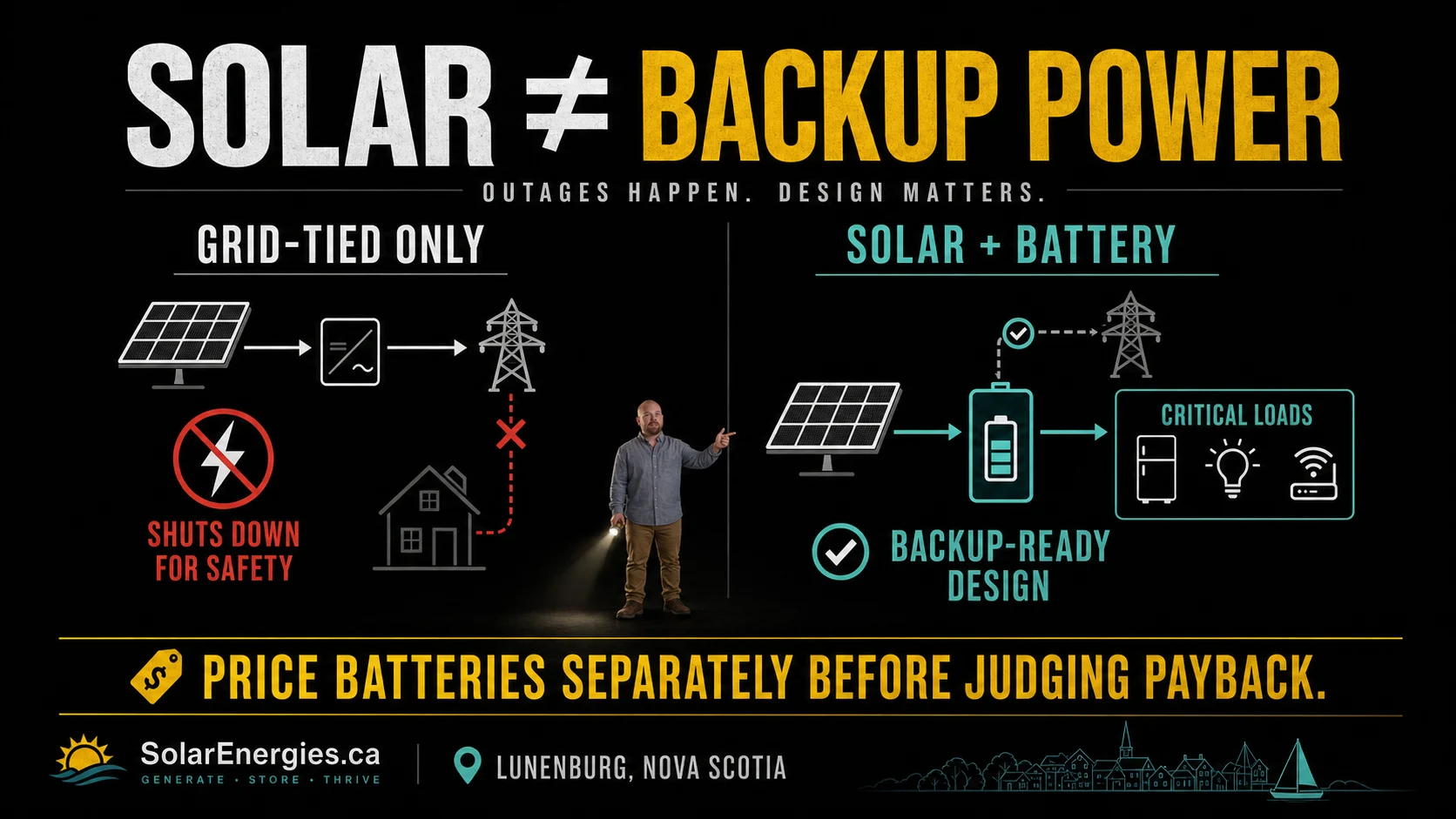
- A normal grid-tied solar system does not power your home during an outage unless it is designed with battery or backup equipment.
Is Solar Worth It In Lunenburg In 2026?
Solar is worth considering in Lunenburg, but it is not an automatic yes.
The stronger case looks like this:
- You use a lot of electricity each year.
- Your roof has at least 15 to 25 useful years left.
- Your best roof planes face south, southeast, southwest, east, or west with limited shade.
- Your quote uses current 2026 incentives, not expired rebate or loan math.
- The installer gives you estimated annual kWh production, not just panel count and monthly payment.
- You plan to stay in the home long enough to benefit from the system.
- You have confirmed whether your property is under Lunenburg Electric Utility or Nova Scotia Power.
- You want long-term power bill control more than a quick rebate-driven payback.
The weaker case looks like this:
- Your roof needs replacement soon.
- Trees, dormers, chimneys, vents, heritage constraints, or nearby buildings limit the usable roof.
- You use very little electricity.
- You plan to sell soon and do not want a financing or buyer-explanation issue.
- The quote assumes your power bill disappears every month.
- You want backup power, but the quote is solar-only.
- The installer avoids questions about utility approval, permits, insurance, monitoring, inverter failure, workmanship, or what happens if net-metering rules change.
Lunenburg’s coastal weather does not kill the solar case. Short winter days, cloud, snow, fog, salt air, and storms all matter, but rooftop solar is judged across a full year. The bigger risk is usually bad design or bad math: oversizing the system, ignoring roof age, using old incentive assumptions, or treating a monthly solar payment as if it were guaranteed savings.
Solar Panels Lunenburg Cost In 2026
There is no official public tracker for residential solar panels Lunenburg cost. Be careful with anyone who gives you one exact “average cost” without seeing your roof, utility bill, electrical panel, and site conditions.
For a normal grid-tied rooftop solar system in Lunenburg or nearby Lunenburg County communities, use $2.75/W to $3.75/W installed as a 2026 planning range before major extras.
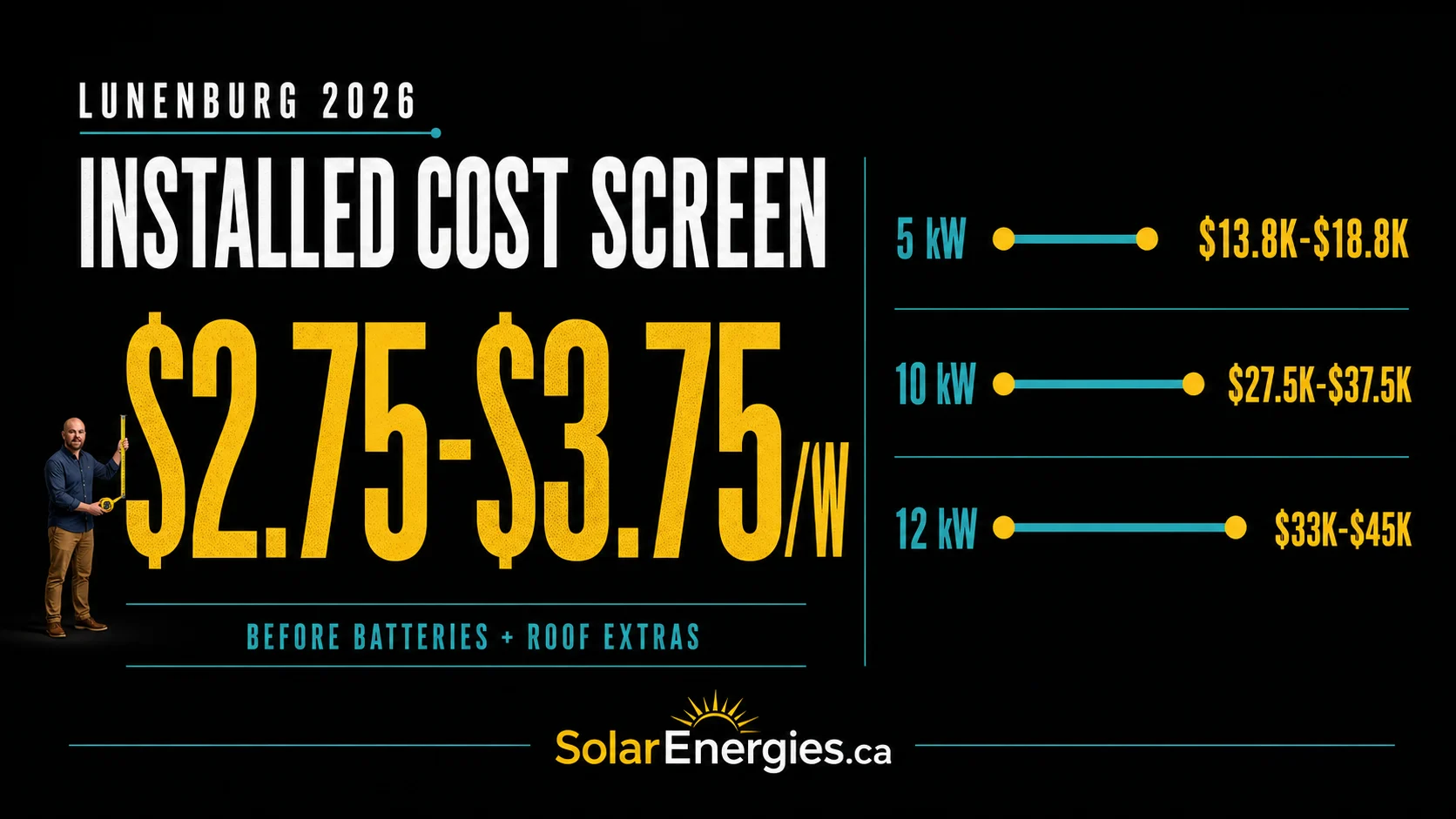
That is a quote-screening range, not a promise. A simple roof with easy access may price better. A steep roof, older wiring, service upgrades, trenching, detached buildings, structural work, premium inverter equipment, snow guards, critter guards, or battery storage can push the total cost higher.
| System size | Rough 2026 installed-cost screen | Typical fit |
|---|---|---|
| 5 kW | $13,750-$18,750 | Smaller home, partial bill offset, limited roof space |
| 7.5 kW | $20,625-$28,125 | Medium-use home, heat pump, moderate electric use |
| 10 kW | $27,500-$37,500 | Higher-use home, larger roof, EV planning |
| 12 kW | $33,000-$45,000 | High-use home, strong roof layout, careful utility review |
| 15 kW | $41,250-$56,250 | Very high-use home, large roof, only if utility and load math support it |
Before comparing prices, ask every solar company to show:
- DC system size and AC inverter size.
- Expected annual kWh production.
- Production by month.
- Installed cost before and after HST.
- Equipment brands and warranty terms.
- Whether roof work, electrical upgrades, permits, utility application costs, monitoring, engineering, and commissioning are included.
- Whether the quote includes battery storage or is grid-tied solar only.
- Financing cost, dealer fee, admin fee, interest rate, lien, payout terms, and what happens if you sell the home.
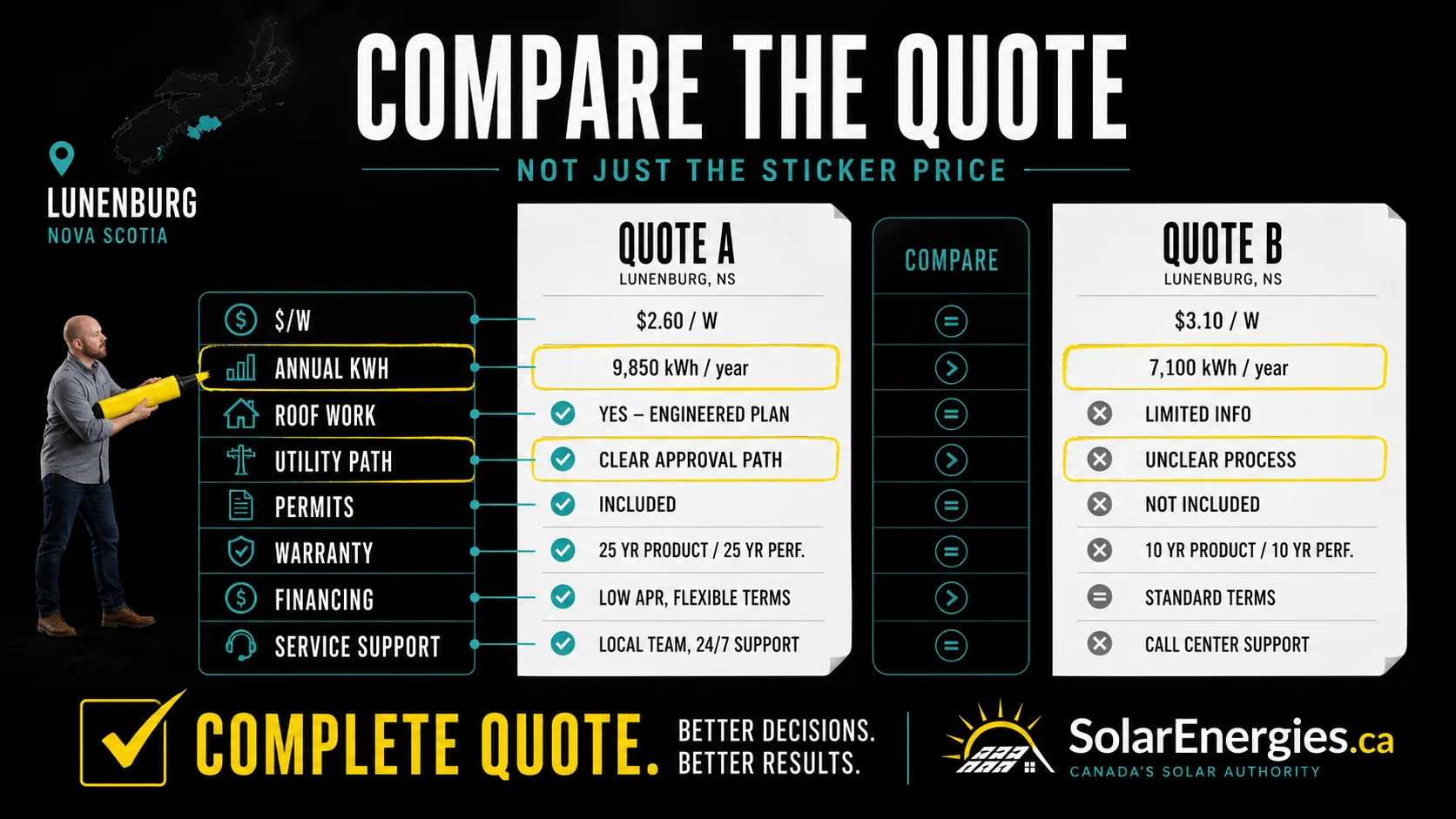
A cheap quote is not automatically a good quote. A high quote is not automatically a bad quote. The useful comparison is cost per watt, cost per expected annual kWh, roof fit, utility approval path, warranty support, and installer accountability.
If the quote is hard to understand, compare it against a second detailed quote before committing.
What Changes The Price In Lunenburg?
Solar panel cost in Lunenburg is not only about the panels. The house and the utility details often decide whether a project is clean or complicated.
| Cost factor | Why it matters in Lunenburg |
|---|---|
| Roof age | If shingles need replacement soon, do the roof first or price future removal and reinstall. |
| Coastal exposure | Wind, salt air, and storms make racking, flashing, attachments, and workmanship important. |
| Heritage or design limits | Some properties may need extra care around roof visibility, approvals, or building character. |
| Utility service territory | Town of Lunenburg Electric Utility and NS Power may have different processes, forms, and billing details. |
| Shade | Trees, nearby buildings, chimneys, dormers, and roof clutter can reduce production. |
| Electrical panel | Older homes may need panel, grounding, meter, or service work before solar installation. |
| System size | Bigger systems cost more in total, and oversizing can create credit or interconnection issues. |
| Inverter choice | Microinverters or optimizers may help complex roofs but can change cost and service planning. |
| Battery storage | Batteries are mainly for backup and resilience, not usually the fastest payback item. |
| Financing | A low monthly payment can hide dealer fees, interest, longer terms, or property-sale complications. |
The number to watch is not only total cost. It is cost per watt and cost per expected annual kWh.
Example:
- A 10 kW system at $30,000 is $3.00/W.
- If it produces around 10,000 to 11,500 kWh/year, the savings depend on your utility rate, fixed charges, riders, taxes, and how credits are handled.
- If the same 10 kW system is quoted at $42,000 with no battery, no roof work, and no clear reason for the premium, ask hard questions.
What A Lunenburg Solar System Might Produce
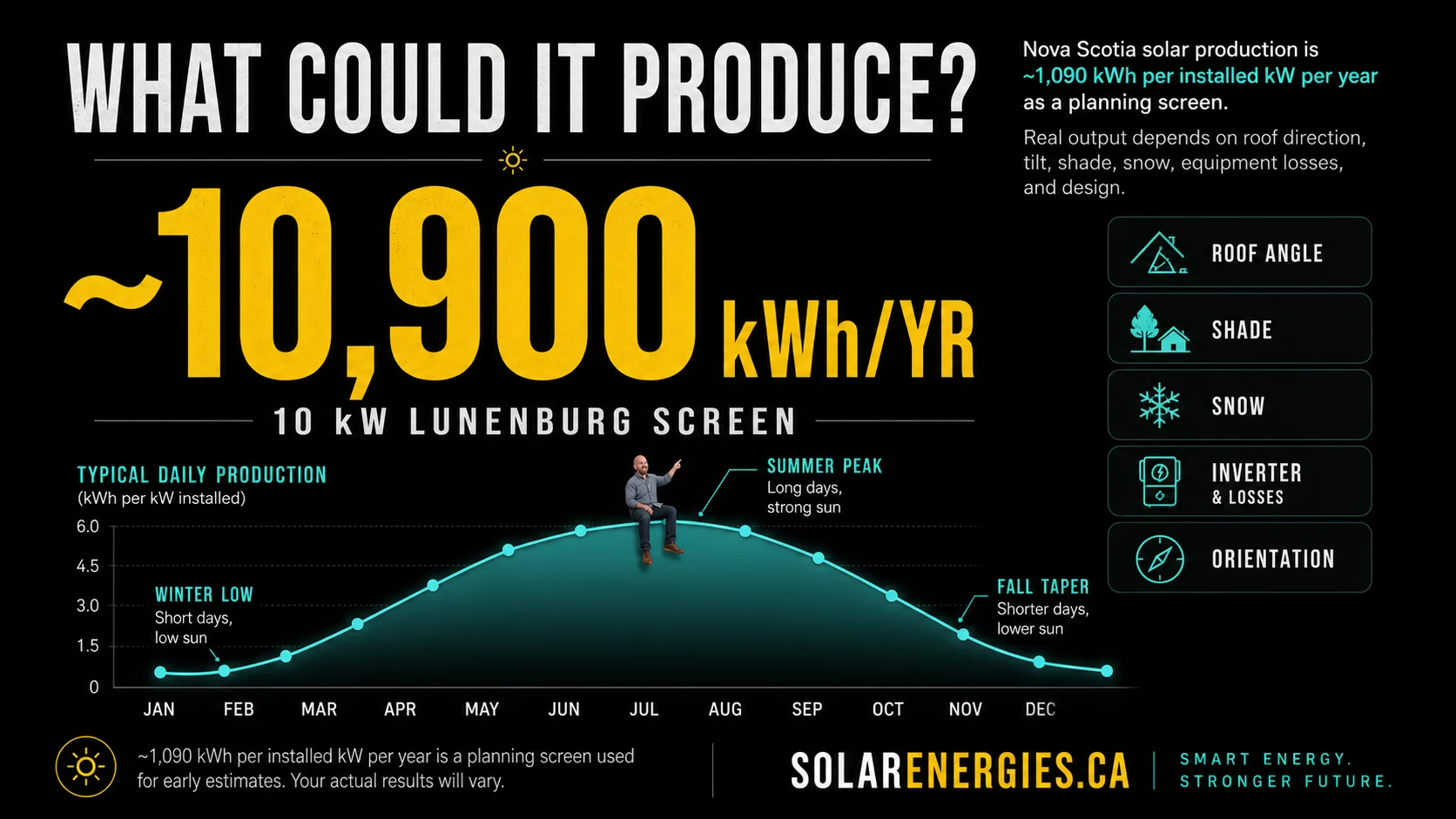
As a rough planning estimate, Nova Scotia solar production is often around 1,090 kWh per installed kW per year, depending on roof angle, direction, shade, equipment losses, weather, snow, and design assumptions. Treat that as a screening number, not a guarantee.
| System size | Rough annual production screen | What it means |
|---|---|---|
| 5 kW | about 5,400 kWh/year | Partial offset for a smaller or efficient home |
| 7.5 kW | about 8,200 kWh/year | Useful for a moderate-use home or heat-pump household |
| 10 kW | about 10,900 kWh/year | Common range for higher annual consumption |
| 12 kW | about 13,100 kWh/year | Larger home, EV planning, or high electric load |
Your quote should show its own production model. Ask for roof plane orientation, tilt, azimuth, shade assumptions, inverter clipping, degradation, monthly output, and annual kWh.
Do not accept “this will wipe out your bill” unless the installer shows the math against your real annual kWh use and your actual utility account.
Grants, Rebates, And Solar Incentives In Lunenburg
This is where 2026 buyers need to slow down.
Many Nova Scotia solar pages, ads, and older quote templates still make the incentive picture sound easier than it is. Here is the current practical version for Lunenburg homeowners.
| Program or incentive | 2026 homeowner status | What to know |
|---|---|---|
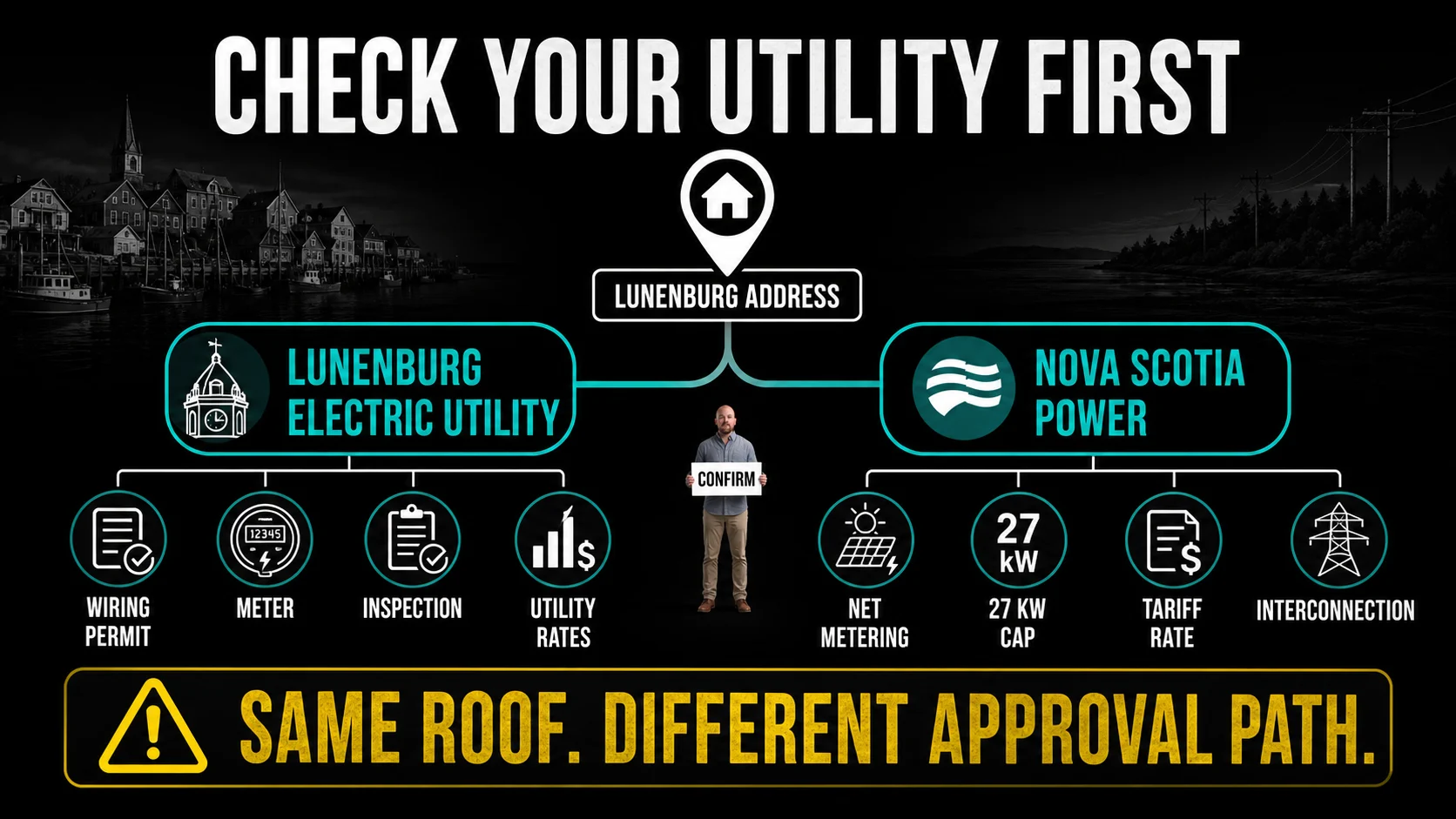
| Efficiency Nova Scotia SolarHomes homeowner rebate | Closed to new homeowner applications | Efficiency Nova Scotia says applications stopped April 17, 2025, and approved projects had to be completed by March 31, 2026. |
| Canada Greener Homes Grant | Closed | Natural Resources Canada marks the grant closed. Do not use it in a new 2026 payback calculation. |
| Canada Greener Homes Loan | Closed to new applications | NRCan says funding is fully committed and new loan applications cannot be approved. Already approved loans are different. |
| District of Lunenburg Clean Energy Financing / PACE | Confirm current intake status and eligibility directly | The Lunenburg program page describes financing details, but do not count it in your quote until Clean Foundation or MODL confirms your property, intake status, and terms. |
| Solar for Non-Profit Organizations | Possible for eligible non-profits and charities | Efficiency Nova Scotia describes a $0.60/W DC rebate up to limits. Not a standard homeowner rebate. |
| Private installer financing | May be available | Some providers may offer options such as 0% financing with $0 down payment, depending on approval and terms. Treat this as private financing, not a government loan. |
| Business tax treatment | Depends on ownership and tax situation | Businesses should confirm current federal tax treatment with an accountant before relying on it. |
If someone says, “You can still get the federal 0% solar loan,” ask them to show the current NRCan page. If they mean private financing, the proposal should say that clearly.
If someone says, “Lunenburg has PACE financing,” ask whether the program is actually open today, whether it applies to your address, and whether it covers rooftop solar under the current intake.
The best way to protect yourself is to build the solar math without assuming a new homeowner rebate or new federal loan. If real funding appears later, that is upside. It should not be the foundation of the deal.
Clean Energy Financing And PACE In The District Of Lunenburg
Clean Energy Financing matters in Lunenburg search results because the District of Lunenburg Clean Energy Financing page describes financing for home energy upgrades, including PACE-style repayment details and program FAQs.
That does not mean every Lunenburg homeowner can use it in 2026.
PACE-style programs can be useful, but they have details that matter:
- Is the intake open today?
- Does your exact property qualify?
- Does the program cover solar panels, or only certain efficiency upgrades?
- Is a home energy assessment required?
- Is the financing attached to the property tax bill?
- Are credit checks required?
- What interest rate and program fees apply?
- Can you repay early?
- What happens if you sell the home?
- Who is responsible if the contractor’s work is not satisfactory?
Those questions are not paperwork trivia. They can change the real cost of solar panels in Lunenburg more than the panel brand does.
One detail to check carefully: the Clean Energy Financing FAQ says that, in the District of Lunenburg, the CEF charge is non-transferable and a lump sum payment for the outstanding balance must be received by the Municipality at the time of sale. That is the kind of term you want to understand before you treat a financing offer like simple monthly savings.
Net Metering And Electricity Rates In Lunenburg
This section needs care because “Lunenburg” can mean different utility situations.
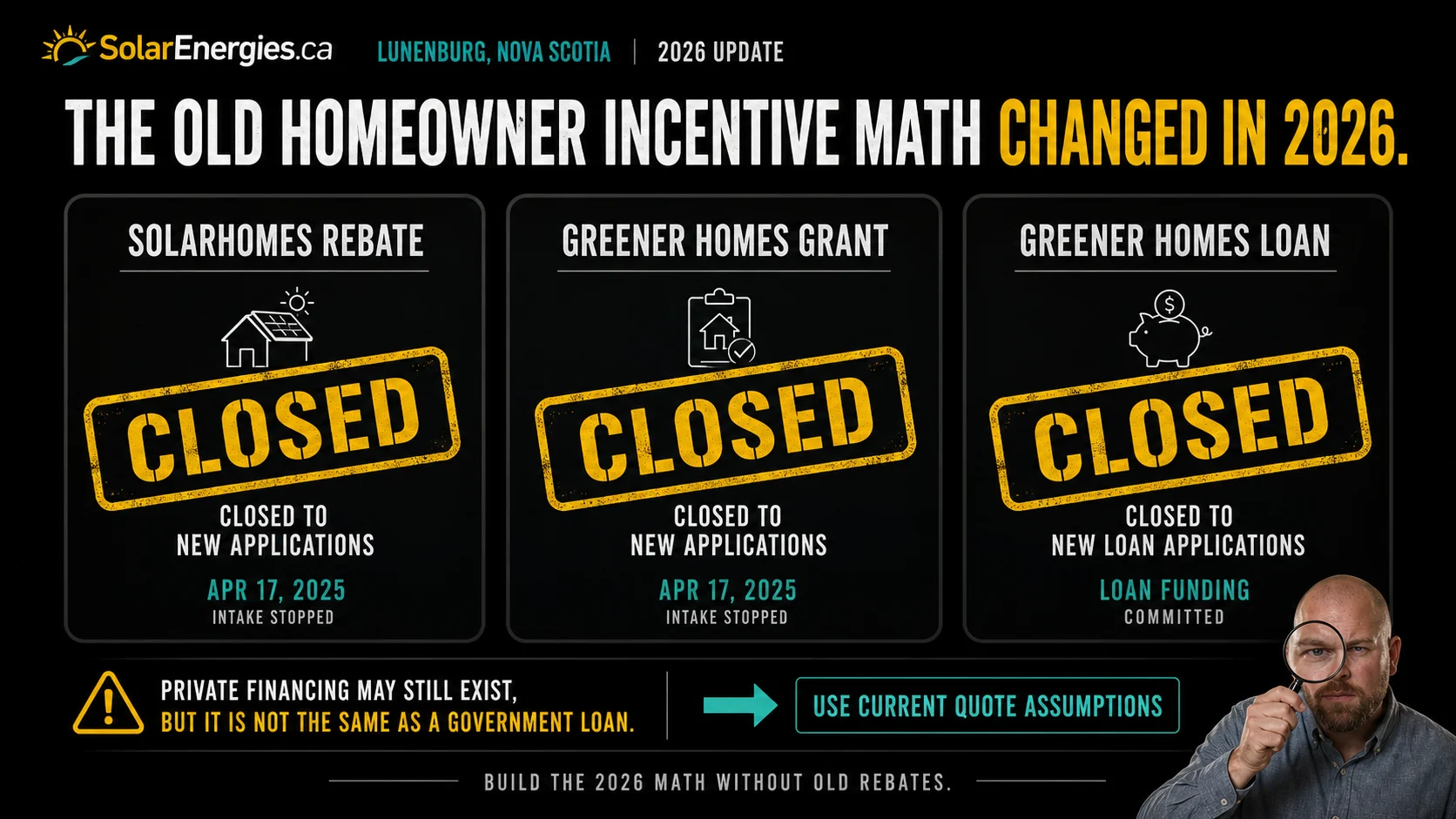
The Town of Lunenburg Electric Utility serves the Town of Lunenburg and surrounding communities including Garden Lots, Blue Rocks, First Peninsula, Stonehurst, Mason’s Beach, and Lilydale. The Town also says the utility issues electric wiring permits and electric wiring inspections.
If your property is served by Lunenburg Electric Utility, ask the utility and your installer to confirm:
- solar interconnection process
- meter requirements
- billing and credit treatment
- current residential rate schedule
- fixed monthly charges
- wiring permit requirements
- inspection requirements
- outage and anti-islanding rules
- whether battery backup changes the approval process
If your property is served by Nova Scotia Power, Nova Scotia’s Renewable Electricity Regulations and NS Power’s net-metering process are central. The regulations classify an NSPI customer with a renewable low-impact generator of 27 kW or less as a residential net-metering customer. Nova Scotia Power’s 2026 tariff book lists the Domestic Service energy charge at 18.324 cents/kWh before riders and taxes, with a customer charge of $20.08/month. It also lists a January 1, 2027 Domestic Service energy charge of 19.067 cents/kWh and customer charge of $21.04/month.
That does not mean a solar system eliminates every bill. Solar can reduce energy charges, but grid-tied customers should still expect fixed charges, taxes, and possibly other items. If a salesperson says your bill will be zero every month, ask them to show the utility assumptions line by line.
Also remember: a standard grid-tied solar PV system shuts down during an outage unless it is designed with approved backup equipment. That is a safety requirement, not a flaw.
Permits, Roof Work, And Power Line Safety
Lunenburg homeowners should not treat permits as an afterthought.
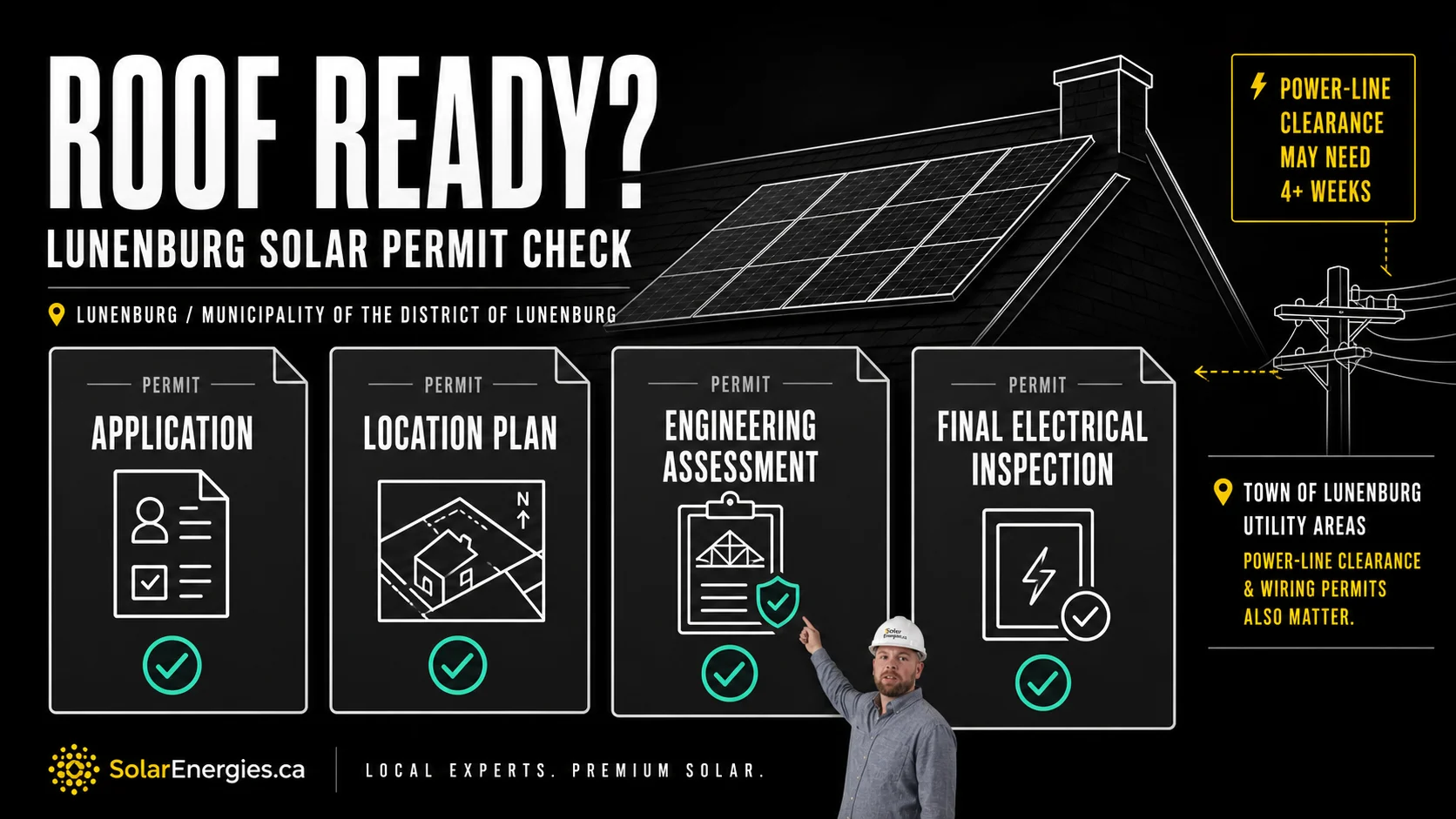
The Town electric utility page says it issues electric wiring permits and inspections. The Town’s Safety and Permits page also says people working near power lines should maintain safe clearance and request a Safe Clearance Report before work near power lines. The page says to request that report at least four weeks before doing work near power lines.
That can matter for solar because rooftop installation may involve ladders, scaffolding, boom trucks, panel delivery, roof replacement, or electrical work near overhead service lines.
For MODL properties, the roof-mounted solar panels page says building permits are required for all roof-mounted solar panel installations. It lists an application form, a location plan, an engineering assessment of the roof structure, and a final electrical inspection report. The permit route can differ between Town of Lunenburg and Municipality of the District of Lunenburg properties.
Before signing, ask the installer:
- Who applies for electrical permits?
- Who handles building or development permits if needed?
- Who contacts the utility?
- Who confirms power-line clearance?
- Who pays if a utility upgrade is required?
- Who schedules inspections?
- What happens if approval takes longer than expected?
Good installers answer those questions plainly.
Community Solar In Lunenburg
Community solar is worth mentioning because Lunenburg and MODL appear in community solar searches, including the MODL Community Solar Garden Project and AI Renewable project pages.
But community solar is not rooftop solar.
Nova Scotia’s Community Solar Program is designed around solar gardens and subscriptions. It can be useful for renters, shaded homes, condos, or homeowners who do not want panels on their own roof. The province says subscribers must be Nova Scotia Power customers in good standing and cannot be participating in another NS Power solar program such as net metering.
So the question is:
- If you own a strong roof and can use net metering, rooftop solar may offer more direct control.
- If your roof is shaded, old, complicated, or unsuitable, community solar may be worth watching.
- If you are served by Lunenburg Electric Utility, confirm whether a specific community solar offer applies to your account before assuming it does.
Do not compare a community solar subscription and rooftop solar as if they are the same product. They solve different problems.
What Reddit Concerns Are Worth Taking Seriously?
Public Reddit threads are not proof of savings, but they are useful for seeing what real Nova Scotia homeowners worry about after the sales call is over.
Here are the concerns that come up often, and how I would answer them for a Lunenburg homeowner.
| Reddit-style concern | Practical answer for Lunenburg |
|---|---|
| “The roof is old. Should I still install?” | Usually no. If the roof is near replacement, do the roof first or price future removal and reinstall. |
| “The monthly solar payment is close to my power bill.” | Compare total cost, term length, dealer fees, interest, and utility savings. A payment that looks equal today may not be a good deal. |
| “Are the grants still available?” | For new 2026 homeowners, the big SolarHomes and Canada Greener Homes programs are closed. Use current assumptions only. |
| “Will solar keep my lights on in an outage?” | Not by itself. You need a system designed for backup, usually with a battery and approved transfer/backup equipment. |
| “Are batteries worth it?” | Batteries can be worth it for outage resilience. They usually make simple payback longer if you only measure bill savings. |
| “What if the inverter or monitoring fails?” | Ask who monitors the system, who gets alerts, what labour is covered, and how quickly service is handled. |
| “What about snow and coastal weather?” | Snow and storms reduce some production, but annual production matters more. Coastal racking and workmanship matter a lot. |
| “Do I need to tell insurance?” | Yes, notify your insurer before installation and ask whether premiums, documentation, or replacement-cost coverage changes. |
| “What if net metering changes?” | Policy risk is real. Avoid math that only works under perfect rules forever. A fair installed price gives you more margin. |
| “Should I size for a future EV or heat pump?” | Maybe, but only with a real load plan. Do not oversize wildly because you might buy an EV someday. |
The common thread is simple: solar problems usually start when a quote turns uncertainty into certainty. A good proposal shows assumptions and gives you room to ask questions.
Local Case Studies And Examples
Lunenburg already appears in the local solar landscape. Polaron has a public Lunenburg solar installation article, and the NeuronWriter SERP includes Lunenburg-specific solar, MODL, Clean Energy Financing, and community solar pages.
Use those examples as proof that solar is not unusual in the region. Do not use them as proof that your home will have the same cost, savings, production, or payback.
For nearby Nova Scotia comparisons, you can also read the Bridgewater solar cost guide, Halifax solar cost guide, and Yarmouth solar cost guide.
The better local proof is your own site assessment:
- roof age and material
- roof orientation and shade
- utility account and annual kWh use
- interconnection route
- permit requirements
- electrical panel condition
- exact installed cost
- equipment and workmanship warranty
- who handles service after installation
That is what decides whether Lunenburg solar is worth it for your house.
How To Choose A Solar Installer In Lunenburg
Choosing a solar installer in Lunenburg is not just about finding the lowest price.
Ask each solar company for:
- a full equipment list
- panel model and wattage
- inverter or microinverter model
- racking and roof attachment details
- wind and coastal exposure assumptions
- annual and monthly kWh estimate
- shade report
- permit plan
- utility interconnection plan
- insurance and workmanship details
- labour warranty
- monitoring process
- service response process
- removal and reinstall cost if the roof needs work later
Also ask whether the installer has handled projects under your actual utility. A Town of Lunenburg Electric Utility project is not automatically the same as an NS Power project.
SolarEnergies.ca can connect readers with a certified solar installer network with 14,000+ installs across Canada. The point is not to pressure you into the first quote. The point is to compare the right details before the roof is touched.
Next Steps
If you are serious about solar panels in Lunenburg, do this in order:
- Pull 12 months of electricity use in kWh.
- Confirm whether your property is served by Lunenburg Electric Utility or Nova Scotia Power.
- Check roof age, roof condition, and shade.
- Use the online solar calculator for a first estimate.
- Get at least two detailed quotes.
- Ask each installer to show current incentive assumptions.
- Confirm permit and utility steps before signing.
- Compare total cost, expected annual kWh, warranty, financing, and service support.
- Notify your insurer before installation.
- If you want outage backup, ask for a separate solar-plus-battery design and price.
Solar can be a good long-term decision in Lunenburg. It just needs to be priced and designed like a serious home upgrade, not sold like a monthly-payment shortcut.
FAQ
Are solar panels worth it in Lunenburg in 2026?
They can be, especially for homes with high electricity use, a good roof, limited shade, and a fair installed price. The case is weaker if the roof is old, the home uses little electricity, the quote relies on expired grants, or you need backup power but are only buying grid-tied solar.
What is the typical solar panels Lunenburg cost in 2026?
A reasonable quote-screening range is about $2.75/W to $3.75/W installed for many straightforward residential systems before major extras. That puts a 10 kW system around $27,500 to $37,500 before unusual roof work, electrical upgrades, batteries, or financing costs.
Are there solar rebates for Lunenburg homeowners?
The big homeowner programs are not open for new 2026 applications. Efficiency Nova Scotia’s SolarHomes homeowner program is closed, the Canada Greener Homes Grant is closed, and the Canada Greener Homes Loan is closed to new loan applications. Check local and private financing separately, but do not build your payback on old rebate math.
Does Clean Energy Financing apply in Lunenburg?
Possibly only if the current program is open and your exact property qualifies. Lunenburg Clean Energy Financing appears in search results, but you should confirm current intake status with Clean Foundation or MODL before counting on it. Ask about interest, fees, property tax bill repayment, credit checks, early repayment, and sale-of-home rules.
Does Lunenburg use Nova Scotia Power net metering?
Some nearby properties may be served by Nova Scotia Power, but the Town of Lunenburg owns and operates Lunenburg Electric Utility for the Town and nearby communities. Confirm your utility first. If you are an NS Power customer, Nova Scotia net-metering rules are central. If you are a Lunenburg Electric Utility customer, confirm the utility-specific process.
Will solar panels power my Lunenburg home during an outage?
Not with a standard grid-tied system. Most grid-tied systems shut down during outages for safety. If backup power matters, ask for a solar-plus-battery design and confirm the backup loads, transfer equipment, inspection requirements, and cost.
Are batteries worth it in Lunenburg?
Batteries can be worth it if outage resilience is important, especially in coastal areas where storms are part of the conversation. They usually make the simple payback period longer if you only measure power bill savings. Price batteries separately so you can see the difference.
How much electricity will solar panels produce in Lunenburg?
As a rough screen, Nova Scotia solar production is often around 1,090 kWh per installed kW per year. A 10 kW system might produce around 10,900 kWh/year before site-specific adjustments. Your real number depends on roof direction, tilt, shade, snow, equipment, and system design.
Do I need permits for solar panels in Lunenburg?
Likely yes, but the route depends on whether your property is in the Town of Lunenburg, MODL, and which utility serves you. The Town utility says it issues electric wiring permits and inspections, and the Town safety page warns about power-line clearance. Ask your installer who handles each permit and inspection.
Should I replace my roof before installing solar?
If the roof is near the end of its life, usually yes. Removing and reinstalling panels later can be expensive and can weaken the payback. A good installer should ask about roof age before talking about system size.
How do I compare solar quotes in Lunenburg?
Compare installed cost per watt, expected annual kWh, equipment, inverter type, roof work, electrical upgrades, permit handling, utility process, monitoring, warranty, financing, and service support. Do not compare one round number against another round number and assume they include the same work.