
Solar Panels Sydney NS/Cape Breton Cost Guide 2026: Is It Worth It?
June 30, 2026
Solar Panels Truro Cost Guide 2026: Is It Worth It?
June 30, 2026Last Updated on June 30, 2026 by Vitaliy
If you are pricing solar panels in Bridgewater, Nova Scotia in 2026, the first thing to know is that the old incentive math is not the current math.
Solar can still be worth it on the South Shore. Bridgewater has Nova Scotia Power net metering, electricity rates high enough for self-generation to matter, an active local energy conversation through Energize Bridgewater, and enough annual solar production to make rooftop solar a serious option for many homes.
But the easy rebate story changed. The homeowner SolarHomes program is closed to new applications. The federal Canada Greener Homes Grant is closed. The Canada Greener Homes Loan is also closed to new loan applications because funding is fully committed.
So the honest question is not, “How big is the rebate?”
It is this:
Can your Bridgewater home produce enough electricity, at a fair installed price, to lower long-term power costs without creating a roof, financing, insurance, or outage-backup surprise?
For many homeowners, the answer can still be yes. For others, the better move is to replace the roof first, reduce wasted electricity, install heat pumps or insulation first, wait for a clearer clean energy financing option, or get better quotes before moving ahead.
Use the online solar calculator for a quick first estimate, then use this guide to sanity-check the solar quote before you sign.
Key Takeaways
- Solar panels in Bridgewater usually make the most sense for homes with high annual electricity use, a solid roof, limited shade, and a solar system sized close to real consumption.
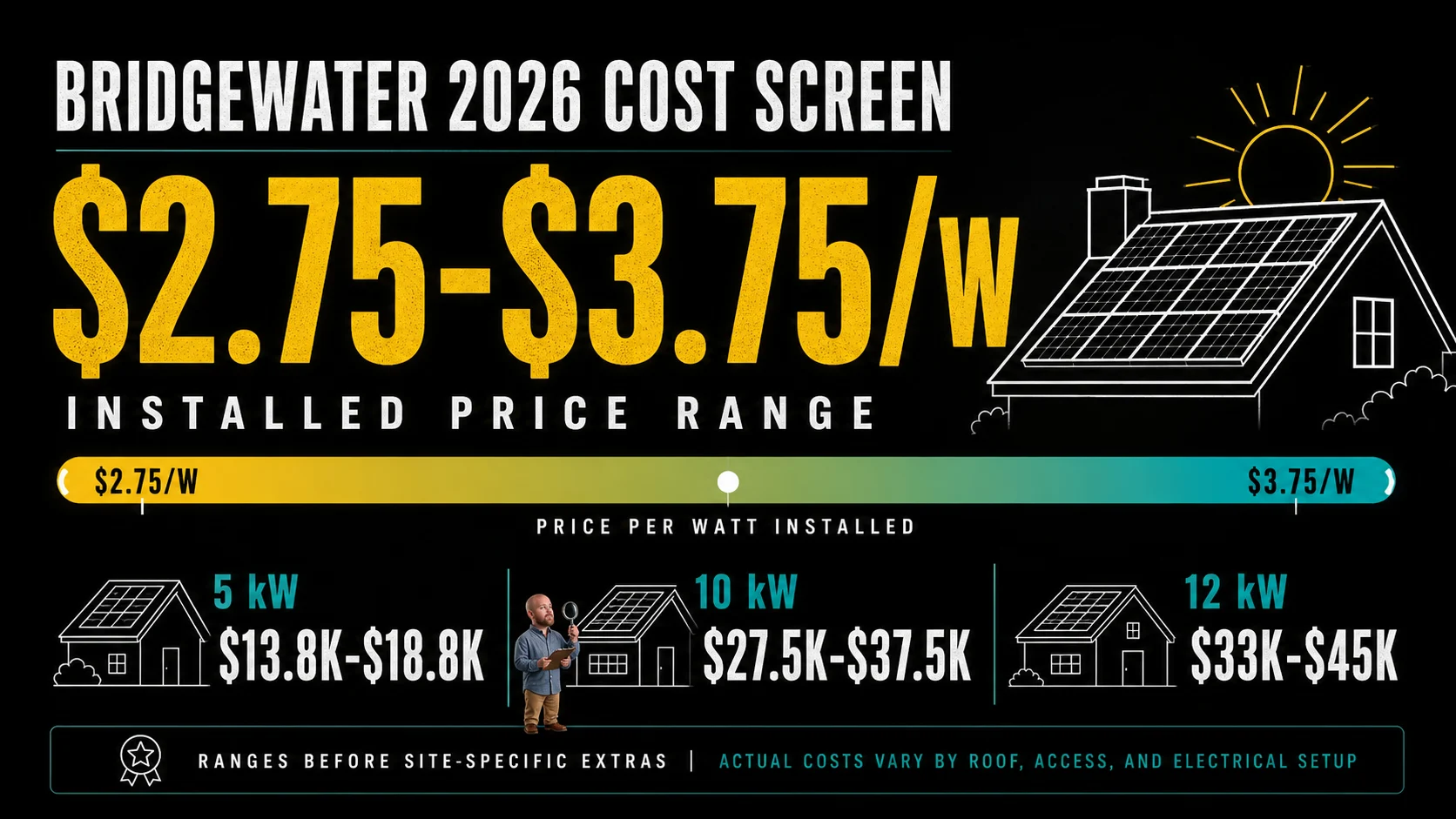
- A practical 2026 quote-screening range is about $2.75/W to $3.75/W installed for many straightforward grid-tied residential solar panel installation projects, before major roof work, electrical upgrades, battery storage, financing costs, or unusual site conditions.
- A 10 kW Bridgewater solar system might land around $27,500 to $37,500 before site-specific extras. A smaller 5 kW system might land around $13,750 to $18,750. Always ask whether HST is included.
- The SolarHomes homeowner rebate is closed to new homeowner applications. Efficiency Nova Scotia says new applications stopped on April 17, 2025, and approved projects had to be completed by March 31, 2026.
- Bridgewater has local clean-energy activity through Energize Bridgewater, but do not assume a current universal municipal solar rebate or low-interest loan until you confirm program status directly.
- Nova Scotia Power’s 2026 tariff book lists the Domestic Service energy charge at 18.324 cents/kWh, before riders such as fuel adjustment, demand-side management, storm cost recovery, and taxes.
- A standard grid-tied solar system normally does not power your home during an outage unless it is designed with the right backup equipment and often a solar battery.
Is Solar Worth It In Bridgewater In 2026?
Solar is worth considering in Bridgewater, but it is not an automatic yes.
The stronger case looks like this:
- You use a lot of electricity every year.
- Your roof has at least 15 to 25 useful years left.
- Your best roof planes face south, southeast, southwest, east, or west with limited shade.
- You plan to stay in the home long enough to benefit from lower electricity bills.
- The quote is built around current 2026 incentives and financing, not expired grant math.
- The installer gives you annual kWh production, not only panel count and monthly savings.
- You are comparing solar against your real alternatives: heat pumps, insulation, air sealing, roof replacement, and future EV charging.
The weaker case looks like this:
- The roof is near replacement.
- Trees, chimneys, dormers, or nearby buildings shade the best roof planes.
- You use very little electricity.
- You are selling soon and do not want financing or property-title questions.
- The quote assumes your power bill disappears every month.
- You want backup power during outages but the quote is solar-only.
- The installer avoids questions about monitoring, inverter failures, insurance, warranty service, or net metering.
Bridgewater’s weather does not kill the solar case. Short winter days, snow, coastal storms, and cloudy weeks all matter, but a properly designed solar PV system is judged over a full year. The bigger risk is usually not winter. It is bad sizing, weak roof planning, optimistic savings math, or poor after-install support.
Solar Panels Bridgewater Cost In 2026
There is no official public tracker for residential solar panels Bridgewater cost. That means any exact “average cost” should be treated carefully.
For a normal grid-tied rooftop system in Bridgewater or nearby Lunenburg County communities, use $2.75/W to $3.75/W installed as a 2026 planning range before major extras.
That is a quote-screening range, not a promise. A simple roof with easy access may price better. A steep roof, old electrical service, detached garage, trenching, structural work, premium microinverters, or battery installation can push the cost higher.
| System size | Rough 2026 installed-cost screen | Typical fit |
|---|---|---|
| 5 kW | $13,750-$18,750 | Smaller home, partial bill offset, limited roof space |
| 7.5 kW | $20,625-$28,125 | Medium home, heat pump or moderate electric use |
| 10 kW | $27,500-$37,500 | Higher-use home, larger roof, EV planning |
| 12 kW | $33,000-$45,000 | Large load, strong roof layout, careful net-metering sizing |
Your quote should show more than one round number. Ask for a breakdown of:
- solar panels and wattage
- inverter or microinverter model
- racking
- monitoring
- design and engineering
- electrical work
- permits and inspections
- Nova Scotia Power interconnection support
- HST
- roof or structural work
- financing charges
- battery or backup equipment, if included
If one quote is much cheaper than the others, do not reject it automatically. Just ask why. It may be a simple job with efficient design. It may also be missing electrical work, roof work, monitoring, warranty support, or HST.
If a quote is much higher, ask the same question. Sometimes the price is justified by a difficult roof or better equipment. Sometimes it is just expensive.
The useful move is to compare detailed solar quotes, not just compare final prices.
Grants, Rebates, And Solar Incentives In Bridgewater And Nova Scotia
This is where Bridgewater homeowners need current information, because a lot of older Nova Scotia solar content is now stale.
| Program or option | 2026 status for Bridgewater homeowners | What to know |
|---|---|---|
| Efficiency Nova Scotia SolarHomes | Closed to new homeowner applications | Efficiency Nova Scotia says new applications stopped on April 17, 2025, and approved projects had to be completed by March 31, 2026. |
| Canada Greener Homes Grant | Closed | NRCan marks the grant closed. Do not build a 2026 quote around a new federal grant. |
| Canada Greener Homes Loan | Closed to new loan applications | NRCan says funding is fully committed and new loan applications cannot be approved. |
| Energize Bridgewater | Local energy program activity, but status must be confirmed | The site says programs are changing and describes home upgrades, solar panels, grant funding, and low-interest loans. Confirm current eligibility before counting on money. |
| Clean Energy Financing Bridgewater | Check current status directly | Public pages and old municipal quick links can be confusing. Do not assume availability until the program confirms it. |
| Solar for Non-Profit Organizations | Possible for eligible non-profits, not normal homeowners | Efficiency Nova Scotia describes a pilot for registered non-profits and charities, with possible $0.60/W DC support up to limits. |
| Business solar tax treatment | Depends on business and tax situation | Businesses should ask an accountant about federal clean technology tax measures and depreciation rules before relying on any tax value. |
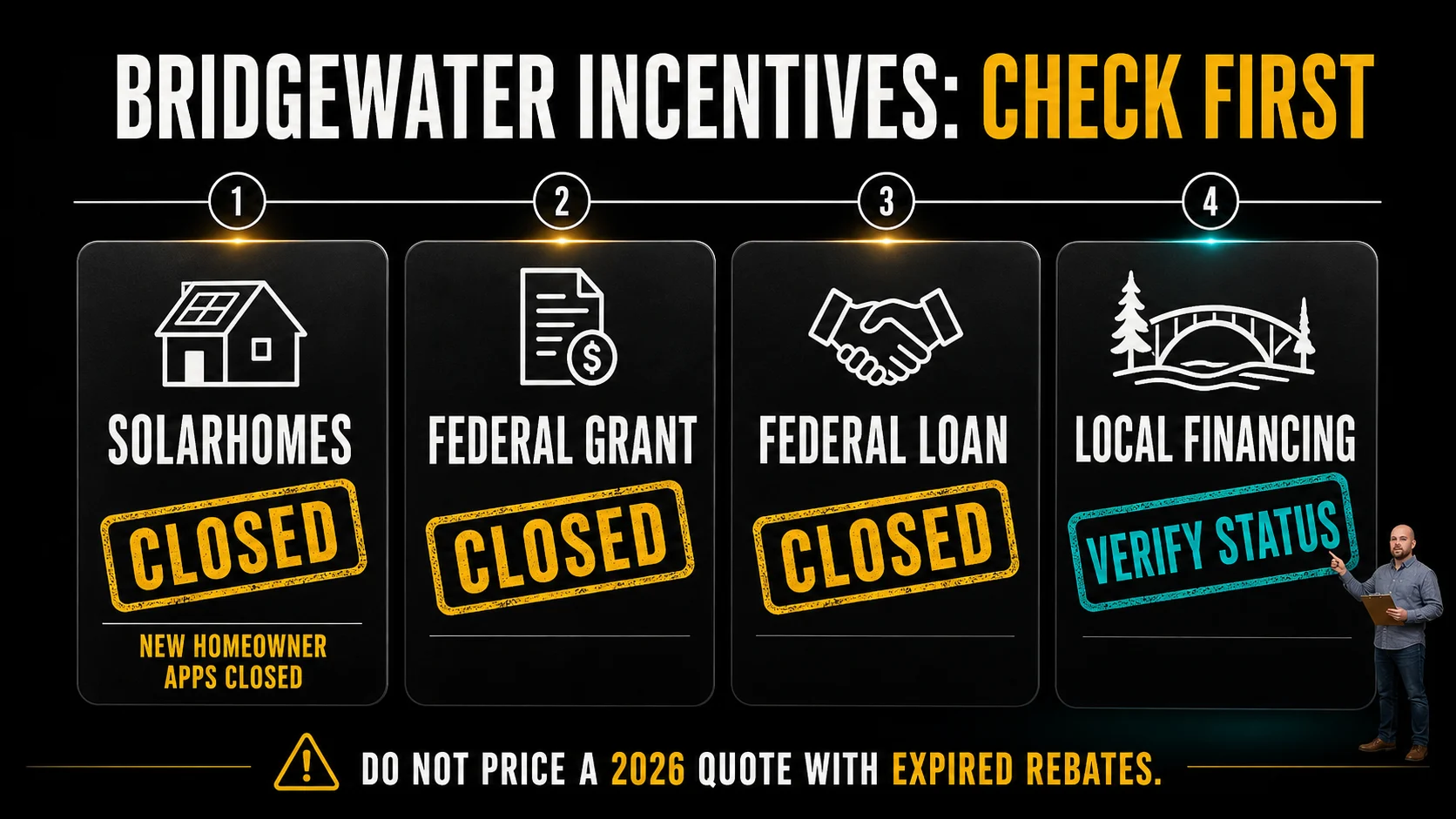
The main warning is simple: do not let a contractor sell you solar with old rebate language.
If the savings page includes SolarHomes money, a new Canada Greener Homes Loan, or a federal grant for a normal 2026 homeowner application, ask the installer to revise the proposal with current assumptions.
Bridgewater’s local clean-energy work still matters. Energize Bridgewater is aimed at reducing energy costs for homeowners, tenants, landlords, and businesses. It also connects energy upgrades with affordability, heat pumps, insulation, solar panels, and home energy data. That local context is useful, especially if you are trying to decide whether solar should come before or after other home energy upgrades.
But local context is not the same as guaranteed funding. Before you count on clean energy financing, ask:
- Is the program open today?
- Does it cover rooftop solar systems?
- Is it only for certain income levels or building types?
- Is there a home energy assessment requirement?
- Is the financing attached to the property tax bill?
- Are credit checks required?
- Can you pay it off early?
- What happens if you sell the home?
Those questions matter more than the brochure language.
Net Metering And Electricity Rates In Bridgewater
Bridgewater homes are typically served by Nova Scotia Power, so the solar math depends heavily on NS Power rates and net metering.
Nova Scotia’s renewable electricity regulations classify an NSPI customer with a renewable low-impact generator of 27 kW or less as a residential net-metering customer. That is large enough for most residential solar systems, but it does not mean every roof should be filled with panels. A good solar system is usually sized around your annual electricity use, roof layout, and future load plans.
Nova Scotia Power’s 2026 tariff book lists the Domestic Service energy charge at 18.324 cents/kWh before riders, with a customer charge of $20.08/month. The same tariff lists January 1, 2027 Domestic Service energy charge at 19.067 cents/kWh and customer charge at $21.04/month.
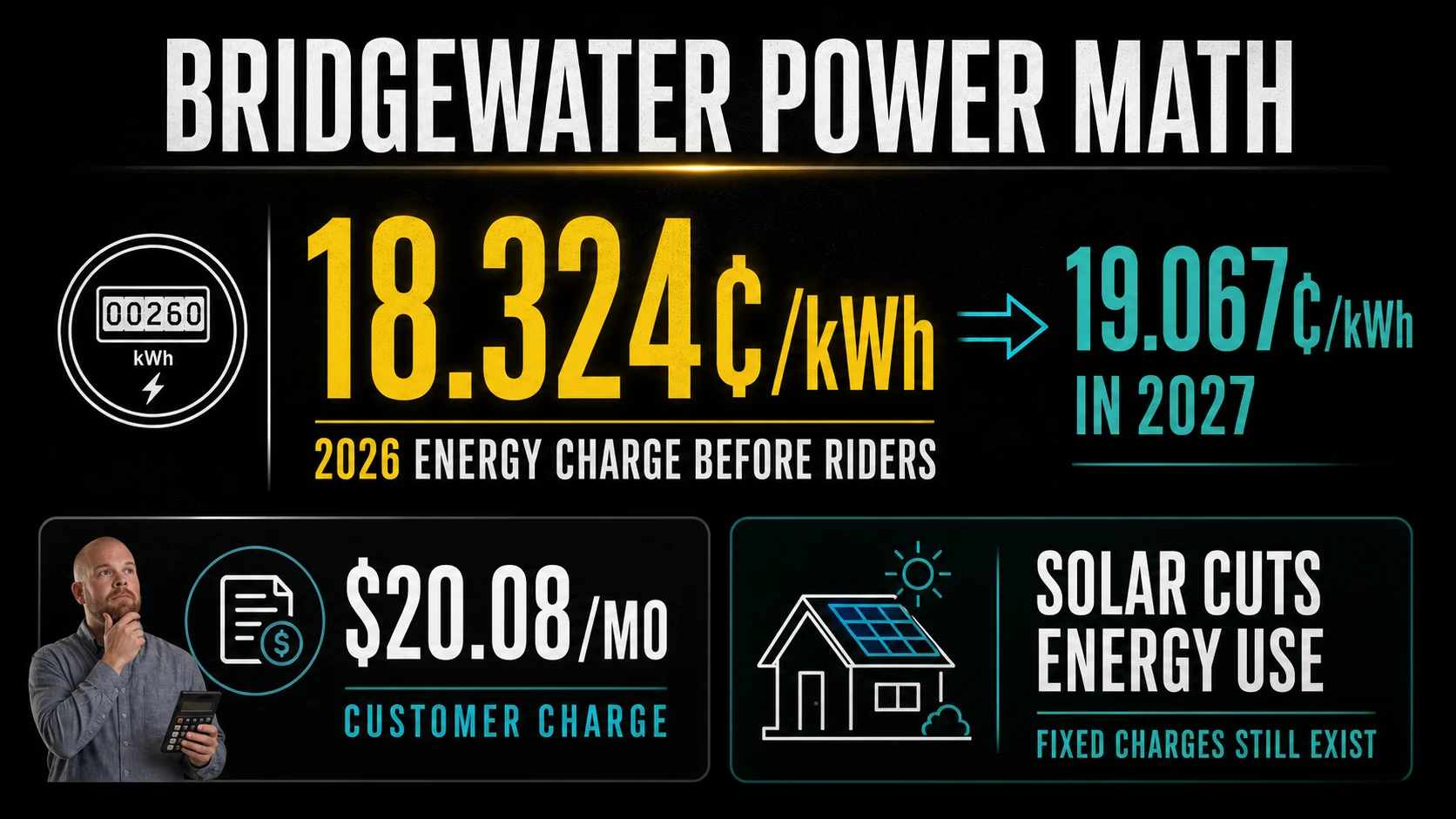
That fixed monthly charge matters. Solar can reduce energy charges, but a grid-tied customer should still expect some NS Power charges. If a salesperson says your bill will go to zero every month, ask them to show the tariff assumptions and the net-metering treatment line by line.
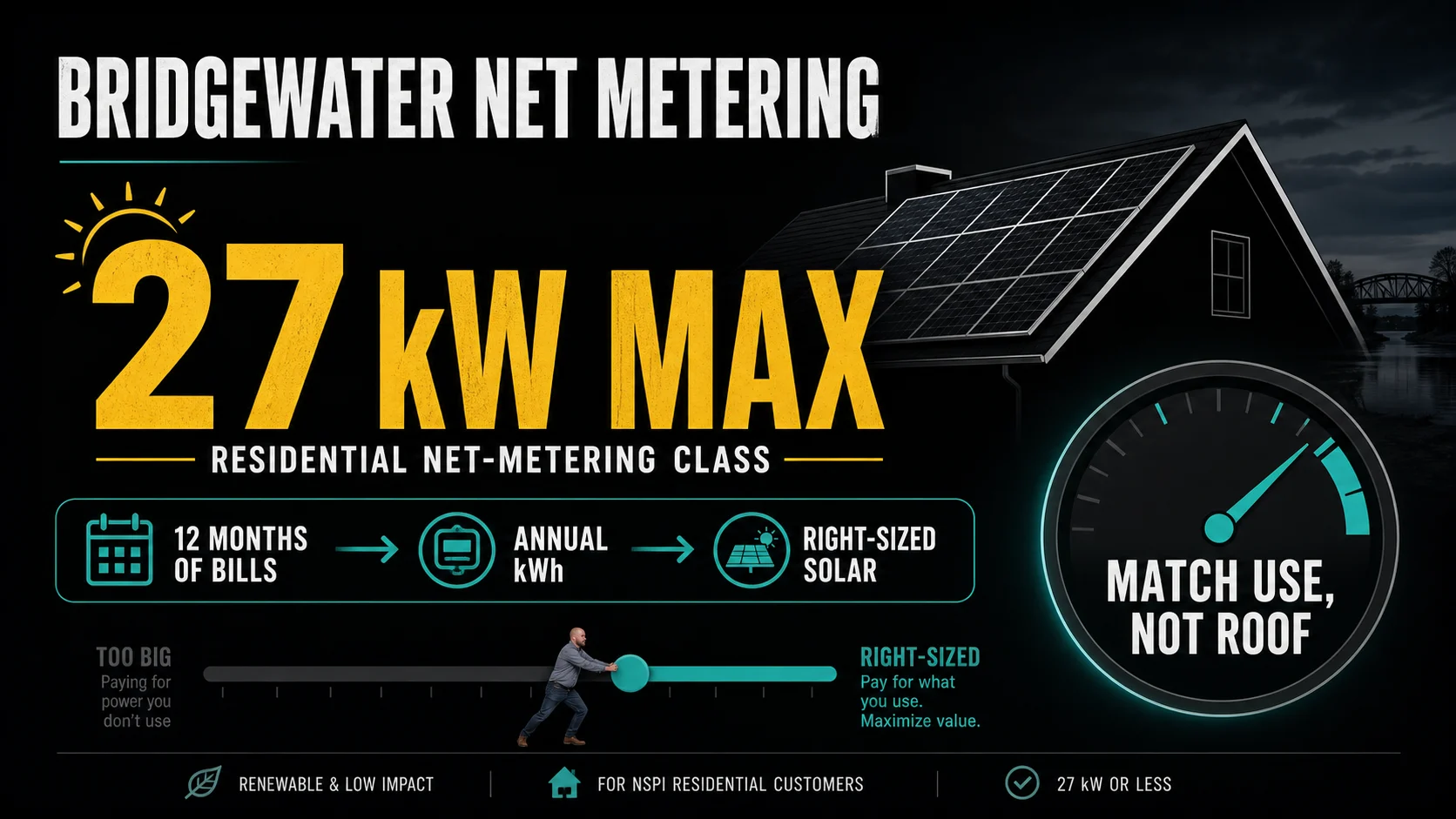
Nova Scotia Power also explains that solar PV works best in full sun but can still produce on cloudy days. That is important in Bridgewater because the question is not “Will panels work on every winter day?” The question is “How much annual kWh will the system produce compared with what I use?”
Ask every installer for:
- estimated annual kWh production
- monthly production estimate
- shading assumptions
- panel orientation and tilt
- inverter clipping assumptions
- degradation assumption
- current NS Power rate used in the savings model
- assumed annual rate increase
- treatment of fixed monthly charges and riders
- what happens to unused credits
If those numbers are not in the proposal, you are not looking at a complete solar assessment.
What Affects Payback In Bridgewater?
The payback period for solar panels in Bridgewater depends on the installed cost, production, electricity rates, financing, and how much of the power you actually use.
Here is a simple way to think about it:
| Factor | Why it matters in Bridgewater |
|---|---|
| Installed cost per watt | A fair price can make solar work even without big rebates. An inflated price can ruin the payback. |
| Annual kWh production | South Shore roofs can produce meaningful annual electricity, but shade and orientation matter a lot. |
| Electricity use | Higher annual usage usually improves the case, especially with heat pumps, electric water heating, or EV charging. |
| Roof age | Removing panels to replace shingles later can damage the economics. |
| Financing | Interest, fees, term length, and property-linked repayment can change the real ROI. |
| Net metering | The value of exported energy depends on current rules and future policy risk. |
| Batteries | Batteries can help with backup, but they usually make simple payback longer. |
| Installer quality | A cheap job with poor monitoring or weak warranty support can become expensive later. |
As a rough screen, a 10 kW system in Bridgewater might produce somewhere around 10,500 to 11,000 kWh/year under decent conditions, using older Nova Scotia production context from EnergyHub and nearby South Shore/Halifax assumptions. That is not a site-specific estimate. Your actual number depends on roof plane, shade, equipment, snow cover, and system design.
At 18.324 cents/kWh before riders, 10,500 kWh of offset electricity has meaningful annual bill value. But the real savings model should still include fixed charges, riders, taxes, financing costs, degradation, and any credits that do not carry forward the way the salesperson assumes.
For many Bridgewater homeowners, solar is most attractive when it is part of a broader home energy plan:
- reduce wasted electricity first
- plan heat pumps and insulation before final solar sizing
- decide whether an EV is likely in the next few years
- make sure the roof is ready
- size the system around future annual use, not just last year’s bill
That is why Energize Bridgewater is relevant even if you do not use a town financing program. The local conversation is not only about solar panels. It is about energy costs, home energy upgrades, comfort, and long-term affordability.
What Nova Scotia Homeowners Worry About On Reddit
Reddit is not a fact source, but it is useful for seeing what real homeowners worry about after the sales meeting ends. In Nova Scotia solar discussions, including local r/halifax threads, the same concerns come up again and again.
Here is the plain answer to each one.
| Reddit concern | Practical answer for Bridgewater |
|---|---|
| “My roof is older. Should I still install?” | Usually no, not until you price the roof decision. If shingles may need replacement in the next 5 to 8 years, ask what removal and reinstall would cost. A solar system can last 25 years; the roof under it needs to be ready. |
| “The quote looks huge.” | Compare cost per watt, equipment, HST, electrical work, monitoring, racking, and warranty support. A 10 kW system at $27,500 and a 10 kW system at $37,500 are very different conversations. |
| “Will my solar payment be lower than my power bill?” | Maybe, but do not judge solar only by the first monthly payment. Compare the full financing cost, term, rate, expected bill offset, maintenance risk, and what happens if you sell. |
| “Can I still use the old rebate or 0% federal loan?” | For new 2026 homeowner applications, no. SolarHomes is closed to new applications, the Greener Homes Grant is closed, and the Canada Greener Homes Loan is closed to new loan applications. |
| “What if the inverter or monitoring fails?” | Ask who monitors the system, what alerts you receive, who handles warranty service, how fast service calls happen in Bridgewater, and whether labour is covered. Monitoring is not a bonus; it is how you know the system is working. |
| “Will solar run my house during an outage?” | A normal grid-tied system usually shuts down during outages for safety. If you want backup power, ask for a battery or backup-ready design with proper islanding and transfer equipment. |
| “Are batteries worth it?” | Usually not for simple payback alone. Batteries make more sense if outage backup, critical loads, medical equipment, sump pumps, or resilience are important to you. |
| “Could net metering change?” | Yes, policy can change. Nova Scotia’s current regulations support net metering, but do not build the whole financial case on perfect rules forever. Ask for conservative savings assumptions. |
| “Do I need to tell my insurer?” | Yes. Tell your home insurance provider before installation and keep records. Ask whether roof penetrations, electrical work, or battery storage affect your policy. |
| “Should I size solar before adding a heat pump or EV?” | Usually no. If a heat pump, EV, hot tub, or electric water heating is likely soon, include that future load before final sizing. Otherwise the system may be undersized for where your home is heading. |
| “How do I avoid a weak installer?” | Ask for local references, warranty process, proof of insurance, electrician credentials, equipment sheets, production assumptions, and who answers the phone after installation. |
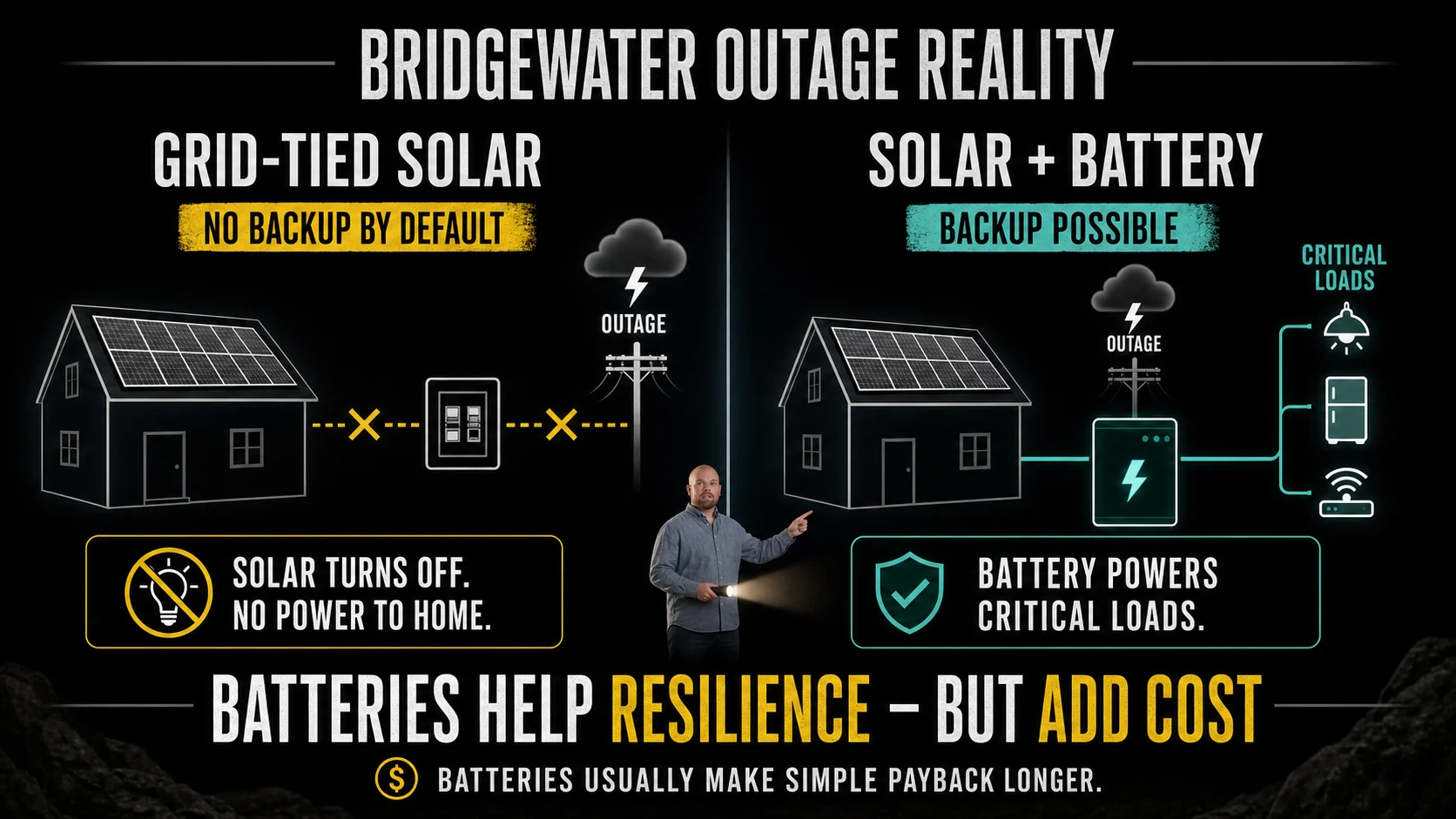
That is the real solar decision. Not “Do panels work?” They do. The better question is whether the whole project is designed honestly for your house.
Learn more about relevant cities:
Solar Panels Nova Scotia: Your Guide to Going Solar
Solar Panels Yarmouth Cost Guide. Is It Worth It?
How To Choose A Solar Installer In Bridgewater
The installer matters as much as the panels.
For Bridgewater solar installation, I would ask every solar company these questions before signing:
| Question | Why it matters |
|---|---|
| How many installations have you completed in Nova Scotia? | Local utility and weather experience matters. |
| Who handles the Nova Scotia Power application? | Interconnection paperwork should not be dumped on you. |
| What annual kWh production are you guaranteeing or estimating? | You need production math, not just panel count. |
| What happens if production is lower? | Some estimates are conservative; some are salesy. Know which you have. |
| What inverter system are you using? | Inverter choice affects monitoring, shade handling, service, and cost. |
| Who services the system if something fails? | Warranty paperwork is not the same as actual service. |
| Is my roof ready? | Roof timing can make or break the project. |
| Does the quote include HST and electrical upgrades? | Missing costs make comparisons useless. |
| How does this work during an outage? | Standard grid-tied solar is not backup power. |
| What financing assumptions are built into this quote? | Interest, fees, and eligibility can change the result. |
SolarEnergies.ca can connect homeowners with a certified solar installer network with 14,000+ installs across Canada. Still, compare the details. A good installer should welcome careful questions.
If financing is part of the conversation, ask about available solar financing options, including whether 0% financing with $0 down payment may be available depending on approval and current program terms. Do not treat any financing offer as automatic until you have the written terms.
Next Steps
If you are serious about solar panels in Bridgewater, do this in order:
- Pull 12 months of Nova Scotia Power bills.
- Check your roof age and condition.
- Decide whether heat pumps, insulation, EV charging, or other home energy upgrades are likely soon.
- Use the online solar calculator for a first estimate.
- Ask for at least two detailed quotes.
- Confirm current incentive and clean energy financing status directly.
- Ask each installer to show annual kWh production, not just monthly savings.
- Tell your insurance provider before installation.
- Decide whether you need outage backup or only bill reduction.
- Compare the full project, not just the lowest sticker price.
Solar can be a good long-term energy investment in Bridgewater. It just needs to be priced honestly, sized carefully, and compared against the other energy upgrades your home may need first.
FAQ
Are solar panels worth it in Bridgewater, Nova Scotia?
Solar panels can be worth it in Bridgewater if your home has high annual electricity use, a solid roof, limited shade, and a fairly priced system. The case is weaker if your roof is near replacement, your usage is low, you plan to sell soon, or the quote depends on expired incentives.
What is the average solar panels Bridgewater cost in 2026?
There is no official Bridgewater residential solar cost tracker. As a practical 2026 screen, use about $2.75/W to $3.75/W installed for many straightforward grid-tied systems before major extras. That puts a 10 kW system around $27,500 to $37,500 before roof work, electrical upgrades, batteries, or unusual site conditions.
Is the SolarHomes rebate still available in Bridgewater?
Not for new homeowner applications. Efficiency Nova Scotia says the SolarHomes program stopped accepting new applications on April 17, 2025, and approved projects had to be completed by March 31, 2026 to be eligible for financial incentives.
Is the Canada Greener Homes Loan still available for solar in 2026?
No. NRCan says the Canada Greener Homes Loan is closed because funding is fully committed and new loan applications cannot be approved. If a quote uses a new federal 0% Greener Homes loan as part of the 2026 math, ask for the numbers to be updated.
Does Bridgewater have local clean energy financing for solar?
Bridgewater has local clean-energy activity through Energize Bridgewater, and older pages reference clean energy financing. But program status can change, and some municipal links are stale. Confirm directly whether financing is currently open, whether it covers rooftop solar, who qualifies, and whether repayment is attached to the property.
How does net metering work for Bridgewater homeowners?
Bridgewater homeowners served by Nova Scotia Power use Nova Scotia’s net-metering framework. Nova Scotia regulations classify an NSPI customer with a renewable low-impact generator of 27 kW or less as a residential net-metering customer. Your installer should explain current NS Power application steps, credit treatment, meter setup, and system sizing limits before you sign.
Will solar panels work during Bridgewater winters?
Yes, but winter production is lower because days are shorter and snow or storms can reduce output. Nova Scotia Power says solar PV works best in full sun but can also produce on cloudy days. Judge the system on annual production, not one cloudy week in January.
Do solar panels power my house during an outage?
Not by default. Standard grid-tied solar systems usually shut down during outages for utility-worker safety. If outage backup matters, ask for a battery or backup-ready design with proper islanding and transfer equipment.
Should I get a battery with solar panels in Bridgewater?
Get a battery if backup power is important, not because it automatically improves payback. Batteries can help with outages and critical loads, but they add cost. For many homeowners, a grid-tied solar system without batteries has a cleaner financial case.
Should I install solar before heat pumps or insulation?
Usually, fix major efficiency issues first or at least plan them before final solar sizing. Heat pumps, insulation, air sealing, EV charging, and electric water heating can change your annual electricity use. If those upgrades are likely, include them in the solar design conversation.
How do I compare Bridgewater solar quotes?
Compare cost per watt, annual kWh production, equipment, inverter type, monitoring, warranty, roof assumptions, HST, electrical upgrades, financing, and who handles NS Power paperwork. The lowest price is not always the best value, and the highest price is not automatically better.