
Solar Panels vs. Old Roofs: The Nanotech Option in BC Homeowners Should Know
December 26, 2025
How to Prevent Moss Growth Under Solar Panels on Roofs in Canada
January 3, 2026You know what question I hear most often these days? “Should I wait for those fancy new solar panels coming in 2026, or just pull the trigger now?”
I get it.
Nobody wants to buy yesterday’s technology at today’s prices. But here’s the cold hard truth from my 12 years working with Canadian homeowners: waiting for “perfect” usually costs you more than jumping in with “really good.”
Let me walk you through what’s actually happening with solar tech right now, and help you figure out if installing makes sense for your situation.
Key Takeaways
- Cost vs. Price: Solar electricity costs have dropped 90% since 2010, but installation labor and hardware floors mean prices have stabilized.
- Incentives are Fleeting: Federal loans are capped/closed to new applicants; provincial programs (ON, BC) are the current focus.
- Tech is Mature: Current 23% efficiency panels are reliable and warrantied. Waiting for unproven 30% tech involves risk.
- Winter Works: Cold improves conductivity, though short days limit total output.
- Batteries: Pack prices are down ($70/kWh), but installed costs remain high. Only buy for backup needs right now.
What’s really driving the “wait for 2026” question?
I understand the hesitation. You see headlines about breakthrough solar cells hitting 30% efficiency in the lab. Your neighbor talks about waiting for panels that’ll be cheaper next year. Suddenly, you’re second-guessing the whole project.
Here is what is fueling this concern. According to the International Renewable Energy Agency (IRENA), the cost of electricity from utility-scale solar PV has fallen by about 90% since 2010. That trend makes people think, “If I wait six more months, maybe prices will drop another 10%.” You can see the trajectory of solar energy growth in the past 10 years to understand why this price drop feels like it should continue forever, even if it has plateaued.
Money is tight. When you are looking at a $20,000 investment, you want to make the smartest call.
The other big driver is the buzz around perovskite-silicon tandem cells. These next-gen panels promise efficiencies over 30%, compared to the 21-23% you get with standard panels today. Companies like Oxford PV started shipping their first commercial batches in 2024, with broader availability expected later. New solar panel studies frequently highlight these efficiency jumps, fueling the hype cycle.
So, the excitement is real. But let’s talk about what actually matters for your roof.
Are you worried about wasting money or missing a better system?
I started SolarEnergies.Ca back in 2017. You know what I learned? Homeowners who waited for “next year’s tech” usually ended up waiting five years. Meanwhile, their neighbors who installed in 2018 have already banked thousands in energy savings.
Yes, solar prices have dropped historically. But in 2025, installed costs have stabilized. Installed cost per watt varies by province, roof type, and electrician work, but you are generally looking at $2.50 to $3.50 per watt.
The real risk is missing incentives. The Canada Greener Homes Loan stopped accepting new applications as of October 1, 2025. Now that the Greener Homes Loan and Grant are gone, homeowners are realizing these programs do not last forever.
In Ontario, the new Home Renovation Savings Program launched in January 2025, offering up to $10,000 (covering 30% of project costs) for solar and battery installations. If you are reading our Solar Panels Ontario Guide, you know that while the program has significant funding, access for individual homeowners isn’t guaranteed indefinitely.
I have seen people install rushed, low-quality systems because they panic about a deadline. That is worse than waiting. The real cost isn’t the panel technology; it’s poor installation or a company that disappears when you need service.
What matters more: efficiency, batteries, or your power rate?
When I sit down with a homeowner, we talk about four big factors that determine if solar makes financial sense.
1. Your electricity rate is king. If you live in Ontario, prices change seasonally. You need to check the Ontario Energy Board’s current Regulated Price Plan for the latest cents per kWh. In Alberta, where rates have historically fluctuated, every kilowatt-hour your panels generate is money kept in your pocket. Higher rates mean faster payback.
2. Incentives cut years off payback. Let’s say you install an 8 kW system for $24,000. If you can use provincial rebates—like BC Hydro’s rebate of up to $5,000 for panels and $5,000 for batteries—you knock a huge chunk off your cost. Make sure you check the specific requirements for BC solar power rebates to ensure your equipment qualifies. That shrinks your payback significantly.
3. Panel efficiency matters, but don’t obsess. A 23% efficient panel generates more power per square metre than a 21% panel. But unless your roof is tiny, you have space. The difference between a 7 kW and 7.5 kW system cost is small. Extra efficiency adds only marginal value for most standard roofs.
4. Battery prices are dropping, but installation costs add up. According to BloombergNEF, pack-level prices for stationary storage have fallen sharply, hitting around $70/kWh. But be careful—that is the price for the battery cells, not the unit on your wall. The complete solar system price for a home battery still includes the inverter, permitting, labour, and margin. It is cheaper than before, but not $70/kWh cheap.
How good is “today’s solar” for Canadian homes?
The solar panels you can buy today are not second-rate technology. They are excellent.
Most residential panels I install now deliver 21% to 23% efficiency. Brands like Canadian Solar offer models using TOPCon cells that hit 23%. If you are looking for the best solar panels in Canada for residential use in 2025, these are mass-produced, field-tested panels with 25-year warranties.
There is a myth that solar doesn’t work in the cold. Actually, physics says otherwise. Cold temperatures help electrical performance because conductivity improves. However, we cannot ignore reality: winter production is still lower overall because the days are shorter and the sun angle is lower.
A typical 7 kW system in Ontario will generate enough to cover a significant portion of an average household’s use. That is real production.
And incentives? Provincial programs have picked up where federal ones slowed down. PEI’s Solar Electric Rebate Program levels depend on when you apply. In fact, when PEI closed previous rebate programs, many homeowners were caught off guard, so always check the current status before signing a contract.
What you get in 2025 systems
Here is what is on the table when you call a solar company right now.
- Efficiency: Most panels range from 21% to 23%.
- Warranties: Industry standard is 25 years for performance. Quality brands promise your panels will still produce at least 84-87% of their original output after 25 years.
- Durability: Panels are rated for heavy snow loads and temps down to -40°C.
- Smart Inverters: Brands like SolarEdge and Enphase offer monitoring right on your phone.
Installation quality matters more than the equipment. I have evaluated over 200 solar companies. When you are vetting installers, there are specific questions to ask solar companies to ensure they aren’t cutting corners. The best ones aren’t always using the fanciest panels; they are the ones who show up, provide clear costs, and know Canadian building codes.
When “good enough” is the smart financial move
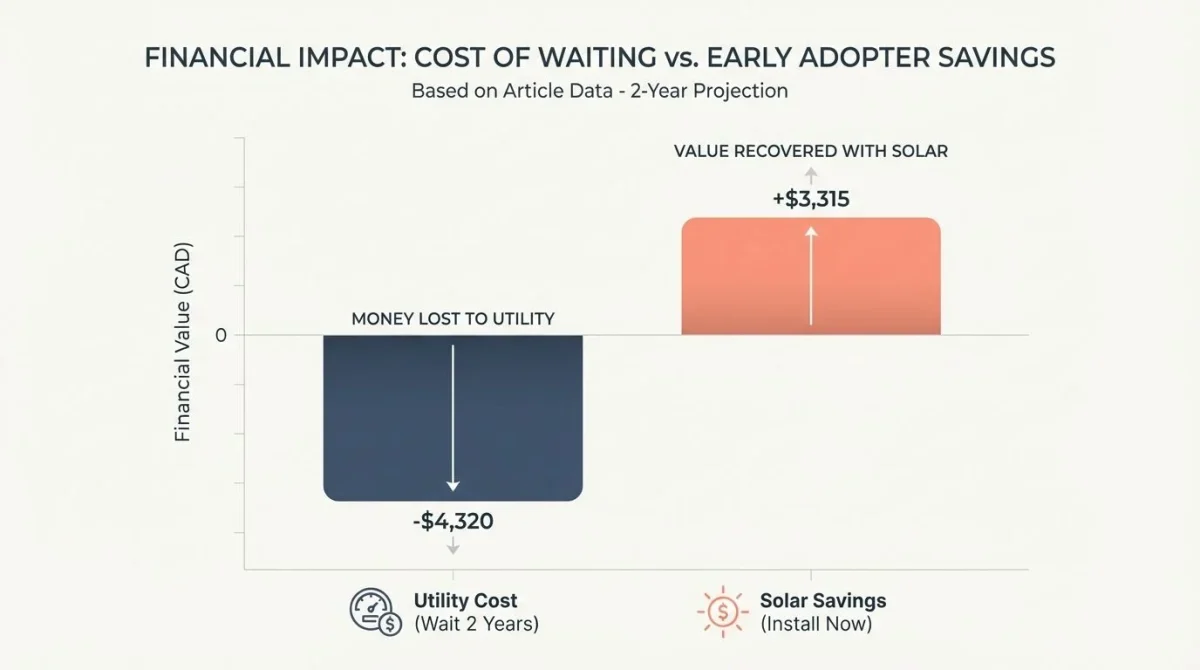
I tell homeowners: “Sure, wait for 30% efficient panels. But what is it costing you to wait?”
Let’s do the math. If your electricity bill averages $180 per month, that is $2,160 a year. Wait two years for “perfect” tech, and you handed your utility over $4,000 with zero return.
A homeowner who installed a system in early 2024 is already generating power. By the time the “wait and see” person installs in 2027, the early adopter has recovered thousands. When we ask, “do solar panels pay for themselves in Canada?“, the answer usually hinges on how soon you start generating.
Also, consider your roof age. If your shingles are 15 years old, replace the roof and install solar together. Don’t install panels now and pay to remove them in five years.
Which 2025 solar inventions are real improvements?
TOPCon and HJT panels are the real deal. TOPCon (Tunnel Oxide Passivated Contact) cells are in mass production. They offer slightly better efficiency (23-24%) and lose less power on hot days compared to older tech. HJT (Heterojunction) panels are even better in low light but cost more.
For most Canadians, TOPCon hits the sweet spot. You get meaningful gains without a massive price jump.
Bifacial panels: Don’t believe the hype for every roof. Bifacial panels collect light from both sides. They work great on ground mounts with white gravel underneath (snow helps too). I’ve seen solar panels on farmland in Alberta get 10-15% extra output this way.
But on a standard dark residential roof? The gain is negligible. The panels are too close to the shingles to capture reflected light. Save your money and get high-quality standard panels.
What about the “2026 Tech” headlines?
Perovskite-silicon tandem cells. NREL’s research-cell efficiency chart shows these cells hitting 33-34% in the lab. It is impressive. Oxford PV began initial commercial shipments in 2024.
But wider consumer availability depends on scale-up, certifications, and price. Canadian certification (CSA) takes time. We need to know these panels can handle a freeze-thaw cycle in Winnipeg for 20 years.
Expect “first-gen risk.” Initial warranties might be shorter than the 25 years you get with silicon. My advice? Let the early adopters in California test them out. By the time they are proven in Canada, you will have already banked years of savings with today’s bulletproof silicon.
Batteries: LFP vs. Sodium
LFP (Lithium Iron Phosphate): This is what you buy today. Safe, reliable, good in cold.
Sodium-ion: Coming soon. Cheaper materials, better in extreme cold. But residential availability in Canada will lag behind EVs.
If you need backup power for frequent outages (rural Nova Scotia, Northern Ontario), buy LFP now. It works. If you just want to lower bills, run the numbers. In many provinces, net metering offers a better return than storing power in a $10,000 battery.
Carbon footprint reality check
People often ask about environmental impact. It depends on where you live.
Canada Energy Regulator data shows Ontario’s grid is already quite clean. A 7 kW system might avoid roughly 0.3 tonnes of CO2e per year there.
In Alberta, where the grid relies more on fossil fuels, that same system could avoid around 4 tonnes of CO2e per year. These reasons to install solar panels in Canada—specifically carbon reduction—are much more compelling in provinces with “dirtier” grids.
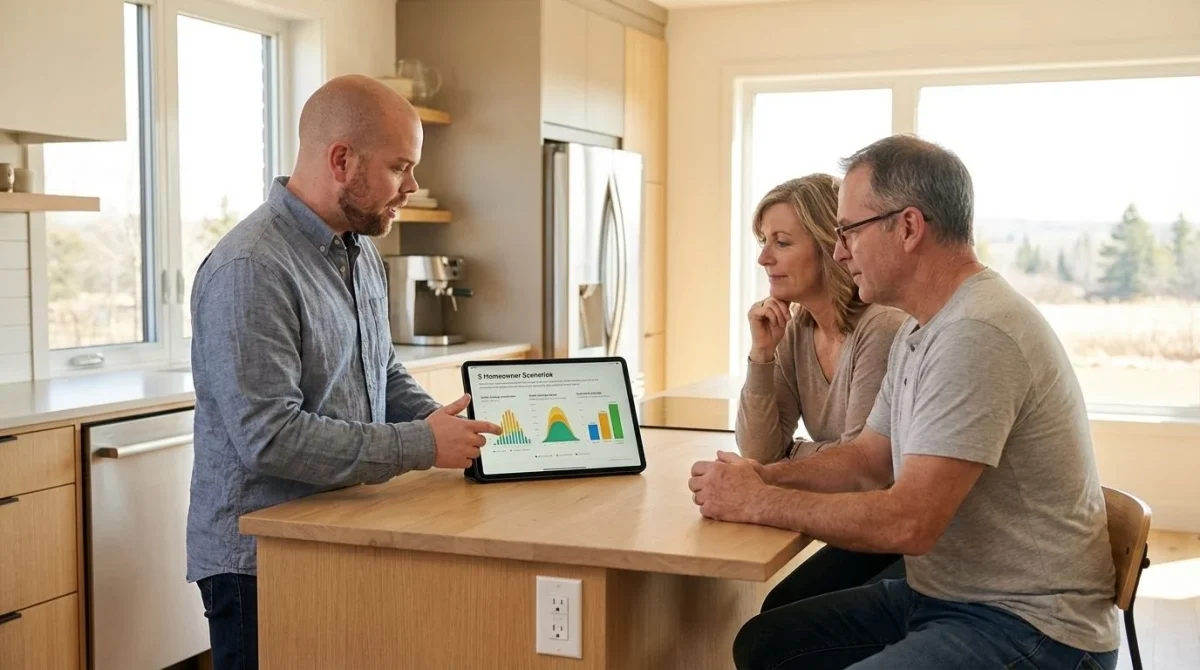
3 homeowner scenarios
Scenario 1: High bills, good roof. Install now. Lock in current incentives. Start saving immediately. Every month you wait is a loss.
Scenario 2: Renovations coming. Wait. Do the roof and solar together. It saves on labor and hassle.
Scenario 3: Selling in 3 years. Probably skip it. While U.S. studies show solar adds value, Canadian data is thinner. Unless you are in a hot market like Metro Vancouver where buyers actively look for green features, you might not recover the full investment in three years.
Final Decision Checklist
- Roof Condition: Is it under 12 years old? (Green Light). Understand what happens to solar panels after 25 years to plan your roof maintenance.
- Space: Do you have 300-400 sq ft of unshaded south/west roof?
- Incentives: Are solar power incentives and grants available now? (Check BC, Ontario, PEI status).
- Rates: Are you paying high rates (12+ cents/kWh)?
- Goal: Backup (need battery) or Savings (net metering)?
- Timeline: Staying 10+ years?
If you checked the boxes, get three quotes. Don’t let the “2026 tech” FOMO paralyze you. The financial cost of waiting usually outweighs the efficiency gain of the next shiny object.
FAQs
1. Are solar panels worth installing now or should I wait until 2026? Waiting typically costs you more in lost energy savings than you gain from newer technology. Start your savings clock today with proven equipment.
2. How much do solar panels cost in Canada right now? Installed costs generally range from $2.50 to $3.50 per watt. You can use a solar panels calculator to get a rough estimate, but getting three local quotes will find the true market price for your roof.
3. How long does it take for solar panels to pay for themselves? With current rates, most of my clients see payback in 8 to 12 years.
4. Will I need to replace my solar inverter before the panels wear out? String inverters often need replacing around year 12. Microinverters usually last 25 years. Budget accordingly.
5. Do solar panels increase home value? It depends on the province. While likely positive, Canadian data is less concrete than in the US. View it as an energy-saving asset first.
Last Updated on December 30, 2025 by Vitaliy