
Yukon Solar Rebate Is Back! A Homeowner’s Guide To Restarting Your Project
December 9, 2025
Do Solar Panels Work On Cloudy Days In Canada? The Truth Behind It
December 17, 2025
You are likely asking yourself if solar is still a smart financial move in 2025. I have analyzed renewable energy markets across Canada for 12 years. The conversation has shifted dramatically.
In Nova Scotia, we are moving away from upfront rebates and toward smart integration. The popular Home Battery Pilot ran from 2022 into early 2024 and is now closed to new applicants. Now, a new wave of Virtual Power Plants (VPPs) and demand response programs like Eco Shift is taking its place.
These programs do not just lower your bill. They turn your home into an active part of the grid.
You can earn rewards for the equipment you already own. I have seen homeowners zero out their electricity costs. They do this by combining new tools with the right financing.
I will walk you through exactly how these systems work in Nova Scotia today. I will show you the specific steps to make the numbers work for your home.
Key Takeaways
- The “Eco Shift” Opportunity: Nova Scotia’s active demand response program pays you to let the grid manage smart devices during peak times. You can earn a $25 sign-up bonus for eligible thermostats, plus rewards for additional devices and annual participation.
- The 2025 Funding Reality: The original Home Battery Pilot is closed to new applicants, and the SolarHomes rebate stopped accepting new applications in April 2025. Financing has replaced free cash as the primary engine for adoption.
- Your “Right to Self-Generate”: Under Bill 145, Nova Scotians have the statutory right to install up to 27 kW of renewable capacity. You do not need complex utility approvals. You can offset your bill through net metering.
- Real-World Resilience: Over 80% of Canadian homeowners experienced a power outage last year. In recent Nova Scotia pilot projects, participants like homeowner Tom MacPherson powered their homes for three full days during outages. Batteries offer security beyond financial return.
- Future VPP Potential: Local programs are in their infancy. Projects like Alberta’s Blatchford Lands link 100 net-zero homes. This shows the blueprint for how Nova Scotia’s grid will evolve to pay homeowners for stored power.
What are Virtual Power Plants (VPPs)?
Think of a Virtual Power Plant as a cloud-based control room. It connects thousands of scattered energy devices. It takes your home battery, smart thermostat, or electric vehicle and operates them as a single, massive power plant.
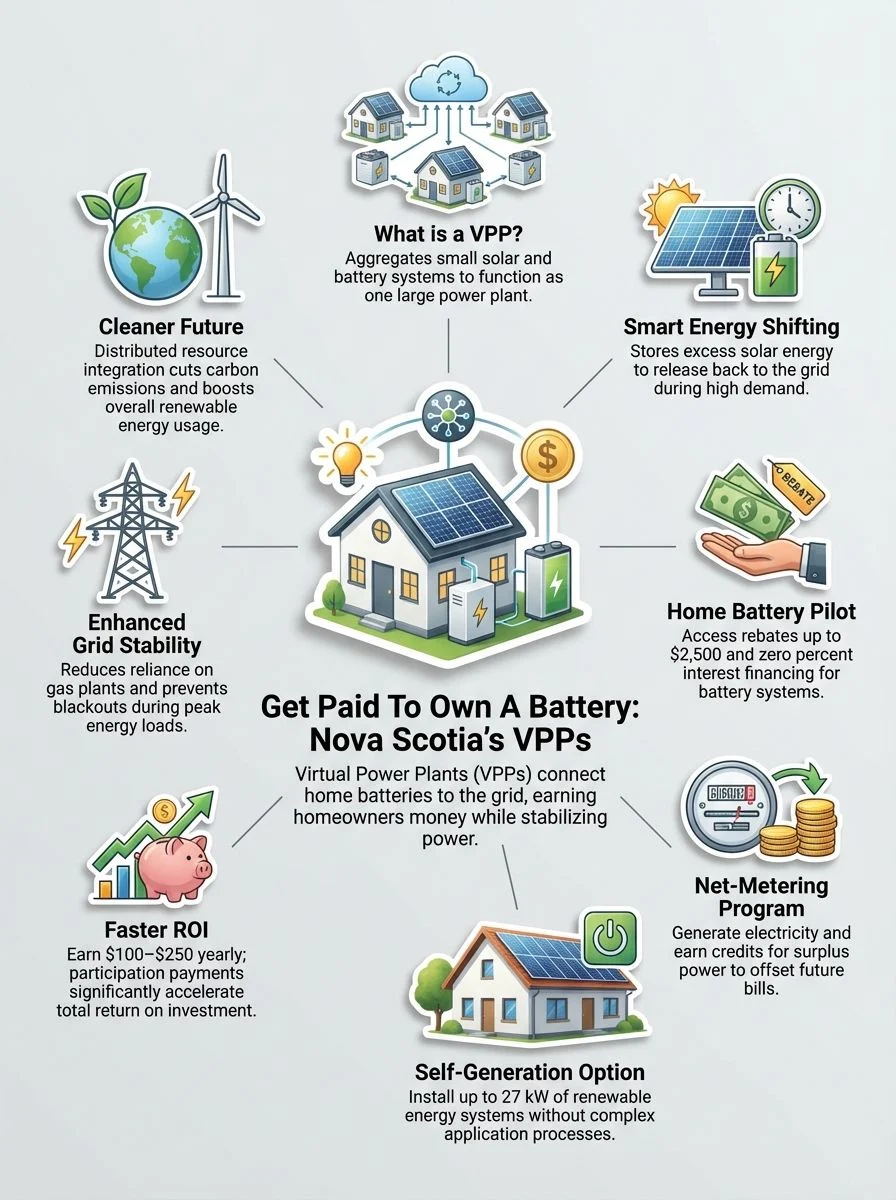
Instead of building a new gas plant to meet demand on a cold February morning, the utility uses software to tap into these distributed resources.
This software aggregates the power from your home with your neighbors’.
For you, this is a passive income stream. You join a program. You set your preferences. The system handles the rest. You feed renewable energy into the grid when prices are high or demand is peaking. You get paid for it.
This approach improves operational profitability for utilities. They do not have to maintain expensive infrastructure that only runs a few days a year. They share those savings with you.
How VPPs Operate in Nova Scotia
Nova Scotia is unique. Our grid faces intense strain during winter storms. VPPs here are designed less for daily trading and more for critical peak shaving and storm resilience.
Connecting Solar Panels and Home Batteries
Your solar panels and home batteries are the hardware backbone. In a typical Nova Scotia VPP setup, your rooftop solar charges your battery during the day.
While your battery is ready for this future, the software programs are currently evolving. In Nova Scotia, early VPP-style programs like Eco Shift currently focus on smart thermostats and heating loads. As more batteries are deployed and integrated, they will be able to discharge into the grid or your home during peak events under similar control signals.
A Critical Rule for Homeowners
Most programs in Nova Scotia enforce a “reserve rule.” The recent Home Battery Pilot required your battery never drop below 20% charge. Even if you help the grid, you have enough power to keep your lights and fridge running during a blackout.
Shifting Energy for Grid Support
The real magic happens with energy management. It is not just about batteries. VPPs talk to your heating system.
During a peak event, the system might pre-heat your home by two degrees before the peak hits. It lowers the thermostat slightly during the expensive window. You stay comfortable. The grid sees a massive drop in demand.
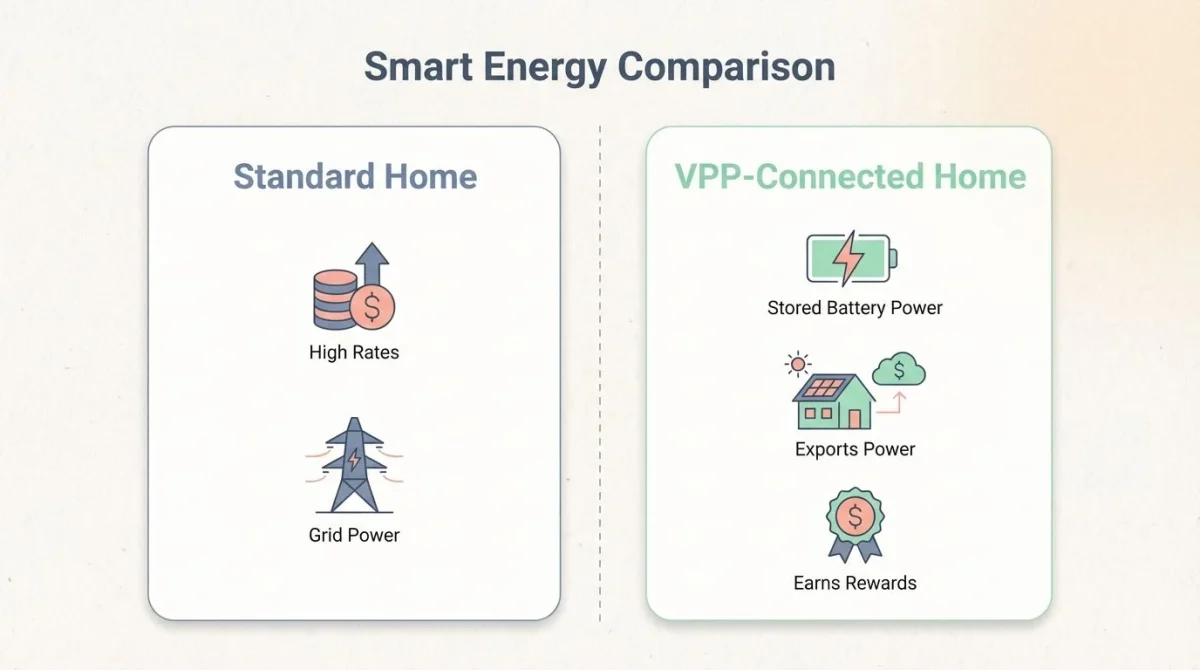
| Action | Standard Home | VPP-Connected Home |
|---|---|---|
| Peak Demand (5 PM – 9 PM) | Draws expensive grid power | Runs on stored battery power |
| Grid Stress Event | Risk of outage/brownout | Exports power to support neighbors |
| Financial Outcome | Pays standard high rates | Earns credits or rewards |
Key Programs and Incentives in Nova Scotia (2025 Update)
The incentive landscape changed in early 2025. Massive upfront rebates are fading. Financing tools and performance-based rewards are replacing them. Here is what is available right now.
The “Eco Shift” Program (Active)
This is the primary demand response program available to Nova Scotians. Run by Efficiency Nova Scotia, Eco Shift focuses on managing peak load through smart devices.
Eco Shift currently enrolls smart thermostats. Battery integration is expected as VPP programs expand. If you own eligible devices, you can enroll to earn cash.
- The Signup Bonus: You receive a $25 sign-up bonus for your first smart thermostat immediately upon enrollment.
- The Multiplier: You get an additional $20 for each extra eligible device (up to $105 total).
- The Annual Passive Income: Participate in at least 50% of peak events. You earn an extra $30 per year.
These numbers seem small compared to a rebate. But they require zero effort. It is “found money” for equipment you plan to buy anyway.

The Self-Generation Option (Bill 145)
This is your statutory right. Under the amended Electricity Act, you can install renewable energy generators or battery storage up to 27 kW.
Why this matters:
There is no complex application process. Your installer follows the normal electrical plans review and inspection process; as long as the system passes, you can self-generate up to 27 kW.
This program uses a bi-directional meter. You bank your surplus power as kilowatt-hour credits.
Warning: Your banked kWh credits reset each March 31. You don’t get a cash payout; extra production above your annual usage is effectively donated back to the grid. That is why you want your system sized to match your yearly consumption, not exceed it.
The Canada Greener Homes Loan
Until October 2025, the main federal financing tool was the Canada Greener Homes Loan, offering up to $40,000 at 0% interest over 10 years.
The program is now closed to new applicants. If you are reading this in the future, check the federal site for whatever replaces it. If you secured the loan before the deadline, you can still install a solar-plus-battery system with no money down, creating immediate positive cash flow.
Status Check: The Home Battery Pilot
You may see references to a pilot offering a $2,500 rebate for Tesla Powerwall 2 systems. This pilot ran from 2022 into early 2024 and is now closed to new applicants.
The program successfully tested grid integration. It is no longer an active route for funding. Join the Efficiency Nova Scotia mailing list. You will be the first to know if a “Phase 2” launches later in 2025.
How VPPs Impact Solar Payback
Adding a battery used to kill your ROI. VPPs and smart financing flipped that logic.
Faster ROI Through Financing
If you pay cash for a battery, the payback period is long. It is often 12 to 15 years.
However, if you secured the 0% Greener Homes Loan, your calculation changes.
You use someone else’s money to build an asset. You participate in programs like Eco Shift. You maximize your Self-Generation credits. You reduce operating costs to near zero.
The “payback” becomes less about years to break even. It becomes about immediate monthly cash flow. Clients who pair federal financing with self-generation credits often see a cheaper total monthly cost from Day 1.
Increasing Savings with Time-of-Use
VPPs rely on timing. Most homeowners are still on a flat rate, but Nova Scotia Power’s Time-of-Use and critical peak pilots are the start of more time-based pricing.
As these expand, batteries that charge off-peak and discharge during peak windows will become more valuable. Even without a full VPP payment structure, this energy arbitrage protects you. You become immune to future rate hikes.
Broader Benefits of VPPs
It is not just about your wallet. Participating strengthens the entire province.
Enhancing Grid Stability
Modelling suggests electricity demand could be 1.6 to 2.1 times higher by 2050. We need smart solutions. When you let your battery talk to the grid, you prevent blackouts.
VPPs respond faster than traditional plants. A battery injects power in milliseconds when frequency drops.
This reduces the need for “peaker plants.” These dirty generators only run a few hours a year. We collectively reduce the carbon intensity of the grid.
Empowering Homeowners
You stop being a passive customer. You start being an active participant.
VPP technology gives you data. You see exactly when you help the grid. You see how much power you contribute.
This visibility leads to better habits. My clients often reduce consumption by another 10-15% simply because they become aware of their usage.
Real Case Studies
Real-world examples show what is possible.
The Nova Scotia Experience
In the recent smart grid pilot, 125 households received batteries.
The results were compelling. During severe weather, participants like Tom MacPherson kept their homes powered for three full days.
This proves the technology works for backup. It provides grid services during blue-sky days.
The Alberta Blueprint: Blatchford Lands
To see the future, look to Alberta’s Blatchford Lands.
Builders equipped 100 net-zero homes with 500 kW of solar and 2 MWh of battery storage. Supported by Emissions Reduction Alberta, this functions as a true microgrid.
These homes share energy. If one house is empty and producing solar, it feeds its neighbor. This integration reduces strain on city infrastructure. It models what new subdivisions in Halifax and Dartmouth could look like.
Conclusion
The landscape for solar and batteries in Nova Scotia has shifted. The easy rebates are gone. The Right to Self-Generate provides a powerful path forward.
There are over 43,000 rooftop PV installations across Canada now. Snow in winter only reduces annual production by about 3%. The technology is proven.
By joining programs like Eco Shift, you squeeze extra value out of your investment. You protect your home from outages.
You have the chance to lock in your energy costs for the next 25 years.
Start with a simple energy audit. It is the first step toward turning your home into a personal power plant.
FAQs
1. What is a Virtual Power Plant (VPP)? Think of a VPP as a digital conductor. It syncs your home battery with the main grid. It supplies power when the neighborhood needs it most. In Nova Scotia, initiatives like Eco Shift connect individual units to stabilize the network during winter storms.
2. How do I get paid for owning a battery? Current programs like Eco Shift focus on smart thermostats, but battery integration is the next step. Future VPPs will likely allow you to rent out a portion of your battery’s capacity during critical times, similar to the setup in the recent Home Battery Pilot.
3. Does joining a VPP improve my solar payback? Yes. Participating speeds up your break-even point. You stack these annual rewards on top of your standard solar energy savings.
4. Are there risks to participating? Extra cycling from VPP events is usually small compared to the battery’s total cycle life, and most modern lithium systems come with 10-year warranties that specifically cover daily cycling and grid services. Still, always confirm with your installer and check the warranty to be sure VPP participation doesn’t void any terms.nd more about immediate monthly cash flow.