Vertical Solar Panels in BC: What Science World’s New Array Means for Homeowners and Commercial Buildings
April 14, 2026
Net Metering Is Your Free Battery in BC: Should You Skip a Powerwall in 2026?
April 20, 2026Last Updated on April 20, 2026 by Vitaliy
A few years ago, I got a home-improvement quote so inflated I checked it twice to see whether it included the neighbour’s garage. Same job. Same house. Wildly different number. Solar quotes can get like that fast.
That’s why this topic matters. A bad solar quote isn’t just expensive. It’s lazy, padded, vague, and built to make you either walk away or overpay without noticing. Canadian homeowners run into this all the time, and the pattern shows up in Reddit threads, utility guidance, and old-fashioned contractor games: vague equipment, weak math, hidden permit costs, stale rebate talk, and contracts that dump risk on you.
Key Takeaways
- A padded solar quote is usually vague on equipment, math, and scope.
- Closed incentives in a live quote are a major warning sign.
- Permit, meter, study, and upgrade costs should never be treated like afterthoughts.
- Net metering and net billing rules change by province and utility.
- A serious installer makes the assumptions easy to audit.
What a “fuck-off quote” actually looks like
Busy installers don’t always say “we don’t want this job.” Some just send a number high enough, vague enough, and sloppy enough to make the problem disappear.
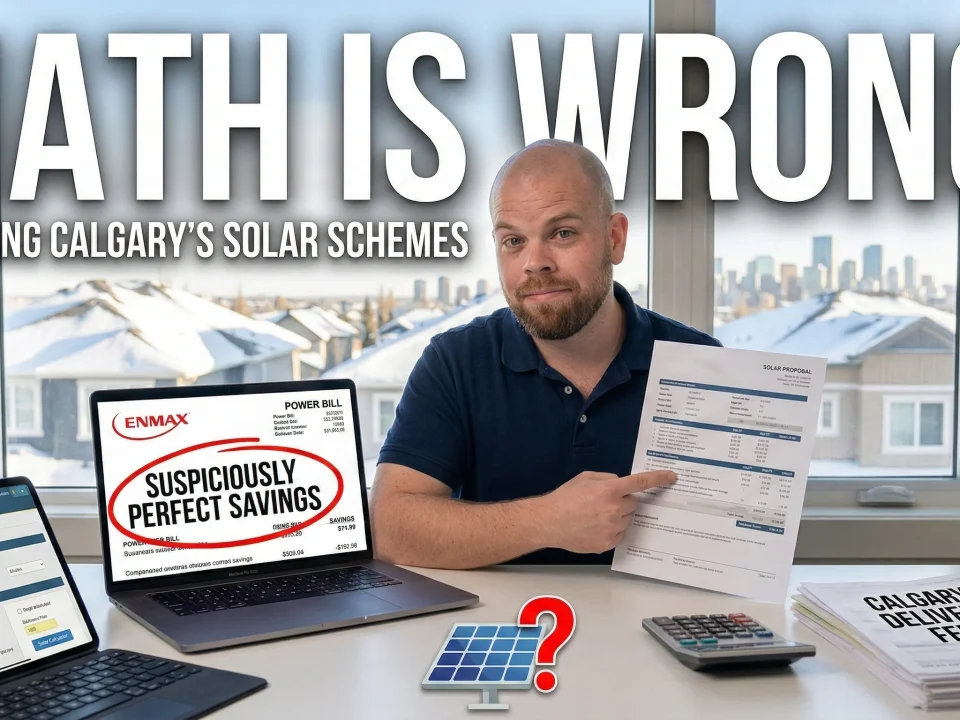
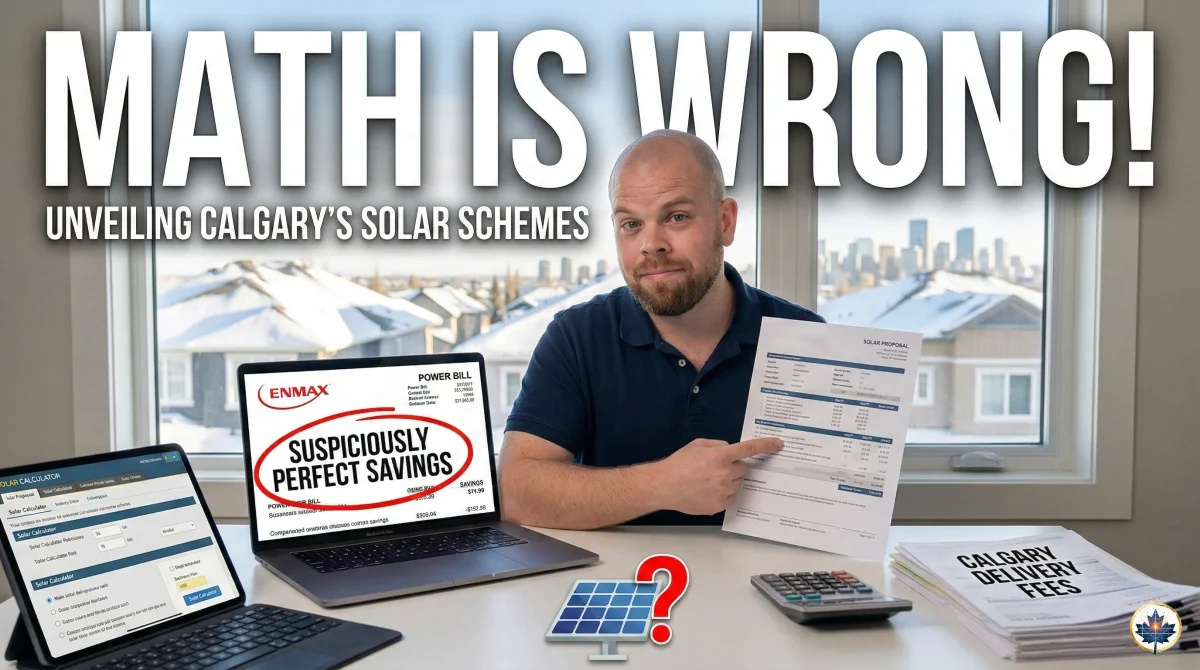
You’ll usually see the same tells. Model numbers are missing. Production claims are high but shading isn’t discussed. Incentives are treated like free money even when the program is already closed. Utility rules are oversimplified. Hidden costs are buried under words like “turnkey” or “as required.” Manitoba Hydro’s own homeowner checklist tells people to ask whether the estimate includes taxes, permit costs, a bi-directional meter, electrical service upgrades, and maintenance, which tells you exactly where weak quotes tend to hide the real price.
Red flag #1: No real equipment list
“Tier 1 panels” means almost nothing to a buyer. “Premium inverter” is just sales filler. You need exact model numbers.
A serious solar quote names the modules, inverter or microinverters, monitoring platform, and major balance-of-system components. Without that, you can’t verify product warranty length, replacement terms, certifications, or degradation promises. SolarEdge, for example, states a standard 12-year inverter warranty with extension options depending on model, which is very different from a quote that just says “25-year system warranty” and hopes you stop asking questions.
Tip for equipment review: If the quote doesn’t let you Google every major part in under five minutes, it isn’t ready.
Red flag #2: Production math that looks too clean
Numbers sell. Bad numbers sell faster.
PVWatts, one of the best-known solar production calculators, uses a default total system loss of 14%, with losses broken into soiling, wiring, shading, availability, connections, light-induced degradation, and more. So when a quote shows huge annual production with barely any discussion of losses, shading, roof plane differences, or degradation, you’re looking at marketing math, not job-ready math.
Shading is where this gets ugly. PVSyst explains that shading is not just “less sun”; it can also create electrical mismatch losses across connected modules, which means a quick “minimal shade” comment without a real shade review is a weak answer.
I’ve seen this firsthand. One quote assumed a clean south-facing dream roof. Actual house? Two roof faces, a chimney, and late-day tree shade. Result? Savings model looked great on paper and weaker in real life.
Red flag #3: Dead incentives still showing up in the price
This one is a credibility test. Installers who still pitch closed programs are telling you they either don’t track policy or don’t care.
Canada Greener Homes Grant intake closed to new applicants in February 2024, and the program closed to existing applicants on December 31, 2025. Canada Greener Homes Loan also closed to new applications, with October 1, 2025 listed as the last day to apply. If a 2026 quote still bakes those dollars into your net cost like they’re open today, treat the whole quote as suspect.
Provincial programs need the same caution. Ontario’s Home Renovation Savings Program solar incentive has a big catch: participants receiving that solar and storage incentive are not eligible for net metering under that path, because the program is built around load displacement. Miss that detail and the economics change fast.
Red flag #4: Hidden permit and interconnection costs
This is where “cheap” quotes turn expensive after signing. Then the change orders start.
Manitoba Hydro says solar installations need an electrical permit and usually a building permit, and that electrical work must be done by a licensed electrical contractor. NB Power says projects need an electrical wiring permit, inspection approval, written utility approval, and a bi-directional meter before connection. Saskatoon Light & Power publishes application fees, study costs, and meter costs for self-generation. Those aren’t weird extras. They’re part of the job.
So when a quote says “permits included” but doesn’t state what happens if the utility asks for a study, service upgrade, meter change, or design revision, you’re exposed.
Red flag #5: Utility rules are treated like they’re the same across Canada
They aren’t. Not even close.
Ontario examples from Toronto Hydro and Hydro One show excess credits can carry forward for up to 12 months. Hydro-Québec describes a longer banking and reset structure. Manitoba Hydro uses net billing instead of classic net metering. NB Power zeros out remaining credits in its annual reconciliation. BC Hydro is closing its old net metering schedule to new customers and moving to a new self-generation rate effective July 1, 2026, with excess generation compensated at 10¢/kWh. That is a big difference in how oversizing works and how export value should be modeled.
A quote that says “solar will wipe out your bill” without naming your utility program is unfinished. Toronto Hydro’s sample bill also makes clear that billing mechanics still matter and that credits don’t simply erase every charge line on the page.
Red flag #6: Financing is the whole sales pitch
Monthly payment talk hides weak pricing better than anything else.
Leases, loans, PPAs, and dealer financing can all be legitimate. Problem is, a padded quote becomes harder to spot once the conversation shifts from system price to “only $149 a month.” Ontario rules now allow third-party arrangements like leasing, renting, financing, and PPAs in net-metering situations, which makes clean comparison even more important. You need the cash price, financed price, APR, term, total repayment, and any escalator in writing.
Short version? Compare dollars per installed watt and total contract value first. Then look at the payment plan.
Red flag #7: Contract terms are vague where they should be sharp
This is where the real damage happens. Quote looks passable. Contract buries you.
Consumer protections vary by province, but Ontario, British Columbia, Alberta, and Quebec all have official guidance around cancellation rights in certain direct sales or consumer contract situations, including 10-day windows in some cases. That doesn’t mean every solar deal gives you the same exit rights. It does mean you should never sign before understanding which rules apply to your deal, how it was sold, and what cancellation fees or change-order clauses sit inside the contract.
Watch for these lines:
- broad equipment substitution rights
- open-ended “additional electrical work as required” wording
- unclear workmanship warranty
- no promise on monitoring access
- cancellation fees that feel designed to trap you
What a solid Canadian solar quote should include
Here’s the fast comparison.
| Good quote | Bad quote |
|---|---|
| Exact panel and inverter model numbers | “Tier 1 panels” and “premium inverter” |
| Production estimate with shading and loss assumptions | Big annual kWh number with no method |
| Clear line on permits, interconnection, inspection, and commissioning | “Turnkey” with no detail |
| Province and utility program named | Generic Canada-wide savings pitch |
| Real incentive status | Closed rebates treated as current |
| Clear warranty split: product vs workmanship | One fuzzy “25-year warranty” |
| Cash price and financing price shown separately | Monthly payment only |
A real quote should read like a project plan. Not a flyer.
What I tell homeowners and business owners now
Don’t let a bad quote scare you away from solar. Let it help you filter installers faster.
Residential buyers should ask for three things right away: equipment list, assumptions sheet, and full scope of work. Commercial buyers should do the same, then push harder on interconnection steps, utility approval timing, and contract language because the mistakes get more expensive as system size grows. Halifax’s municipal solar program says it can take an average of 4 to 6 months from signing to a system being fully installed and operating, which tells you why any installer promising instant completion without process detail deserves a long pause.
Second personal one. Years back, I reviewed two quotes for a similar roof. One was cheaper up front and sounded smoother on the phone. Other one was more detailed, a bit less flashy, and answered every annoying question I had. Guess which one I trusted more. Always the quote that makes the hard parts visible.
FAQ
How many solar quotes should I get in Canada?
Three is a good minimum. Fewer than that and you won’t see the pattern.
What should I ask for first?
Ask for exact equipment models, annual production assumptions, permit scope, interconnection scope, warranty terms, and cash price.
Can solar still make sense if federal programs are closed?
Yes. Plenty of projects still work without those programs, but the quote has to stand on its own numbers.
Is net metering the same in every province?
No. Ontario, Quebec, Manitoba, New Brunswick, Nova Scotia, and British Columbia all handle excess generation and crediting differently.
What if the installer says the utility process is “easy”?
Ask them to name the exact utility program, permit steps, meter requirements, and approval order in writing.
Are high quotes always bad?
No. Complex roofs, electrical upgrades, and interconnection work can raise cost. High plus vague is the real problem.
Should commercial property owners use the same checklist?
Yes. Same checklist. Bigger stakes.