
BC’s New COAST Challenge: Will It Fund YOUR Next Home Battery Upgrade?
December 5, 2025
Yukon Solar Rebate Is Back! A Homeowner’s Guide To Restarting Your Project
December 9, 2025
You’ve seen the headlines. Tariffs are shaking up the renewable energy world.
If you are thinking about going solar, you are probably wondering if a new federal tax is about to make your investment way more expensive. You are right to worry.
According to reports surrounding the BC Hydro 2024 Call for Power, a 25 percent tariff on imported wind towers has already been confirmed. This proves Ottawa isn’t bluffing. It raises major concerns about whether solar panels are next on the chopping block.
I’ve been consulting on solar energy for over 12 years. Homeowners ask me this daily. The good news? You can still protect your savings if you move fast.
Let me walk you through what is actually happening, how it hits your wallet, and the smart moves you need to make before prices climb.
Key Takeaways
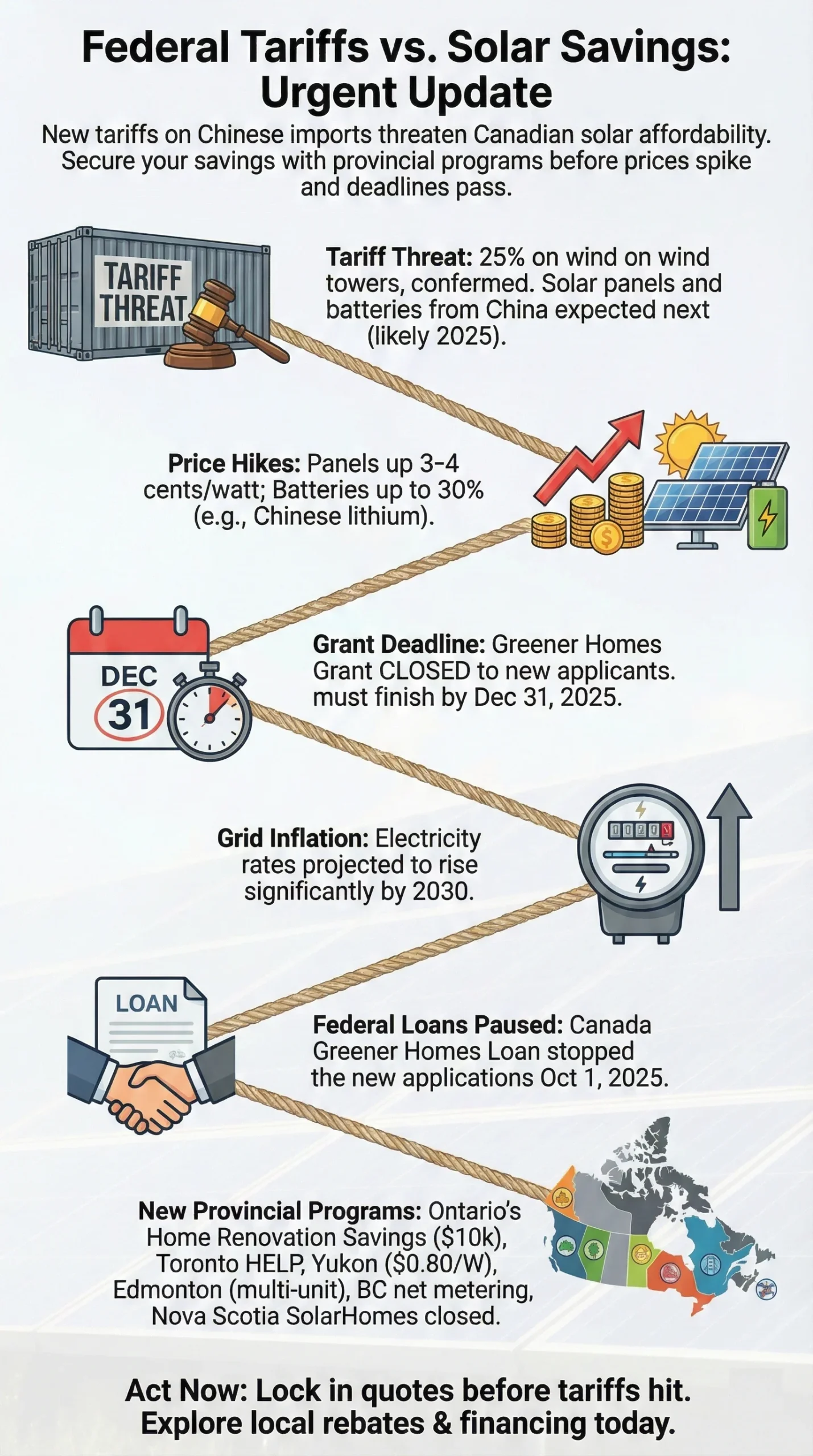
- Tariffs Are Real: Canada has already slapped a 25% tariff on imported wind towers. New tariffs on Chinese solar products are expected to start as early as 2025.
- Price Hikes Incoming: If Canada mirrors the U.S. tariff structure, homeowners could pay an extra 3 to 4 cents per watt for panels and up to 30% more for batteries.
- Job Market Risk: U.S. data suggests that for every job created by tariffs, we could lose roughly 31 jobs elsewhere in the sector due to higher costs.
- Grant Deadlines: The federal Canada Greener Homes Grant is closed to new applicants. If you are already in, you are expected to finish by December 31, 2025.
- New Rebates: While federal loans have paused, provinces like Ontario have launched new programs like the Home Renovation Savings Program to fill the gap.
The Federal Tariff: What Is Actually Happening?
A proposed federal tariff could raise the price of imported solar panels across Canada. If you have been planning to install solar power, this changes your math.
Ottawa is preparing new tariffs on Chinese solar products and critical minerals. This follows the 2024 Fall Economic Statement. While we don’t have a confirmed “10 percent” start date for Canada yet, the writing is on the wall.
Trade experts at Blakes confirm that solar panels and batteries are on the consultation list.
Why does this matter?
If Canada copies the U.S. approach, Chinese solar imports could face massive surtaxes. In my experience working with suppliers, steep increases disrupt the supply chain fast. Manufacturers in Southeast Asia often get caught in the crossfire of anti-dumping cases, sending prices skyrocketing.
How Much Will This Cost You?
Let’s look at the numbers.
If Canada mirrors the U.S. tariff structure that Solar.com models, hardware prices could jump roughly 10–30%.
- Panels: Expect to pay an extra 3 to 4 cents per watt.
- Hardware: Racking and wiring could rise by 2 to 3 cents per watt.
- Batteries: This is the big one. Storage systems relying on Chinese lithium components could jump by 30 percent. If you are considering storage, look into the Tesla Powerwall availability in Canada to gauge current market rates.
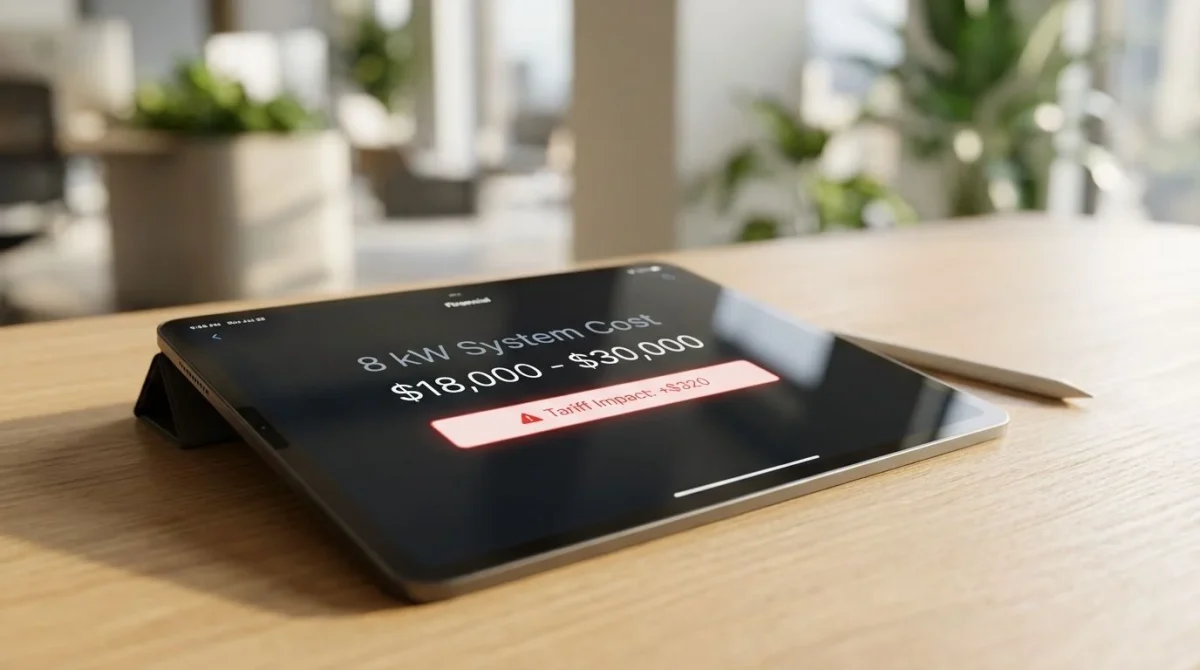
On a typical 8 kW home system, that might not sound like much. But adding 4 cents per watt is an extra $320 just for panels. Add in the battery hike and balance of system costs, and your quote could jump by thousands of dollars overnight. For a detailed breakdown, check the complete solar system price for a home.
How To Prepare For Rising Costs
Solar panel prices are volatile. Smart planning is your only defense.
1. Watch Your Deadlines
If you were lucky enough to get into the Canada Greener Homes Grant before it closed to new applicants in early 2024, you are on the clock. You are expected to complete your upgrades and paperwork by December 31, 2025, based on current federal guidance—check your grant portal for your exact deadline.
If you missed the grant, you also missed the Canada Greener Homes Loan, which stopped accepting new applications on October 1, 2025. You now need to look at provincial options. For those needing alternatives, explore how to finance your solar panels now that the loan is gone.
2. Lock In Quotes Now
Electricity rates are projected to rise significantly by 2030. Solar is still a smart buy, with most Canadian home systems in 2025 running about $2.50 to $3.50 per watt before incentives.
My advice? Get a quote today. Once tariffs are official, suppliers will adjust pricing immediately. If you order after the announcement, you pay the new rate. You might also want to confirm if solar panels pay for themselves in your specific province.

Which Incentives Are Still Available?
The federal well has dried up for new applicants, but provinces and cities are stepping up.
- Ontario: The province launched the Home Renovation Savings Program in January 2025. You can get up to $10,000 for clean energy upgrades, including $5,000 for Ontario solar panels and $5,000 for batteries.
- Edmonton: Edmonton’s Change Homes for Climate – Solar Program now focuses on multi-unit buildings, with incentives up to $0.50 per watt, capped at $4,000 per dwelling. Earlier $0.40/W single-family rebates have closed. For specific costs, check our guide on solar panels in Edmonton or review the broader Alberta solar guide.
- Yukon: The Good Energy rebate is still solid, offering $0.80 per watt up to $5,000. Read more in our Yukon guide.
- Toronto: The HELP program offers low-interest financing up to $125,000.
- Nova Scotia: Bad news here. The SolarHomes rebate closed to new homeowners in April 2025. See current Nova Scotia rebates for alternatives or read our analysis on solar panels in Nova Scotia.
- British Columbia: While BC Hydro deals with wind tariffs, homeowners should review our solar panels BC guide to navigate local net metering rules.
The Broader Impact on Canada’s Industry
Tariffs don’t just hurt homeowners. They hurt the industry.
The Canadian Renewable Energy Association has warned that wind tower tariffs are already adding millions to project costs. BC Hydro confirmed that nine major wind projects are getting hit by these new taxes.
When costs go up, projects get cancelled.
U.S. analysis from the SEIA suggests that tariffs can destroy more jobs than they save. Their data shows that for every job protected by tariffs, roughly 31 jobs are lost elsewhere due to lower installation demand. If Canada follows this path, we risk stalling the momentum we built over the last five years.
Conclusion
Federal tariffs are coming. The wind sector is already paying them. Solar is next.
Delaying your decision means you risk paying higher prices for hardware while missing out on the remaining provincial rebates.
Check your local incentives. Get a quote. Lock it in. Protecting your wallet is just as important as protecting the environment.
FAQs
1. Will new tariffs raise my solar costs? Yes. If the federal government aligns with U.S. policy on Chinese imports, hardware prices will jump. Surtaxes on steel and aluminum are already here; solar is likely next.
2. Can I still apply for the Canada Greener Homes Grant? No. It closed to new applicants in early 2024. If you are already approved, you generally have until December 31, 2025, to finish the work.
3. Are there Canadian-made panels that avoid tariffs? Yes. Brands like Heliene (Ontario) or Silfab (Mississauga) manufacture locally. However, check with your installer, as some components may still be subject to supply chain tariffs. You can find more details on best solar panels in Canada here.
4. How much will prices go up? Industry scenarios suggest a 10 to 30 percent increase in hardware costs, specifically for batteries and panels imported from China or Southeast Asia.