
Are Solar Panels Worth It In BC After Greener Homes Loan Is Gone?
October 11, 2025
Do solar panels increase home value in Canada
October 15, 2025Last Updated on June 23, 2026 by Vitaliy
Solar panels in Kelowna can still make financial sense in 2026, but the answer depends on one boring detail before anything else: who sends your electricity bill. A BC Hydro customer and a FortisBC customer in the Okanagan may face different rebate rules, different credit rules, and different payback math. If you skip that step, a quote that looks good on paper can be built on the wrong assumptions.
Kelowna has strong solar potential, especially on open south- and west-facing roofs, but sunshine alone does not pay for a system. You need the right system size, a realistic production estimate, a roof that is ready for panels, and a quote that matches your actual energy use.
Key Takeaways
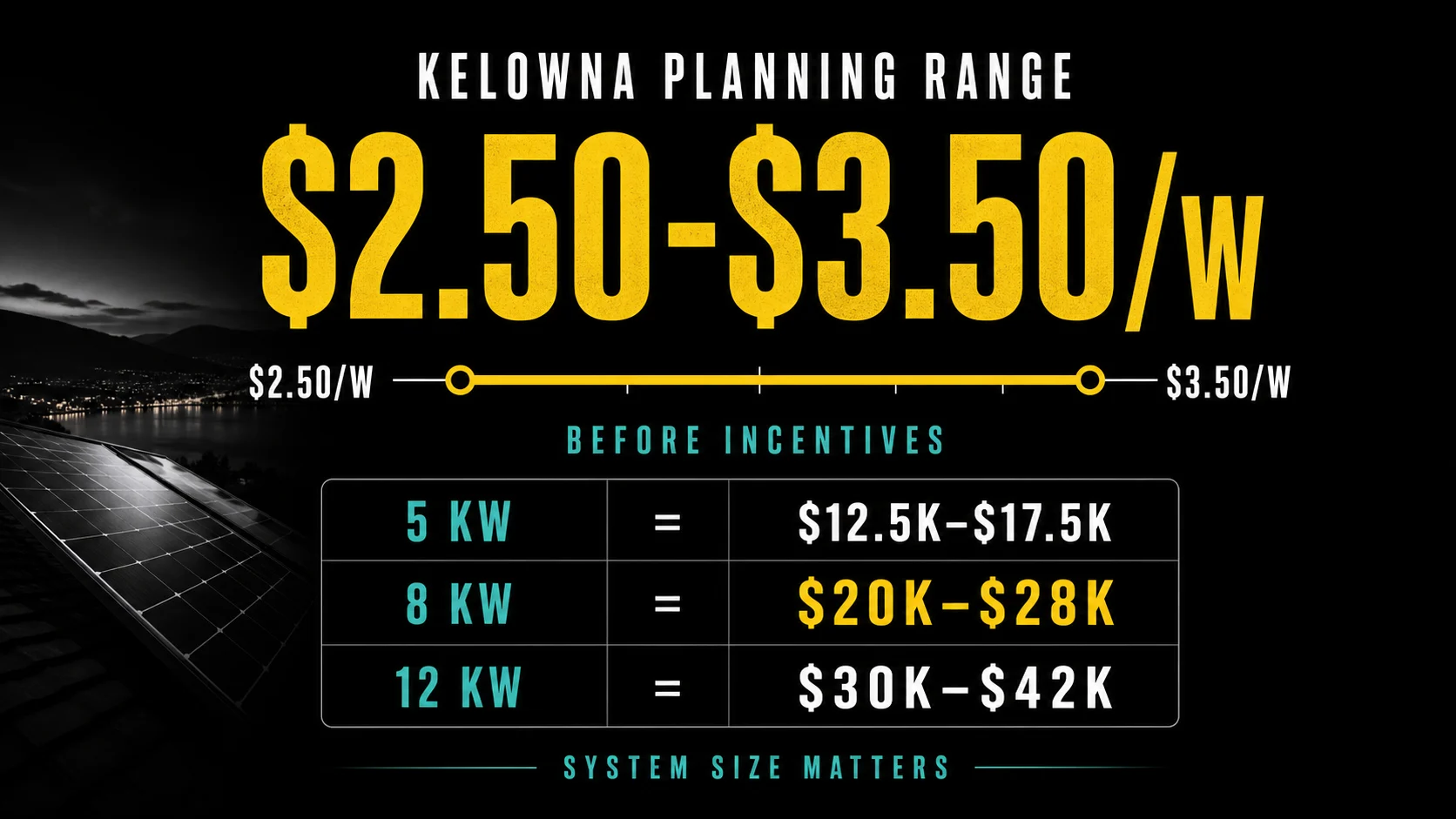
- Most Kelowna residential solar installations still land in the rough range of $2.50 to $3.50 per watt installed, before any utility rebate or financing. A typical 8 kW system may cost about $20,000 to $28,000 before incentives.
- BC Hydro customers may qualify for BC Hydro solar panel and battery storage rebates, including up to $5,000 for eligible grid-connected solar panels and up to an additional $5,000 for qualifying battery storage.
- FortisBC customers should focus on the FortisBC Net Metering Program, proper annual sizing, and quote quality. FortisBC net metering allows excess generation to be banked for future billing periods, but systems are limited to 50 kW and must be designed to offset expected annual use.
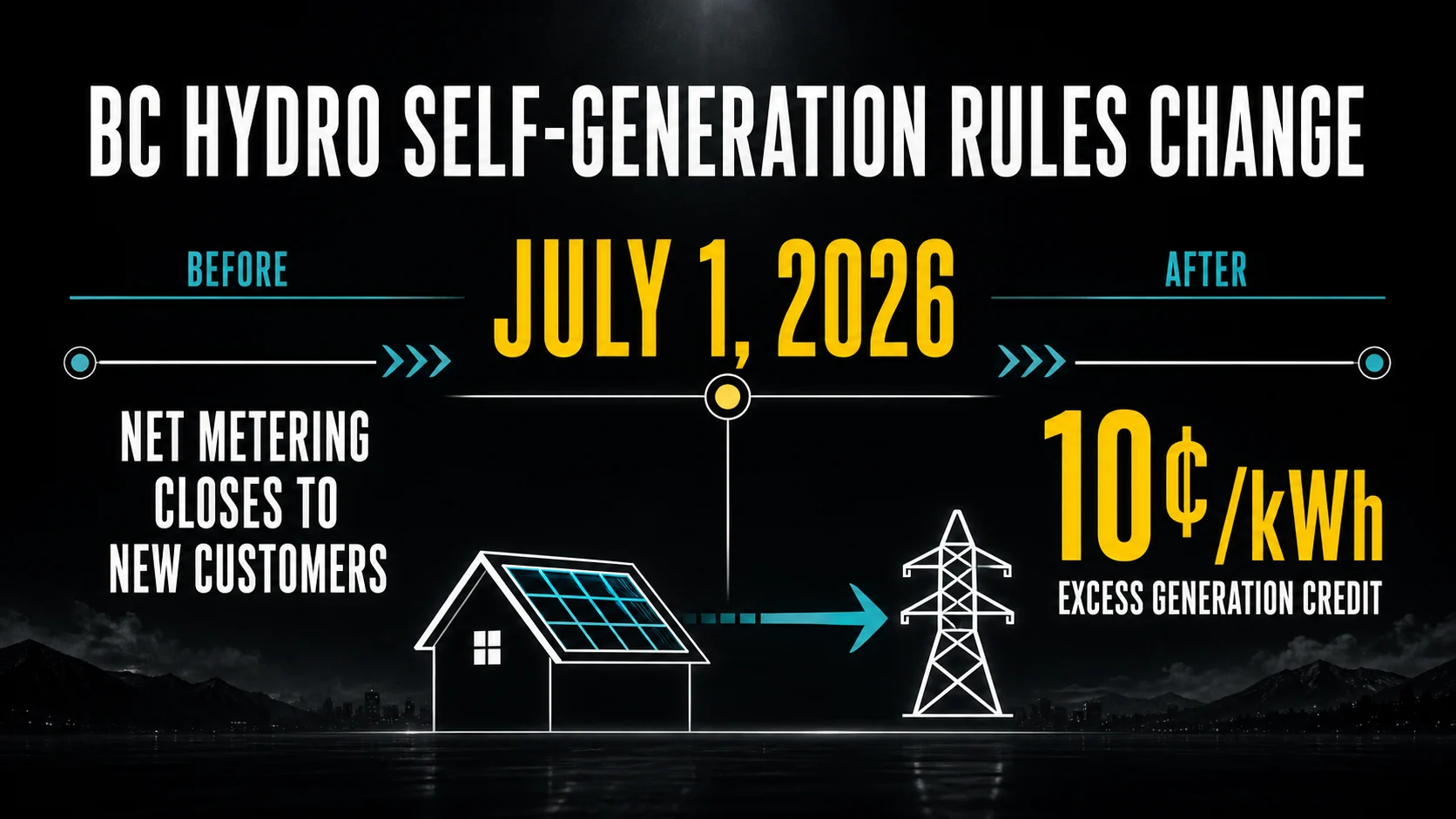
- BC Hydro’s self-generation rules are changing on July 1, 2026. The old net metering rate closes to new customers, and the new self-generation rate pays 10 cents per kWh for excess generation, according to BC Hydro’s customer generation service rate update.
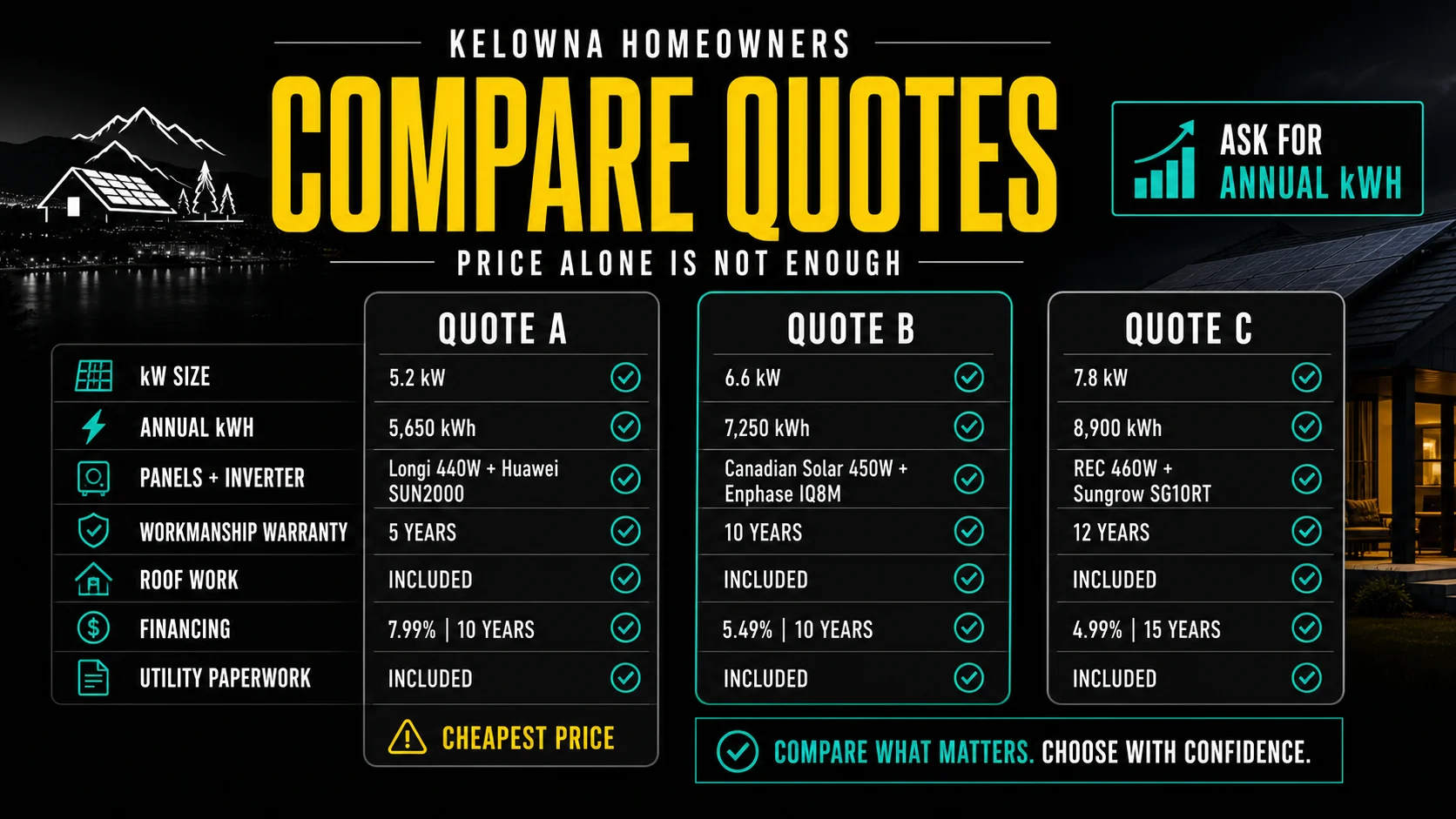
- Do not compare solar quotes by price alone. Compare system size, production assumptions, panel and inverter brands, workmanship warranty, roof work, financing terms, and who handles permits and utility paperwork.
Is Solar Worth It In Kelowna?
For many Kelowna homeowners, yes. The city has better-than-average solar conditions for British Columbia, and the Okanagan’s long summer days help a properly placed solar energy system produce a strong share of its annual electricity in spring, summer, and early fall.
The catch is winter. Solar panels still work in cold weather and cloudy conditions, but output drops when days are short, snow covers the array, or the roof has shade from trees, hills, chimneys, or nearby buildings. That is why the annual production estimate matters more than a salesperson’s best summer number.
Tip for Kelowna homeowners: ask the solar installer for the annual kWh estimate, rather than just the system size in kilowatts. A 10 kW system on a clear south-facing roof is not the same as a 10 kW system split across shaded roof planes.
If you want a quick first check before calling installers, use the SolarEnergies.ca online solar calculator to see whether solar panels in Kelowna are likely to fit your roof, bill, and budget.
Solar Panel Cost In Kelowna In 2026
A reasonable planning range for a grid-tied residential solar installation in Kelowna is still about $2.50 to $3.50 per watt installed. That usually includes solar panels, inverter equipment, racking, electrical work, design, permits, and labour. Premium panels, complex roofs, service upgrades, trenching, battery storage, or structural work can push the price higher.
| Annual electricity use | Typical solar system size | Estimated installed cost before incentives | Best fit |
|---|---|---|---|
| 6,000 kWh | 5 kW | $12,500 to $17,500 | Smaller home, efficient appliances, modest usage |
| 10,000 kWh | 8 kW | $20,000 to $28,000 | Average detached home or heat-pump household |
| 15,000 kWh | 12 kW | $30,000 to $42,000 | Larger home, EV charging, higher electric heating load |
A common local concern is quote shock. One Kelowna homeowner may hear about a small 2 kW or 3.5 kW system and expect a low price, while another household with EV charging or electric heating may need a much larger array. Those are different projects. Before reacting to the final price, divide the quote by watts installed and compare what is included. For a Lower Mainland comparison, see the Richmond solar panels guide.
Another fair question is whether you can install part of the system yourself and pay only for the electrical hookup. In practice, grid-tied solar is not a good DIY shortcut for most homeowners. Utility approval, code compliance, rapid shutdown requirements, inverter setup, roof attachments, liability, and warranty coverage all matter. If you want to reduce cost, ask installers whether there are design changes that lower price without weakening production or warranty support.
Tip for comparing quotes: ask each solar contractor for system size, estimated annual kWh, panel model, inverter model, workmanship warranty, monitoring details, total installed price, and estimated cost per watt. A cheaper quote can be worse if it assumes weak production or leaves out work you will have to pay for later.
Kelowna Rebates: BC Hydro Versus FortisBC
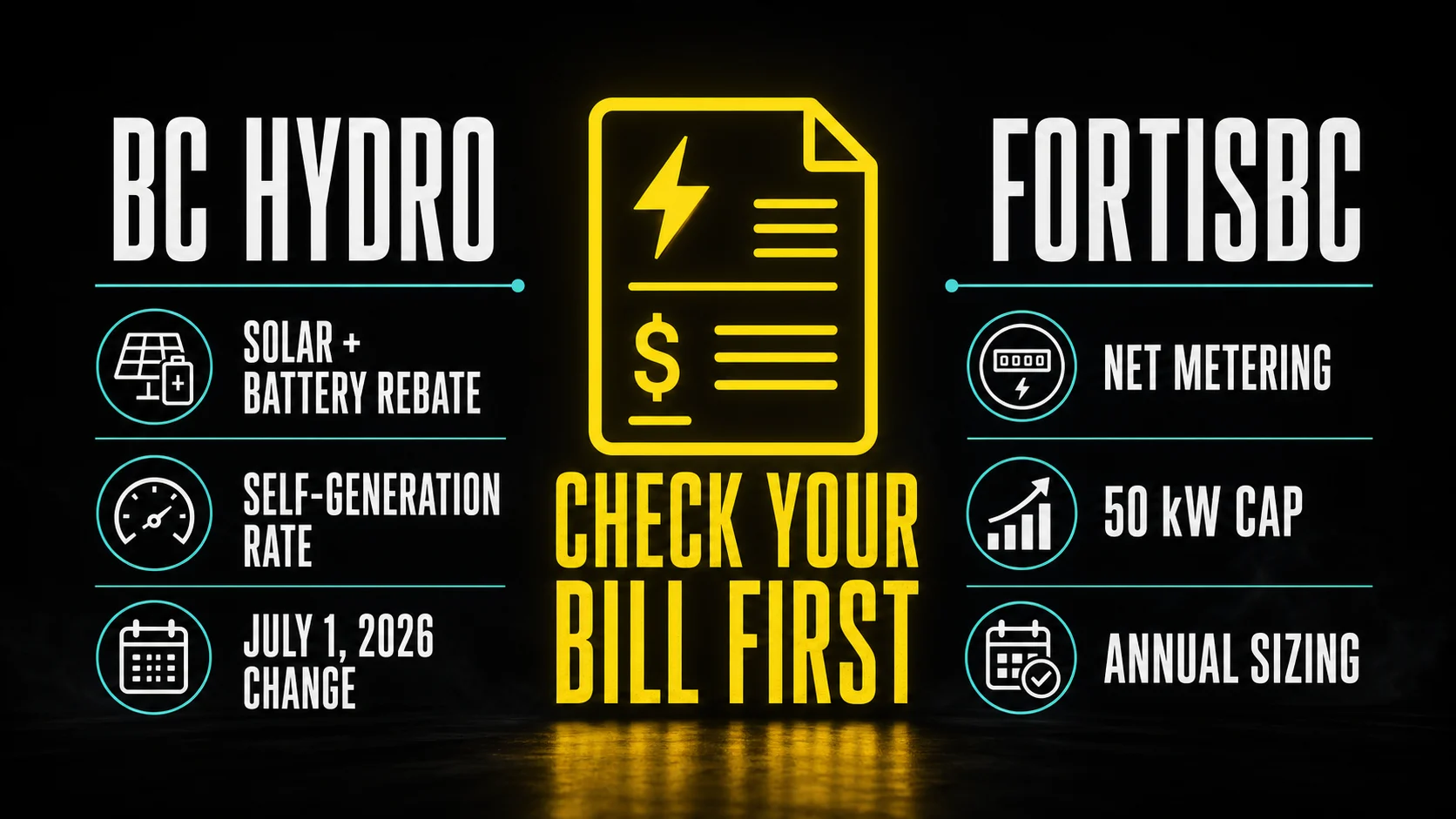
Do this first: look at your electricity bill. Kelowna-area homeowners may be served by FortisBC or BC Hydro depending on the property. The available incentives and net metering rules are not identical.
If You Are A BC Hydro Customer
BC Hydro’s current residential offer can be meaningful. The utility says qualifying residential customers can save up to $10,000 on eligible solar panels and battery storage, with up to $5,000 for eligible grid-connected solar panels and up to an additional $5,000 for qualifying battery storage systems.
The fine print matters. BC Hydro says battery rebate rules changed on April 1, 2026, and that beginning June 1, 2026, solar and battery installations must be completed by a Home Performance Contractor Network member to be eligible for rebates. If your quote includes a BC Hydro rebate, ask the installer to show you exactly how the current program rules apply to your address and equipment.
BC Hydro also says its self-generation rate changes on July 1, 2026. New customers move under Rate Schedule 2289, while the previous net metering service rate closes to new customers. For many homeowners, this makes system sizing even more important. You want to use as much of your solar energy as possible in your own home instead of oversizing only to export extra power.
If You Are A FortisBC Customer
FortisBC’s Net Metering Program is the main planning piece. FortisBC says residential, commercial, and irrigation customers can participate when they generate renewable electricity for their own use. Excess power can be banked and used in a future billing period, and the generation equipment must be on your property and designed to offset some or all of your own consumption.
FortisBC also lists a 50 kW maximum generating capacity for its net metering program. That is far above what most homes need, but it matters for larger residential and small commercial solar projects.
The practical takeaway: a FortisBC customer should not plan around a BC Hydro rebate unless the property is actually served by BC Hydro. Build your payback using FortisBC bill data, the net metering credit rules, your roof production estimate, and the installed price after any tax treatment or financing that applies to your situation.
What About The Canada Greener Homes Grant Or Loan?
The Canada Greener Homes Grant is no longer the simple planning anchor it once was for new solar buyers. Some homeowners still ask about the Greener Homes Loan because older projects used it for interest-free financing. Treat that as a financing question, not a guaranteed rebate. Before signing, confirm the current federal loan status, eligibility, energy audit requirements, and timing directly with the program or your lender.
If upfront cost is the sticking point, ask about available financing options. Depending on approval and program terms, some buyers may see 0% financing with $0 down payment, but the monthly payment still needs to make sense against your real electricity savings.
How Net Metering And Self-Generation Affect Payback
Solar payback in Kelowna is mostly driven by four numbers: installed cost, annual production, your electricity rate, and how your utility credits exported power.
With FortisBC net metering, the goal is usually to size the system close to your expected annual consumption. With BC Hydro, the July 1, 2026 rate change means new self-generation customers should pay close attention to the value of exported energy. BC Hydro says the new rate lets customers send up to 100 kW per phase back to the grid and earn 10 cents per kWh for excess generation.
| System size | Estimated annual generation | Example annual bill offset at $0.15/kWh | Comment |
|---|---|---|---|
| 5 kW | 5,500 to 6,500 kWh | $825 to $975 | Works for smaller loads or partial offset |
| 8 kW | 8,800 to 10,400 kWh | $1,320 to $1,560 | Common planning size for many homes |
| 12 kW | 13,200 to 15,600 kWh | $1,980 to $2,340 | Often tied to EV charging or higher usage |
The $0.15/kWh figure above is only a modelling example. Use your own bill to estimate your blended electricity cost, and ask your installer to show whether their savings estimate uses retail offsets, export credits, rate escalation, or a mix of assumptions.
Before choosing an installer, compare a few detailed quotes. SolarEnergies.ca can connect you with certified installers who have completed 14,000+ installs across Canada, so you can compare real options instead of guessing.
Do You Need A Battery In Kelowna?
Most grid-tied solar systems do not need a battery to reduce electricity bills. Net metering or self-generation credits are usually the first financial tool. A battery becomes more interesting when you want backup power, better use of your own solar energy, or access to a battery-specific rebate.
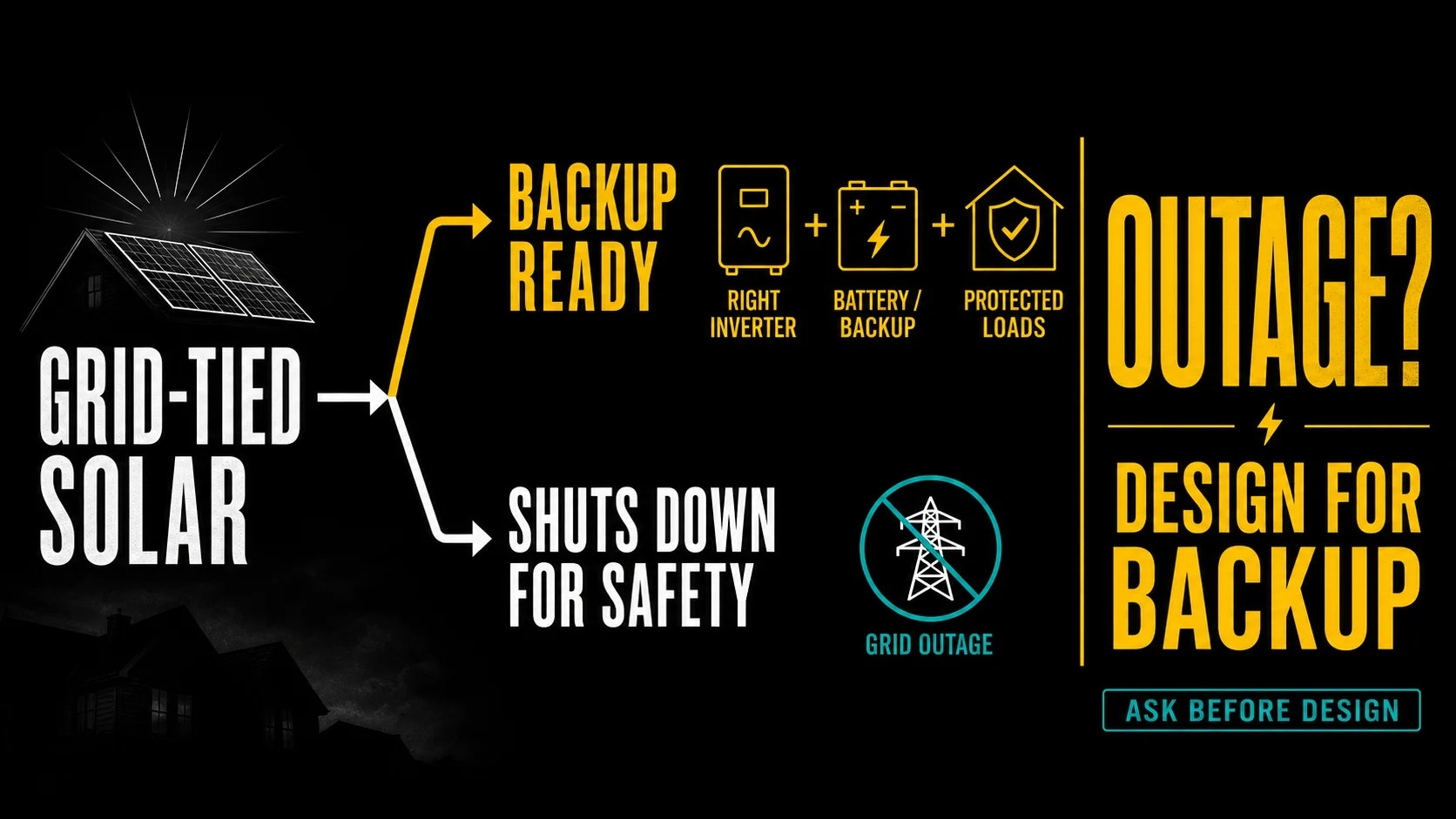
This is where many homeowners get stuck. They assume solar panels automatically keep the house running during an outage. A standard grid-tied solar system usually shuts down during an outage for safety unless it has the right inverter, transfer equipment, and battery or backup configuration. If outage protection is part of your goal, say that before the installer designs the system.
For BC Hydro customers, battery storage may qualify for a rebate, but the program rules changed in 2026. For FortisBC customers, the battery decision usually needs to stand on backup value, self-consumption, and personal comfort, instead of simple payback alone.
Roof, Snow, Shade And Winter Checks
Kelowna is a good solar market, but the roof still decides whether your property is a good project. Ask for a site assessment that checks roof age, roof material, roof plane direction, shading, snow movement, electrical panel capacity, and where the inverter and disconnects will go.
Tip for roof condition: if your asphalt shingles have less than about 10 years of useful life left, price the roof work before solar. Removing and reinstalling panels later can be expensive, and it can weaken the payback you expected.
Winter production is not zero, but it is lower. Cold panels can work efficiently, yet short days and snow cover reduce output. A good design should show monthly production, rather than just annual production, so you can see how much summer surplus is expected to support winter usage.
How To Choose A Solar Installer In Kelowna
The best solar installation is not always the cheapest quote. It is the quote that gives you a reliable system, clear assumptions, strong workmanship, and support if something fails five years from now.
- Ask for references from recent Okanagan installations.
- Confirm whether the installer handles FortisBC or BC Hydro applications, permits, inspections, and commissioning.
- Ask which panels and inverter are included, and why those products fit your roof.
- Check workmanship warranty length and what happens if the company changes ownership.
- Request a monthly production estimate and a payback calculation using conservative assumptions.
- Watch for vague promises, pressure tactics, missing utility details, or savings claims that ignore your actual bill.
A fair concern with any solar company is long-term service. Panels can last 25+ years, but inverters, monitoring equipment, roof penetrations, and warranty claims still need someone accountable. Get the service process in writing before you sign.
Commercial Solar In Kelowna
Commercial solar in Kelowna can be attractive for farms, warehouses, churches, shops, and buildings with daytime loads. The best candidates have large usable roof space, predictable electricity use, and ownership that can use tax and depreciation advice properly.
For FortisBC customers, watch the 50 kW net metering cap. For BC Hydro customers, review the self-generation rules carefully, especially if the system may export significant power. Commercial projects need sharper modelling than residential projects because demand patterns, rate classes, tax treatment, and operating hours can change the economics.
Final Verdict For Kelowna Homeowners
Solar panels in Kelowna are still worth a serious look in 2026, especially if you have a sunny roof, steady electricity use, and a utility program that supports a sensible payback. The strongest projects are not oversized. They are sized to your annual use, designed around your roof, and priced with current rebate and utility rules.
Start with your bill, then compare quotes. If you are with BC Hydro, verify rebate eligibility and the July 1, 2026 self-generation rate. If you are with FortisBC, build the math around FortisBC net metering and your own consumption. That one step can save you from a bad solar decision.
If you want help checking your options, SolarEnergies.ca can help you compare quotes from certified installers and see whether solar panels make sense for your Kelowna property before you commit to anything.
Frequently Asked Questions
How much do solar panels cost in Kelowna?
A practical planning range is about $2.50 to $3.50 per watt installed. That puts a 5 kW system around $12,500 to $17,500, an 8 kW system around $20,000 to $28,000, and a 12 kW system around $30,000 to $42,000 before incentives. Your final price depends on roof complexity, equipment, electrical work, battery storage, and installer scope.
What is the BC Hydro rebate for solar panels?
BC Hydro says qualifying residential customers can receive up to $5,000 for eligible grid-connected solar panels, calculated at $1,000 per kW of installed generator capacity and capped at 50% of installed product cost. Battery storage may add up to $5,000 more, depending on the battery and program rules. Check the current BC Hydro rebate page before signing because contractor and battery rules changed in 2026.
Does FortisBC offer the same solar rebate as BC Hydro?
No. If your property is served by FortisBC, do not assume BC Hydro’s solar rebate applies. FortisBC customers should focus on FortisBC net metering, annual system sizing, installed cost, financing, and any tax treatment or other programs that apply to their project.
Do solar panels work in Kelowna winter?
Yes, but winter output is lower because days are shorter and snow can cover panels. Cold weather itself is not the problem. Shade, snow cover, roof angle, and short daylight hours are the bigger factors. Ask for a monthly production estimate so you can see the seasonal pattern.
Do I need a battery with solar panels in Kelowna?
Not necessarily. Many grid-tied homes use solar without a battery and rely on utility credits to improve the economics. A battery makes more sense if you want backup power, want to use more of your own solar energy at home, or qualify for a battery rebate that changes the numbers.
Can solar panels power my home during an outage?
Only if the system is designed for backup power. A standard grid-tied system usually shuts down during an outage for safety. If outage protection matters, ask for a design that includes the right inverter, battery, transfer equipment, and protected-load panel.
How many quotes should I get before installing solar?
Get at least three detailed quotes if you can. Compare system size, annual kWh estimate, cost per watt, panel and inverter brands, warranties, roof work, financing terms, and who handles permits and utility applications. The cheapest quote is not always the best value.
Is there a 30% tax credit for solar panels in Canada?
Canadian homeowners should not plan around a U.S.-style 30% residential solar tax credit. Incentives in Kelowna depend on Canadian federal programs, BC utility programs, utility service territory, and the specific project. Ask your installer and tax professional to separate rebates, loans, tax treatment, and financing so the quote does not blur them together.