CBTSSe & III-V Panels: The Future of Solar, or Just Lab Talk?
April 11, 2025
Is Solar Energy Worth It in Nova Scotia in 2025?
April 13, 2025Last Updated on June 30, 2026 by Vitaliy
If you own a home and want solar panels in Nova Scotia, 2026 presents a completely different financial reality for solar power. The province has a rapidly growing distributed solar market driven by some of the highest electricity rates in the country. Solar remains a practical way to cut your utility bills, but the numbers need to be checked against current rates, roof conditions, financing terms, and local installer quotes before you sign.
10 Key Takeaways for Solar Panels Nova Scotia 2026
- Big freebies are gone. Nova Scotia’s SolarHomes rebate and the federal Greener Homes grants permanently closed to new applicants in 2025. You now pay market rates.
- Power rates keep climbing. As of May 1, 2026, Nova Scotia Power charges 19.128¢/kWh plus a $20.08 monthly base charge. Generating your own electricity helps reduce how much of your bill is exposed to future rate increases.
- Use $23,000 to $29,000 as a planning estimate. A standard 9.17 kW system may land in that range before financing, but treat it as a quote-checking range until a Nova Scotia installer prices your roof, electrical work, equipment, and permitting.
- Zero-down financing requires careful math. Installers offer 0% promotional loans, but they often hide heavy merchant fees in the principal. Always compare the direct cash price against the total financed amount.
- Battery incentives replaced panel rebates. The Home Battery Storage Rebate can help with eligible storage costs, and Eco Shift incentives may include enrollment and participation payments. Verify the current device-specific terms before buying a battery.
- Cold weather can help panel efficiency. Solar panels in Nova Scotia often operate efficiently in winter because cold temperatures improve electronics performance. Snow can temporarily reduce output, but angled panels often shed it once sun and warmer conditions return.
- Standard systems fail during blackouts. If the grid drops, your panels shut off instantly for safety. You must install a battery to keep your fridge and internet running during an outage.
- Net metering remains fully active. The utility credits your account for any excess power you send back to the grid, applying it to your future bills.
- Production numbers are highly reliable. Depending on your roof layout, expect your system to generate between 1,000 and 1,100 kWh per installed kW every single year.
- You reduce reliance on a coal-heavy grid. Coal still generated 47.3% of the province’s electricity in 2023. Making your own power directly cuts how much fossil-fuel-generated electricity you buy from the grid.
Nova Scotia has a solid solar resource. Depending on your roof angle, shading, and site conditions, many homes produce roughly 1,000 to 1,100 kWh per installed kW every single year.
Solar Panels Nova Scotia Cost:
For planning, a standard 9.17 kW solar system may land around $23,000 to $29,000 before financing, but do not treat that as a guaranteed Nova Scotia quote. Canada PV market reports show installed pricing varies widely, and your final number depends on roof complexity, equipment, electrical work, permits, batteries, and installer margin. Savings: Homeowners often reduce their energy bills by a conservative $1,300 annually. With current utility prices, your specific offsets could be higher or lower.
Check Your Solar Financing Options
Use our calculator to estimate system size, monthly savings, and whether your home may qualify for zero-down financing. Some qualified homeowners can access promotional 0% financing through private lending partners, but offers vary by credit profile, income, debt, and lender rules. Credit approval is required. Some financing programs may accept applicants with credit scores starting in the low 600s, but approval depends on the lender and the rest of your file.
Use the SolarEnergies.ca calculator to see your solar numbers before you collect quotes. Qualified homeowners may be able to access 0% financing with $0 down, depending on credit approval, lender rules, and program terms. Ask for both the cash price and the financed price so the comparison is clear.
One useful detail to note: promotional 0% financing is real, but financing platforms usually build costs into the deal on the merchant side. Compare the cash price versus the financed price, not just the monthly payment.
How to Use Our Free Nova Scotia Solar Calculator
Solar Panels Nova Scotia CalculatorEstimate system size
Start with your last 12 months of power bills. The calculator uses your exact annual consumption to estimate a system size that actually matches your usage, rather than throwing out a random baseline number.
Estimate annual production
Next, input the site assumptions that dictate performance in Nova Scotia: roof angle, shading, and location. We use a grounded planning range of 1,000 to 1,100 kWh per installed kW each year to give you realistic production expectations.
Estimate bill savings
The calculator then compares your likely production output against current power costs. As of May 1, 2026, Nova Scotia Power’s residential rate is 19.128¢/kWh plus a $20.08 monthly base charge, so even conservative savings estimates deserve serious attention.
Check financing possibilities
This is where the tool provides serious value. It helps you see whether cash, municipal financing, or private lending makes the most mathematical sense. It also flags whether zero-down structures are worth exploring, without pretending approval is guaranteed.
Compare cash and financed options
The best feature places the raw numbers side by side. It shows the cash price, the financed price, the estimated monthly payment, and the long-term savings altogether. You stop staring at a single monthly payment and see the full financial deal clearly.
Solar Panels Nova Scotia: What Changed in 2026?
Closed rebates and what replaced them
The major rooftop-solar rebates are now closed, but some battery incentives and financing options are still available. Efficiency Nova Scotia closed the SolarHomes rebate to new homeowner applications on April 17, 2025. Natural Resources Canada also shut down the Federal Greener Homes Grant, and the Greener Homes Loan stopped accepting new applicants on October 1, 2025. You now pay market rates for the panels themselves. You can still finance these projects, and solar panels easily last over 25 years with minimal maintenance.
Rising electricity rates and why solar still matters
As of May 1, 2026, Nova Scotia Power residential rates changed to 19.128¢/kWh, plus a $20.08 monthly base charge. Generating your own power directly cuts your reliance on those expensive utility rates, saving many homeowners a conservative $1,300 annually depending on system size, usage, and roof conditions. In 2023, coal still provided 47.3% of Nova Scotia’s electricity generation. Solar panels reduce your carbon footprint by replacing some of that grid electricity with clean energy produced on your own roof.
What Solar Incentives Are Still Active in Nova Scotia?
Closed: SolarHomes
The old SolarHomes rebate is permanently closed to new homeowner applications. Efficiency Nova Scotia stopped accepting new homeowner submissions on April 17, 2025. Many older articles still talk about this rebate as if it operates today. It does not exist for new residential applicants.
Closed: Greener Homes Grant and Loan
The federal side changed completely as well. The Canada Greener Homes Grant is closed, and the Canada Greener Homes Loan is also closed to new applicants. Natural Resources Canada says October 1, 2025, was the absolute last day to apply for the loan. Do not build your 2026 budget around old federal money that you cannot access.
Still active: battery rebate and Eco Shift
This is where homeowners may still extract real value. Efficiency Nova Scotia’s Home Battery Storage Rebate is active. The rebate can cover up to $300 per kWh of battery capacity or 40% of eligible costs, capped at $2,500. Eco Shift incentives may include enrollment and participation payments, but the amounts depend on the enrolled device and current program terms. Verify the latest Eco Shift rules before buying storage.
Still active: net metering
Net metering did not disappear. For most homes, the practical version is Nova Scotia Power’s Self-Generating Option, which covers renewable generators or battery storage devices up to 27 kW AC on the same meter. Larger eligible systems move into Commercial Net Metering: Class 1 covers more than 27 kW up to 100 kW, while Class 2 can apply above 100 kW for eligible customers. Nova Scotia Power also lists caps of 200 kW for many customers and up to 1,000 kW for certain demand-charge, farm, winery, and aquaculture customers.
Still active in some cases: municipal and private financing options
This factor matters because it replaces some of the exact roles those old rebates played. Halifax’s Solar City program remains active, requiring repayment over 10 years at a fixed 4.75% interest rate handled through the property tax system. On the private side, some installers still advertise zero-down or 0% promotional financing for qualified homeowners. The catch is simple: these offers are not universal. Exact terms depend entirely on the lender’s rules and the borrower’s profile.
Use the calculator to see what solar could look like for your home. SolarEnergies.ca can help qualified homeowners compare installer quotes and available financing options, including 0% financing with $0 down where approved. The smart move is to compare cash price, financed price, warranty, equipment, and production estimate side by side.
How Solar Systems Work in Nova Scotia
How panels, inverters, and the grid work together
Solar panels capture sunlight and turn it into electricity for your home, even through cloud cover. You use your own solar power first, and seamlessly pull from the provincial grid if you need extra electricity at night. A certified electrical contractor wires the system directly into your main breaker panel.
What happens during outages
If the utility grid goes down, your standard solar system shuts off immediately for safety reasons. This protects utility workers repairing the lines.
When battery storage makes sense
Battery storage can keep selected loads running during outages, depending on battery size and usage. Efficiency Nova Scotia now offers a Home Battery Storage Rebate up to $2,500. You can also get $500 cash back by enrolling your battery in the Eco Shift program.
Nova Scotia’s Solar Energy Potential
Is solar good in Nova Scotia’s climate?
Nova Scotia has a growing distributed solar market. By the end of 2023, the province reached about 72.5 MW of distributed solar power capacity. The sun’s energy is entirely free. Nova Scotia receives enough sunlight to make solar energy function extremely well across the entire province.
Sunlight, snow, and annual production
Systems in Nova Scotia typically produce between 1,000 and 1,100 kWh per kW annually. For example, Amherst averages around 1,125 kWh per kW annually. Halifax produces roughly 1,073 kWh per kW annually. These regional differences show that solar panels in Nova Scotia work reliably in every specific corner of the province. Snow might reduce your output temporarily, but annual losses are modest. Cold weather actually helps panel efficiency.
Roof angle, shading, and site conditions
South-facing roofs produce the most power, but east or west orientations work perfectly fine with the right inverter design.
Who Is a Good Fit for Solar in Nova Scotia?
Good roof orientation
South-facing roofs usually produce the most electricity, but east- and west-facing roofs perform highly effectively with the right design. Nova Scotia boasts a solid solar resource, and many homes produce 1,000 to 1,100 kWh per installed kW each year, depending on angle, shading, and site conditions. A home does not need a perfect roof to make mathematical sense. It just requires a layout that gives the installation crew a workable surface.
Low shading
Shade can materially reduce production output. Trees, large chimneys, neighbouring rooflines, and complex roof shapes can cut into daily generation. That does not automatically kill a project, but it changes the math. Homes with clean sun access usually get stronger production, simpler system design, and faster financial payback.
Higher daytime or annual usage
Solar makes the most aggressive financial sense when the home consumes heavy amounts of electricity over the year. Households running electric heating, EV chargers, or heavy daytime loads can benefit strongly. With Nova Scotia Power’s residential rate at 19.128¢/kWh plus a $20.08 monthly base charge as of May 1, 2026, offsetting your own usage remains valuable even after the rebate era ended.
Long-term ownership plans
Solar operates as a long-term asset. Homeowners who plan to stay put for years extract the best results. That extended timeframe allows the system to pay back its exact cost and gives the financing structure room to function properly. If someone plans to sell soon, the project still holds value, but they must evaluate the precise payback period, the loan transferability, and how a financed roof affects the property sale.
The Cost of Solar Panels in Nova Scotia
Average price range for solar panels in Nova Scotia
Use the $2.51 to $3.16 per watt figure as a planning range, not a guaranteed local installed price. Because the main provincial and federal rooftop-solar rebates are closed to new applicants, your quote now depends more heavily on roof complexity, equipment choices, electrical work, financing structure, and installer pricing.
What affects your final system cost
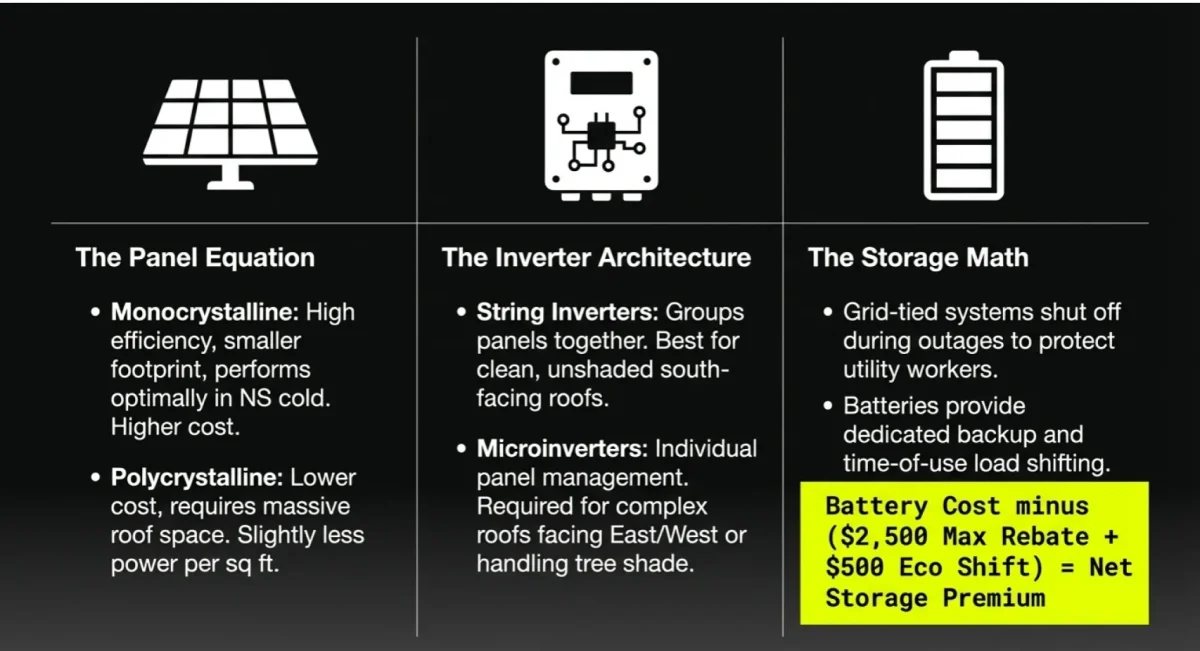
Panel choice: Most modern residential quotes use efficient monocrystalline panels because they produce more power from limited roof space. The specific brand, warranty, degradation rate, and inverter pairing matter more than chasing the cheapest panel type.
What a 9.17 kW system usually looks like
A typical 9.17 kW solar system costs between $23,000 and $29,000. As a planning estimate, it requires roughly 472 square feet of clear roof space. Panel wattage and layout change the exact footprint.
Financing Options for Solar Panels Nova Scotia
Halifax Solar City and property-based financing
If you live in Nova Scotia, you can still manage the upfront costs through organized financing structures. You can utilize municipal financing options like Halifax Solar City’s PACE program to avoid draining your savings account. Halifax Solar City’s PACE Program: You start with zero upfront costs. You repay the loan over 10 years at a fixed 4.75% interest rate directly through your property tax bill.
Zero-down private financing
Private Financing: Some installers advertise 0% financing or zero-upfront-cost options, but that does not mean every homeowner gets the same offer.
Try our calculator today. We will help qualified homeowners explore 0% down, 0% financing with simple approval requirements. In many cases, the total price stays the same as cash, just split into manageable payments. Honest numbers. No hidden catches. That is our promise.
Solar Panels Nova Scotia Calculator CanadaBank loans and HELOC options
You will likely use municipal PACE loans or bank financing to cover the costs. Many property owners utilize Home Equity Lines of Credit or standard bank loans to spread payments over a decade.
How to compare financing offers
Always check the total cost, including fees. The final result remains the same: you lower your carbon footprint and immediately drop your monthly utility bills. The hardware pays for itself over time.
Can You Still Go Solar With Zero Down in Nova Scotia?
What zero-down financing actually means
Yes, zero-down is completely possible in specific cases. It usually means you do not pay the heavy installation cost upfront. The project gets fully financed, and you repay the principal over time through monthly installments. That specific mechanism makes solar possible for many people after the main rebates disappeared. Remember one absolute rule: zero down never means free. It just restructures exactly how you pay the total cost.
When 0% financing may be available
Promotional 0% financing exists with us. Some companies aggressively advertise it for qualified property owners. However, not every homeowner secures the exact same offer, and not every single installer uses the same lending program. Approval relies directly on your credit profile, verifiable income, debt load, and the underwriter’s rules. We state it clearly: 0% and zero-down financing may be available, but strictly for qualified applicants working through certain partners.
Why the monthly payment is not the only number that matters
Buyers often get lazy here and regret the paperwork later. A remarkably low monthly payment looks fantastic on paper, but it indicates a very weak deal if the term runs too long or the financed price is artificially inflated. Financing platforms openly admit that promotional programs, including 0% offers, carry high costs on the merchant side. That is precisely why the financed price differs wildly from the raw cash price.
Cash price vs. financed price
Always demand the cash price and compare it directly against the total financed price. If two different installers quote systems with identical monthly payments, but one carries a higher total project cost, a longer term limit, or weaker warranty protection, those deals are unequal. Smart buyers evaluate the installed base price, the interest rate, the hidden fees, the exact term length, and whether the lender applies a severe penalty if you pay the balance early. Halifax Solar City allows early payoff with zero penalty. That detail alone proves why checking the fine print matters.
How Many Solar Panels Do You Need?
Match system size to annual usage
Switching to solar requires basic math and planning. Here are the exact factors you need to evaluate. Look at your last twelve months of power bills. A 9.17 kW system generally produces roughly 10,000 kWh every year. That specific hardware setup costs roughly $23,000 to $29,000 before financing.
System Size: Does the total kW output actually match your yearly usage?
Roof space and layout
As a planning estimate, a standard 6 to 8 kW setup requires roughly 400 to 600 square feet of clear roof space. A larger 9.17 kW system needs about 472 square feet.
Choosing the right inverter
Equipment Specs: Are they using high-efficiency hardware? You must select the proper inverter for your roof structure. String inverters group panels together, while microinverters handle individual panels to optimize production if your roof faces multiple directions or experiences shading.
Is battery storage worth it?
If you install solar panels in Nova Scotia, Efficiency Nova Scotia now offers a Home Battery Storage Rebate that covers $300 per kWh of capacity or 40% of the cost, capping at $2,500. Eco Shift may also offer enrollment or participation incentives for eligible devices, but you should verify the current device-specific terms before adding a battery to the quote.
When a Battery Makes Sense – And When It Does Not
Backup power needs
A battery makes functional sense for one primary reason: backup power. Grid-tied inverters automatically shut off during utility outages. If you want your refrigerator, specific lights, internet router, sump pump, or sensitive medical gear to remain active during a blackout, battery storage becomes completely relevant to the project.
Time-of-use and load shifting potential
Storage helps owners who demand tight control over when their solar energy gets consumed. This matters significantly if your goal is reducing grid dependence or shifting your heavy usage to cheaper time blocks. It is not exclusively about emergency blackouts. Some households use batteries strictly for daily flexibility and consumption control.
Battery rebate and Eco Shift value
The raw numbers get interesting here. Nova Scotia’s battery rebate can drop your upfront equipment cost by up to $2,500. Eco Shift may add enrollment or participation payments depending on the eligible device and current program rules. Those incentives do not make batteries cheap, but they do validate running the exact math.
When the added cost may not pay off
A battery is not automatically the smartest purchase for every single roof. If your grid connection rarely fails, your budget sits tight, or you only prioritize basic bill reduction, solar without storage usually provides the cleanest financial deal. Batteries add undeniable resilience, but they also add high cost. Demand quotes showing both options: solar only, and solar with integrated storage.
How to Choose a Solar Installer in Nova Scotia
What to look for in a solar company
Picking a careful solar installer improves your odds of getting a high-performing system and avoiding repair problems later. You have options. Here is how to find a trustworthy professional.
Customer Reviews
Check past references. A proven track record of happy local homeowners tells you exactly how the company operates.
Warranties, licensing, and experience
Certifications and Credentials: Look for installers listed by the Canadian Renewable Energy Association (CanREA). CanREA now runs the solar guide and installer directory, and its listed members sign a code of conduct.
Warranties: Look for clear equipment warranties, usually around 25 years for panels, plus a written workmanship warranty that explains roof penetrations, labour, service response, and what happens if the installer stops operating.
Local Expertise: Hire people completely familiar with Nova Scotia’s specific climate and building codes. They understand how to properly angle the hardware for our winters.
Where to verify installers
We evaluated these specific providers based on a clear methodology: verified customer reviews, strong warranties, years in business, local experience, financing options, and service area. Polaron: Highly rated for clean installations and responsive service. Nova Solar Capital: Offers fair pricing and helps coordinate your financing options. Solar Ascent: Focuses entirely on customized solutions based on your specific daily energy consumption.
Do not pick the absolute cheapest quote. Cheap labor usually creates expensive roof leaks later. Talk to different licensed companies. Check their CanREA standing and refuse any bid that looks suspiciously cheap.
Solar Panel Installation in Halifax, Dartmouth, Bedford, and Across Nova Scotia
If you are comparing solar panel installation in Halifax, Dartmouth, Bedford, Sackville, Truro, Sydney, or elsewhere in Nova Scotia, the best quote is the one that proves the math for your specific roof and power bill. A local installer should map shade, check roof age, confirm the right system size, and show how the design works with Nova Scotia Power’s Self-Generating Option before you commit.
Compare at least three quotes side by side. Look at the installed cash price, financed price, panel and inverter models, workmanship warranty, production estimate, monitoring setup, permit handling, and whether battery storage is optional or being pushed too hard. Two quotes can show the same monthly payment while hiding very different equipment, terms, or long-term value.
SolarEnergies.ca can help Nova Scotia homeowners compare options through a certified installer network with 14,000+ installs across Canada. Use the calculator first, then use the quote process to test the numbers instead of relying on a single sales proposal.
Questions to Ask Before You Sign a Solar Contract
What is the cash price?
Demand the full installed cash price in hard writing. That single number keeps everyone honest. It gives you an absolute baseline before financing variables muddy the total calculation.
What is the financed price?
Next, ask for the total financed cost. Do not settle for just the monthly payment figure. If the project advertises zero-down or 0%, determine whether the financed base price differs from the cash price. Promotional financing carries merchant fees that are entirely invisible if you only evaluate the monthly breakdown.
What happens if I move?
Contract details dictate what happens when you sell the property. Can you pay the balance off early? Does the exact financing transfer to the new homeowner easily? Does the lender place a rigid lien against your property? Halifax Solar City lets property owners clear the balance early with zero penalty. That specific detail warrants checking on every single contract.
What is covered under workmanship and equipment warranties?
Ask for the panel warranty, the inverter warranty, and the workmanship warranty separately. They are entirely different documents. A 25-year panel warranty sounds fantastic during a sales pitch, but it does not replace a weak workmanship guarantee if the roof wiring fails or water breaches your shingles.
Who handles utility approvals?
A competent installer explains exactly who handles the utility paperwork, the required electrical permits, the municipal inspections, and the final grid connection steps. In Nova Scotia, your system size dictates which connection rules apply, especially as your generation capacity approaches the 27 kW limit.
The Solar Installation Process in Nova Scotia
Site assessment and quote
Putting solar on your roof follows a very straightforward process. Gather at least three separate quotes from certified installers before you sign anything. Check each proposal against this exact list:
Total Costs: Does the proposal show the installed price per watt, total cash price, financed price, battery cost if included, and any assumptions behind the estimate?
Estimated Energy Production: Ask them to prove their output calculations based on your specific roof.
Warranties: Are you covered if an inverter fails in year five?
Site Assessment: A technician measures your roof, checks the structural integrity, and maps the shading.
Permits and approvals
Custom Design and Permits: They engineer the system and pull the required municipal electrical permits.
Installation day
Installation: The actual roof work takes 1 to 3 days in Nova Scotia.
Avoid Common Pitfalls: Never hire unlicensed roofers to do high-voltage electrical work. Verify your shingles are in great condition before installing 25-year hardware over them.
Inspection, utility approval, and monitoring
Inspection and Activation: The utility company inspects the wiring. Once approved, you turn the system on. Solar panels require almost zero regular maintenance. You spend roughly $25 per kW annually for an occasional professional inspection.
Net Metering in Nova Scotia
How credits work
When your panels generate electricity that you do not instantly use, the excess feeds into the provincial grid. Nova Scotia Power credits your account for this outflow, which directly lowers your subsequent billing cycles.
27 kW, Class 1, and Class 2 explained
Nova Scotia Power uses the Self-Generating Option for renewable generators or battery storage devices up to 27 kW AC on the same meter. Eligible systems above 27 kW move into Commercial Net Metering. Class 1 covers more than 27 kW up to 100 kW. Class 2 can apply above 100 kW for eligible customers, with Nova Scotia Power listing a 200 kW cap for many customers and up to 1,000 kW, or 1 MW, for certain demand-charge, farm, winery, and aquaculture customers.
What homeowners should check before signing
The province has serious targets for renewable energy. Also, check if they have experience with the provincial Community Solar initiatives. Nova Scotia launched Canada’s first subscription-based community solar garden in Cape Breton in October 2024. The province’s climate plan aims for at least 500 MW of new local renewable energy by 2026, plus an additional 50 MW specifically for community solar projects.
Common Myths About Solar Panels in Nova Scotia
Solar does not work in winter
Solar panels in Nova Scotia generate power through the coldest months. Heavy snow can temporarily cover the glass and lower output, but annual losses are usually manageable when the system is designed well. Excessive summer heat slightly degrades performance, so cooler weather can help the hardware run efficiently. Installers also consider tilt, roof pitch, wind exposure, and snow behaviour when they design the system.
Solar means full blackout backup
A normal grid-tied solar system shuts off during outages. Battery storage can keep selected loads running during outages, depending on battery size and usage.
Solar stopped making sense after rebates ended
Switching to solar power in Nova Scotia remains a highly practical decision packed with long-term financial and environmental perks. Solar can make a home more appealing to buyers who want lower and more predictable energy costs. By installing panels now, you lock in your personal energy costs while the rest of the grid transitions. The core financial benefits of solar remain highly compelling.
Lower Bills: Offset electricity that now costs 19.128¢/kWh for standard residential service and reduce your costs by a conservative $1,300 annually, depending on system size and usage. Environmental Impact: Reduce how much power you buy from a grid where 47.3% of electricity still came from coal in 2023. With a growing distributed solar market and clear financing options available, 2026 is still a strong year to check your numbers and upgrade your home.
Relevant City Guides:
Solar Panels Yarmouth Cost Guide: Is It Worth It?
Solar Panels Sydney NS/Cape Breton Cost Guide 2026: Is It Worth It?
Solar Panels Halifax Cost Guide: Is It Worth It?
Solar Panels Dartmouth: Prices, Rebates, and Best Companies
Solar Panels Kentville Cost Guide: Is It Worth It?
Solar Panels Lunenburg Cost Guide: Is It Worth It?
Solar Panels Truro Cost Guide: Is It Worth It?
Solar Panels Bridgewater Cost Guide: Is It Worth It?
FAQs
How can Nova Scotian homeowners benefit from solar energy in 2026?
You cut your heavy monthly power bills and immediately reduce your reliance on a coal-heavy utility grid. Solar panels in Nova Scotia generate clean electricity right on your roof, locking in your energy costs for the next two decades.
What financing options are available for solar installation in Nova Scotia?
Since the major rooftop-solar rebates are closed, you rely on programs like Halifax’s Property Assessed Clean Energy (PACE). This allows you to pay off the system over 10 years at a fixed 4.75% interest rate. Private solar installers also coordinate standard bank loans.
How efficient are solar panels in Nova Scotia in our climate?
They run highly efficiently. Nova Scotia gets solid annual sunlight, allowing systems to produce 1,000 to 1,100 kWh per kW. Cold weather actually helps the hardware run better than it does in extreme summer heat.
Can solar energy systems be integrated with existing home energy setups?
Yes. A certified electrical contractor wires the system directly into your main breaker panel. You use your own solar power first, and seamlessly pull from the provincial grid if you need extra electricity at night.
What maintenance is required for solar panels in Nova Scotia?
Almost none. You spend about $25 per kW each year for a basic professional inspection. Normal rainfall washes most of the dust and dirt off the glass automatically.
How does switching to solar impact a Nova Scotia family’s carbon footprint?
It can reduce it significantly. Because coal still generates a large share of electricity in this province, making your own clean power reduces how much fossil-fuel-generated electricity you buy from the grid.