

Canadian Solar’s Big US Manufacturing Move: Will It Make Your Next Battery Cheaper?
December 2, 2025
North B.C. Solar Proves Solar Durability: What Remote Power Can Teach Canadian Homeowners
December 4, 2025
If you live in Alberta, you have likely stared at your electricity bill recently and wondered why the transmission fees cost more than the actual energy you used. If you are in British Columbia, you might be looking at the low water levels in local reservoirs with a quiet sense of dread, knowing that roughly 98% of BC Hydro’s electricity comes from renewable sources—mostly large hydro dams that rely entirely on rain and snowpack.
We are seeing a massive shift in how Western Canada manages power. But the headlines are messy, and the details matter.
The federal government and the province of Alberta recently signed a Memorandum of Understanding (MOU). This isn’t just a handshake; it commits them to pursue new large transmission interties with British Columbia and Saskatchewan. Some analysts describe it as a “nation-building electricity superlink across the West.” I will call it the Western Super-Grid in this article.
Key Takeaways
- The Signatories: The Federal Government and Alberta signed the MOU. BC is the intended partner for the grid connection.
- The Matchup: Alberta has excess wind/solar; BC has water storage. Connecting them solves problems for both.
- The Timeline: This is a long play. Think early 2030s, not 2025.
- The Money: It stabilizes electricity prices, preventing them from crashing to zero (good for solar owners) and reducing the need for expensive US imports (good for BC ratepayers).
- The Risk: Who pays for the construction? Without federal backing via the Infrastructure Bank, wires charges could rise in the short term.
I tend to be skeptical of big government announcements until I see the copper wire going into the ground. My goal here is to strip away the political framing and look at the engineering and financial reality.
Is this just another press release destined for a filing cabinet, or will it actually improve the payback period for your solar investment? Let’s look at the data.
The Problem: Why We Have Volatility and Waste
To understand why this grid expansion matters, you first need to understand why the current system is hurting your wallet.
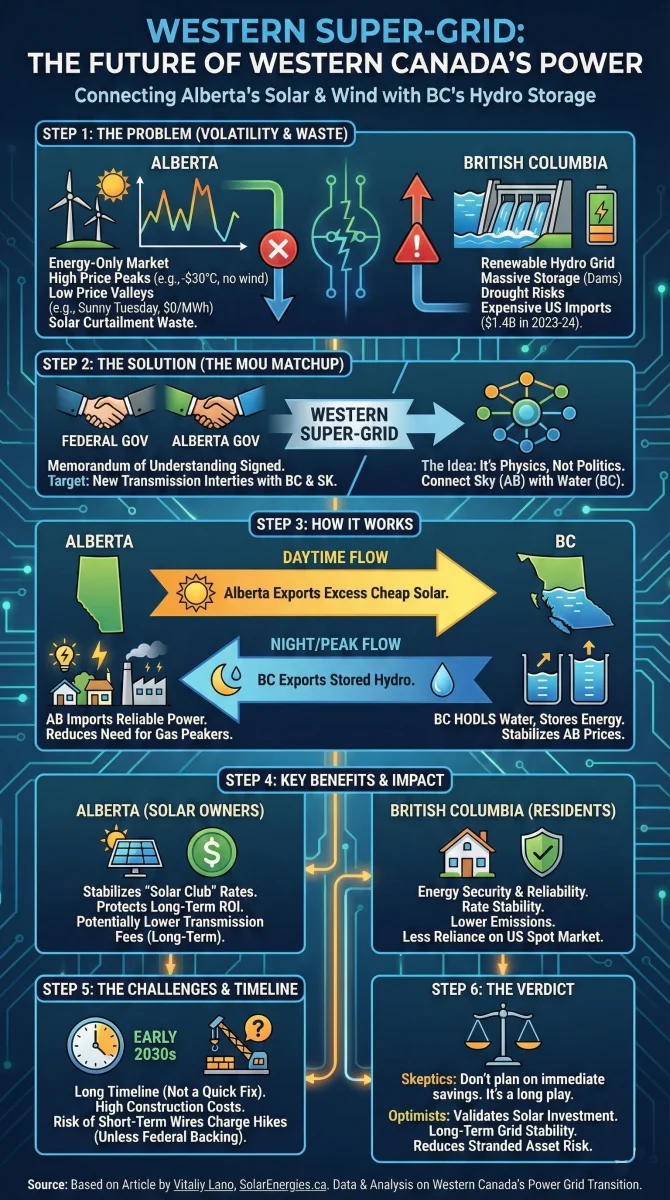
Alberta is an energy-only market, one of only two in North America (the other is Texas). Prices are set in a real-time spot market, with an hourly pool price that swings wildly based on supply and demand. When the wind stops blowing and the sun sets during a -30°C cold snap, supply drops, and prices hit the ceiling. During extreme events, prices can spike to the current price cap of about $1,000/MWh.
Conversely, during a sunny Tuesday in July, we have the opposite problem. Alberta has seen an explosion in solar capacity. We now generate so much solar power during peak daylight hours that we often have more electricity than the grid can handle.
The Hidden Cost of “Curtailment”
In periods of oversupply, the pool price can drop all the way to $0/MWh for some hours, especially on sunny, low-demand days. When there is physically nowhere for the power to go, the grid operator (AESO) has to curtail generation—telling producers to shut off.
Most of this curtailment risk hits large utility-scale projects first. But if we do not improve export and storage, high solar penetration will eventually spill over into lower pool prices for everyone, including rooftop owners. Think about the waste here. It’s like growing a garden full of vegetables but throwing half of them in the compost because you can’t eat them fast enough. The sun is shining, the energy is free, but because we cannot store it or move it, we simply throw it away.
The BC Drought Dilemma
British Columbia has the opposite problem. Their grid is a massive battery in the form of hydroelectric dams. They can store energy for months behind concrete walls. But that system relies on weather.
In 2023–24, drought forced BC Hydro to import about 13,600 GWh of electricity at a cost of roughly $1.4 billion—among the highest import years on record. They were buying power from the US spot market, often at a premium, because they physically did not have enough water to run the turbines at full capacity safely. Even some BC Hydro plans show they are off track without significant changes.
This is where the “Super-Grid” logic comes in. It is not about politics; it is about physics. Alberta has the sky (wind and sun). BC has the water (storage).
If you connect them with a big enough wire, Alberta sends cheap solar to BC during the day. BC shuts off the dams and holds that water back. When the sun sets in Alberta, BC opens the gates and sends that stored hydro power back east.
Analyzing the MOU: Who Signed What?
The article from The Hub outlines the agreement. It is important to correct the record on who actually signed this.
The MOU is between the Government of Canada (represented by Mark Carney) and the Government of Alberta (Premier Danielle Smith). British Columbia is not a signatory yet, but the document specifically targets new transmission interties between Alberta, BC, and Saskatchewan.
Commentary on the MOU from legal experts and analysts highlights three things that matter for a Western grid:
- Better Data Sharing: Provinces stopping the guessing game about what the neighbor needs.
- Corridor Planning: Identifying specific 500 kV corridors through the Rockies. You cannot just run high-voltage lines anywhere; you need specific geographic paths.
- Indigenous Equity: Structuring projects so Indigenous communities can participate as equity partners, which is essential for getting anything built in Western Canada.
The Critique: The Timeline is Longer Than You Think
I need to be realistic with you. This is an agreement to start studying. We aren’t digging holes yet. Building high-voltage transmission lines through the Rocky Mountains isn’t just expensive; it is an engineering nightmare involving complex terrain and strict environmental reviews.
Comparable 500 kV projects in Western Canada (like the Fort McMurray West line) have landed in the low-to-multi-billion-dollar range and taken close to a decade from approvals to operation. This isn’t a 2-year fix; you are looking at the early-2030s at best.
So, while this is good news for the long-term grid, it is not going to lower your bill next month.
Impact on Alberta Solar Owners
If you own a home or business in Alberta with solar panels, or if you are considering an installation, this project changes the long-term risk profile of your investment.
1. Stabilizing the “Solar Club” Rates
Right now, Alberta solar owners enjoy fantastic rates. Some Solar Club-style plans in Alberta pay around 30 cents/kWh for summer exports. These retailers can offer these rates because they hedge their bets on the market pool price. As the demand for renewable energy increases, many are looking into options like calgary solar panels roi to maximize their investment.
However, if solar generation keeps growing and we cannot export it, the daytime pool price will crash to zero more frequently. If the pool price is worthless, retailers will eventually stop offering high export rates. They cannot pay you 30 cents for something they can only sell for 0 cents.
A strong connection to BC puts a “floor” under that price. If we can export 1000 MW of solar to Vancouver during the day, the Alberta pool price stays healthy. That means your high-export solar rebate stays safe for years to come.
2. The Transmission Fee Argument
Look at the “Transmission and Distribution” line on your bill. For many Alberta households, wires charges (transmission + distribution) add up to roughly 40–60% of the bill. A major driver of these costs is the need to maintain “peaker plants.”
These are natural gas plants that sit idle for much of the year. We pay to keep them staffed and maintained just for the few hours when demand spikes. They are an expensive insurance policy.
If BC Hydro acts as our battery, we do not need as many expensive peaker plants sitting around doing nothing. We import power on demand. In theory, this lowers the fixed costs of the grid, which should lower your transmission riders over time.
Tip for Alberta Homeowners: Do not wait for the intertie to be built. The current market volatility is actually profitable for you if you manage it right. Join a High-Export rate plan in March. Switch to a low fixed rate in October. You are effectively acting as a mini-utility, selling high and buying low.
Impact on BC Residents
For residents in British Columbia, the benefits are less about making money and more about energy security and rate stability.
BC Hydro regularly shows up in utility comparisons as having some of the lowest residential and commercial electricity rates in North America. But that stability is threatened by climate variability. If a multi-year drought hits, BC has to buy power. Without a good connection to Alberta, BC is forced to buy from the US Pacific Northwest markets.
The Price Difference: Alberta’s average wholesale pool price in mid-2025 was in the tens of dollars per MWh (around $30/MWh), while during extreme events the U.S. Northwest has seen spot prices spike above $100/MWh.
There is a clear arbitrage opportunity here. Importing cheap Alberta solar during the day allows BC to save its precious water. It is significantly cheaper than competing for expensive power in Washington State during a heatwave.
Authority Insight: The Canadian Climate Institute’s modeling shows that stronger interprovincial transmission is one of the lowest-cost ways to cut electricity emissions, improve reliability, and can even lower rates compared to each province trying to go it alone.
The Federal Strategy: Why Now?
We have to look at the political chessboard. Why are Alberta and Ottawa—who usually fight—signing this now?
Ottawa has now finalized the Clean Electricity Regulations. They aim to push fossil-fuel generation way down by 2035 and reach a net-zero electricity system by 2050. Alberta has pushed back hard, stating that relying only on intermittent renewables with current battery technology is unreliable.
By partnering with the federal government to connect to BC’s 98% renewable grid, Alberta creates a strategic pathway. It allows Alberta to decarbonize by using BC’s hydro to backstop its own wind and gas generation. It is a pragmatic move to keep the lights on while moving toward federal goals.
Practical Pain Points: Who Pays for the Wires?
Here is the friction point that nobody likes to discuss. Infrastructure costs money. Who pays for a multi-billion dollar transmission line?
In the utility world, these costs are recovered through the rate base—that means you. There is a risk that before we see the savings from efficient energy trading, we will see a hike in transmission fees to pay for the construction loan.
Vitaliy’s View: The only way to avoid this hitting your bill directly is if the federal government steps in. The Canada Infrastructure Bank has publicly signaled interest in financing these types of interprovincial clean power projects. If they provide low-interest loans or grants, it cushions the blow for the ratepayer. If they don’t, expect your transmission fees to climb before they drop.
Strategic Comparison: Isolated vs. Integrated
Let’s break down the difference between the current state and the proposed future state.
Scenario A: Isolated Alberta Grid (Current)
- Solar Value: High risk. As more people install panels, the value of daytime electricity drops. Curtailment increases.
- Reliability: Fragile. We rely on gas plants starting up instantly when the wind dies. If a plant freezes, we get grid alerts.
- Cost: Volatile. Prices swing from near $0 to $999.99. High fixed costs for standby plants.
Scenario B: Integrated Western Grid (The Goal)
- Solar Value: Stable. Excess power is sold to BC. The “floor” price is maintained, protecting solar ROI.
- Reliability: High. BC Hydro acts as a massive backup generator that can turn on in seconds.
- Cost: Smoother. We stop wasting cheap renewables and stop paying for as much idle gas capacity.
Vitaliy’s Verdict: What Should You Do?
I look at solar quotes and energy contracts every single day. I see the confusion these headlines cause. Here is my honest assessment.
For the Skeptics: You are right to doubt the timeline. We have been talking about a stronger intertie for 40 years. Do not build your financial plans around this happening soon. It is a slow, bureaucratic process involving environmental permits and federal negotiations.
For the Optimists: This is the validation you needed. The fact that the federal government and Alberta signed this proves that the economics are undeniable. Solar is not a fringe technology anymore; it is a major part of the Western Canadian generation mix.
If you are a business owner with a large roof, this reduces the risk of your asset becoming “stranded” or curtailed in the 2030s. It makes a 25-year solar farm on your land investment safer.
FAQ: The Western Super-Grid
Q: Will this mean Alberta stops using Natural Gas? A: No. Natural gas will remain a base load and peaker source for a long time. This interconnection just reduces the waste of renewables and provides a cleaner backup than firing up a gas turbine for 30 minutes.
Q: Does this help with grid alerts like January 2024? A: Yes, but it is not a magic wand. During the January 2024 grid alert, imports were already constrained because BC and the U.S. Northwest were in the same deep freeze. A stronger Western grid can’t fix every event, but more transfer capacity gives operators more tools to keep the lights on in future events like this.
Q: Can I sell my solar power directly to BC residents? A: No. You sell to the Alberta pool (or your retailer). The grid operator (AESO) handles the transfer to BC. You benefit indirectly through a more stable pool price.
Q: Why hasn’t this been done before? A: Politics and Protectionism. For decades, BC wanted to protect its domestic supply, and Alberta feared that connecting to a regulated market would break its deregulated model. The combined pressure of federal carbon regulations and recent severe droughts finally forced everyone to the table.
The Western Super-Grid is a massive infrastructure project. It comes with high costs and engineering headaches. But for the homeowner with solar panels on their roof, it represents long-term security. It means the energy you generate will always have a buyer, whether that is your neighbor in Calgary or a hydro pump in Revelstoke.
Vitaliy Lano is the owner of SolarEnergies.ca. He provides data-driven reviews of solar installers and helps Canadian homeowners understand the real economics of renewable energy.