
Solar in B.C.: What Keremeos Teaches Homeowners About Solar Payback
June 9, 2026
Nova Scotia Fire Hall Solar Project: Why Solar Is Becoming a Budget Tool, Not a Luxury
June 12, 2026Last Updated on June 10, 2026 by Vitaliy
Off-grid solar in BC can work, but the first question is not “How many panels do I need?” The first question is: are you truly off-grid, or are you connected to BC Hydro, a BC Hydro remote microgrid, FortisBC, or New Westminster’s electric utility? That one detail changes your rebate options, permit path, battery plan, and payback math.
Get it wrong and you can buy equipment that does not qualify, miss a rebate, create an interconnection problem, or end up with a battery system that is more expensive than expected. Start with eligibility before equipment.
Key Takeaways
- True off-grid solar in BC is different from grid-tied solar with battery backup.
- BC Hydro’s regular residential solar rebate is for eligible grid-connected BC Hydro customers, not fully disconnected cabins.
- BC Hydro lists up to $5,000 for eligible solar panels and up to $5,000 for eligible battery storage, but the rules are strict.
- BC Hydro remote microgrid communities have a separate rebate path, with larger rebates while current funding levels last.
- FortisBC customers can use FortisBC net metering if they qualify, but they are not eligible for BC Hydro’s regular residential solar rebate.
- DIY can make sense for small portable systems, but it is a poor fit for rebate projects, grid interconnection, permanent wiring, and battery storage.
If you want a quick first check, use the SolarEnergies.ca online solar calculator to see whether solar makes sense for your property before collecting quotes. A calculator can help with rough solar value, but it cannot confirm rebate eligibility, permit requirements, or utility interconnection approval.
Off-Grid Solar BC: First, Define Your Property
People use “off-grid” in a few different ways. For solar rebates and permits, those differences matter.
| Property situation | What it usually means | Rebate path |
|---|---|---|
| True off-grid cabin or home | No utility connection | Do not assume regular BC Hydro rebates apply |
| BC Hydro grid-connected home | Connected to BC Hydro’s main system | Regular BC Hydro solar and battery rebates may apply |
| BC Hydro remote microgrid home | Connected to a BC Hydro microgrid in a remote community | Separate remote microgrid rebate may apply |
| FortisBC electric customer | Connected to FortisBC electricity service | FortisBC net metering may apply; BC Hydro rebate does not |
| New Westminster customer | Connected to New Westminster Electric Utility | City-specific solar and battery rebate path may apply |
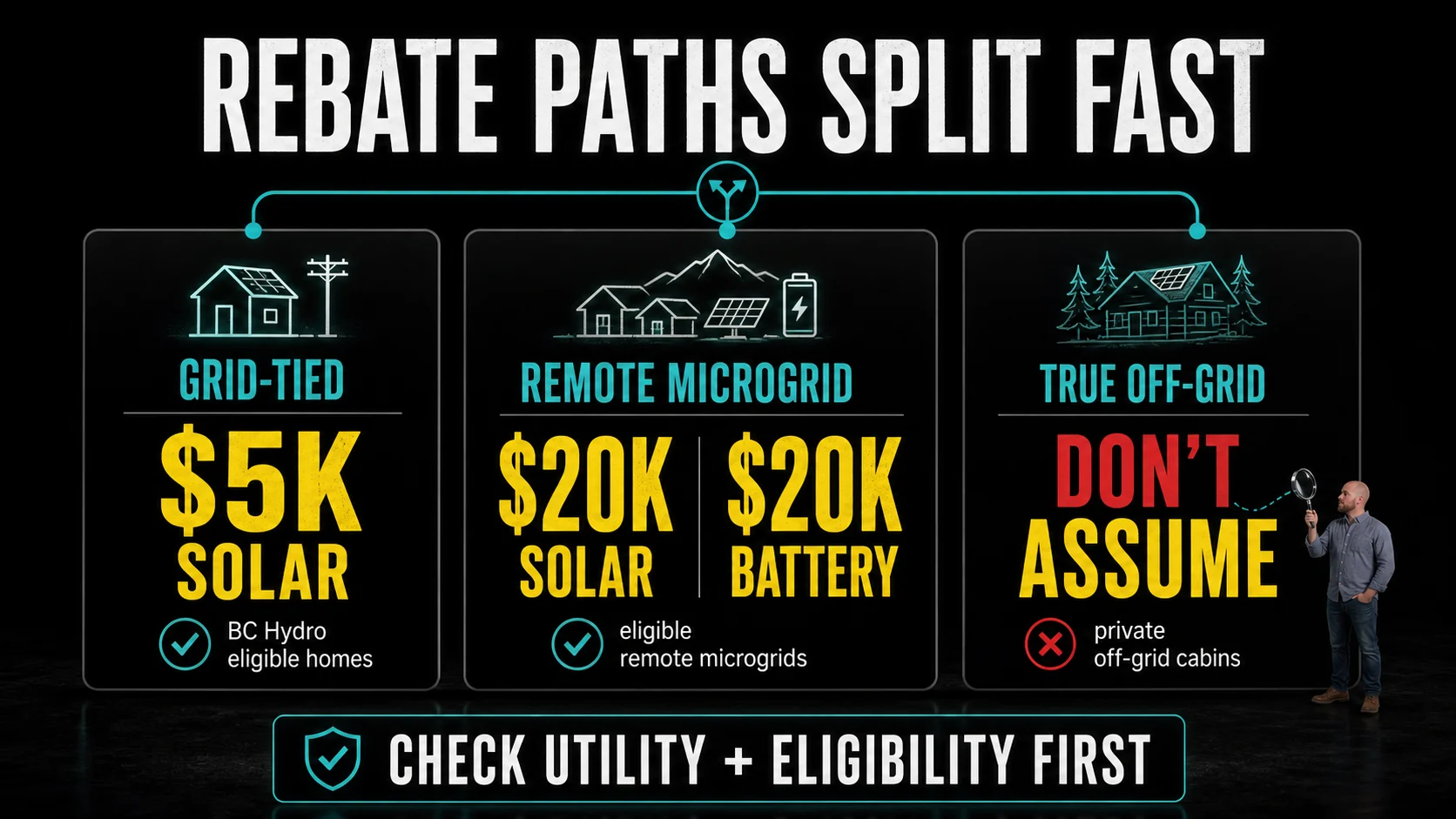
BC Hydro’s regular residential rebate page says eligible properties must have a BC Hydro residential account, be grid-connected, and be located in BC Hydro’s service territory. It also says FortisBC customers are not eligible for those BC Hydro rebates. See BC Hydro’s current solar panel and battery storage rebate rules.
That is the big warning for anyone searching “off-grid solar BC.” If your cabin is truly disconnected from the utility, the regular BC Hydro residential rebate is not your default funding source.
True Off-Grid Solar in BC: What Changes
True off-grid solar is not just grid-tied solar without the utility paperwork. The system has to carry the property when the sun is weak, the weather is bad, and the batteries are low.
That changes the design:
- Batteries become central, not optional.
- Winter sizing matters more than summer production.
- Backup generation is common for multi-day storms or heavy winter loads.
- Electric heat can make the system much larger and more expensive.
- Permanent wiring, inverters, batteries, and solar equipment still need a permit review.
- Insurance and resale can depend on proper documentation.
True off-grid does not mean permit-free. If you are installing permanent electrical equipment, solar equipment, battery storage, inverters, or wiring, check Technical Safety BC or your municipality before work starts.
Can You Get a Rebate for Off-Grid Solar in BC?
Maybe, but not always through the program people usually mean.
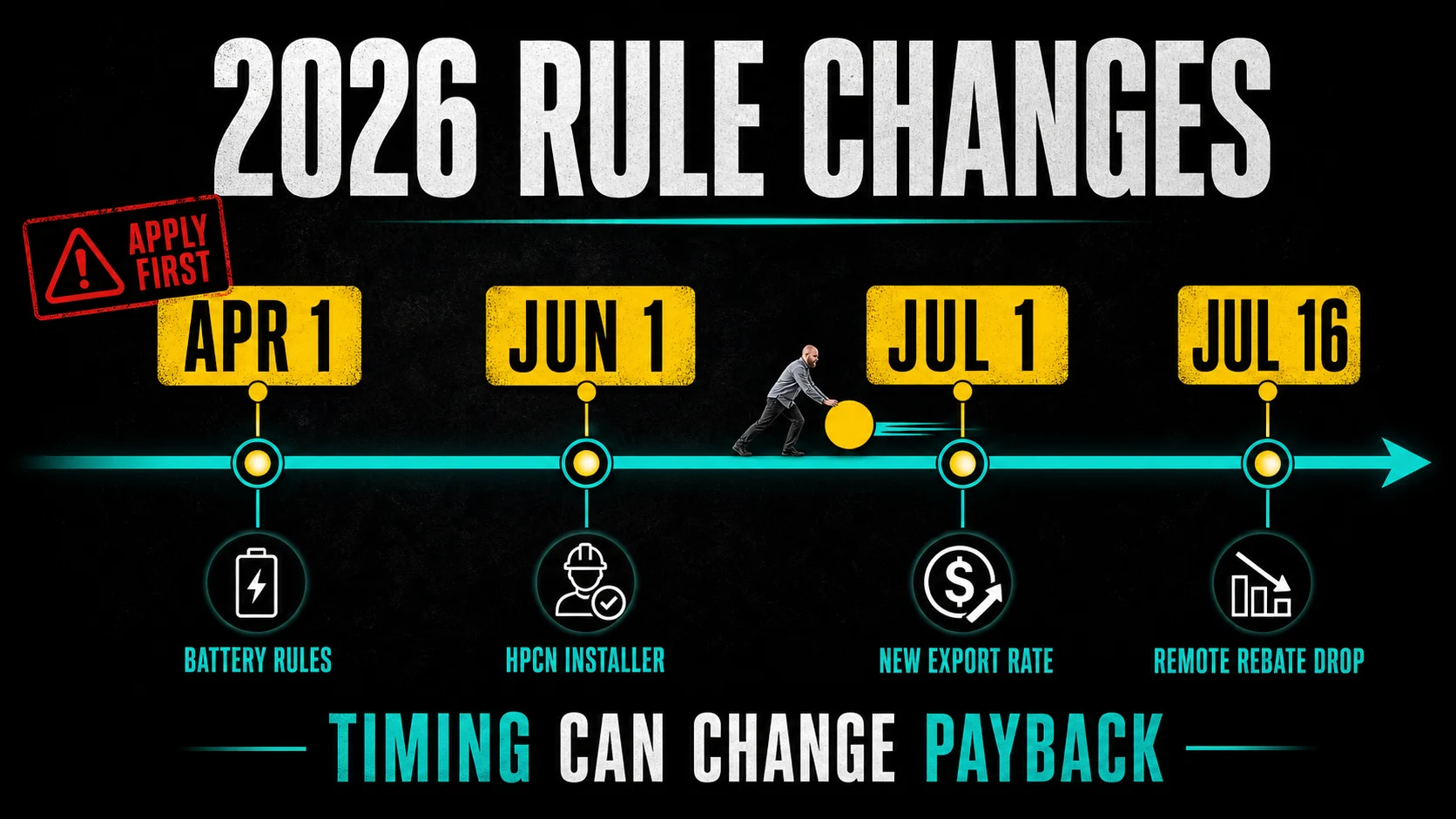
BC Hydro’s regular residential solar rebate offers up to $5,000 for eligible grid-connected solar panels. The formula is $1,000 per kW of installed generator capacity, capped at 50% of installed product cost, with a maximum rebate of $5,000. BC Hydro also lists battery rebates that changed as of April 1, 2026: up to $1,500 for batteries paired with solar, or up to $5,000 for batteries enrolled in Peak Saver. Battery-only systems that are not enrolled in Peak Saver are no longer eligible under that regular path. BC Hydro explains the current amounts on its residential solar and battery rebate page.
The catch is eligibility. BC Hydro says solar generation must connect to its distribution system through self-generation, and you must receive application pre-approval before buying equipment. Self-installations are not eligible. Systems must be designed and installed by a licensed contractor with a GST number and a valid BC licence. As of June 1, 2026, installations must be completed by a Home Performance Contractor Network member to qualify for rebates.
Tip for rebate planning: do not buy panels, inverters, or batteries first. Confirm your utility account, rate path, contractor eligibility, equipment eligibility, and application pre-approval first.
Remote Microgrid Rebates Are Different
Remote microgrid rebates sound like off-grid funding, but they are not the same as a private off-grid cabin system.
BC Hydro says customers in eligible remote communities supplied by a BC Hydro microgrid can apply for solar and battery rebates. These microgrids are not connected to BC Hydro’s integrated system, but the customer is still connected to a BC Hydro microgrid. For residential customers, BC Hydro lists up to $20,000 for grid-connected solar panels and up to $20,000 for battery storage while funding lasts and subject to case-by-case review. The current solar amount is $2,000 per kW, capped at 75% of installed product cost, up to $20,000 for residential customers. Battery storage is listed separately, with a residential maximum of $20,000. See BC Hydro’s remote microgrid solar and battery rebates.
Timing matters. BC Hydro says that as of July 16, 2026, remote microgrid rebate amounts will drop to $1,000 per kW for solar and $500 per kWh for batteries, capped at 50% of installed product costs. Applications submitted before July 16 are reviewed under the current rebate amount.
There is also a capacity limit. BC Hydro says remote microgrids limit aggregate self-generation to 15% of average community load, and each application is reviewed until the local community limit is reached. That means remote customers should not assume approval is automatic.
What Changed in 2026 for BC Hydro Solar
BC solar rebate and net metering advice from older articles can now be wrong.
BC Hydro says the current net metering service rate, Rate Schedule 1289, closes to new customers when the new self-generation service rate starts on July 1, 2026. Under Rate Schedule 2289, BC Hydro will purchase excess generation at 10 cents per kWh and compensate customers each billing cycle instead of annually. BC Hydro explains the transition on its customer generation service rate update page.
Existing net metering customers can remain on Rate Schedule 1289 until 10 years have passed from their initial service start date. Customers who received a solar rebate move to Rate Schedule 2289 when it begins, although BC Hydro describes a one-time repayment option for some rebate recipients.
For a homeowner, this changes the question from “Does solar offset my bill one-for-one?” to “How much of my production will I use directly, and how much will I export?”
What About FortisBC and New Westminster?
FortisBC customers should not plan around BC Hydro rebate dollars.
FortisBC has a net metering program for eligible residential, commercial, and irrigation customers. FortisBC says the system must use renewable energy, be located on the customer’s property, serve that property, and be designed to offset some or all of the customer’s own consumption. The maximum allowable generating capacity is 50 kW, and FortisBC must approve the application before construction begins. See FortisBC’s net metering program rules.
New Westminster is a special case because it has its own electric utility. The City of New Westminster lists solar and battery rebate information for residential customers and references up to $5,000 for solar and up to $5,000 for battery storage. Check the city’s current solar PV and battery storage rebate page before relying on those numbers.
Canada Greener Homes Loan and Grant: Do Not Build a 2026 Plan Around It
Many older solar articles still mention the Canada Greener Homes Grant or Loan. That can confuse homeowners.
Natural Resources Canada now lists the Canada Greener Homes Grant as closed and says December 31, 2025 was the last day to submit documents. It also lists the Canada Greener Homes Loan as closed, with no further applications approved. Existing approved applications are not affected. See the current Canada Greener Homes Initiative status.
For a new BC solar buyer in 2026, treat Greener Homes as past context, not active funding.
How Much Does Solar Cost in BC?
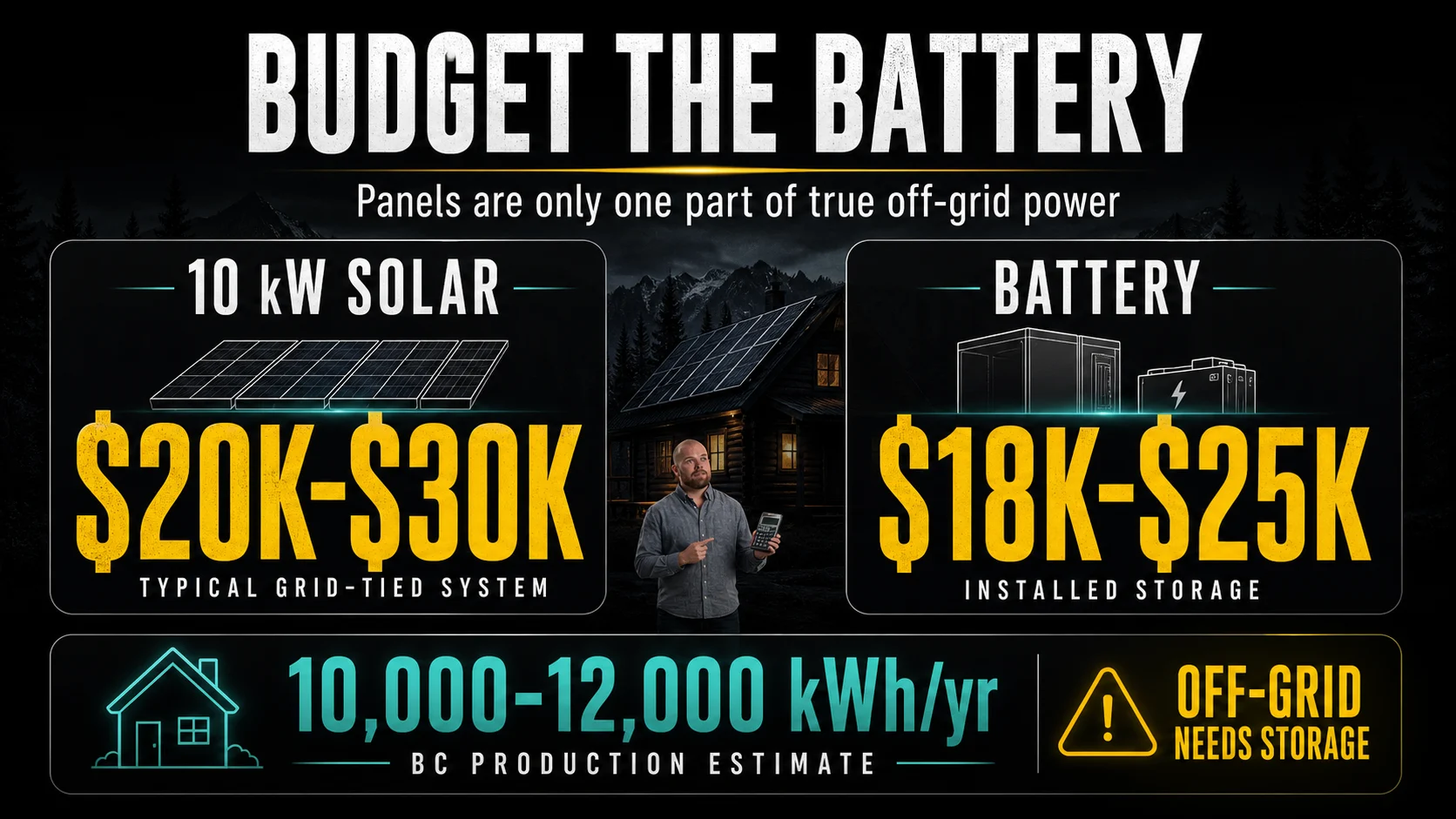
BC Hydro gives useful cost anchors for grid-tied residential solar. It says a solar PV system typically ranges from $2,000 to $3,000 per kW DC installed, with an average of about $2,500 per kW DC. A 10 kW residential system typically costs $20,000 to $30,000. BC Hydro also says a 10 kW residential roof system in BC can generate about 10,000 to 12,000 kWh per year, while an average household uses about 10,000 kWh per year. See BC Hydro’s solar panel cost and production guidance.
Off-grid systems can cost more because the system has to do more. You may need more battery storage, backup generation, winter design margin, transport to a remote site, trenching, roof or ground mounting, electrical upgrades, and a contractor willing to work in the location.
BC Hydro says a lithium-ion residential battery system and installation averages about $18,000 to $25,000. That cost matters because true off-grid living depends on storage. Solar panels make electricity when the sun is available. Batteries and backup systems carry the home through nights, storms, heavy rain, and winter stretches. See BC Hydro’s battery storage cost guidance.
Tip for winter: size the system around your worst month, not your best month. Coastal rain, mountain snow, shaded lots, and electric heat can all change the math.
DIY Solar in BC: Where It Makes Sense and Where It Gets Risky
DIY solar is not one thing.
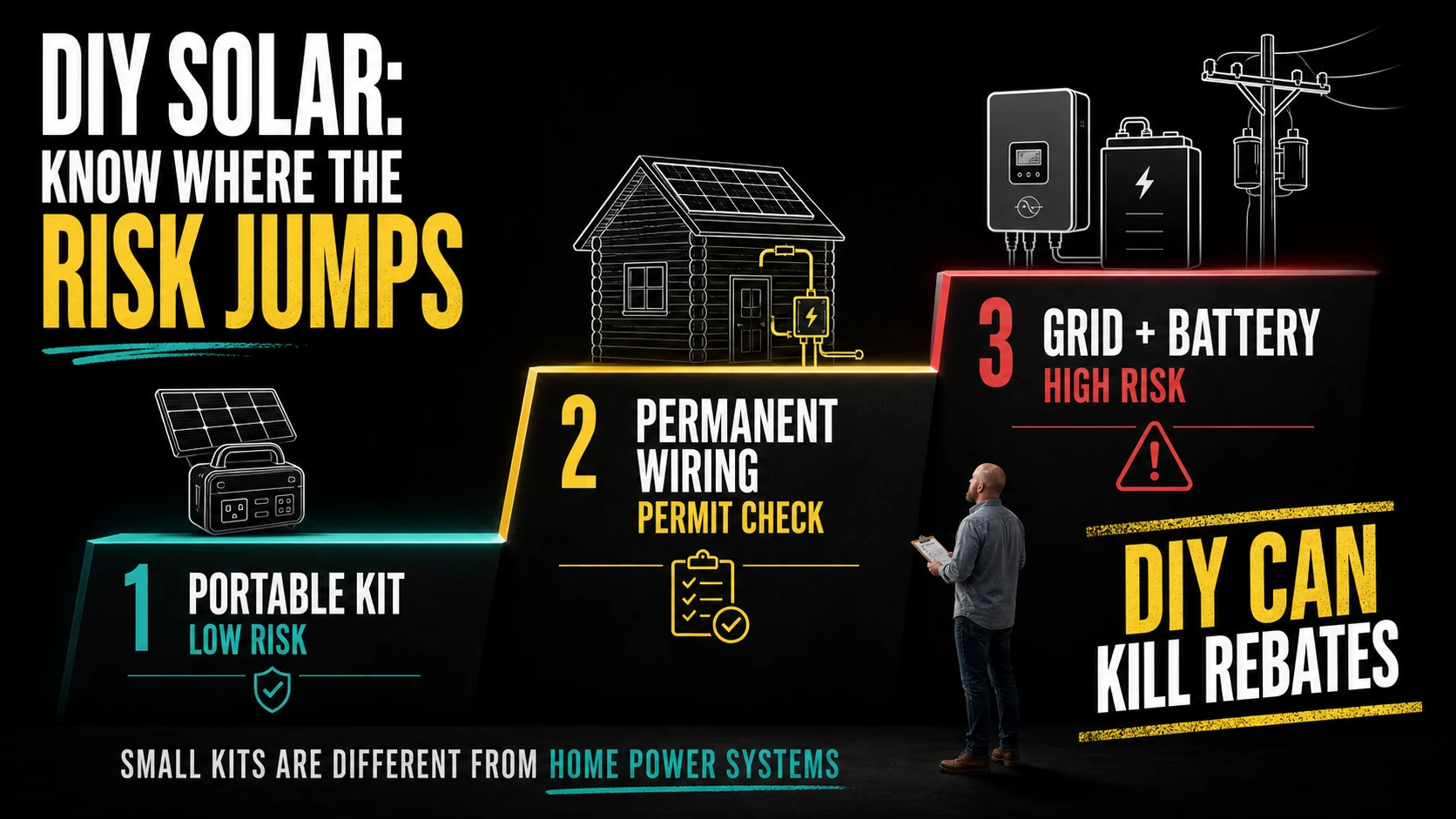
A small portable solar kit for camping, RV use, or a non-permanent cabin load is very different from a permanent home power system with batteries, inverters, transfer equipment, roof attachments, and utility interconnection.
For BC Hydro rebate projects, the answer is clear: self-installations are not eligible. The system must be designed and installed by an eligible licensed contractor, and as of June 1, 2026, a Home Performance Contractor Network member is required for rebate eligibility.
Technical Safety BC says licensed contractors and homeowners installing electrical equipment generally require electrical installation permits, and failing to obtain a required permit can lead to consequences ranging from warnings to monetary penalties or prosecution. For standard electrical installation permits, a Field Safety Representative must be named on the permit application. Homeowner permits follow a separate process, and many properties or project types still require a licensed contractor. In some municipalities, including Vancouver, Victoria, Surrey, Burnaby, North Vancouver, West Vancouver, and Maple Ridge, the permit path goes through the municipality or district instead of Technical Safety BC. See Technical Safety BC’s electrical installation permit requirements.
Here is the practical split:
| Project type | DIY risk | Better path |
|---|---|---|
| Portable solar for camping or small seasonal loads | Lower, if it is not connected to permanent wiring or utility interconnection | DIY may be reasonable if it is not tied into permanent wiring |
| True off-grid cabin with permanent wiring | Medium to high | Use a licensed electrical contractor for wiring, batteries, inverter, and inspection |
| BC Hydro grid-connected rebate project | Very high | Use an eligible licensed contractor; DIY can kill rebate eligibility |
| BC Hydro remote microgrid project | Very high | Apply first, wait for review, then install to approved specs |
| FortisBC net metering project | High | Follow FortisBC application and interconnection steps |
| Battery storage system | High | Use approved equipment and qualified installation |
| Roof-mounted solar on an older roof | High financial risk | Check roof age and removal/reinstall costs before signing |
My practical view: DIY can save labour on small, non-permanent setups. For a home, cabin, or battery-backed system, the risk usually moves from “Can I wire this?” to “Will it be legal, insurable, safe, approved, and eligible?”
When Hiring a Solar Company Is Worth It
A good installer is not just selling panels. They should be protecting the project from expensive mistakes.
For BC homes, that can include:
- Utility eligibility review
- Solar production estimate
- Battery sizing
- Self-generation application support
- BC Hydro, FortisBC, or New Westminster process guidance
- Electrical permit coordination
- Product certification review
- Roof attachment and water protection
- Final inspection documents
- Rebate paperwork
- Warranty support
Before choosing an installer, compare a few detailed quotes. The cheapest number is not always the best deal if the equipment, warranty, production estimate, battery sizing, or rebate plan is weaker. SolarEnergies.ca can help you compare options from qualified solar installers without relying on one sales pitch.
Questions to Ask Before Signing
Ask these before you pay a deposit:
- Am I truly off-grid, grid-tied, remote microgrid, FortisBC, or New Westminster?
- Which rebate path applies to my exact utility account?
- Are you eligible for BC Hydro rebate projects after June 1, 2026?
- Will you submit the self-generation application before I buy equipment?
- Which BC Hydro rate schedule applies to my project after July 1, 2026?
- Is my battery eligible under the current program rules?
- Who handles the electrical permit?
- Who requests the inspection?
- What happens if the utility rejects the application?
- What happens if my remote microgrid community limit is full?
- Does my roof need work before panels go on?
- What will removal and reinstallation cost if I replace the roof later?
- Will my insurer accept the system?
- What is covered by workmanship warranty versus equipment warranty?
Bottom Line
Off-grid solar in BC can be a smart move for the right property, but the money side is not simple. A grid-connected BC Hydro home, a remote microgrid home, a FortisBC home, a New Westminster home, and a true off-grid cabin all follow different rules.
Start with the property type. Then verify the utility path, rebate eligibility, permit requirements, battery design, and contractor credentials. After that, compare quotes.
That order protects your budget.
FAQ
Does BC Hydro offer rebates for true off-grid solar cabins?
BC Hydro’s regular residential solar and battery rebate is built around eligible grid-connected BC Hydro properties. The property must have a BC Hydro residential account, be grid-connected, and connect solar generation through self-generation. If your cabin is fully disconnected from the utility, do not assume the regular BC Hydro rebate applies.
Remote microgrid communities are a separate case. Those customers are connected to a BC Hydro microgrid, not a private off-grid system.
How much can I get from BC Hydro for solar panels in 2026?
BC Hydro currently lists up to $5,000 for eligible residential solar panels under its regular rebate. The formula is $1,000 per kW of installed generator capacity, capped at 50% of installed product cost.
For remote microgrid residential customers, BC Hydro lists up to $20,000 for solar while current rebate amounts apply, with changes scheduled for July 16, 2026.
Are battery rebates available in BC?
Yes, but eligibility depends on the program. BC Hydro’s regular residential rebate currently lists up to $1,500 for batteries paired with solar, or up to $5,000 for batteries enrolled in Peak Saver. Battery-only systems that are not enrolled in Peak Saver are no longer eligible under that regular path.
Remote microgrid battery rebates are separate and can be larger, but the property must be in an eligible remote microgrid community and pass BC Hydro’s review.
Can I install solar myself in BC and still get a rebate?
For BC Hydro’s regular residential solar and battery rebate, no. BC Hydro says self-installations are not eligible. The project must be designed and installed by a licensed contractor, and as of June 1, 2026, a Home Performance Contractor Network member is required for rebate eligibility.
Small portable DIY solar is a different category. Permanent wiring, batteries, roof mounting, and grid interconnection need much more care.
Is FortisBC net metering the same as BC Hydro’s rebate?
No. FortisBC net metering lets eligible customers generate renewable electricity and receive bill treatment for excess generation under FortisBC’s rules. It is not the same as BC Hydro’s residential solar rebate.
FortisBC says eligible systems must be on the customer’s property, serve that property, and be designed to offset annual consumption, with a maximum capacity of 50 kW.
Is the Canada Greener Homes Loan still available for solar in 2026?
No. Natural Resources Canada lists the Canada Greener Homes Loan as closed and says no further applications can be approved. Approved applications are not affected, but new solar buyers should not build a 2026 plan around that loan.
Is off-grid solar enough to run electric heat in BC?
Sometimes, but it can get expensive fast. Running lights, a fridge, internet, electronics, and a water pump is one project. Running electric heat through a wet or snowy winter week is a much larger battery and backup power problem.
If heating is part of the plan, get a proper load calculation before sizing the system.
Should I get solar panels, batteries, or both?
For a grid-connected home, solar panels often come first because they generate the electricity. Batteries make sense when backup power, outage resilience, Peak Saver eligibility, or higher self-consumption matters.
For a true off-grid property, batteries are not optional in the same way. They are central to the system.