Off-Grid Solar in BC: Costs, Rebates, Batteries, Permits, and DIY vs Hiring a Pro
June 10, 2026
Solar Panels Abbotsford 2026: Cost, Rebates, Fraser Valley Roofs And Farm Loads
June 19, 2026Last Updated on June 12, 2026 by Vitaliy
Solar in Nova Scotia is no longer just a climate upgrade. For community buildings, small businesses, and long-term property owners, it can be a way to control one of the bills that never stops rising: electricity.
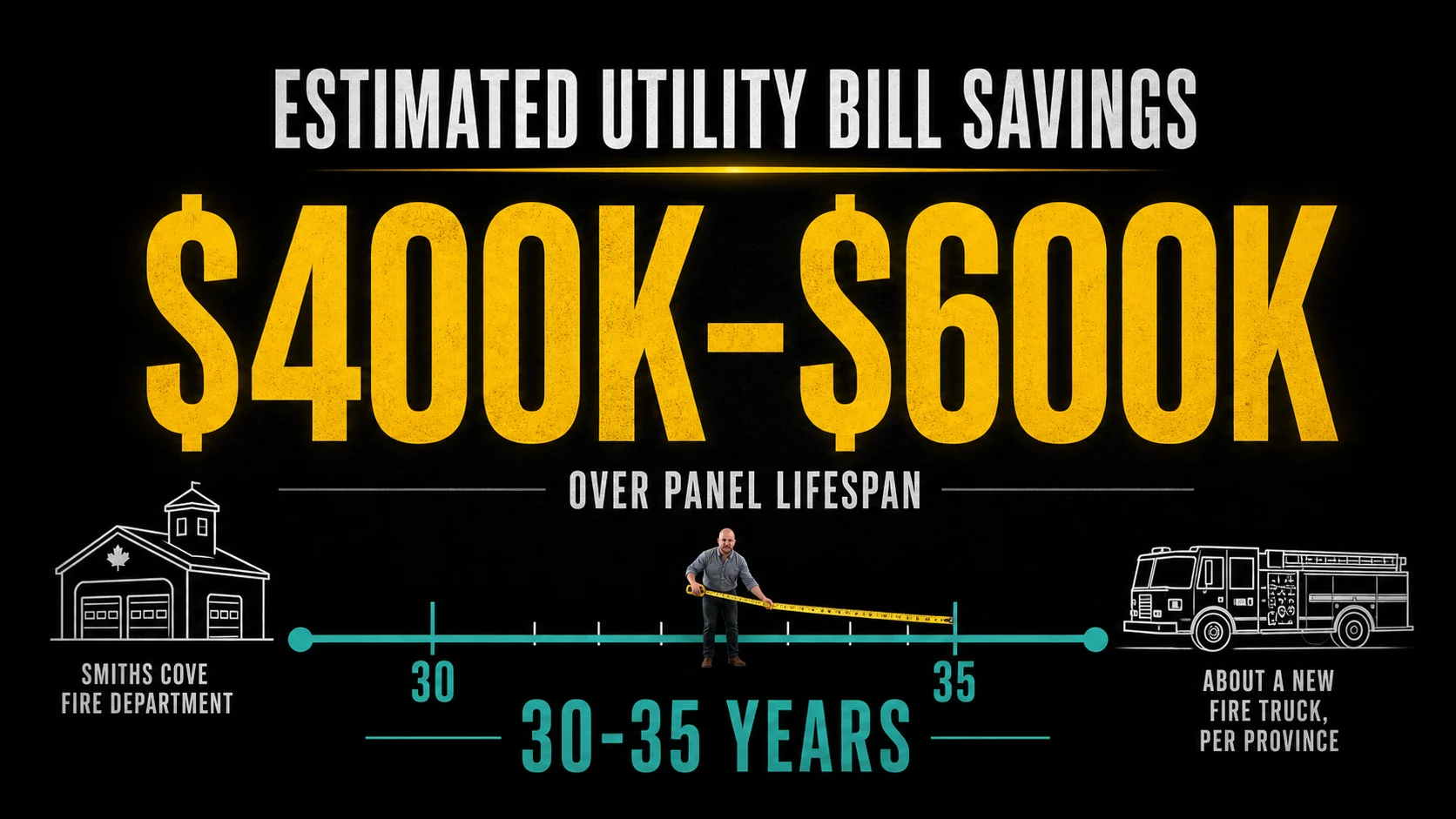
That is the practical lesson from the Smiths Cove Fire Department solar project in Digby County. On June 11, 2026, the Government of Nova Scotia announced $94,043 for a solar energy system expected to meet about 97% of the volunteer fire department’s energy needs. The province estimates the project will save $400,000 to $600,000 over the solar panels’ expected 30- to 35-year lifespan, and says that is about the cost of a new fire truck today: Nova Scotia government release on the Smiths Cove Fire Department solar project.
A poor solar decision can lock a building into weak savings for decades. A good one can turn a monthly power bill into money for equipment, operations, and real community service.
Key Takeaways
- Nova Scotia is providing $94,043 to help the Smiths Cove Fire Department install solar.
- The project is expected to meet about 97% of the fire department’s energy needs.
- The province estimates $400,000 to $600,000 in energy bill savings over 30 to 35 years.
- Businesses and community buildings need to size solar carefully because net metering is mainly about offsetting their own bills. Unused banked credits can lose value under the program rules.
- Solar can lower bills, but it does not automatically provide backup power during an outage.
- The best solar projects start with predictable annual electricity use, a long-term owner, and clear quote comparisons.
What Happened in Smiths Cove?
The Smiths Cove Fire Department serves Smiths Cove and the surrounding area in Digby County. The fire hall is more than a place to park emergency vehicles. The province says it also acts as a shelter during extended power outages, where people can get warm and charge phones and other devices. It also hosts local events, theatre group rehearsals, fundraising breakfasts, coffee hours, weddings, and other gatherings.
That changes the budget conversation.
If a fire hall is both an emergency building and a community hub, lowering its utility costs helps protect more than one service. It can reduce pressure on volunteers, fundraising, municipal support, and day-to-day operating budgets.
The project is funded through Nova Scotia’s Sustainable Communities Challenge Fund, a grant program that helps communities adapt to climate change or reduce its impacts. The province says the fund was created in 2021 as part of the Environmental Goals and Climate Change Reduction Act and has provided about $13 million for climate-related projects since launching.
The Simple Math Behind the Solar Savings
The official numbers are strong.
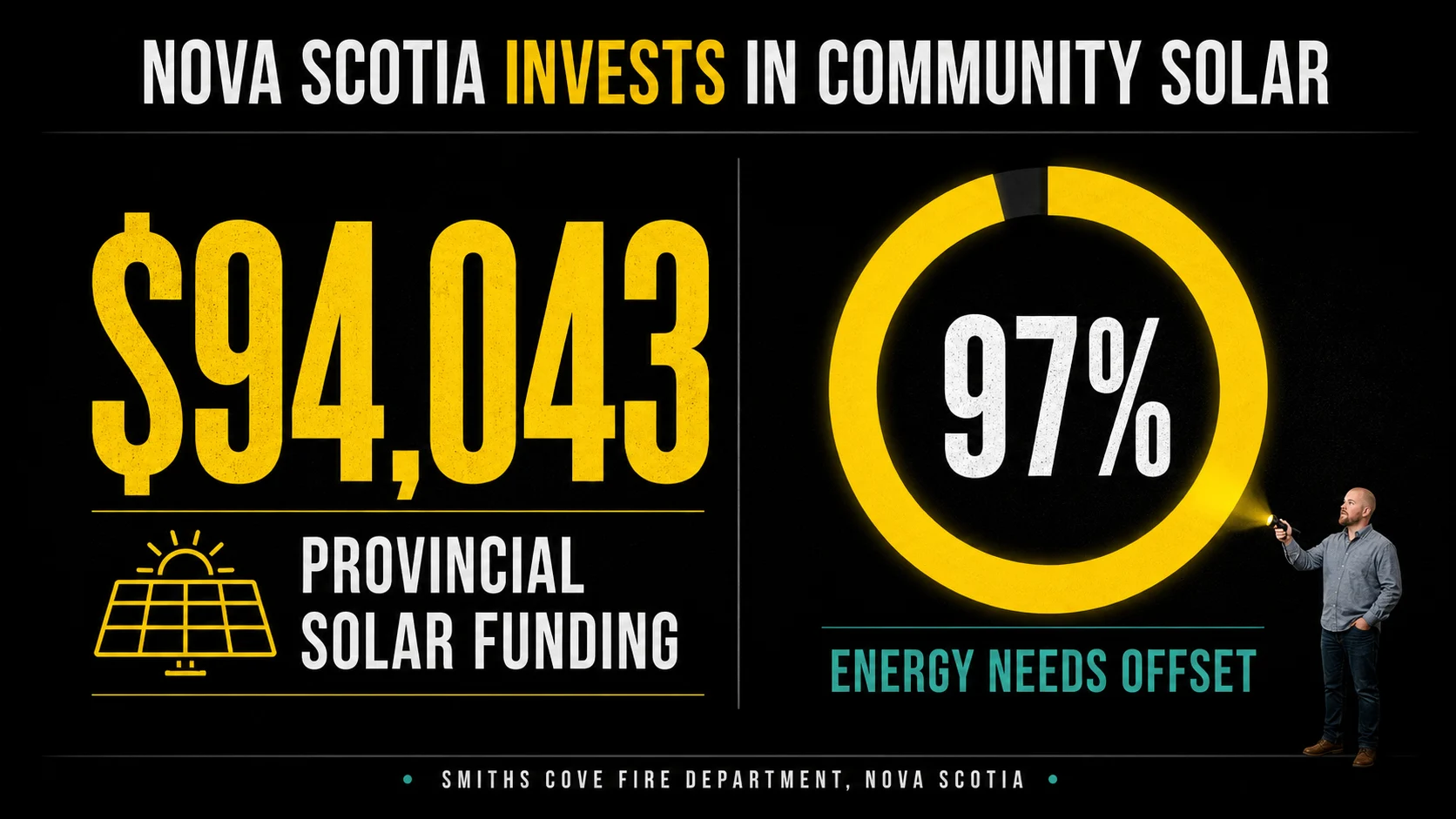
| Project Detail | Official Figure |
|---|---|
| Provincial funding | $94,043 |
| Expected energy offset | About 97% |
| Estimated lifetime savings | $400,000 to $600,000 |
| Expected panel lifespan | 30 to 35 years |
If you divide the province’s projected savings across the expected lifespan, the implied avoided power cost is roughly $11,400 to $20,000 per year. That is a simple calculation from the official savings range, not a separate annual savings number published by the province.
For a fire hall, that’s real money.
It can mean fewer dollars spent on electricity and more dollars available for equipment, maintenance, emergency readiness, and the people doing the work.
Tip for community buildings: do not judge solar only by the upfront cost. Look at the full life of the system, the annual bill it can offset, and whether grant funding can reduce the payback period.
What Other Community Buildings Can Learn
Solar works best financially when the building has predictable annual electricity use, a long-term owner, and a system sized close to real consumption.
That makes the Smiths Cove project relevant for:
- Fire halls
- Community centres
- Arenas
- Churches
- Non-profit buildings
- Municipal offices
- Workshops
- Small commercial buildings
The Sustainable Communities Challenge Fund supports non-repayable grants between $75,000 and $1,000,000 per project, generally covering 60% to 80% of eligible project costs. Applicants must contribute to the project, and the required contribution depends on total eligible project costs: Sustainable Communities Challenge Fund funding details.
Eligible lead applicants include Nova Scotia municipalities, First Nations bands and tribal councils, post-secondary institutions, and non-profit organizations operating in Nova Scotia: SCCF application eligibility.
This is not a normal homeowner rebate. It is a community-scale funding program. Still, the lesson applies to homeowners and business owners: solar makes the most sense when the system is sized to a real electricity bill and the owner plans to benefit from the savings for many years.
For more province-specific planning context, see our guide to Nova Scotia solar financing.
If you want a quick first check, use the SolarEnergies.ca online solar calculator to see whether solar makes sense for your property before you start collecting quotes.
The Net Metering Detail Buyers Should Understand
For commercial and community buildings, net metering is mainly about offsetting electricity use, not creating a new revenue stream.
Nova Scotia Power says its Commercial Net Metering Program allows customers to install renewable generation to offset part or all of their own electricity needs. It also says the program is not intended for customer sale of electricity, and excess generation above annual consumption within the same calendar year is not purchased: Nova Scotia Power Commercial Net Metering Program.
Banked energy credits can offset future bills during the year, but credits left over at the anniversary date can lose value under the program rules. Nova Scotia Power says excess generation above annual consumption within the same calendar year is not purchased.
This is where sizing gets serious.
A solar system that is too small may leave savings on the table. A system that is too large may produce credits that are not fully useful. The target is usually a system that closely matches the building’s expected annual electricity use.
Commercial net metering customers still pay applicable non-kWh monthly charges. Customers on demand-charge rates also need to account for demand charges, because solar mainly offsets energy use, not every part of the bill.
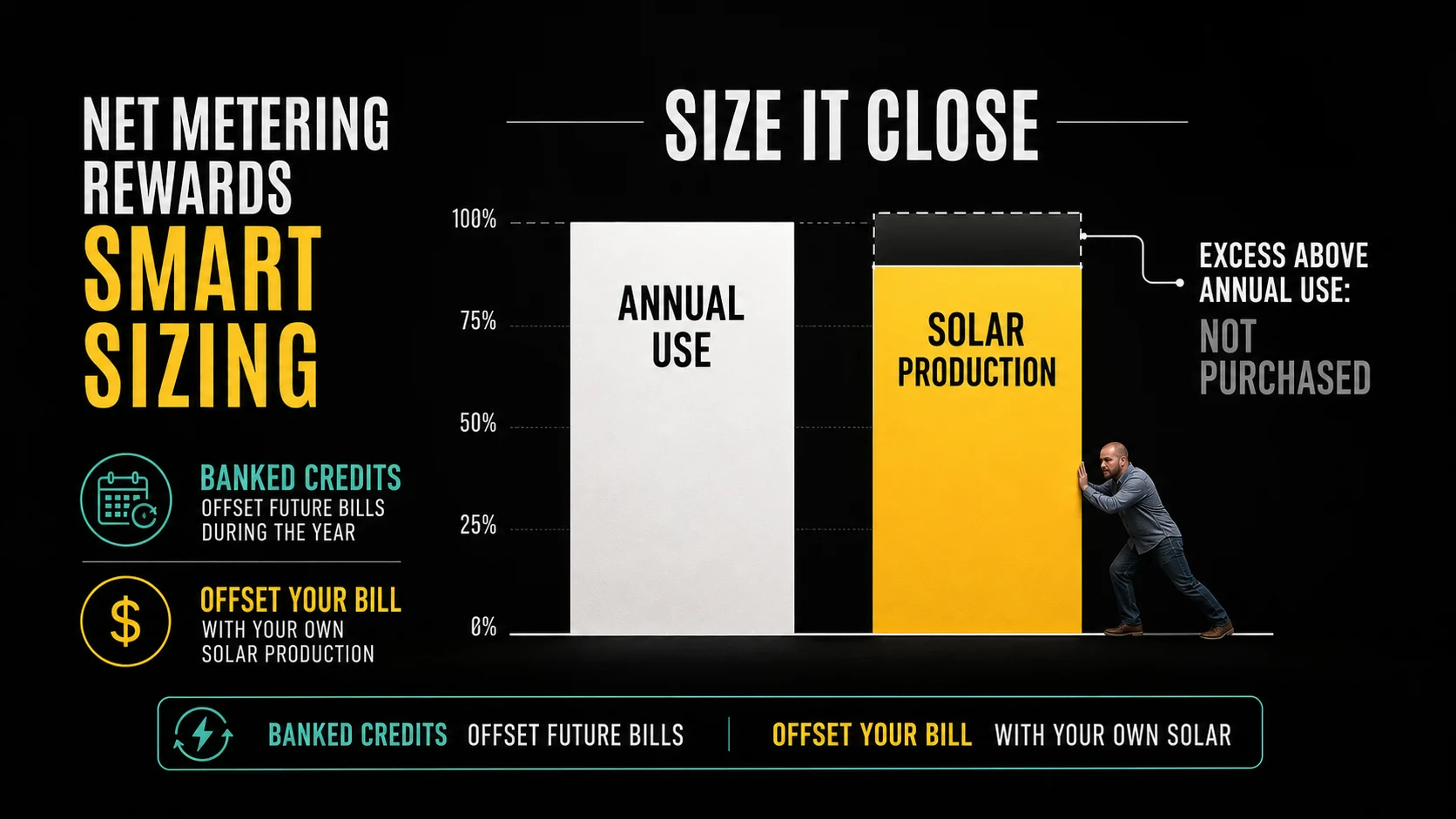
Tip for small businesses: ask your installer to show your annual electricity use beside the system’s expected annual production. If those numbers do not line up, ask why.
Solar Is Not Automatically Backup Power
This is one of the most important parts of the story.
The Smiths Cove fire hall acts as a shelter during extended outages, but a standard grid-tied solar system does not automatically keep a building powered when the grid goes down.
Nova Scotia Power says that if a customer wants to operate a generating system during a power outage, the system must have special transfer and isolating capabilities. During an outage, the generating facility must be disconnected from the distribution system to protect crews working to restore power: Nova Scotia Power Self-Generating Option FAQ.
So there are two separate questions:
- Will solar lower the power bill?
- Will solar keep the building running during an outage?
Those are different designs.
A bill-offset solar system may be enough for many buildings. An emergency building may need batteries, transfer equipment, and a design that can safely operate when the grid is down.
Tip for fire halls and emergency buildings: ask directly whether the proposal includes battery storage, transfer equipment, and outage operation. Do not assume panels on the roof mean backup power inside the building.
If outage planning is part of the decision, our Nova Scotia battery rebate guide is a useful next read.
Why This Fits Nova Scotia’s Energy Direction
Nova Scotia’s Renewable Electricity Regulations require that, beginning in 2030, each load-serving entity supply customers with renewable electricity equal to at least 80% of total electricity supplied, measured at customer meters. The same regulations include solar energy in the definition of renewable low-impact electricity: Nova Scotia Renewable Electricity Regulations.
That does not mean every roof should get panels immediately. It does mean solar is part of the province’s long-term electricity direction.
For property owners, the decision is still personal. The right question is not “Is solar good?” The right question is “Does solar fit this building, this bill, this roof, and these rules?”
Nova Scotia also has broader solar options outside owned rooftops, including Nova Scotia community solar projects for people who cannot install panels on their own roof.
Before choosing an installer, compare a few detailed quotes. The cheapest number is not always the best deal if the equipment, warranty, production estimate, monitoring, or financing terms are weaker. SolarEnergies.ca can connect you with certified installers who have completed 14,000+ installs across Canada, so you can compare real options instead of guessing.
What the Project Does Not Tell Us Yet
The Smiths Cove announcement gives useful headline numbers, but it does not answer every technical or financial question.
We still do not know:
- The solar system size in kW
- The total installed project cost
- The installer
- The fire hall’s annual electricity use before solar
- Whether battery storage is included
- Whether the building can operate from solar during an outage
- The assumptions behind the $400,000 to $600,000 savings estimate
That does not make the project weak. It just means readers should be careful with any solar claim that does not show the full math.
A strong solar quote should include system size, expected annual production, current annual usage, bill offset, warranties, equipment details, financing terms, and what happens if the system produces more or less than expected.
If upfront cost is the sticking point, ask about available financing options, including 0% financing with $0 down payment where approved. Just make sure the financing terms are included in the payback math.
What Homeowners and Small Businesses Can Take From This
The Smiths Cove fire hall project is not mainly a homeowner rebate story. It is a decision-making story.
The useful lesson is this: solar works best when the owner has a long-term reason to control electricity costs and the system is designed around real usage.
For a homeowner, that means checking roof condition, electricity use, expected production, net metering value, and how long you plan to stay in the home.
For a small business, it means looking at annual consumption, rate class, demand charges if applicable, operating hours, financing cost, and whether the system is sized for bill offset rather than oversized production.
For a community building, it means finding the right grant, building a realistic budget, and asking whether the project is only about lower bills or also about backup power.
When you are ready to compare proposals, start with our guide on how to compare solar quotes and choose an installer in Canada.
The next step is not to guess. Run the numbers first. Then compare quotes.
FAQ
Does the Smiths Cove Fire Department solar project prove solar is worth it in Nova Scotia?
It proves solar can make strong financial sense for the right building. The province says the Smiths Cove Fire Department system is expected to meet about 97% of the department’s energy needs and save $400,000 to $600,000 over 30 to 35 years.
That does not mean every property will get the same result. Solar payback depends on system size, electricity use, roof condition, installation cost, net metering rules, financing, and how long the owner benefits from the system.
Is the $400,000 to $600,000 savings estimate guaranteed?
No. It is an estimate published by the Government of Nova Scotia.
Actual savings would depend on system production, future electricity rates, equipment performance, maintenance, and the building’s electricity use over time. The estimate is still useful because it shows the scale of avoided utility costs over the life of the system.
Will solar keep a fire hall running during a power outage?
Not automatically. Nova Scotia Power says a generating system needs special transfer and isolating capabilities to operate during an outage. Without the right design, a grid-tied solar system must disconnect from the distribution system during outages to protect utility crews.
If backup power matters, ask whether the project includes batteries, transfer equipment, and outage-rated operation.
Can a business in Nova Scotia make money selling extra solar power?
Commercial net metering is mainly for offsetting the customer’s own electricity use. Nova Scotia Power says excess generation above annual consumption within the same calendar year is not purchased.
That means the best system is usually sized close to expected annual electricity use, not far above it.
Who can apply for the Sustainable Communities Challenge Fund?
Eligible lead applicants include Nova Scotia municipalities, First Nations bands and tribal councils, post-secondary institutions, and non-profit organizations operating in Nova Scotia.
The program is not a standard residential homeowner rebate. It is aimed at community organizations and institutions.
What should a community building ask before installing solar?
Ask for the system size, total installed cost, expected annual production, current annual electricity use, grant contribution, net metering treatment, warranty terms, and whether the system works during outages.
Those details can change the quote, the payback, and the real value of the project.
What should a homeowner take from this fire hall project?
The main lesson is to think long term. Solar is strongest when it is matched to real electricity use and judged over years, not months.
For a homeowner, the first step is to check whether your roof, electricity bill, and local rules support a good solar case. After that, compare multiple quotes so you can see equipment, warranties, production estimates, and financing side by side.