
Selling a Solar Home in Canada in 2026: The Hidden Trap That Can Erase $20,000 at Closing
April 21, 2026
A Langley Church Got BC Hydro Money for Solar Panels — Here’s What That Means for Your Home or Business
April 24, 2026Last Updated on April 21, 2026 by Vitaliy
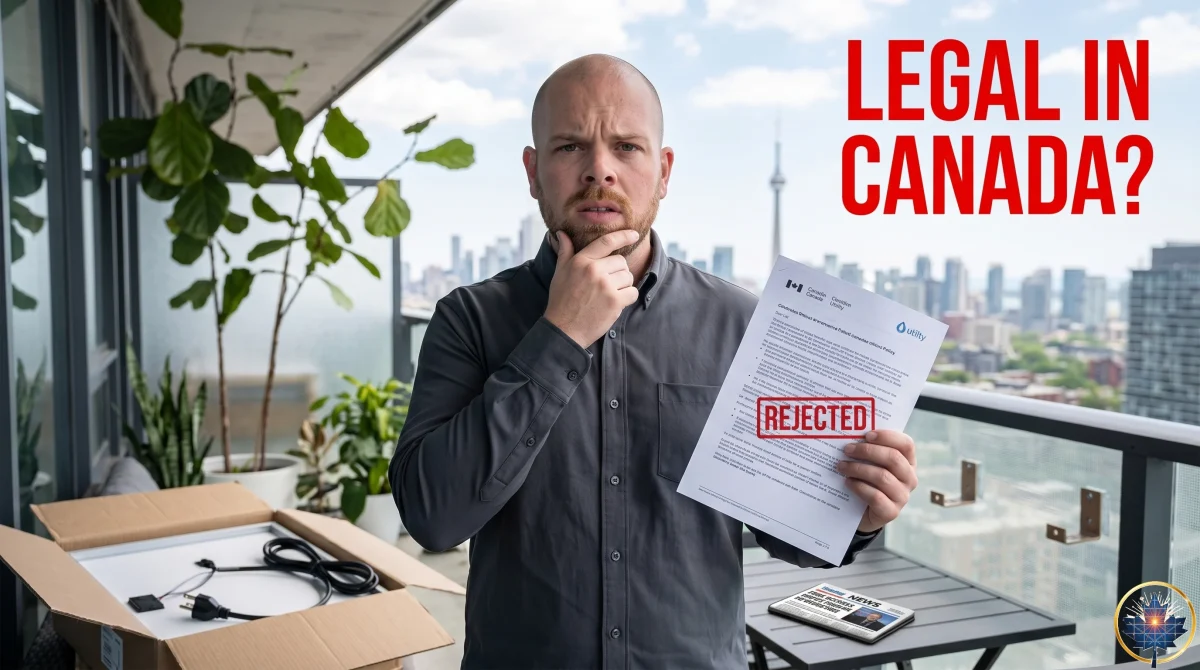
Germany registered more than 1.1 million new plug-in balcony solar systems in three years. Canada, as of April 2026, still has no legal path for a renter to buy a certified 800-watt balcony solar kit, plug it into a wall socket, and call it compliant. That gap isn’t a sunlight problem. It’s a rulebook problem. And millions of Canadian renters are paying for it every month on their electricity bill.
Key Takeaways
- Germany registered 1.1+ million new plug-in solar systems between 2023 and 2025 after regulating the category.
- Canada has 5.0 million renter households (33.1% of all households) who are currently locked out of self-generation by design.
- Southern Quebec generates ~1,200 kWh per installed kW annually, comparable to or better than German output.
- BC Hydro, Hydro-Québec, Hydro One, and Alberta utilities all require advance approval, interconnection paperwork, and a bi-directional meter. Plug-in kits don’t qualify.
- Standards Council of Canada is moving on a plug-in PV standard. Certified hardware and a compliant install pathway are the missing piece.
- If you own a roof, full residential rooftop solar still pencils out. BC Hydro pegs a 7 kW system at ~7,700 kWh/year in B.C.
Here’s the data, the policy failure, the cost picture, and what renters can actually do right now.
Germany turned balcony solar panels into a regulated product
The numbers from Bundesnetzagentur tell the story cleanly:
- 2023: ~260,000 new plug-in solar systems registered
- 2024: ~435,000 new plug-in solar systems registered
- 2025: ~430,000 new plug-in solar systems registered
More than 1.1 million devices in 36 months. The regulator openly admits the real count is higher because not every install gets registered. By early 2024, VDE was already calling the category commonplace.
1.1 million plug-in solar systems registered in Germany between 2023 and 2025. Canada registered zero under a certified plug-in class — the class doesn’t exist yet.
Then policy caught up. Since May 2024, Germany has defined a balcony power plant (Balkonkraftwerk) as a small device with up to 2,000 W of module capacity and up to 800 W of solar inverter output. Registration got simpler. Homeowners who skip feed-in payments don’t even need to notify the grid operator separately after logging the system in the public market register. Since October 2024, tenants and apartment owners have had a legal right to install one, with landlords limited to justified objections rather than blanket refusals, as reported by Reuters.
By late 2025, VDE rolled out a product-standard framework that explicitly allows safe connection through a normal household socket under defined conditions. A dedicated “energy socket” is still the safer choice for higher wattage or edge cases, but the regulator isn’t pretending plug-in is automatically dangerous anymore.
What actually drove the German boom
Climate branding didn’t do it. Bills did.
Russia’s 2022 invasion of Ukraine pushed household energy costs sharply up. Clean Energy Wire reported residential energy prices in Germany sat roughly 12% above pre-war levels even after the worst of the shock passed. More than half the German population rents. For those households, a balcony kit is one of the only realistic ways to self-generate any power at all.
The math made the decision easy. A typical 800-watt balcony system generates roughly 600 to 900 kWh per year under decent conditions. Prices dropped to €400–€800 for a full 800-watt setup, with smaller kits near €200. Payback period lands between 2.5 and 5 years.
Not every balcony is a winner. VDE flagged that shaded, vertical west-facing installs can produce dramatically less than an ideal south-facing angle. Enough balconies are good enough, though, and that’s what turned it into a mass-market product.
Canada has the renters. Canada has the sun.
Statistics Canada confirms the addressable market for apartment solar and renter solar is already here:
| Stat | Value |
|---|---|
| Canadian homeownership rate (2021) | 66.5% |
| Renter household growth, 2011–2021 | 21.5% |
| Owner household growth, 2011–2021 | 8.4% |
| Total renter households | 5.0 million |
| National rental rate | 33.1% |
| Homes built 2016–2021 that are tenant-occupied | 40.4% |
That’s exactly the housing stock balcony solar panels are built for. Apartments. Condos. Small urban homes where nobody controls a whole roof.
Rooftop solar is not a fair substitute. BC Hydro puts a typical 10 kW residential rooftop solar system at C$20,000–C$30,000 installed. That’s a mortgage-adjacent decision, not a $600 gadget. If you do own a roof and want to see how that math pencils out for your home, you can read how to spot a bad solar quote or start with our practical rooftop guide.
Sunlight isn’t the excuse either. Hydro-Québec reports southern Quebec can generate about 1,200 kWh per installed kW each year. BC Hydro’s figure for a 7 kW B.C. rooftop solar system lands near 7,700 kWh annually. Canada Energy Regulator ranks Regina, Saskatoon, Calgary, Winnipeg, Ottawa, Montreal, and Toronto as strong solar PV cities. In many of those markets, balcony-scale productivity matches or beats Germany’s average. Orientation, shade, and mounting angle still decide the final number.
Rates keep pushing the math in favour of self-generation
As of April 1, 2026, BC Hydro residential bills rose a net 3.75%. Hydro-Québec residential rates rose 3% the same day. Ontario’s winter 2025–26 regulated prices run from 9.8¢/kWh off-peak up to 20.3¢/kWh on-peak, with tiered pricing at 12.0¢ and 14.2¢/kWh.
The pressure isn’t uniform coast to coast. The direction is consistent. Power isn’t getting cheaper. Entry-level self-generation has a better political opening in Canada today than at any point in the last decade.
The Canadian rulebook assumes you own a roof
Here’s where the two countries split.
In British Columbia, BC Hydro requires any grid-tied solar system to be approved before install. Its self-generation program explicitly tells customers to hire a contractor to design, accept, and connect the system to the grid. The current solar-and-battery rebate is even stricter: eligible systems must be hardwired, fixed to the property, and connected through a permanent communicating bi-directional meter. Temporary, portable, plug-in, or mobile systems don’t qualify. That’s a rooftop net metering and interconnection market. It isn’t a balcony solar market.
In Quebec, Hydro-Québec says prospective solar customers need a master electrician or engineer to file a connection request and receive conditional approval before they buy equipment.
In Ontario, Hydro One requires a micro-generation connection application for projects 10 kW or less, warns applicants that any costs incurred before receiving an offer to connect are at their own risk, and states in its Conditions of Service that customers need Hydro One approval before constructing electrical facilities.
Alberta runs the same micro-generation playbook. Advance approval. Interconnection paperwork. Bi-directional meter. Final permit and inspection before energizing. FortisAlberta states the same in its micro-generation requirements.
Ontario’s Electrical Safety Authority (ESA) adds another layer. Supply authorities must be consulted for any interconnected power production. Approved interactive solar inverters are mandatory. Disconnecting means are required. Plan review may be required before any electrical work begins. The ESA framework also ties back into the Canadian Electrical Code, which still treats every grid-connected PV install as a conventional hardwired rooftop solar project.
None of that is outrageous for a hardwired rooftop system. All of it is miles away from “buy a certified 800-watt kit, file a quick online notification, plug it in.”
The safety gap is real. It’s also closing.
Anyone who waves off the safety concern is being careless. UL Solutions has documented specific risks: overcurrent problems, possibly undetected conductor overloads, GFCI compatibility issues, energized attachment plugs, and user-accessible solar inverter output circuits that don’t behave like hardwired systems.
The Standards Council of Canada confirmed the gap in a January 2026 notice stating that a Canadian standard for interactive plug-in PV is intended to address the gap in current requirements. That work is the precursor to a CSA-aligned certified kit pathway.
The honest update is that the argument has shifted. It’s no longer “these devices can’t be made safe.” HTW Berlin’s 2025 short report concluded that 800-watt plug-in solar in normal use doesn’t meaningfully raise conductor temperatures, fire risk, or cable aging. Even worst-case theoretical overload scenarios didn’t produce a statistically significant change in fires. VDE’s 2026 framework allows safe household-socket connection under defined limits: 800 VA inverter cap, 960 Wp module cap, anti-islanding protection required, with energy sockets and professional work required beyond that.
The technology isn’t the blocker anymore. The product certification, connector design, branch-circuit rules, and meter handling are what need engineering attention.
Tip for renters: Don’t buy a grey-market plug-in kit off a cross-border listing and assume you’re compliant. Until Canada finalizes a standard, connecting any unapproved PV device to your branch circuit can void insurance, break your lease, and expose you to utility disconnection. Wait for certified hardware tied to a Canadian rule path.
What Canada needs to do next
The defensible position is simple. Canada should copy Germany’s second act, not its early grey-market years.
That means a formal low-voltage, low-wattage plug-in PV class inside the Canadian Electrical Code and provincial practice rules. A starting cap around 800 W AC. Certified integrated kits, not loose piles of panels and adapters. Mandatory anti-islanding protection. Clear branch-circuit rules. Labeling. Approved mounting methods. A connector architecture purpose-built for plug-in PV. And a light-touch online notification process for certified systems below the threshold, plus meter updates where needed.
That’s not deregulation. That’s better regulation.
The housing-law piece matters just as much. Germany learned early that a technical right to install means nothing if landlords, condo boards, and homeowner associations can say no for any reason. A Canadian version should let building owners reject a kit for real structural, façade, fire-safety, or insurance reasons. Not because distributed generation makes them nervous. Without that fix, balcony solar stays a talking point for detached-home owners with patio space. With it, it becomes the first real entry-level solar product for ordinary urban households — apartment solar, condo solar, and renter solar included.
If you’re looking at full-system ownership instead, these guides on solar incentives in Canada, payback across provinces, and balcony solar panels in Canada are the better next read.
FAQ
Can I legally plug a balcony solar kit into my Canadian apartment today?
No. There’s no certified plug-in PV standard in Canadian code yet, and every major utility requires approval, a licensed install, and a bi-directional meter for grid-connected solar.
Why does Germany allow balcony solar but Canada doesn’t?
Germany spent 2023–2025 turning a grey-market product into a regulated class with wattage caps, a VDE product standard, simplified registration, and tenant rights. Canada hasn’t built that framework yet.
How much does a balcony solar system cost in Canada?
There’s no official Canadian retail market because the product class isn’t certified here. In Germany, an 800-watt balcony solar kit runs €400–€800 (roughly C$600–C$1,200). Grey-market imports cost more once you factor in shipping, duty, and the risk of utility or insurance issues.
How many kWh does an 800W balcony solar panel produce per year?
Between 600 and 900 kWh per year under decent conditions, based on German field data. In sunnier Canadian locations like southern Ontario, Quebec, or the Prairies, a well-oriented system should hit the upper end of that range. Shade, vertical mounting, and west-facing balconies cut output significantly.
Are there Canadian provinces that already allow plug-in solar?
Not as of April 2026. BC, Alberta, Ontario, and Quebec all require advance utility approval and hardwired installation for any grid-tied PV system. The Standards Council of Canada is working on a plug-in PV standard, which is the first step.
Can you install solar panels on a condo balcony in Canada?
Technically, yes, on the hardware side — mounting kits exist. Legally, no, not in a compliant grid-connected way until Canada has a plug-in PV standard and provincial interconnection rules match. Off-grid setups that charge a battery without touching household wiring are a separate path, but they’re limited in usefulness.
What’s the difference between a Balkonkraftwerk and regular solar panels?
A Balkonkraftwerk (German balcony power plant) is a certified kit — solar panels, micro-inverter, mounting, cable, and a specific plug — designed to clip onto a railing and feed under 800 W directly into a household circuit. Regular rooftop solar is a hardwired, higher-wattage system that runs through a bi-directional meter and requires utility interconnection.
Is plug-in solar actually safe?
Under certified German limits (800 VA inverter, 960 Wp module), HTW Berlin’s 2025 data shows no significant change in fire risk or conductor temperature in normal use. Safety depends on certification and correct branch-circuit conditions, not the concept itself.
If I own a house, should I wait for balcony solar or go rooftop now?
Rooftop. A 7 kW B.C. system produces around 7,700 kWh/year. Balcony kits max out near 800 W. For homeowners, full residential solar is a different category entirely.
Will Canadian utilities accept plug-in solar once a standard lands?
Expected path: a certified kit under 800 W, light-touch online notification, updated meter rules. Until then, grey-market installs risk insurance and utility issues.
Written by Vitaliy Lano, owner of SolarEnergies.ca — Canada Goes Solar. 12 years reviewing solar companies and helping Canadian homeowners and renters make informed decisions.