
Solar Panels Halifax Cost Guide 2026: Is It Worth It?
June 30, 2026
Solar Panels Bridgewater Cost Guide 2026: Is It Worth It?
June 30, 2026Last Updated on June 30, 2026 by Vitaliy
Solar Panels Sydney NS/Cape Breton Cost Guide 2026: Is It Worth It?
If you are pricing solar panels in Sydney, NS or anywhere in Cape Breton in 2026, the first thing to know is that the old Nova Scotia solar math is not the current math.
Solar can still be worth it here. Sydney homes are served by Nova Scotia Power, electricity rates are high enough for self-generation to matter, Nova Scotia still has net metering, and many Cape Breton homes have enough roof space for a practical solar system.
But the easy incentive story changed. The homeowner SolarHomes program is closed to new applications. The Canada Greener Homes Grant is closed. The Canada Greener Homes Loan is also closed to new loan applications because federal funding is fully committed.
So the honest question is not “How big is the rebate?”
It is this:
Can your Sydney or Cape Breton home produce enough electricity, at a fair installed price, to lower long-term power costs without creating a roof, financing, insurance, or outage-backup surprise?
For a lot of homes, the answer can still be yes. For others, the better answer is to fix the roof first, reduce wasted electricity, install a heat pump first, wait for a better financing option, or get a clearer quote before moving ahead.
Use the online solar calculator for a quick first estimate, then use this guide to sanity-check the solar quote before you sign.
Key Takeaways
- Solar panels in Sydney and Cape Breton usually make the most sense for homes with high annual electricity use, a solid roof, limited shade, and a system sized close to real consumption.
- A practical 2026 quote-screening range is about $2.75/W to $3.75/W installed for many straightforward grid-tied residential solar panel installation projects, before major roof work, electrical upgrades, battery storage, financing costs, or unusual site conditions.
- A 10 kW Sydney solar system might land around $27,500 to $37,500 before site-specific extras. A smaller 5 kW system might land around $13,750 to $18,750. Always ask whether HST is included.
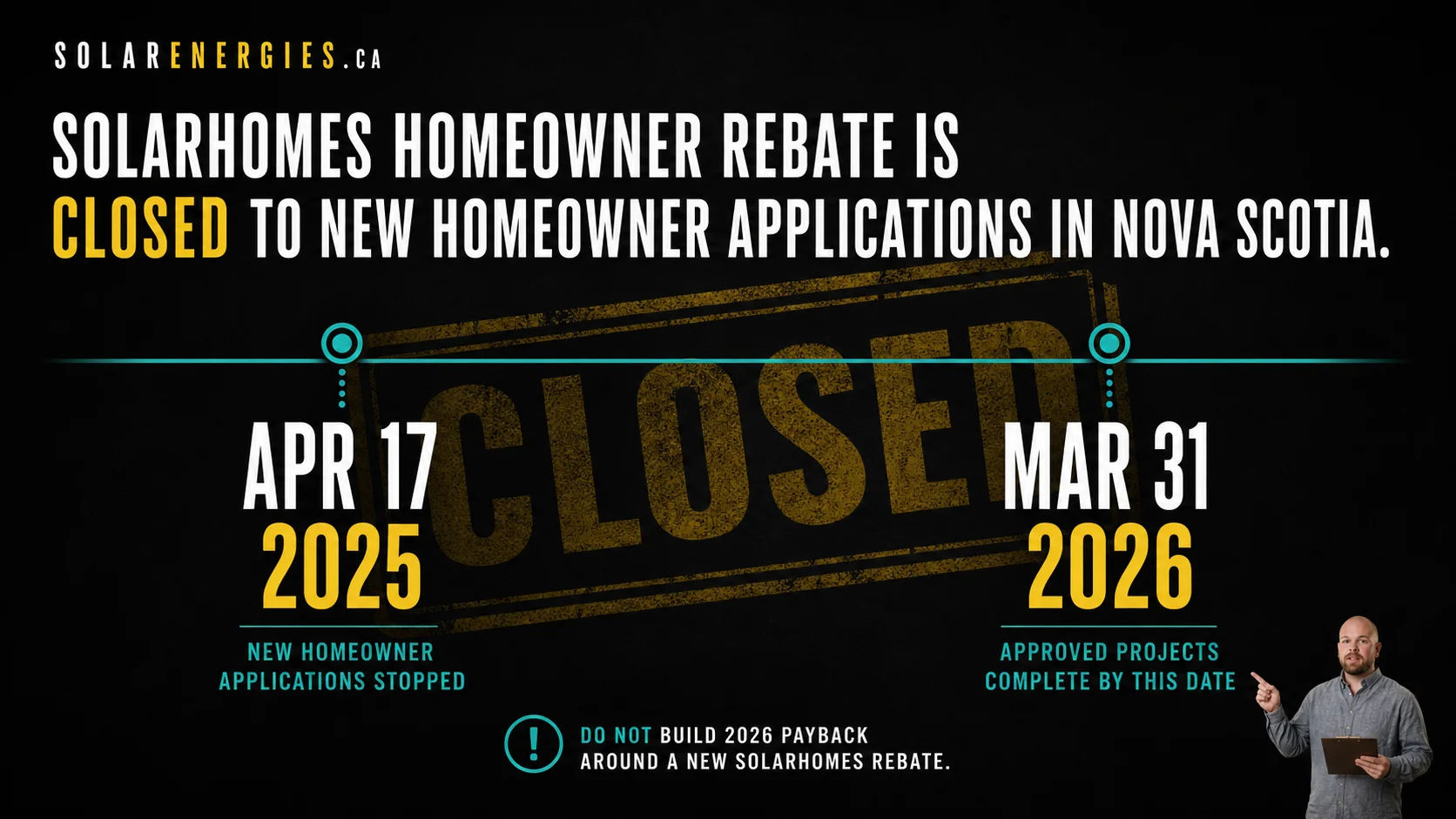
- The SolarHomes homeowner rebate is closed to new homeowner applications. Efficiency Nova Scotia says new applications stopped on April 17, 2025, and approved homeowner projects must be completed by March 31, 2026.
- The Canada Greener Homes Loan is closed to new loan applications. Do not let a 2026 quote depend on new federal 0% loan approval.
- Nova Scotia Power’s 2026 tariff book lists the Domestic Service energy charge at 18.324 cents/kWh, before riders such as fuel adjustment, demand-side management, storm cost recovery, and taxes.
- A standard grid-tied solar system normally does not power your home during an outage unless it is designed with the right backup equipment and often a solar battery.
Is Solar Worth It In Sydney And Cape Breton In 2026?
Solar is worth considering in Sydney, Glace Bay, New Waterford, North Sydney, Sydney Mines, and other Cape Breton communities, but it is not an automatic yes.
The stronger case looks like this:
- You use a lot of electricity every year.
- Your roof has at least 15 to 25 useful years left.
- Your best roof planes face south, southeast, southwest, east, or west with limited shade.
- You plan to stay in the home long enough to benefit from the solar system.
- Your quote uses current 2026 incentives and financing, not expired grant math.
- You want long-term energy cost control more than a fast rebate-driven payback.
- The installer gives you annual kWh production, not only panel count and monthly savings.
The weaker case looks like this:
- The roof is near replacement.
- Trees, chimneys, dormers, or nearby buildings shade the best roof planes.
- You use very little electricity.
- You are selling soon and do not want financing or lien questions at closing.
- The quote assumes the power bill disappears every month.
- You want backup power during outages but the quote is solar-only.
- The installer avoids questions about monitoring, inverter failures, insurance, or net metering.
Cape Breton’s weather does not kill the solar case. Short winter days, snow, coastal storms, and cloudy weeks do matter, but a properly designed solar PV system is judged over a full year. The bigger risk is usually not winter. It is bad sizing, old roof timing, optimistic savings math, or weak after-install support.
Solar Panels Sydney NS Cost In 2026
There is no official public tracker for residential solar panels Sydney cost. That means any exact “average cost” should be treated carefully.
For a normal grid-tied rooftop system in Sydney or Cape Breton, use $2.75/W to $3.75/W installed as a 2026 planning range before major extras.
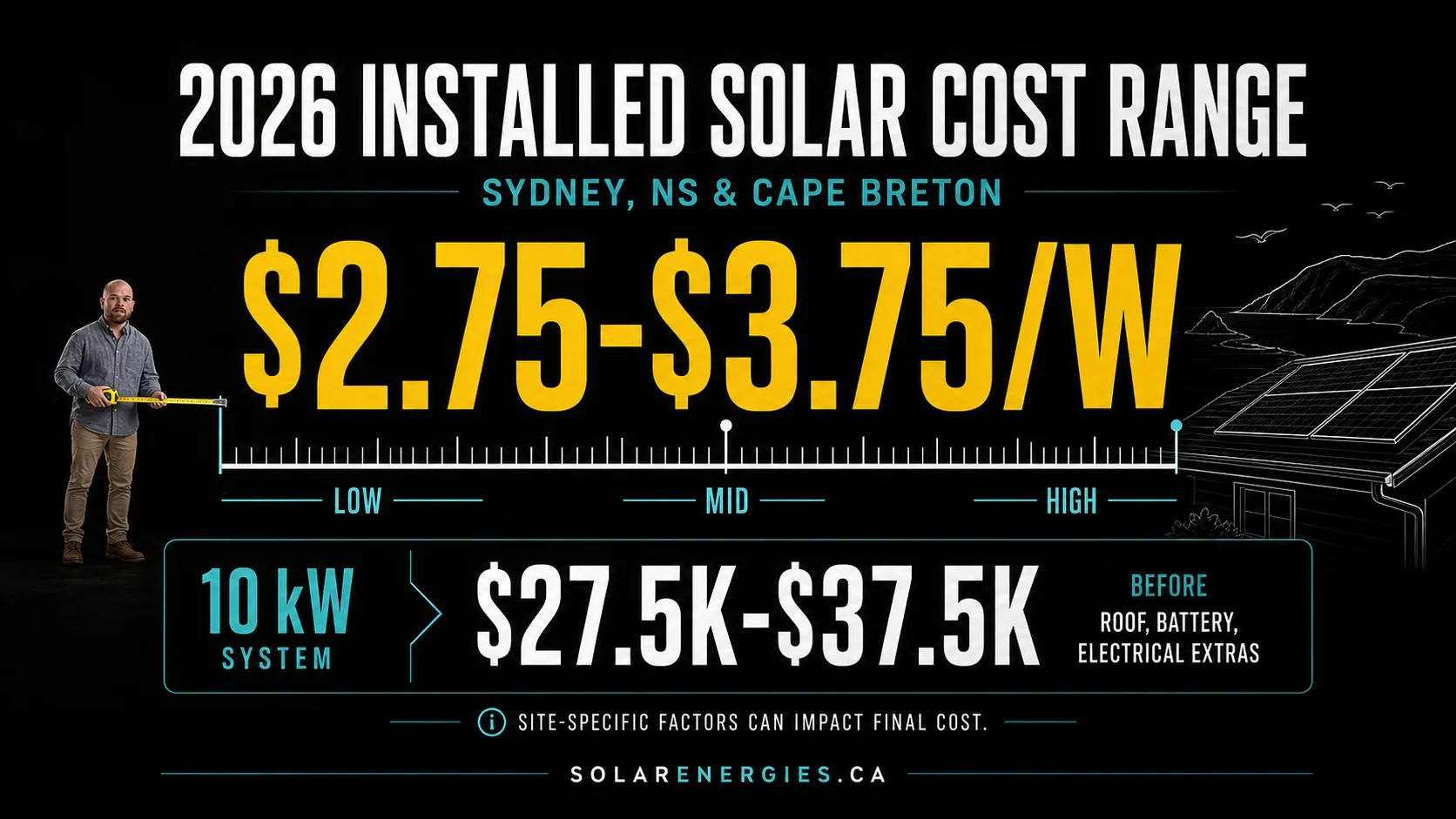
That is a quote-screening range, not a promise. A simple roof with easy access may price better. A steep roof, electrical service upgrade, detached garage, trenching, structural work, premium microinverters, or battery installation can push the cost higher.
| System size | Rough 2026 installed-cost screen | Typical fit |
|---|---|---|
| 5 kW | $13,750-$18,750 | Smaller home, partial bill offset, limited roof space |
| 7.5 kW | $20,625-$28,125 | Medium-use home, heat pump or moderate annual use |
| 10 kW | $27,500-$37,500 | Higher-use home, larger roof, EV or heat-pump planning |
| 12 kW | $33,000-$45,000 | Large annual use, strong roof layout, careful net-metering sizing |
The price should be broken down clearly. Ask for:
- solar panel make and model
- inverter or microinverter model
- racking and roof attachment details
- monitoring platform
- design and engineering
- electrical work
- permits and inspections
- Nova Scotia Power interconnection support
- HST
- roof or structural work, if needed
- financing cost
- battery storage or backup hardware, if included
If the quote gives you one round number and a big savings claim, ask for the details before comparing it to another installer.
How Much Power Can Solar Produce In Sydney?
Sydney is not the sunniest place in Canada, but it has enough solar resource for rooftop solar to work.
For a first screen, I would use about 950 to 1,080 kWh per installed kW per year for a reasonably oriented Cape Breton roof. Some local competitors use around 1,080 kWh/kW/year for Sydney, and EnergyHub’s solar maps are based on Natural Resources Canada photovoltaic potential data. Your actual number can be higher or lower depending on roof angle, orientation, snow, shade, equipment, and inverter design.
In practical terms:
| System size | Conservative planning production | Better-roof planning production |
|---|---|---|
| 5 kW | 4,750 kWh/year | 5,400 kWh/year |
| 7.5 kW | 7,125 kWh/year | 8,100 kWh/year |
| 10 kW | 9,500 kWh/year | 10,800 kWh/year |
| 12 kW | 11,400 kWh/year | 12,960 kWh/year |
Do not size a system from square footage. Size it from your last 12 months of Nova Scotia Power kWh use, plus any near-certain future loads such as an EV, heat pump, hot tub, basement suite, or workshop.
This is one of the most useful lessons from local Reddit solar discussions in Nova Scotia. Homeowners often compare systems by monthly payment, panel count, or whether one bill looked good. The better comparison is annual production versus annual consumption.
Sample Sydney Payback Math
Here is a simple base case using:
- 10 kW system
- $3.25/W installed cost
- 10,800 kWh in first-year production
- 18.324 cents/kWh base Domestic Service energy charge
- no rebate
- no battery
- no financing interest
- no roof or electrical upgrade
| Item | Estimate |
|---|---|
| Installed cost | $32,500 |
| First-year production | 10,800 kWh |
| Base energy value | About $1,979/year |
| Simple payback before financing and rate changes | About 16.4 years |
That is not a forecast. It is a sanity check.
The payback can improve if the installed price is lower, the roof produces well, electricity rates rise, or the bill savings include riders and taxes that the simple table leaves out. It can get worse if you finance at a high rate, add a battery, replace a roof, oversize the system, or have shade.
This is why I would not sell Sydney solar as a “quick payback” product in 2026. With the homeowner rebate and federal loan closed to new applications, the cleaner way to think about solar is long-term bill control. It can still be a good decision, but the quote needs to stand on its own.
Grants, Rebates, And Solar Incentives In Sydney/Cape Breton
This is the section where old articles and old sales scripts can mislead people.
SolarHomes homeowner rebate
Efficiency Nova Scotia says the SolarHomes program is now closed for homeowners. New applications stopped on April 17, 2025. Approved homeowner projects must be completed by March 31, 2026 to be eligible for financial incentives.
For a Sydney or Cape Breton homeowner starting fresh in 2026, do not build your payback around a new SolarHomes homeowner rebate.
Solar for Non-Profit Organizations
Efficiency Nova Scotia still lists a Solar for Non-Profit Organizations pilot. The page says eligible registered non-profits and charities installing grid-tied solar photovoltaic systems may qualify for $0.60/W DC, covering up to 25% of system costs before HST, capped at $15,000.
That can matter for Cape Breton charities, churches, community organizations, and registered non-profits. It is not a homeowner rebate.
Canada Greener Homes Grant and Loan
NRCan says the Canada Greener Homes Grant is closed.
NRCan also marks the Canada Greener Homes Loan as closed. The official page says funding is fully committed and new loan applications cannot be approved.
That matters because a lot of Nova Scotia homeowner conversations from 2023 and 2024 mention 0% federal financing. Those comments were useful at the time, but they are not current 2026 eligibility advice.
If an installer still presents a new federal 0% loan as part of your Sydney solar quote, ask them to update the financing math. For deeper context on local loan planning, see this guide to Nova Scotia solar financing.
CBRM and municipal financing
Sydney is part of Cape Breton Regional Municipality. During this research, I did not find a current CBRM-specific residential solar rebate or a Halifax-style Solar City financing program on the official CBRM website.
That does not mean permits and municipal rules do not matter. It means the main 2026 homeowner decision is built around provincial/federal program status, Nova Scotia Power net metering, your roof, your quote, and your financing.
Before installation, ask the contractor who handles CBRM permits, inspections, electrical permits, and any structural review.
Community Solar In Sydney: An Option If Rooftop Panels Do Not Fit
Sydney also has a separate community solar story. This is not the same as buying solar panels for your roof, but it matters for people who cannot install solar at home.
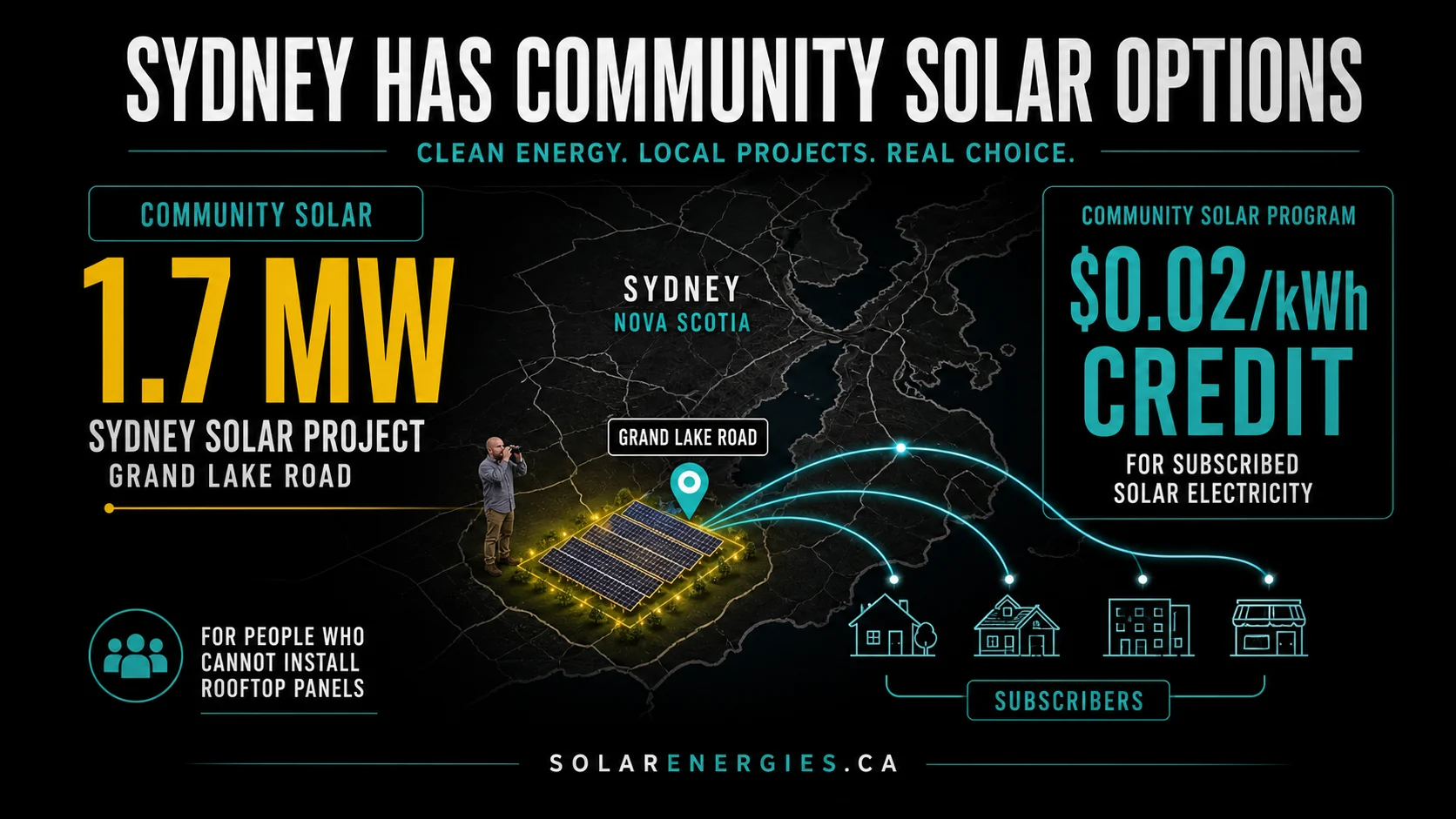
In May 2025, the Province announced a second solar garden coming to Sydney on Grand Lake Road through Nova Scotia’s Community Solar Program. The Province said AI Renewables and the Multicultural Association of Cape Breton are partnering on the Sydney Solar project, with $340,000 in provincial support and expected capacity of 1.7 MW.
The first project in the program launched at Pine Tree Park Estates in Sydney. The Province described it as Canada’s first subscription-based community solar garden program project, supplying 555 kW of solar energy to residential and commercial subscribers in facilities owned by New Dawn Enterprises.
The Community Solar Program is designed for people and organizations who want clean energy but may not be able to put solar panels on the roof because of shade, roof space, apartment or condo living, shared housing, or upfront cost. Subscribers continue to get a regular Nova Scotia Power bill, and the solar energy credit appears on the bill after they subscribe.
The program page says subscribers can choose to replace 10% to 100% of their electricity with solar electricity, and the credit is $0.02/kWh for the energy generated by the subscription. It also says subscribers need to be Nova Scotia Power customers in good standing and not already participating in another Nova Scotia Power solar program such as net metering.
This can be useful if rooftop solar does not fit your property. But do not compare it directly to owning a solar panel system. A community solar subscription is about bill credits and access to clean power. A rooftop system is about owning equipment, producing electricity on-site, and taking on the roof, inverter, warranty, and financing decisions yourself.
For a wider explanation of how this option can help people without a solar-ready roof, see the SolarEnergies.ca article on Nova Scotia community solar.
Net Metering And Electricity Rates In Sydney
Sydney and most Cape Breton homeowners are served by Nova Scotia Power.
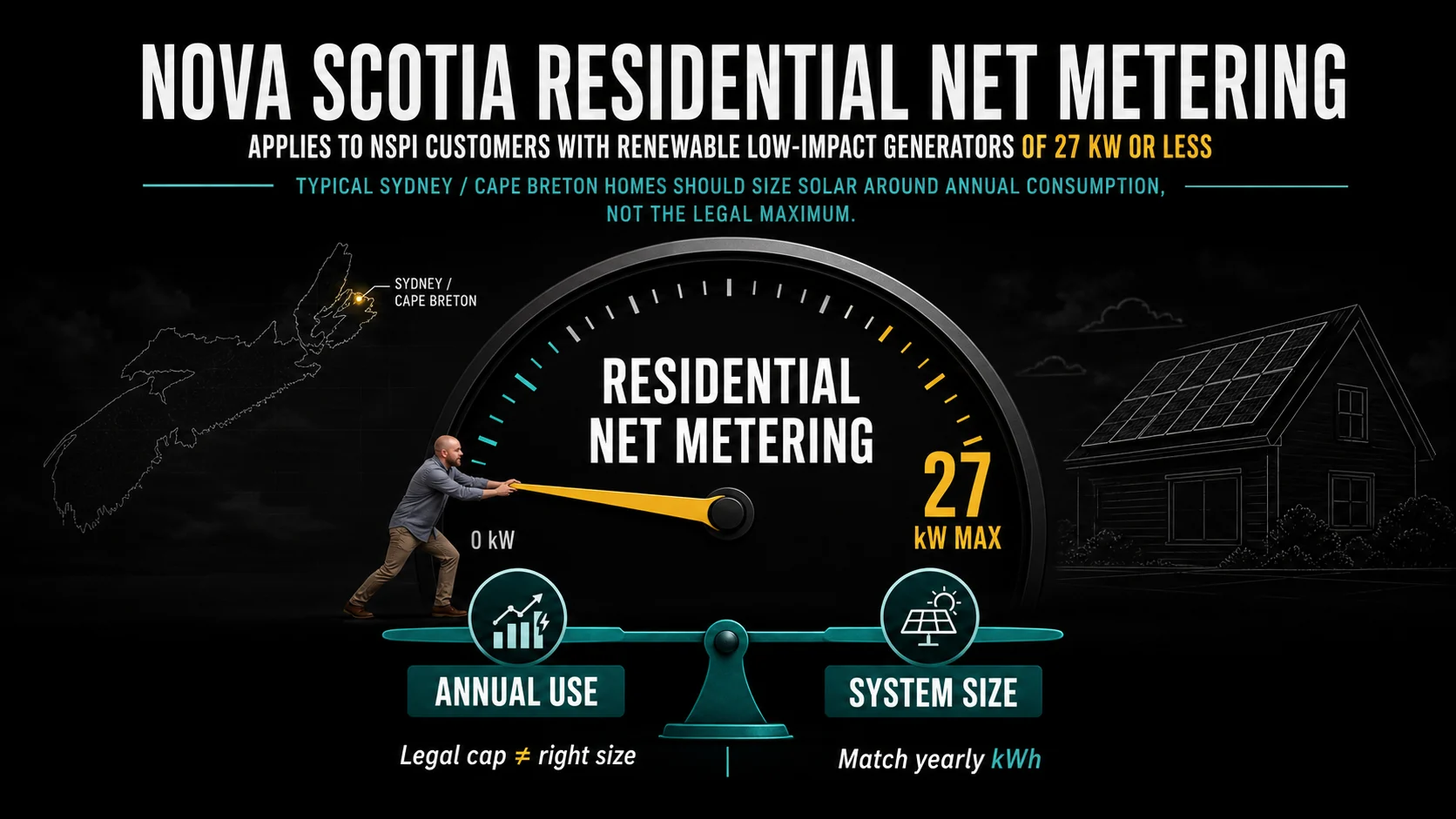
Nova Scotia’s renewable electricity regulations classify an NSPI customer with a renewable low-impact generator of 27 kW or less as a residential net-metering customer. That cap is above what most homes will install. A normal Sydney rooftop system is usually sized by annual use, roof space, and budget, not by the legal maximum.
Nova Scotia Power’s solar PV page explains the basic system: solar photovoltaic panels convert sunlight into electricity, and smart inverters convert that power for household use and monitoring.
The utility rate matters because solar saves money by reducing electricity you would otherwise buy.
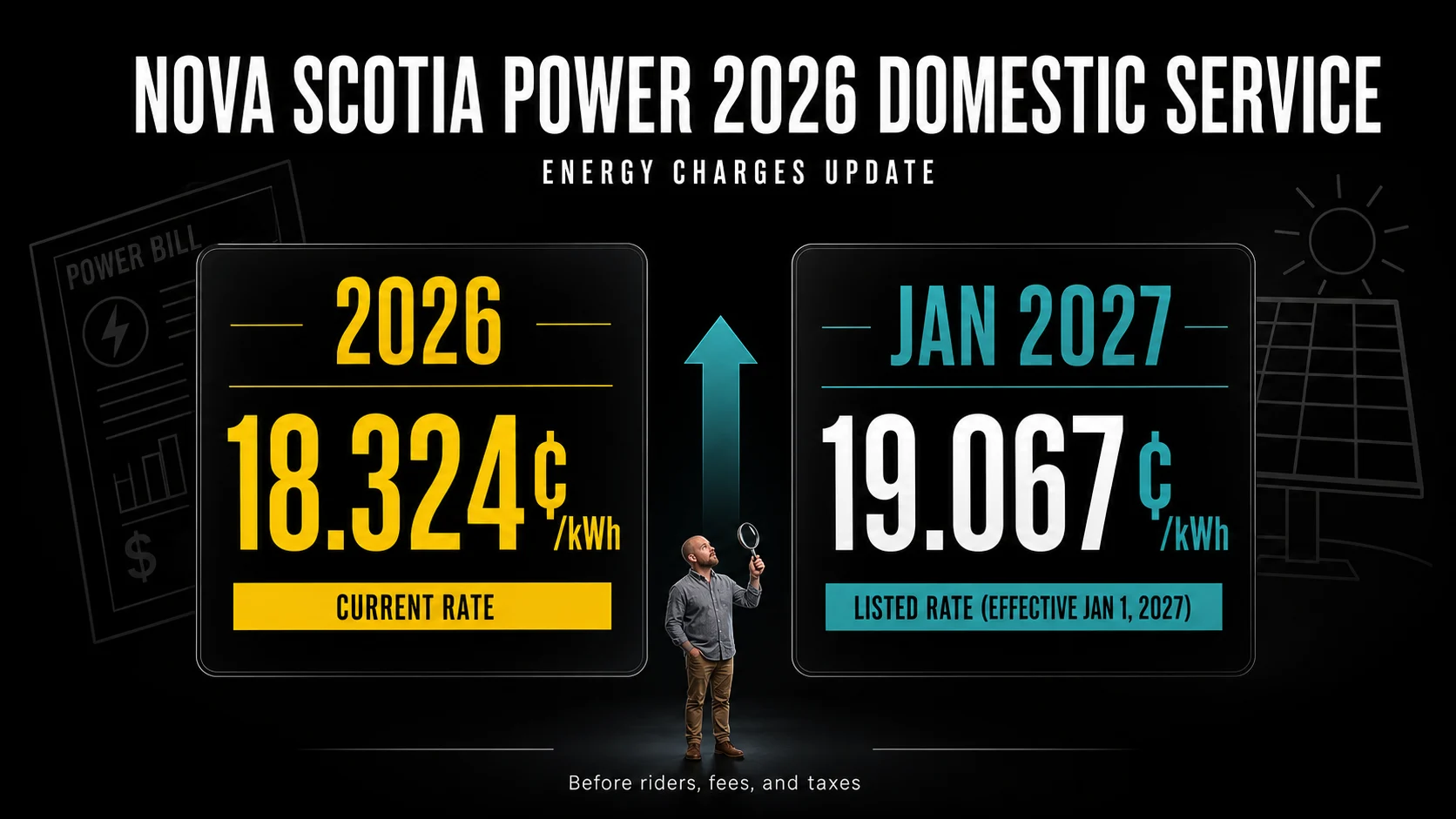
Nova Scotia Power’s 2026 tariff book lists:
| Domestic Service item | 2026 listed rate | January 1, 2027 listed rate |
|---|---|---|
| Monthly customer charge | $20.08/month | $21.04/month |
| Energy charge | 18.324 cents/kWh | 19.067 cents/kWh |
Those are before riders such as fuel adjustment, demand-side management, storm cost recovery, and taxes.
That means a solar kWh can be valuable, but your bill may not disappear. Fixed charges can remain. Winter bills can still happen. Credits may build in brighter months and get used in darker months.
Before signing a quote, ask:
- What annual kWh production are you assuming?
- What Nova Scotia Power rate are you using?
- Are riders, fixed charges, and HST included or ignored?
- How are exported credits treated?
- Are you assuming future rate increases?
- What happens if my winter use is higher than expected?
The answer should be clear enough that you can repeat it to someone else.
What Affects Payback In Cape Breton?
The payback period for solar panels in Sydney and Cape Breton depends on more than installed cost.
| Factor | Why it matters |
|---|---|
| Roof age | Removing and reinstalling panels for roof work can damage the economics. |
| Roof layout | A simple, broad roof plane is easier and cheaper than a chopped-up roof. |
| Shade | Trees, chimneys, nearby buildings, and dormers can reduce production. |
| Annual usage | Solar works best when there is enough consumption to offset. |
| Future loads | EVs, heat pumps, hot tubs, and suites can change the right system size. |
| Installed cost | A difference of $0.50/W can change payback by years. |
| Financing | A cash purchase, home-equity loan, private financing, and installer loan all produce different math. |
| Net metering | Export credit rules and future rate design affect long-term value. |
| Monitoring | If an inverter fails and nobody notices, expected savings fall. |
| Batteries | Batteries can improve outage resilience but often weaken simple payback. |
If you are planning a heat pump or EV soon, tell the installer before they design the system. If that load is definite, it should be part of the plan. If it is just a vague maybe, avoid oversizing the system on a guess.
What Local Reddit Concerns Get Right
Reddit is not an official source. It is useful because homeowners ask the questions sales pages often avoid.
The public Nova Scotia and Halifax-area solar discussions I reviewed for earlier Nova Scotia city guides raised the same concerns that matter for Sydney and Cape Breton. Here is how I would answer them before buying.
| Concern from homeowners | Practical answer for Sydney/Cape Breton |
|---|---|
| “Will solar erase my power bill?” | Usually no. A good system can reduce the energy portion of the bill, but fixed charges, winter usage, riders, taxes, and timing can remain. Ask for a full-year model. |
| “Will the solar payment just replace my old power bill?” | It might in the early years, especially with financing. Compare total cost, interest, and post-financing savings, not only monthly cash flow. |
| “Are old grant and loan comments still valid?” | No. The SolarHomes homeowner program, Greener Homes Grant, and Greener Homes Loan are closed to new applicants. Use current 2026 assumptions. |
| “Should I install before adding an EV or heat pump?” | If the new load is certain, include it in the design. If it is uncertain, avoid paying for a much larger system before your usage is real. |
| “What if my roof is old?” | Fix the roof first if it is near replacement. Solar panels can last 25 years or more, and removal/reinstall work can be expensive. |
| “Will solar work during a power outage?” | Standard grid-tied solar normally shuts down during an outage for safety. You need approved backup equipment and often a battery for outage power. |
| “Are batteries worth it?” | Batteries can make sense for outage resilience, but they often make simple payback worse. Price solar-only and battery-backup options separately. |
| “What if the inverter or monitoring fails?” | Ask who monitors the system, what alerts you receive, who handles warranty claims, and how quickly service calls are handled after installation. |
| “Do I need to tell insurance?” | Yes. Tell your insurer before installation. Ask about roof attachments, replacement value, electrical work, and whether your policy needs updating. |
| “Could net metering change?” | Policy can change over a 25-year equipment life. Do not buy a project that only works under one optimistic credit assumption. Use conservative math. |
This is not anti-solar. It is how you avoid buying the wrong solar system.
Local Case Studies And Examples
Public Sydney-specific case studies with full system size, price, production, roof type, and payback are limited.
Polaron’s public Nova Scotia solar page lists Cape Breton as a service area and shows Nova Scotia project examples, including systems in places such as Guysborough, Bedford, Hantsport, Lunenburg, Bridgewater, and other communities. That is useful local market context, not proof of what your Sydney roof will cost or produce.
But do not treat a province-wide example as your Sydney quote.
A project in Guysborough, Bedford, or Bridgewater can show what a solar installation may look like in Nova Scotia. It cannot prove your Cape Breton roof will produce the same amount, cost the same amount, qualify for the same financing, or deliver the same payback.
Use examples for confidence. Use your own bills and roof data for the decision.
How To Choose A Solar Installer In Sydney/Cape Breton
Do not choose only by the lowest price. Choose the quote you can understand and defend.
When you compare detailed solar quotes, ask each solar installer for the same core numbers:
| Question | Why it matters |
|---|---|
| What system size are you proposing in kW DC? | This is the starting point for cost and production. |
| What first-year kWh production are you modelling? | You need kWh, not just panel count. |
| Which roof planes produce how much? | This exposes shade and orientation assumptions. |
| What cost per watt am I paying? | It makes quotes easier to compare. |
| Is HST included? | Solar quotes can look very different if tax is handled differently. |
| Which inverter or microinverters are included? | This affects monitoring, performance, and future replacement. |
| Who handles CBRM permits, electrical permits, and inspections? | The answer should be specific. |
| Who handles Nova Scotia Power paperwork? | Interconnection and net metering should not be vague. |
| What happens during an outage? | If backup is not included, the quote should say so plainly. |
| What warranties cover panels, inverter, racking, roof penetrations, and workmanship? | A 25-year panel warranty does not mean every part is covered for 25 years. |
| Who monitors the system after installation? | Monitoring failures can quietly cost money. |
| What financing cost is included in the payback? | Interest changes the answer. |
SolarEnergies.ca can connect readers with a certified solar installer network with 14,000+ installs across Canada. Still compare the details. A good installer should welcome informed questions.
What The Solar Installation Process Looks Like In Cape Breton
A normal Cape Breton solar installation should feel organized before anyone is on the roof. If the process is vague, slow down.
Here is the basic path:
- Review 12 months of Nova Scotia Power usage.
- Check the roof age, roof structure, shade, and electrical panel.
- Design the solar PV system around annual kWh use, roof layout, and budget.
- Confirm the solar equipment: panels, inverter or microinverters, racking, monitoring, and warranty terms.
- Confirm permits, inspections, insurance, and Nova Scotia Power interconnection steps.
- Install the solar array and electrical equipment.
- Complete inspection, utility approval, commissioning, and monitoring setup.
- Review the first few power bills and compare actual power output against the production estimate.
The important part is accountability. You should know who handles CBRM paperwork, who handles NS Power paperwork, who explains the monitoring app, and who responds if solar generation drops after installation.
Do Batteries Make Sense In Cape Breton?
Batteries are worth discussing in Cape Breton because storms and outages are real. But battery backup and solar payback are different decisions.
A grid-tied solar system without backup equipment normally shuts down when the grid is out. That protects utility crews and prevents unsafe islanding. If outage power matters, ask for a proper backup design from the start.
A home battery can help run selected loads:
- fridge
- freezer
- internet
- lights
- sump pump
- medical equipment
- well pump, if sized correctly
- small heating or heat-pump loads, depending on design
It may not run the whole house for days unless the system is designed and wired for that.
Ask:
- Which loads will be backed up?
- Is there a critical loads panel?
- How many hours of backup are expected?
- Can solar recharge the battery during a longer outage?
- What is the usable battery capacity?
- What is the battery warranty?
- How much does the battery add to the quote?
If your main goal is bill savings, run solar-only math first. If your main goal is resilience, a battery may still be worth it even when the financial payback is weaker.
Next Steps For Sydney And Cape Breton Homeowners
Here is the order I would use:
- Pull 12 months of Nova Scotia Power bills and total your kWh use.
- Check roof age, roof direction, and shade.
- Decide whether an EV, heat pump, hot tub, suite, or workshop load is coming soon.
- Use the online solar calculator for a first screen.
- Confirm that the quote does not rely on closed SolarHomes, Greener Homes Grant, or Greener Homes Loan assumptions.
- Get at least two detailed solar quotes.
- Ask each installer to separate solar, battery, roof, electrical, HST, and financing costs.
- Confirm insurance before installation.
- Compare payback with conservative production and current Nova Scotia Power rates.
The best result is not maximum panels. It is the right system at the right price, with no surprise roof, financing, insurance, or outage-backup problem.
Relevant City Guides:
Solar Panels Yarmouth Cost Guide: Is It Worth It?
Solar Panels Nova Scotia: Your Guide to Going Solar
FAQ
Are solar panels worth it in Sydney, Nova Scotia?
They can be. Solar panels in Sydney are most likely to be worth it if you use a lot of electricity, have a good roof, can get a fair installed price, and do not rely on closed rebates or closed federal loan programs. The math is weaker for shaded roofs, old roofs, low-usage homes, and short ownership timelines.
What is the average solar panels Sydney cost in 2026?
Use about $2.75/W to $3.75/W installed as a planning range for many straightforward residential projects. That puts a 10 kW system around $27,500 to $37,500 before unusual roof, electrical, battery, or financing extras. Get a detailed quote before making a decision.
Are there solar rebates in Cape Breton?
For homeowners starting fresh in 2026, the major point is that the Efficiency Nova Scotia SolarHomes homeowner program is closed to new applications. Registered non-profits and charities should check Efficiency Nova Scotia’s Solar for Non-Profit Organizations pilot. Always confirm current terms before signing a contract.
Is the Canada Greener Homes Loan still available for solar panels?
No, not for new loan applications. NRCan says the Canada Greener Homes Loan is closed because funding is fully committed and new loan applications cannot be approved. If a quote still assumes new federal 0% loan approval, ask for updated math.
How does net metering work for solar panels in Sydney?
Nova Scotia regulations classify an NSPI customer with a renewable low-impact generator of 27 kW or less as a residential net-metering customer. In practice, your installer should size the system around your annual electricity use, roof, and budget, then handle the Nova Scotia Power interconnection process.
Will solar panels work during Cape Breton winters?
Yes. Solar panels generate electricity from light, not heat, so they still work in winter. Production is lower because days are shorter, the sun angle is lower, storms are more common, and snow can cover panels. Judge the system by annual production, not one January bill.
Will solar panels power my home during a Sydney outage?
Usually not by themselves. A standard grid-tied solar system normally shuts down during outages. If you want backup power, ask for approved backup equipment, a critical loads plan, and usually a solar battery.
Should I replace my roof before installing solar?
If the roof is near the end of its life, yes. Solar panels can last 25 years or more, and removing/reinstalling them for roof work can be expensive. A roof with only a few years left can weaken the payback.
Are batteries worth adding in Cape Breton?
Batteries can be worth it for outage resilience, but they often make simple payback worse. If your main goal is lowering electricity cost, compare solar-only first. If your main goal is backup power during storms, price the battery as a resilience upgrade.
How many solar panels do I need for a Sydney home?
It depends on annual electricity use and panel wattage. A 5 kW system might use roughly 12 to 14 modern panels. A 10 kW system might use roughly 24 to 28 panels. Your installer should size the system from your power bills and roof layout, not from a generic panel count.
What is the 33% rule in solar panels?
There is no special Sydney or Nova Scotia homeowner rule commonly called the “33% rule.” People may use that phrase for different design, usage, or electrical rules. For a Cape Breton homeowner, the practical rule is simpler: size the system around annual usage, roof conditions, net-metering rules, and current incentives, not a vague percentage shortcut.
What is the 20 rule for solar panels?
There is no official Sydney or Nova Scotia net-metering rule that homeowners commonly need to know as the “20 rule.” If an installer uses that phrase, ask exactly what they mean. They may be talking about roof age, expected production losses, inverter sizing, usage growth, or a design margin. Do not sign based on a rule of thumb you cannot verify.
How do I choose a solar installer in Sydney or Cape Breton?
A good installer should give you clear production assumptions, real equipment details, proper permits, strong monitoring support, insurance clarity, and conservative payback math. Get at least two quotes and compare cost per watt, first-year kWh, inverter choice, warranty terms, roof attachment method, and after-install service.